

RBT definitions become useful when a learner can name the term, describe observable features, apply it in a fictional example, and explain its boundary.
Table of Contents
- What makes RBT definitions useful
- Use observable language
- Put terms in context
- Contrast similar concepts
- Build a reliable study routine
- Respect role boundaries
- Common definition mistakes
- Frequently asked questions
- References
RBT KNOWLEDGE · TERMINOLOGY
RBT Definitions: A Clear Glossary Guide
A practical method for learning terms, recognizing examples, and respecting role boundaries.
RBT definitions become useful when a learner can name the term, describe observable features, apply it in a fictional example, and explain its boundary. A glossary is a starting point, not a replacement for current official materials, assigned training, supervision, or the details of a service plan.
Many errors happen because a person recognizes a word without being able to use it. Knowing that reinforcement is important is different from identifying what changed after a consequence, or from deciding how a plan should be changed. Learn each term as a tool for accurate communication, not as permission to make an independent clinical decision.
What makes RBT definitions useful
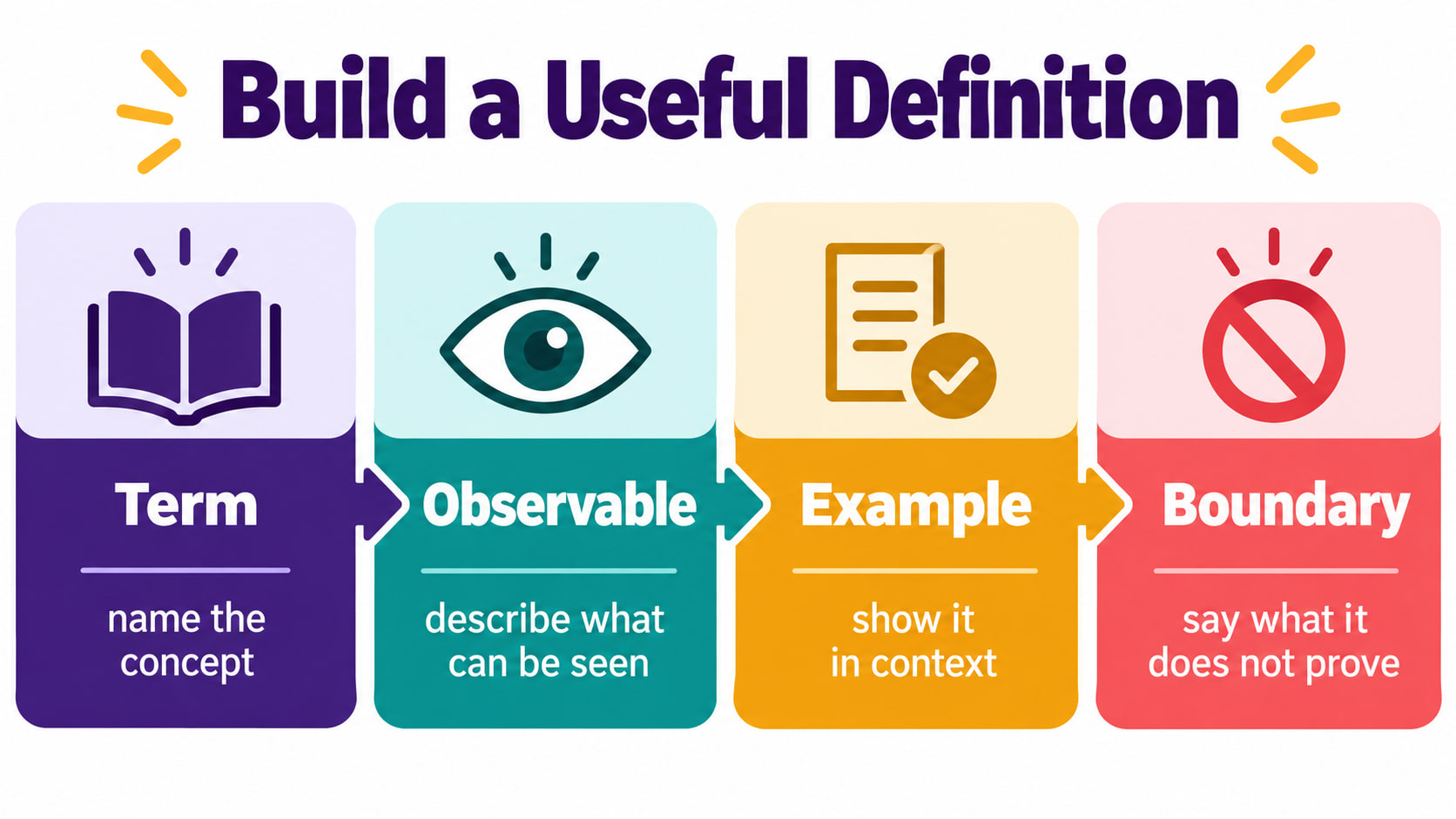
A useful definition begins with the term and its essential features. It avoids circular wording, vague praise, and unnecessary jargon. It also tells you what the term does not mean. For example, an operational definition should describe how behavior can be observed and measured; it should not simply repeat a label such as “noncompliance” without specifying what would count.
Use a four-part test when reviewing a definition: Can I name the concept? Can I describe what an observer could see or record? Can I give a fictional example? Can I identify a common confusion or boundary? If one answer is missing, the definition needs more study or a clearer source.
Use observable language
Observable language helps a team communicate about events rather than assumptions. “Placed the cup on the table within ten seconds” gives a reader something to check. “Was cooperative” may hide several different actions and does not define what was observed. A strong definition supports consistent recording by different people.
When reading an RBT term, ask whether it describes an action, a condition, a measurement, a consequence, or a process. Keep the categories separate. A behavior is not the same thing as its possible function, and a data value is not the same thing as the conclusion a team may later draw from a pattern.
Observable language does not mean that every real situation is simple. It means that the record starts with what can be seen, heard, counted, timed, or otherwise defined according to the assigned system. Questions about interpretation belong in the appropriate supervision and clinical process.
Put terms in context
A term can be accurate but still misleading when removed from context. A prompt, for example, is connected to an instruction and a response; a measurement term is connected to a defined event and a recording system. Read the surrounding example and ask what information makes the term applicable.
Context also includes the setting, person, procedure, and goal. A general definition cannot tell an RBT exactly what to do with a particular client. The assigned plan and supervisor direction determine the procedure. A glossary should help you ask a better question, not replace the answer from the responsible professional.
Contrast similar concepts
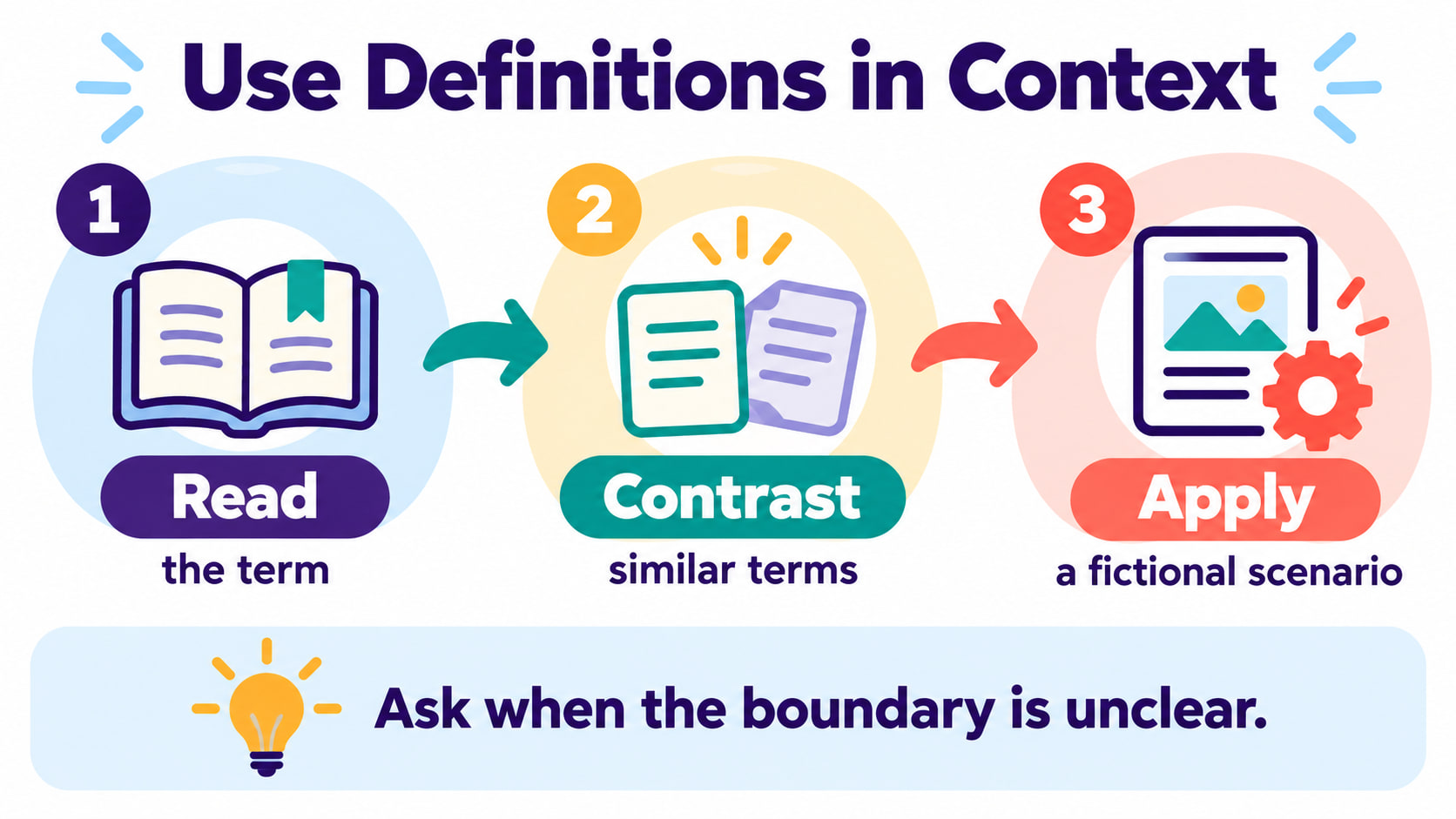
Comparison is often more effective than repetition. Put similar terms in two columns and write one difference that changes how you would describe or record an event. For example, distinguish an antecedent from a consequence by asking whether the event occurred before or after the behavior. Distinguish frequency from duration by asking whether you are counting events or measuring how long one lasts.
Use careful contrasts for reinforcement and punishment as well. These terms describe changes in future behavior, not whether a consequence feels pleasant or unpleasant. A preferred item is not automatically reinforcement, and a difficult event is not automatically punishment. The definition depends on the effect on future responding and the evidence available in the assigned context.
Do not turn a contrast into a shortcut. When a scenario is unclear, identify the missing information. A confident guess may sound fluent while still using the wrong term. Write down what you know, what you observed, and what question needs supervision.
Build a reliable study routine
Study one small group of terms at a time. Read the definition, close the source, and explain it in your own words. Then create a fictional example and a non-example. Finally, write one boundary sentence: “This term does not by itself prove…” The boundary step prevents memorized vocabulary from becoming overconfident interpretation.
Use retrieval instead of rereading only. Make cards with the term on one side and the definition, observable example, contrast, and boundary on the other. Review cards at spaced intervals and mark the type of error you make. If you repeatedly confuse two terms, study them together rather than practicing each in isolation.
Keep examples private and fictional. Do not paste real client notes, names, photographs, or distinctive details into study cards or public discussion groups. A good study routine improves professional communication while protecting confidential information.
Respect role boundaries
Knowing a definition does not authorize an RBT to diagnose, select an assessment independently, change a behavior plan, interpret a complex ethical exception, or give client-specific advice. RBT work occurs within assigned procedures, supervision, organizational policy, and the applicable requirements for the setting.
When a definition raises a practical question, describe the observed situation and ask the supervisor or designated professional. State the term you are unsure about, the facts you know, the source you checked, and the decision that needs direction. This is more useful than applying a broad word to a specific situation without checking the plan.
Common definition mistakes
- Using labels as definitions: repeating “challenging behavior” without observable criteria.
- Confusing examples with rules: treating one illustration as the only possible form of a concept.
- Mixing observation and interpretation: recording a guess about function as if it were directly seen.
- Ignoring the time sequence: calling an event an antecedent or consequence without checking when it occurred.
- Overgeneralizing: applying a general glossary sentence to a client-specific decision.
- Studying outdated sources: accepting process claims without checking current official materials.
Use definitions to make communication more precise. A term is doing its job when it helps two people describe the same event, notice the same missing information, and ask the same next question. That standard is more valuable than collecting a long list of words that cannot be applied carefully.
Frequently asked questions
What should an RBT definition include?
Include the term, essential features, an observable example, a contrast with a similar concept, and a boundary describing what the term does not prove.
Are examples part of the definition?
An example illustrates a definition but is not the definition itself. Use more than one fictional example to check whether you understand the underlying features.
Can a glossary answer a client-specific question?
Not by itself. Use the glossary for general learning, then follow the assigned plan and ask the supervisor or responsible professional about the specific situation.
How can I avoid confusing similar RBT terms?
Study the terms side by side, identify the feature that separates them, and practice fictional scenarios that contain enough information to make the distinction clear.
Source note: Review current BACB materials, assigned training, organizational policy, approved systems, and supervisor direction for your setting. This article is educational and does not provide individualized legal, clinical, employment, or credentialing advice.
Ready to practice the RBT concepts you just reviewed?
Try an independent, original RBT practice resource with exam-style questions, scoring, and answer explanations.
References
- Behavior Analyst Certification Board. RBT Test Content Outline, 3rd edition.
- Behavior Analyst Certification Board. RBT Handbook.
- Behavior Analyst Certification Board. RBT Ethics Code.