
RBT documentation and reporting includes objective session notes, timely supervisor communication, reporting variables that may affect progress, and protecting confidential information.
Table of Contents
- RBT documentation and reporting: quick answer
- What the RBT Test Content Outline requires
- What makes an RBT note objective?
- What to include in a session note
- Report variables that may affect progress
- Seek clinical direction
- Communicate intervention-team concerns
- Protect confidential information
- Session note vs. incident report
- A reliable documentation workflow
- Common RBT documentation mistakes
- Frequently asked questions
RBT task list and professional documentation
RBT Documentation and Reporting: Write Objective Notes
RBT documentation and reporting is more than completing a session note at the end of a visit. The current RBT Test Content Outline treats documentation as a set of professional skills: communicate team concerns, seek clinical direction, report variables that may affect progress, and communicate objectively what happened in a session while following legal, regulatory, workplace, and confidentiality requirements.
RBT documentation and reporting: quick answer
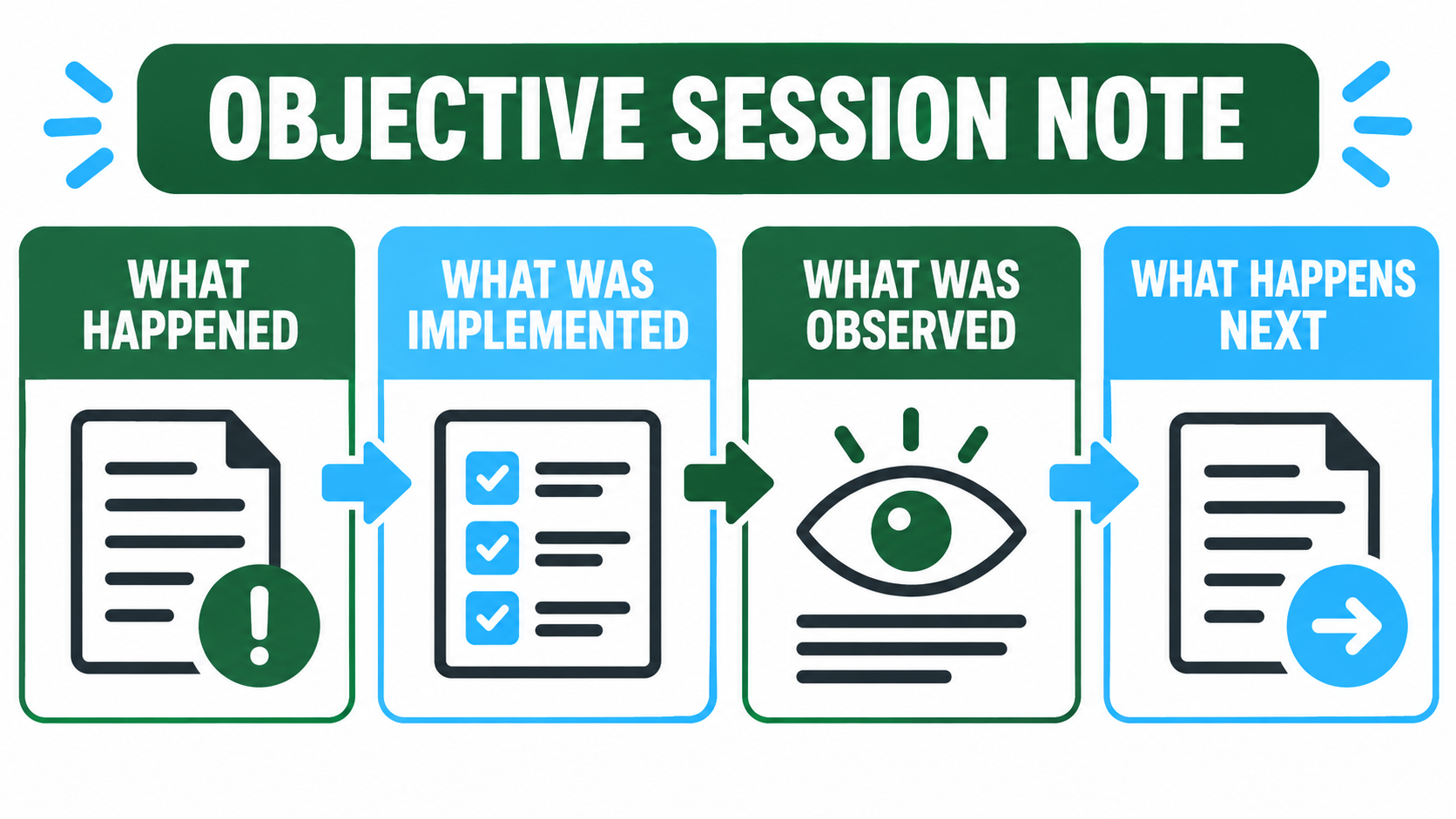
A strong RBT record answers four questions: What happened? What was implemented? What was observed? What needs to happen next? Write observable facts, identify the program or procedure used, record relevant data according to the current plan, report important changes promptly, and send clinical questions through the supervisor’s communication chain.
Do not turn a note into a diagnosis, a personal opinion, or a defense of the session. A record should help the supervisor understand the service delivered and make informed clinical decisions without guessing what the RBT meant.
What the RBT Test Content Outline requires
The current BACB RBT Test Content Outline (3rd ed.) places Documentation and Reporting in Domain E. It lists four tasks:
- Communicate concerns and suggestions from the intervention team with a supervisor in a timely manner.
- Seek and prioritize clinical direction from a supervisor in a timely manner, including when there are training needs, data irregularities, or chain-of-command questions.
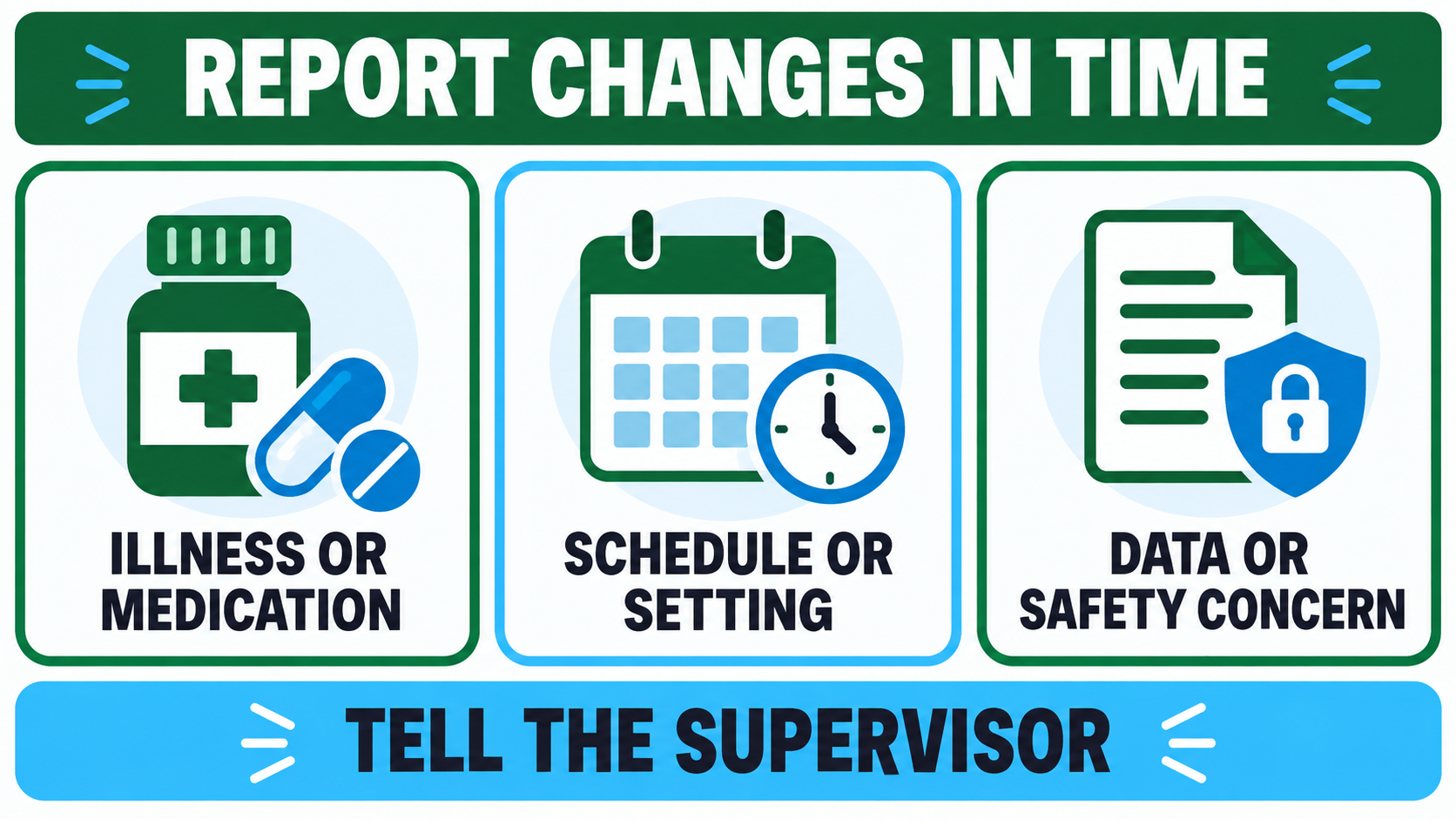
- Report or document variables that might affect client progress, such as illness, medication, or schedule changes, in a timely manner.
- Communicate objectively what occurred during the session in accordance with applicable legal, regulatory, and workplace requirements.
The outline is not a substitute for your agency’s form. It tells you the professional behaviors the task covers; the current program, policy, and supervisor tell you where and how to record them.
What makes an RBT note objective?
An objective note uses descriptions that another person could observe or verify. Instead of writing “the client was difficult,” describe the relevant action: “After the instruction was presented, the client pushed the materials away and left the table.” Instead of “the program went well,” write the procedure implemented, the measurement recorded, and the observable response.
Objective does not mean cold or incomplete. Include context that matters: the setting, the instruction or event, the assistance provided, the response, and the outcome. Avoid unnecessary private details that do not support service documentation.
Separate observation from interpretation. “Caregiver reported that the client slept poorly” is different from “poor sleep caused the behavior.” The first is attributed information; the second is a clinical conclusion that may require supervisor analysis.
Use the current operational definitions and measurement system. A note can be grammatically perfect and still be unreliable if the RBT changes the definition, rounds data without authorization, or records an inference as an event.
What to include in a session note
The exact form varies, but a useful session note commonly identifies:
- the date, time, setting, and people involved;
- the programs or goals addressed;
- the procedures implemented as written;
- the data collected or measurement summary required by the program;
- observable responses and relevant context;
- prompts, reinforcement, or other planned supports used;
- variables that could affect the session;
- caregiver or team communication that needs follow-up;
- the next planned step or supervisor question.
Do not copy yesterday’s note and change only the date. Reuse a template for structure, but write the current session’s actual events. A note should be completed within the time and system required by the employer and payer, not reconstructed from memory days later.
Report variables that may affect progress
The RBT outline specifically names illness, medication, and schedule changes as examples of variables that might affect client progress. Other relevant changes may include sleep, appetite, a new setting, a staffing change, unusual noise, a family event, a missed appointment, or a safety issue. The RBT’s role is to notice and report the variable, not to decide that it caused the outcome.
Report time-sensitive information through the approved route. A variable that affects today’s safety or service should not wait for a monthly meeting. If the change is medical or urgent, follow the organization’s emergency and caregiver-notification policy. Do not advise a family to start, stop, or change medication.
Seek clinical direction
Contact the supervisor when you need training, the data look irregular, the program is unclear, a safety concern appears, or the client’s response does not match the plan. Give a concise description of the observation, the program or procedure involved, what you tried within the plan, and the decision you need.
Following the chain of command is part of reporting. If the primary supervisor is unavailable, use the backup process. Do not change a program, invent a target, or discontinue a procedure simply because you cannot reach someone immediately—unless the plan or emergency policy directs you to protect safety in that way. Record the contact attempt and the direction received.
A good record shows both service delivery and limits. “Supervisor notified of repeated data discrepancy; supervisor requested a direct observation before the next session” is more useful than “supervisor aware.”
Communicate intervention-team concerns
Caregivers, teachers, and other service providers may offer information or suggestions. Listen respectfully, record relevant observations, and communicate them to the supervisor through the authorized route. Do not promise that a suggestion will be adopted or argue that a clinical change has already been approved.
Use attributed language: “Teacher reported that the transition was difficult after lunch” or “Caregiver asked whether the home routine can use the same visual.” This preserves the source of the information and helps the supervisor decide what follow-up is appropriate.
Team communication should be timely and professional. Avoid discussing a client in public spaces, group chats that are not approved for confidential information, or social media. Use the organization’s secure system.
Protect confidential information
The BACB TCO also expects RBTs to identify and comply with requirements for collecting, using, storing, protecting, and disclosing confidential information. Use only approved systems, protect passwords, check recipients before sending, and keep client identifiers out of personal notes or unapproved applications.
Do not photograph a session note for convenience, leave a paper form in a car, or copy identifying information into an AI tool or personal cloud folder unless the organization has explicitly authorized that system and its privacy controls. When a supervisor asks for documentation, send it through the approved channel.
Confidentiality does not mean hiding a required safety or reporting event. Follow the policy for sharing information with the people who are authorized and need it for care, safety, billing, or compliance.
Session note vs. incident report
A routine session note describes the service delivered. An incident report records a safety, injury, emergency, property, or other event that the organization requires staff to report separately. One may not replace the other. Ask the supervisor or policy owner which forms are required.
Complete the incident form promptly after immediate safety is restored. Keep the session note objective and do not use it to assign blame. If a medical, legal, or self-reporting process applies, follow that process as well and ask the responsible professional what documentation belongs in each channel.
A reliable documentation workflow
Before the session: open the current program, confirm definitions and forms, and check for supervisor updates.
During the session: collect data as written, note relevant variables, and record questions while details are fresh.
Immediately after: write observable events, complete required forms, notify the supervisor of time-sensitive concerns, and secure the record.
Before submitting: check the date, client, program, data, names, signatures, recipients, and required follow-up. Correct errors according to the system’s audit trail; do not quietly delete or backdate a record.
Common RBT documentation mistakes
- Writing labels instead of observations: Describe what happened.
- Mixing facts and conclusions: Attribute reports and seek supervisor analysis.
- Delaying time-sensitive changes: Report illness, medication, schedule, data, and safety concerns promptly.
- Changing measurement definitions: Use the current program and ask when unclear.
- Copying a previous note: Record the actual session.
- Using insecure channels: Protect confidential information.
- Assuming one form covers everything: Check whether a separate incident or compliance report is required.
Frequently asked questions
What should an RBT write in a session note?
Record the setting, programs, procedures implemented, data required by the plan, observable responses, relevant variables, communication, and follow-up.
How do I make a note objective?
Use observable and measurable descriptions, attribute information to its source, and separate what you saw from clinical interpretation.
Should an RBT report a medication change?
Report it promptly through the approved supervisor and caregiver or workplace route. Do not provide medication advice or infer causation.
Do I need an incident report in addition to a session note?
Possibly. Follow the organization’s policy; safety, injury, emergency, or compliance events may require a separate form.
Can I keep client notes in a personal app?
Only if the organization has explicitly approved the app and its privacy controls. Otherwise use the secure system designated by the provider.
Official sources: BACB RBT Test Content Outline (3rd ed.); RBT Test Content Outline source document; BACB RBT Handbook; BACB RBT supervision resources. Retrieved September 28, 2026. Follow the current workplace form and confidentiality policy.
Ready to practice the RBT concepts you just reviewed?
Try an independent, original RBT practice resource with exam-style questions, scoring, and answer explanations.
References
- Behavior Analyst Certification Board. RBT Test Content Outline, 3rd edition.
- Behavior Analyst Certification Board. RBT Handbook.
- Behavior Analyst Certification Board. RBT Ethics Code.