
RBT documentation should make relevant service information clear, accurate, useful, and aligned with the current approved process.
Table of Contents
- What RBT documentation is meant to do
- The four-part documentation cycle
- Start with observable facts
- Record the required information
- Connect the record to the current plan
- Review, protect, and submit the record
- RBT documentation examples
- Common documentation mistakes
- Frequently asked questions
- References
RBT PRACTICE · CLEAR RECORDS
RBT Documentation: How to Record Clear, Useful Service Information
A practical framework for recording observable facts, connecting notes to the current plan, protecting privacy, and asking focused questions.
RBT documentation is the written or electronic record of relevant service information completed through the approved process. Useful documentation helps the authorized team understand what occurred, what was measured, what support was delivered, and what question needs follow-up. It is not a place to guess about motives, fill gaps with memory, or create a new treatment instruction.
The exact form, deadline, data fields, signature process, correction method, storage location, and retention period depend on the organization and service setting. Use this article as a thinking framework, then follow the current service plan, workplace policy, approved documentation system, and supervisor direction.
Before starting, know which record you are completing. A session note, skill-acquisition data sheet, incident report, communication log, supervision record, and billing-related form may have different purposes. Combining them casually can leave out required information or place private details in the wrong system.
What RBT documentation is meant to do
A clear record creates a reliable handoff. It can show the date and setting, the relevant targets or routines, the measurement method used, the assistance provided, and the response observed. It can also identify an unusual event, a missing material, a safety concern, or a question that should be routed to the supervisor.
Good documentation is specific without being excessive. It includes information that helps the authorized team make sense of service delivery and leaves out speculation, gossip, unnecessary personal details, and unsupported conclusions. The goal is not to make a note sound impressive. The goal is to make it accurate, understandable, and useful.
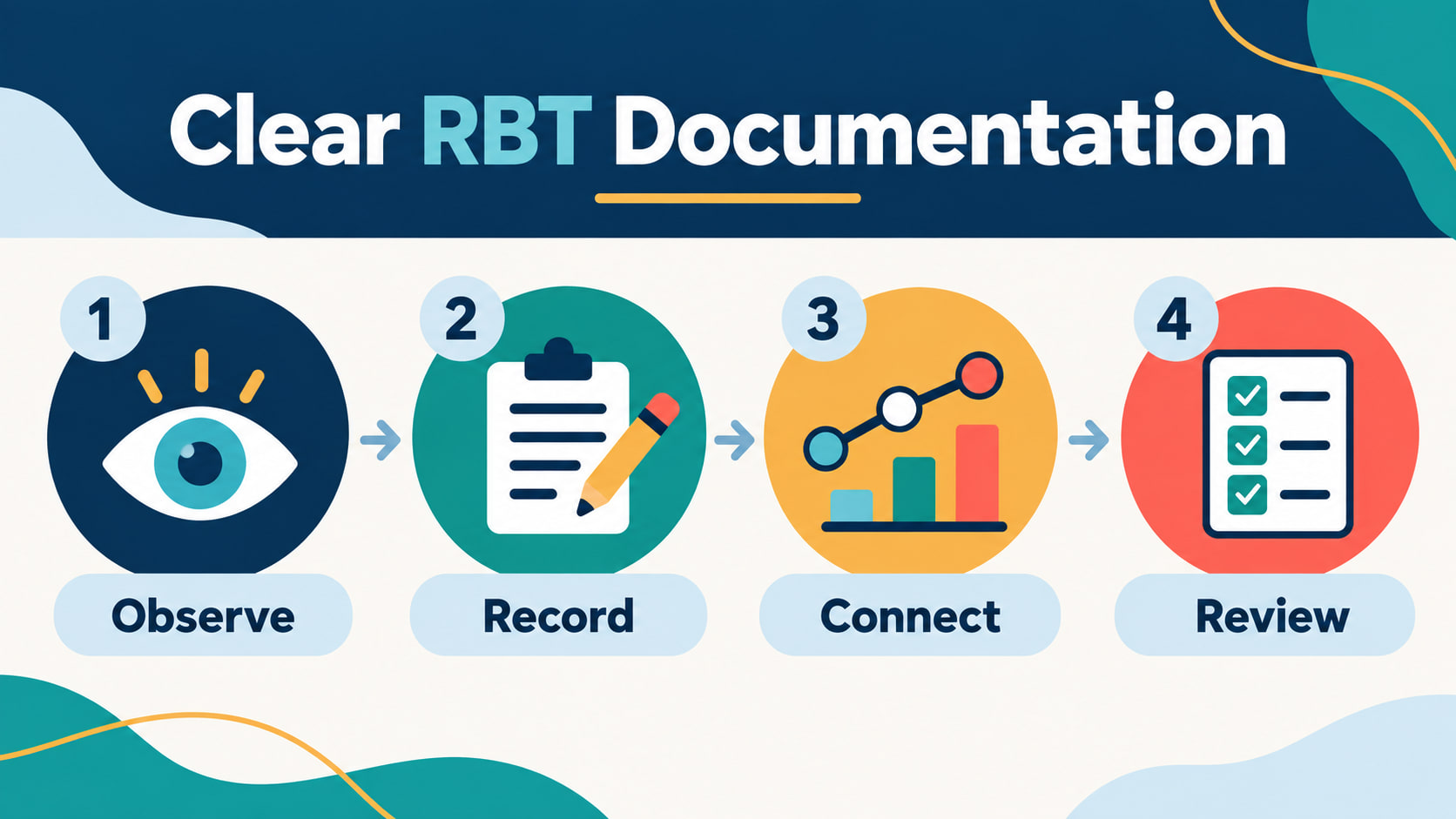
The four-part documentation cycle
- Observe: notice the relevant event, response, prompt, context, or measurement.
- Record: enter the required facts in the approved field or form.
- Connect: relate the entry to the current target, procedure, or session purpose.
- Review: check accuracy, privacy, completeness, and the correct submission route.
Start with observable facts
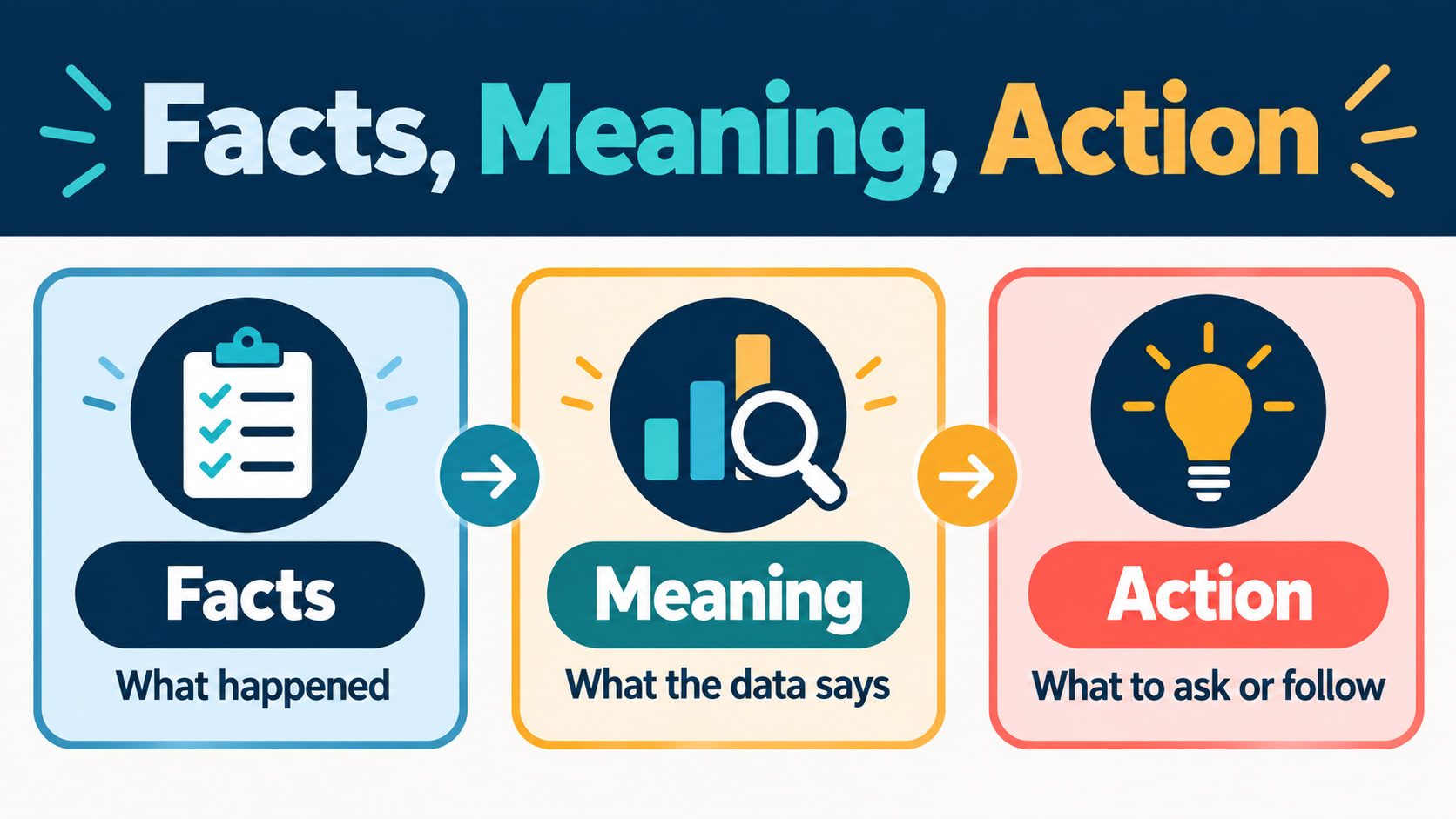
Begin with what could be seen, heard, counted, timed, or otherwise verified. Describe the response and relevant context rather than assigning an internal motive. For example, “left the table twice during the five-minute work period” is more useful than “did not want to work.” The first statement identifies an observable event; the second makes an unsupported interpretation.
Use the measurement system specified for the target. If the procedure calls for frequency, duration, latency, percentage, task-analysis steps, or another measure, use that system consistently. Do not substitute a convenient estimate because the original measurement was difficult. If required information is missing, follow the correction or escalation process rather than inventing a value.
Separate direct observation from a report received from someone else. If a caregiver, teacher, or coworker shares relevant information, record it according to the approved format and identify it as a report when the form requires that distinction. Do not present secondhand information as though you personally observed it.
Record the required information
Use a pre-submission check that matches the approved system. Depending on the form, this may include the correct client or case identifier, date, start and end times, setting, target or activity, data values, prompts, relevant materials, unusual events, and required signatures. Enter only what the system requests and what you are authorized to record.
Write while details are fresh when the workflow allows it, but do not let speed reduce accuracy. If the system is unavailable, use the approved downtime procedure. Never backdate a record, copy a previous note without checking it, or sign for another person. A correction should remain transparent and follow the system’s documented correction method.
Connect the record to the current plan
A note should make clear which current target, routine, or procedure the entry relates to. That connection does not mean the RBT rewrites the plan. It means the record can be understood in context. Use the terminology and codes required by the approved program, and ask the supervisor when a new situation does not fit the written instructions.
Do not turn a documentation entry into an unauthorized clinical judgment. “The learner completed four of five programmed opportunities with a gestural prompt” reports service information. “The learner is cured” makes a conclusion the record cannot support. Keep outcome language proportional to the observed information.
Review, protect, and submit the record
Before submitting, read the entry as if another authorized team member had to understand the session without asking you to translate it. Check names and identifiers, dates and times, values, spelling of required fields, omitted sections, and any contradictory entries. Confirm that the record is attached to the correct case and sent through the approved system.
Protect privacy during writing, storage, and communication. Do not place client-identifying information in personal notes, screenshots, public posts, unapproved messaging apps, or a shared file that is not part of the authorized workflow. A record can be accurate and still be mishandled if it is sent to the wrong person.
If you notice an error after submission, follow the organization’s correction process and tell the appropriate person. Do not silently delete, overwrite, or conceal a material change. If the issue involves safety, privacy, falsified data, a missing signature, or a procedure outside your competence, use the designated escalation route promptly.
RBT documentation examples
Data entry: A useful entry identifies the target, the programmed opportunity or observation period, the recorded result, and the required prompt or response code. It does not replace a data value with “good session.”
Session summary: A useful summary connects the activities completed with the current program and notes relevant barriers or questions. It does not promise a future outcome or claim that a single session proves mastery.
Unexpected event: A useful entry records what happened, when it happened, what immediate approved response occurred, and who was notified through the required route. It does not assign blame or provide a diagnosis.
Common documentation mistakes
- Using labels instead of observations: conclusions replace measurable events.
- Guessing missing data: an estimate is entered as though it were observed.
- Copying yesterday’s note: details are carried forward without checking the current session.
- Mixing records: private or unrelated information is placed in the wrong form.
- Changing the plan in the note: documentation is used to create an instruction rather than report service delivery.
- Submitting without review: a correct observation is attached to the wrong case or recipient.
When a form is unclear, the safest next step is usually a focused question: identify the field, describe what you observed, explain what is missing, and ask which approved process applies. This preserves accuracy and keeps decision ownership with the appropriate supervisor or organization.
Frequently asked questions
What makes RBT documentation objective?
It uses observable, relevant information and the required measurement system instead of guessing about motives, using vague labels, or making unsupported promises.
Can I correct a submitted RBT record?
Follow the organization’s documented correction process. Do not quietly erase or backdate information, and ask the responsible person when the route is unclear.
Should every event go into the session note?
Not necessarily. Use the record designed for the event and follow the current policy. A safety, incident, supervision, or communication issue may require a separate approved form.
What should I do when I cannot remember a data value?
Do not invent one. Follow the approved missing-data or correction process and notify the appropriate supervisor if required.
Source note: Review current BACB materials, organizational policy, the written service plan, the approved documentation system, and supervisor direction for your setting. This article is educational and does not provide individualized legal, clinical, employment, or credentialing advice.
Ready to practice the RBT concepts you just reviewed?
Try an independent, original RBT practice resource with exam-style questions, scoring, and answer explanations.
References
- Behavior Analyst Certification Board. RBT Test Content Outline, 3rd edition.
- Behavior Analyst Certification Board. RBT Handbook.
- Behavior Analyst Certification Board. RBT Ethics Code.