
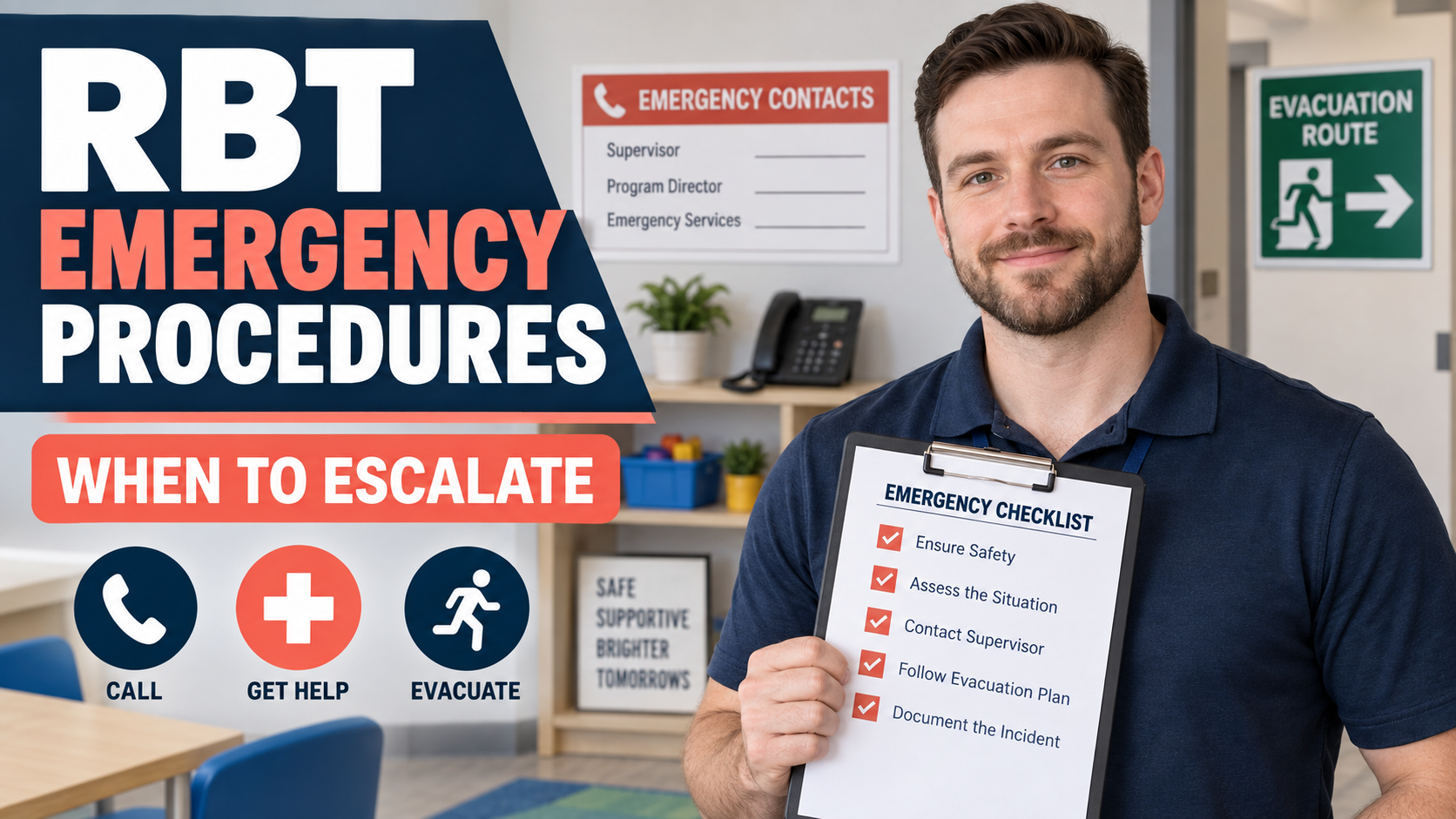
RBT emergency procedures begin with recognizing danger and using the approved emergency plan, then continue through escalation, handoff, and objective reporting.
Table of Contents
- RBT emergency procedures: quick answer
- Emergency procedures vs. crisis procedures
- What to know before an emergency
- Recognizing when to escalate
- Calling for help
- Following the approved plan
- The emergency handoff
- Documenting and reporting
- After the immediate emergency
- Common RBT emergency-procedure mistakes
- Frequently asked questions
RBT safety, escalation, and reporting
RBT Emergency Procedures: When to Escalate and Report
RBT emergency procedures begin with recognizing danger and using the approved emergency plan, but the work does not end when the immediate risk passes. An RBT must know when to call for help, how to hand off accurate information, what to document, and which decisions belong to a supervisor, emergency responder, or other authorized professional.
RBT emergency procedures: quick answer
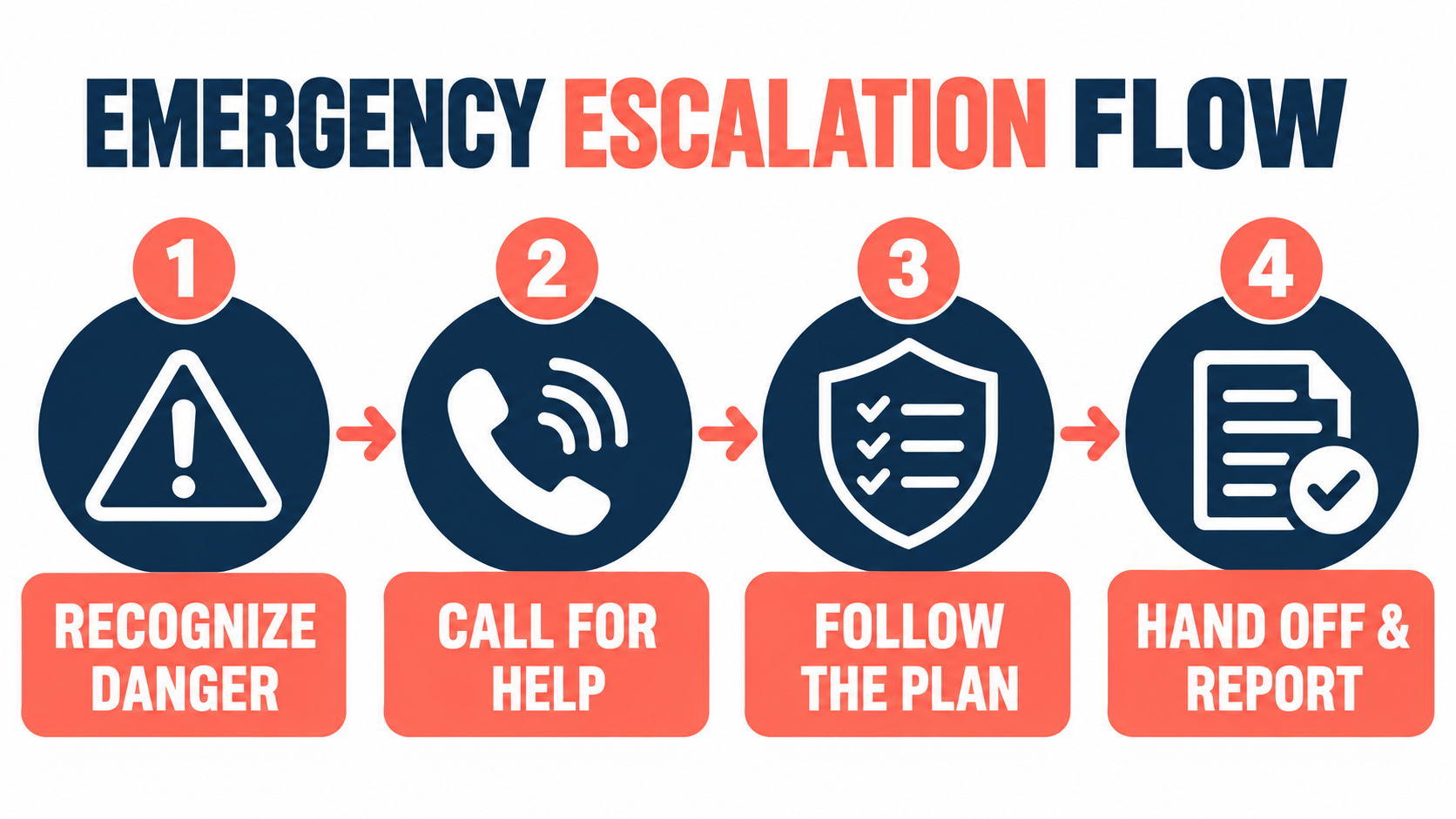
When an emergency occurs, recognize the danger, use the approved emergency instructions, call for the level of help required, protect people without inventing a new intervention, hand off accurate information, and complete the required report. The RBT is not expected to diagnose the event or solve every clinical decision alone.
The BACB’s current RBT Test Content Outline includes “implement crisis/emergency procedures” under behavior reduction. That competency is implemented through the plan and training used in the actual service setting. A general article cannot replace a client’s medical, behavioral, or workplace emergency instructions.
Emergency procedures vs. crisis procedures
The terms overlap, but they answer different questions in practice. A crisis procedure is usually an approved response for a known pattern of escalation or behavior reduction concern. An emergency procedure addresses an urgent threat to life, health, physical safety, or the immediate environment. A crisis can become an emergency, and the client-specific plan should explain when the response changes.
Do not use the difference as a reason to delay help. If there is immediate danger, a serious injury, a medical concern, fire, a missing person, or another event requiring urgent response, follow the emergency route. The appropriate action may involve emergency services, building staff, a supervisor, a caregiver, or more than one resource.
What to know before an emergency
Preparation should happen before the session. Ask the supervisor or organization to show you:
- the current client-specific emergency and crisis plan;
- the conditions that require a supervisor call or emergency call;
- the location of exits, phones, first-aid supplies, and emergency information;
- the backup contact if the primary supervisor is unavailable;
- the required incident-report and session-note forms;
- the privacy and communication rules for contacting caregivers or responders;
- the procedures you are trained and authorized to perform, and the procedures you must not perform.
Check the plan version and review changes after a new risk, injury, medication change, setting change, or clinical update. An RBT should be able to locate the instructions quickly without searching through personal messages or relying on memory.
Recognizing when to escalate
Escalation means bringing the right help into the situation early enough to protect safety. Use the objective indicators in the plan rather than a personal threshold. Examples can include an injury, breathing difficulty, loss of consciousness, dangerous access to the environment, a weapon or fire risk, a missing client, a threat that cannot be contained within the plan, or any situation in which staff cannot maintain safety.
Do not wait for certainty about a diagnosis. Describe what you observe and communicate the risk. “The client fell, is not responding to voice, and has irregular breathing” is more useful to a responder than “the client may be having a serious episode.” Use the emergency contact route stated in the plan and local policy.
If the event is not an immediate emergency but is outside the current protocol, contact the supervisor and pause the affected procedure until direction is provided. A supervisor may decide that the session ends, a caregiver is contacted, or the plan needs review.
Calling for help
When calling a supervisor or emergency resource, provide the minimum information needed for a safe response: your name and location, who is involved, what happened, current safety or medical status, what steps were already taken, and what help is needed. Stay on the line if instructed. If the client’s privacy rules permit, provide responders with the information needed for care; do not volunteer unrelated confidential details.
Use the organization’s communication chain if the primary contact does not answer. Do not keep trying routine channels when the emergency plan calls for emergency services. Ask another trained adult to contact the supervisor when doing so does not compromise safety, but do not leave an unsafe person unsupervised simply to make a phone call.
After help arrives, follow the responder’s directions and the organization’s handoff policy. An RBT should not argue with responders, withhold relevant facts, or continue a service-delivery procedure after responsibility has been transferred.
Following the approved plan
Use only the intervention steps that the client-specific plan and your training authorize. The plan may include prevention, space, communication, evacuation, supervision, or other actions. It may also state what not to do. Do not add a physical restriction, medication, punishment, or medical response because you saw it online or used it with another client.
Protect dignity and safety together. Keep bystanders away when directed, preserve privacy, and reduce unnecessary stimulation if the plan says to do so. If the plan no longer matches the environment, communicate that fact and seek direction. The emergency is not an opportunity to test a new technique.
The emergency handoff
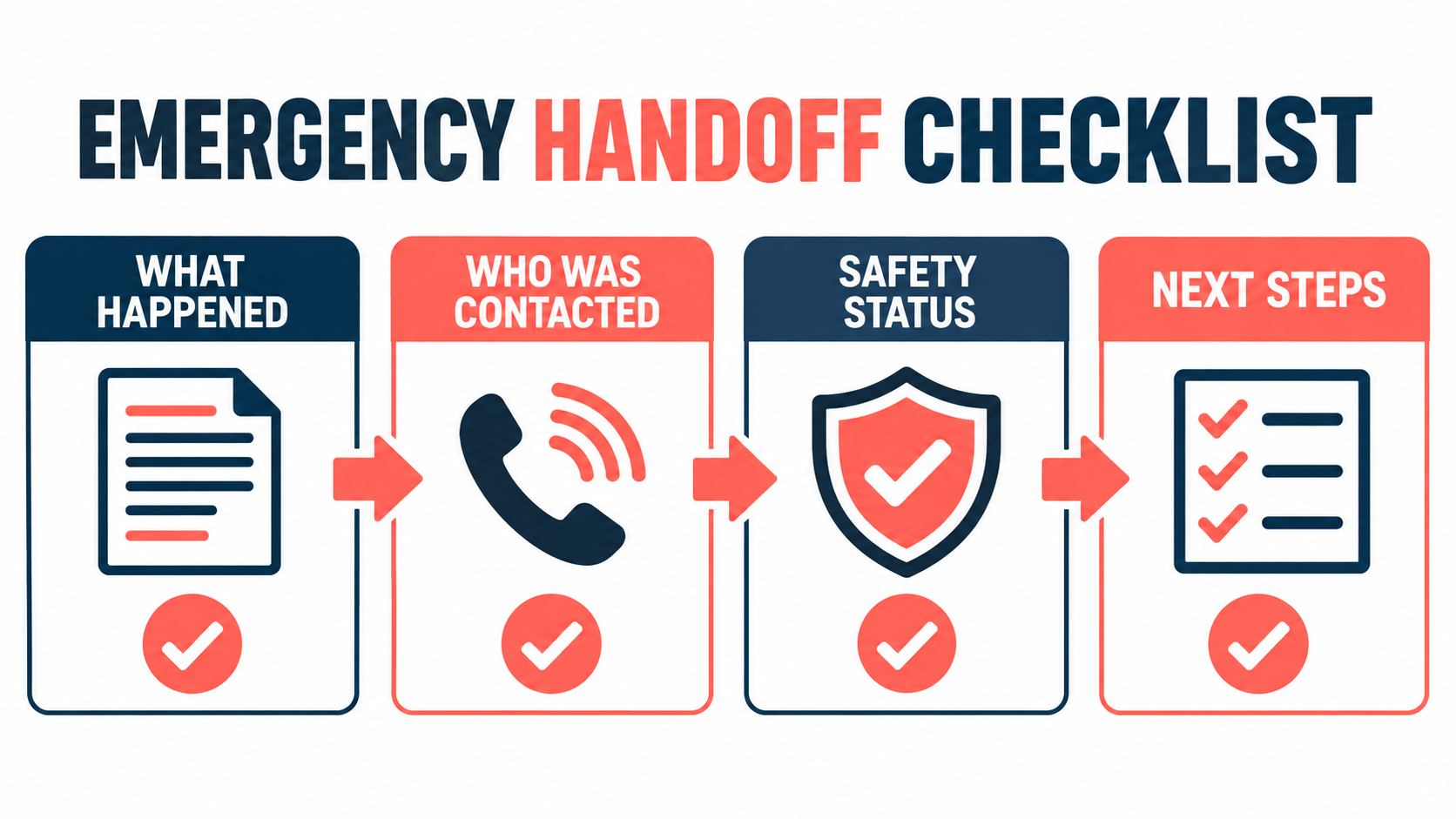
A good handoff lets the next responsible person act without reconstructing the event from rumors. Give a short chronological account: what was happening before the event, the observable emergency, the safety steps taken, who was contacted, the current status, and any known injury or property concern. Include the client’s location and the names of people who can provide additional information.
Use plain, objective language. Distinguish what you saw from what someone else told you. If you are uncertain, say so. Never change a fact to make the event sound less serious or more controlled than it was.
Documenting and reporting
Complete the required incident report and session documentation as soon as the person is safe and the organization’s policy allows. Record the date, time, setting, people present, observable events, actions taken under the approved plan, contacts and times, injuries or damage if known, and the outcome. If a separate medical, safety, or legal report is required, complete that form too.
Do not write conclusions that you cannot support. “Client yelled and ran toward the parking lot” is an observation; “client wanted attention” is an interpretation unless the supervisor has established a documented function and the note requires it. Do not include unnecessary private information, and store the report according to confidentiality rules.
After the immediate emergency
Ask the supervisor what follow-up is required. The team may need to review the plan, check on the client and staff, notify a caregiver, complete additional training, or suspend a service until the risk is assessed. An emergency can reveal a gap in the environment or protocol; reporting it is part of prevention, not an admission of failure.
RBTs should also use the organization’s support process after a distressing event. Ask for debriefing and clarification rather than carrying an unresolved question into the next session. Do not discuss the event publicly or post identifying details on social media.
Common RBT emergency-procedure mistakes
- Waiting for a diagnosis: Communicate observable danger and use the emergency route.
- Calling the wrong channel: Follow the plan’s escalation and backup chain.
- Improvising treatment: Use only approved, trained procedures.
- Leaving the scene to make a call: Keep safety and supervision in place.
- Giving a vague handoff: Report what happened, actions taken, current status, and next steps.
- Delaying documentation: Complete required reports promptly after safety is restored.
- Sharing the story publicly: Protect client confidentiality.
Frequently asked questions
What is the first step in an RBT emergency?
Recognize the immediate danger and use the current client-specific emergency plan. Call for the level of help required by the plan and local rules.
Should an RBT wait for a supervisor before calling emergency services?
Not when the emergency plan or immediate danger requires emergency services. Follow the written escalation route and do not delay urgent safety action for routine supervision.
What should be included in an emergency handoff?
Explain what happened, who is involved, what actions were taken, who was contacted, the current safety status, and what next step is needed.
Can an RBT create a new emergency response?
No. Use approved procedures within your training and scope. If the plan does not fit, protect immediate safety and seek direction.
Is emergency reporting separate from a session note?
It may be. Follow the workplace policy to determine whether an incident report, medical report, or other form is required in addition to the routine note.
Official sources: BACB RBT Test Content Outline (3rd ed.); RBT Test Content Outline source document; BACB Supervision, Assessment, Training, and Oversight; BACB RBT examination resources. Retrieved September 28, 2026. Always follow the current emergency plan and workplace policy.
Ready to practice the RBT concepts you just reviewed?
Try an independent, original RBT practice resource with exam-style questions, scoring, and answer explanations.
References
- Behavior Analyst Certification Board. RBT Test Content Outline, 3rd edition.
- Behavior Analyst Certification Board. RBT Handbook.
- Behavior Analyst Certification Board. RBT Ethics Code.