

RBT group supervision can be an efficient, collaborative part of ongoing oversight, but it does not replace every individual supervision requirement.
Table of Contents
- RBT group supervision: quick answer
- What group supervision is
- Current BACB structure
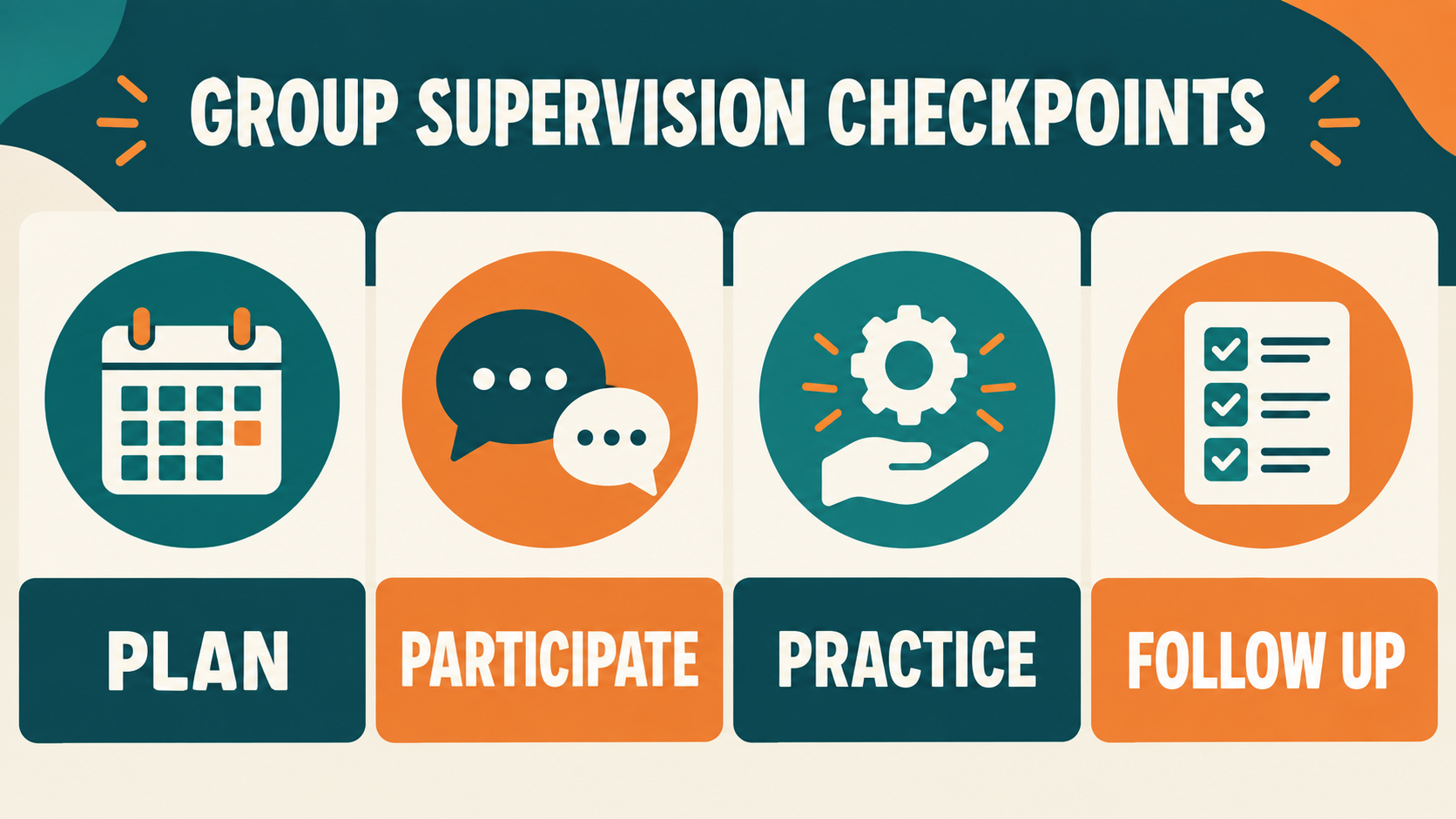
- How to prepare before the meeting
- How to participate well
- Keep the discussion client focused
- What to document
- What group supervision cannot replace
- When the format is not working
- Frequently asked questions
- Official source note
Group supervision format, monthly requirements, active participation, direct observation, and audit-ready records
RBT Group Supervision: What to Expect and Document
RBT group supervision can be an efficient, collaborative part of ongoing oversight, but it does not replace every individual supervision requirement. The current BACB RBT Handbook says one of the two required monthly supervision contacts may occur in a small group, while at least one contact must be individual and one monthly meeting must include observation of the RBT providing services. This guide explains how to prepare, participate, and keep records without treating a group meeting as a shortcut around supervision.
RBT group supervision: quick answer
Under the June 2026 BACB RBT Handbook, ongoing supervision must include at least two face-to-face, real-time contacts per month. At least one of those contacts must be individual, meaning no other RBTs or trainees are present. The other contact may be a small-group meeting with two to ten RBTs who share similar experiences. The supervisor must observe the RBT providing services in at least one monthly meeting; the observation may occur in person or through an appropriate real-time video method when permitted.
The handbook also states that ongoing supervision is client focused and separate from professional development. A group training or staff meeting is not automatically group supervision, and one event cannot be counted for both ongoing supervision and professional development. The supervisor and organization must determine the compliant structure for the RBT’s clients and work.
What group supervision is
Group supervision is an interactive supervision meeting in which a small number of RBTs with similar experiences participate with a qualified supervisor. The group format creates opportunities to compare implementation questions, practice communication, receive feedback, and learn from patterns that appear across cases. It is still supervision, not a lecture that RBTs passively watch.
“Group” describes the format, not the removal of individual responsibility. Each RBT remains responsible for following the current plan, protecting confidentiality, reporting concerns, and asking for client-specific direction. The supervisor remains responsible for making sure the meeting provides meaningful oversight and that the overall monthly requirements are met.
Because the participants may work with different clients, the supervisor should control how examples are presented. Use the minimum necessary information, remove unnecessary identifiers, and do not assume that another RBT is authorized to know every detail about a client. A useful discussion can be specific about a skill or procedure without exposing private information.
Current BACB structure
The exact structure matters more than the label used by an employer. The current handbook identifies the following checkpoints:
- Two real-time contacts per month: supervision cannot be reduced to email, a phone-only check-in, or a recording that has no real-time interaction and feedback.
- One individual contact: at least one of the two monthly sessions must be individual, with no other RBTs or trainees present.
- One observation: the supervisor must observe the RBT providing services in at least one monthly meeting. In-person observation is preferred, but the handbook allows compliant real-time technology methods.
- Small-group limits: a small group includes two to ten RBTs with similar experiences. The number of RBTs cannot exceed ten, even if more than one supervisor attends.
- Five percent minimum: ongoing supervision must be at least 5% of the hours spent providing behavior-analytic services each calendar month under the applicable structure.
- Client-specific oversight: the supervisor or RBT Requirements Coordinator must have enough knowledge of the client to inform the clinical direction of the RBT’s work.
These requirements are a floor, not a promise that every group meeting is enough for every situation. A supervisor may schedule more individual contact, more observation, or additional coaching when the RBT is learning a new procedure, working with a changing plan, or facing a safety concern.
How to prepare before the meeting
Preparation keeps the group from becoming a list of vague complaints. Review the current programs, recent objective data, session notes, and any feedback already received. Select one or two questions that can be discussed without unnecessary identifying details. A strong question describes the setting, the observable event, the procedure used, the response, and the decision you need.
Bring the materials the supervisor has requested: data summaries, a de-identified note, a prompt hierarchy, a teaching sequence, or a practice script. Confirm whether the meeting will include role-play, direct observation, case review, or documentation review. If you need client-specific guidance that cannot be safely discussed in a group, request an individual follow-up rather than trying to solve it in front of peers.
Check the calendar and your service hours so you can see how the contact fits into the month. Do not calculate compliance by dividing one group meeting across several organizations. The handbook says an RBT working at different organizations must meet the requirements independently at each organization, so ask the relevant supervisor or coordinator how the hours are tracked.
How to participate well
Active participation means listening, asking relevant questions, practicing a skill, receiving feedback, and explaining what you will do next. It does not require dominating the meeting. When another RBT presents a similar challenge, compare the principle or procedure rather than comparing private client details.
Use feedback as a supervision activity, not as a personal verdict. If a supervisor identifies a prompt error, data problem, or communication gap, restate the correction in your own words and practice it when possible. Ask what observable outcome will show that the correction was implemented. This makes the next session easier to evaluate.
Keep your contributions factual. “The learner refused” may be too broad; “after the instruction, the learner pushed the materials away and did not begin within 30 seconds” gives the supervisor something to analyze. If your information comes from a caregiver or teacher, identify it as a report rather than presenting it as a direct observation.
Keep the discussion client focused
Ongoing supervision is intended to support high-quality services and maintain the RBT’s behavior-analytic, professional, and ethical repertoires. That means a meeting should connect discussion to actual service delivery: implementing a plan, collecting data, prompting, teaching, responding to a variable, writing a note, or communicating a concern.
A general topic such as “communication skills” becomes supervision when the group applies it to an authorized program, rehearses the relevant response, reviews data, and receives feedback. A general presentation with no client-focused oversight may be useful professional development, but it should not automatically be logged as ongoing supervision.
Protect confidentiality throughout. Use approved case labels, avoid discussing information that does not affect the question, and follow the employer’s video, screen-sharing, and record-storage policies. If a group member is not authorized to receive a detail, leave it out and ask the supervisor how to handle the issue privately.
What to document
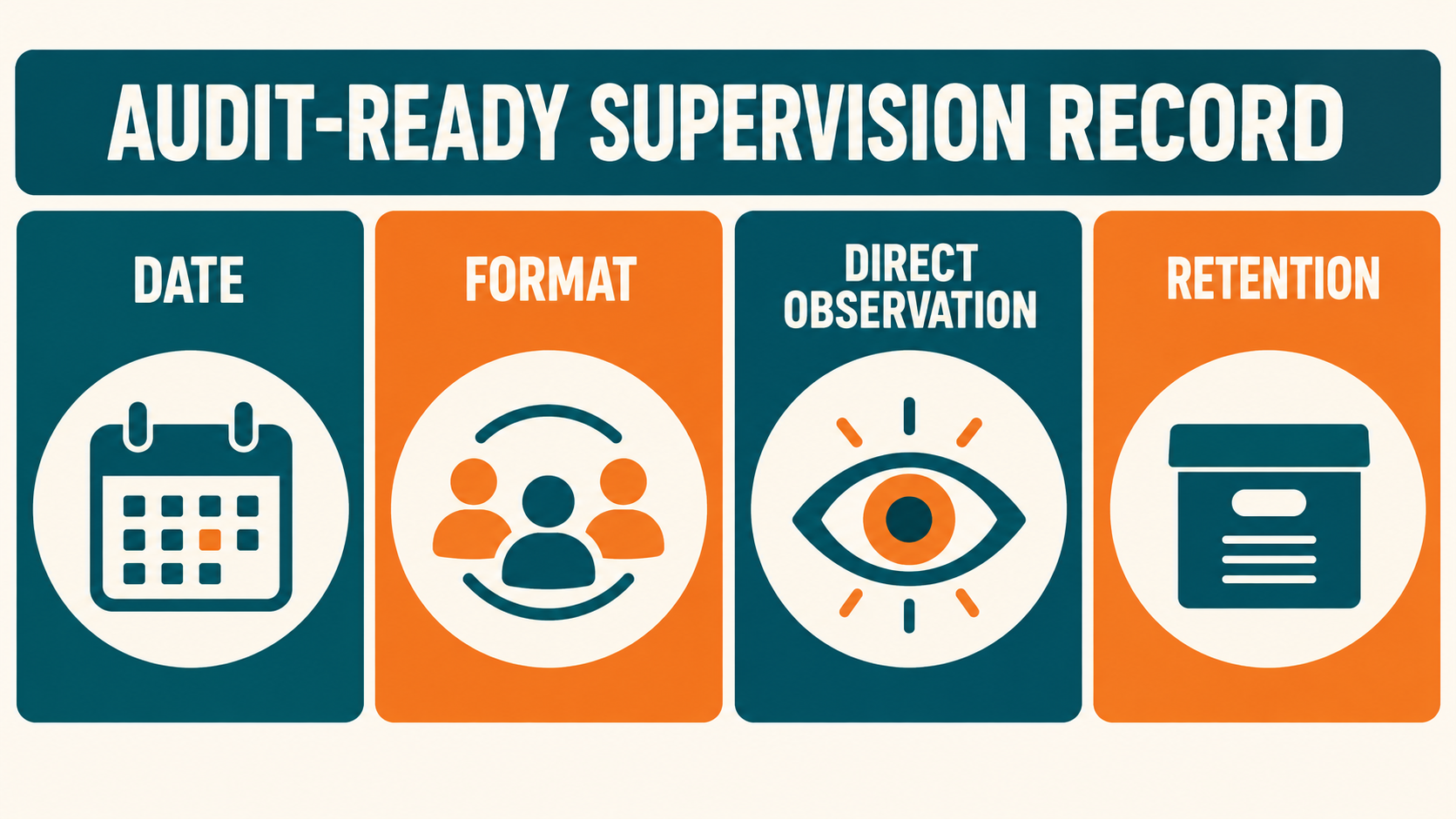
The handbook requires the RBT and supervisor or coordinator to maintain documentation demonstrating that supervision requirements are met. Keep the record consistent with the organization’s form and retention system. At a minimum, check that the record captures:
- the days and times the RBT provided behavior-analytic services;
- the date and duration of the supervision contact;
- the format, such as individual or group;
- the date on which direct observation of the RBT working with a client occurred;
- the name of the supervisor who provided the contact;
- evidence of the supervisor’s relationship to the client; and
- additional records, such as session notes, when records do not agree.
The current handbook says supervision documentation must be retained for at least seven years, even after the supervisory relationship ends or another person assumes responsibility. Use the official system, confirm who owns the record, and do not rely on a personal calendar or an informal chat as the only evidence.
What group supervision cannot replace
Group supervision cannot replace the required individual contact. It cannot replace direct observation when the monthly observation has not occurred. It cannot authorize an RBT to change a behavior plan, diagnose a client, or act outside training. It also cannot turn a professional-development presentation into client-focused supervision simply because a supervisor was in the room.
Likewise, a supervisor’s attendance does not automatically make every discussion appropriate for every client. The supervisor must have sufficient client-specific knowledge, and the RBT must have an approved supervisor or RBT Requirements Coordinator for each client served under the applicable rules. If the group format leaves an important client question unresolved, ask for individual direction.
Do not treat a group meeting as proof that supervision is complete until the date, duration, format, observation status, supervisor, and client relationship are recorded and reconciled with service hours. The record is part of the compliance process, not clerical decoration.
When the format is not working
Raise a concern when you repeatedly cannot ask questions, receive no feedback, do not know whether the meeting is supervision or training, cannot access client-specific direction, or cannot see how the monthly requirements are being documented. A simple message can say: “I attended the group meeting on this date, but I am not sure whether it was logged as ongoing supervision or professional development. Could you confirm the format, the observation plan, and any individual follow-up needed for my client?”
If you do not have a qualified supervisor or coordinator on record, or if you believe the requirements are not being met, contact the appropriate supervisor, coordinator, employer, and—when necessary—the BACB using the applicable process. Do not continue practicing under the assumption that an informal group chat provides the same protection as compliant supervision.
Keep your own contemporaneous record within the approved policy, but do not create competing versions of the official log. If the organization’s records differ from yours, report the discrepancy promptly and preserve the supporting documentation requested by the responsible person.
Frequently asked questions
How many RBTs can be in a small-group supervision meeting?
The current BACB RBT Handbook describes a small group as two to ten RBTs with similar experiences. The number of RBTs may not exceed ten, regardless of how many supervisors attend.
Can all monthly supervision be group supervision?
No. At least one of the two monthly supervision contacts must be individual. The other may be a compliant small-group meeting, and the supervisor must observe the RBT providing services in at least one monthly meeting.
Does group supervision count as professional development?
Ongoing supervision and professional development are separate requirements. The same event cannot satisfy both, so confirm how the organization is classifying and documenting the meeting.
Can a group meeting discuss several clients?
It can address client-focused supervision within the approved structure, but confidentiality and supervisor-client oversight still apply. Use the minimum necessary information and move client-specific or sensitive issues to an individual discussion when needed.
Official source note
This educational guide was checked against the BACB RBT Handbook updated June 2026 and the BACB RBT supervision resources, retrieved September 28, 2026. Employer, payer, state, legal, and workplace requirements may add requirements or differ in implementation.
Role boundary: This article is general education, not individualized certification, employment, legal, or clinical advice. Confirm the current rules and your supervision structure with the responsible supervisor or RBT Requirements Coordinator.
Ready to practice the RBT concepts you just reviewed?
Try an independent, original RBT practice resource with exam-style questions, scoring, and answer explanations.
References
- Behavior Analyst Certification Board. RBT Test Content Outline, 3rd edition.
- Behavior Analyst Certification Board. RBT Handbook.
- Behavior Analyst Certification Board. RBT Ethics Code.