

If you search for RBT handbook, you need more than a downloadable checklist. The current Behavior Analyst Certification Board (BACB) Handbook is the control document for obtaining and maintaining RBT certification; it is not simply another study guide. The BACB page currently presents a June 2026 update and explains that applicants and certificants must follow the requirements in the version that applies to their application, examination, and maintenance timeline.
Table of Contents
- RBT handbook: what does it actually control?
- RBT handbook roadmap: eligibility to active certification
- Eligibility: age, education, and background checks
- 40-hour training: the date window is part of the requirement
- Initial Competency Assessment: use the current packet
- Application, fees, and exam authorization
- The exam section of the RBT handbook
- After the exam: supervision, ethics, and active status
- The 2026-to-2027 maintenance transition
- Build an RBT handbook evidence ledger
- Common mistakes when using an RBT handbook checklist
- Frequently Asked Questions
- References
This distinction matters during the 2026 transition. The RBT Test Content Outline (3rd ed.) controls what the current examination measures, while the Handbook controls the certification path, required documents, fees, timing windows, supervision, ethics, and recertification. RBT Training offers independent study content. It is not the BACB, does not review applications, does not administer the official examination, and is not affiliated with or endorsed by the BACB.
The current exam includes 43 tasks across six domains and presents 85 multiple-choice questions: 75 scored questions and 10 unscored pilot questions. Each question has four answer choices and the exam time is 90 minutes. These facts help you study, but a practice score does not replace eligibility, training, competency assessment, application approval, or ongoing supervision.
Use this article as a navigation and evidence checklist, then open the current BACB Handbook before you enroll, pay, upload a document, schedule an exam, or renew. Requirements, fees, forms, and transition instructions can change. No course, article, or study guide can guarantee certification or a passing result.
RBT handbook: what does it actually control?
The Handbook describes the requirements for obtaining and maintaining RBT certification. It also links to the current application forms, training outline, competency packets, TCO, Ethics Code, supervision resources, and recertification materials. Because the BACB publishes new versions as needed, the Handbook should be treated as a versioned source rather than a page you download once and never revisit.
| Question | Where to verify it | Why it matters |
|---|---|---|
| Am I eligible to apply? | Current RBT Handbook, eligibility section | Age, education, checks, training, and assessment must all fit the current rules. |
| What will the exam test? | RBT Test Content Outline (3rd ed.) | The TCO is the exam blueprint; it is not the whole certification process. |
| Which form should I upload? | Current BACB application and competency packet | Older packets can leave an application incomplete or misaligned. |
| How do I remain active? | Handbook maintenance sections, Ethics Code, and portal | Supervision, self-reporting, recertification, and status rules continue after the exam. |
A useful mental model is simple: the TCO tells you what to learn for the examination; the Handbook tells you what to do and document for the credential. A strong study plan uses both, but it never substitutes an independent guide for the current BACB requirements.
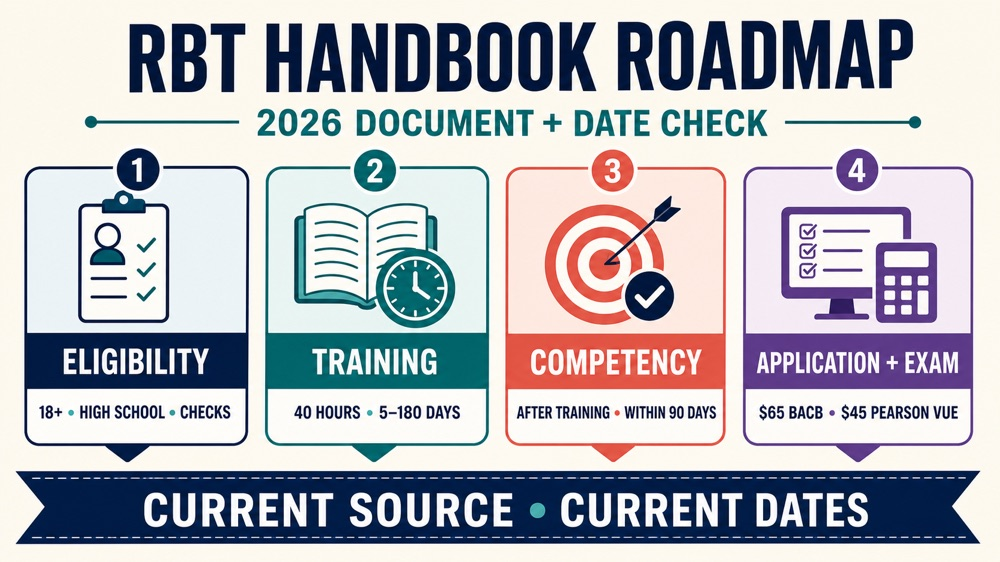
RBT handbook roadmap: eligibility to active certification
| Stage | Current checkpoint | Evidence to preserve |
|---|---|---|
| 1. Eligibility | At least 18, high-school education or equivalent, background check, and abuse registry check under current rules. | Check results and attestation details. |
| 2. Training | Qualifying 40-hour training completed in no fewer than 5 days and no more than 180 days. | Certificate, dates, provider, and curriculum information. |
| 3. Competency | Current Initial Competency Assessment after training and within the application timing window. | Completed current packet and assessor information. |
| 4. Application | Submit the BACB application, attestation, training certificate, competency packet, and fee. | Portal confirmation and submitted documents. |
| 5. Examination | After approval, schedule and pass the official RBT examination. | Authorization email and Pearson VUE appointment. |
| 6. Maintenance | Follow supervision, ethics, self-reporting, and current recertification rules. | Supervision records, PD documentation, and portal status. |
The chain matters. A full-length practice exam can diagnose study needs, but it cannot make a training certificate valid or turn an informal skill check into a competency assessment. Keep the evidence for each stage before moving to the next one.
Eligibility: age, education, and background checks
Under the current 2026 eligibility information, an applicant must be at least 18 years old when submitting the certification application and must have completed at least a high-school education or equivalent. The attestation process also addresses a criminal background check and an abuse registry check. The exact way a check is handled can depend on the applicant’s jurisdiction, so read the current form instead of copying a checklist from an older blog post.
- Age: confirm your age on the application date, not only when you begin studying.
- Education: keep the evidence required by the current application process.
- Criminal background check: verify the current date and organization requirements.
- Abuse registry check: follow the current instructions if your state or province has no registry or the information is unavailable.
- Local requirements: an employer or jurisdiction may require fingerprinting or additional screening even when a specific step is not required by the BACB.
Do not assume an old employment check automatically satisfies the application. Record the check type, date, jurisdiction, and attesting person in a private document ledger. Do not send private identity or client documents to an independent study site for informal review.
40-hour training: the date window is part of the requirement
The current Handbook states that the RBT 40-hour training must meet the 2026 RBT 40-Hour Training Requirements and Curriculum Outline and must be completed in no fewer than 5 days and no more than 180 days. The start and end dates count in the calculation. The training may be offered by an employer, university, or online provider, but the BACB does not provide the training, completion certificates, or provider recommendations.
| Training check | What to verify before relying on the course |
|---|---|
| Current curriculum | Does the provider identify the current 2026 requirements and curriculum outline? |
| Calendar window | Do the recorded start and end dates fall between 5 and 180 days inclusive? |
| Certificate | Will the provider issue the certificate needed for the certification application? |
| Provider relationship | Does the provider meet the current independence rule rather than being related to, subordinate to, or employed by the applicant? |
| Older training | Has it been compared with the current requirements instead of assumed valid because it says “RBT”? |
Example: a course completed in a weekend may appear efficient, but it cannot satisfy a rule that requires the training dates to span at least 5 days. Conversely, a course started and finished far apart may exceed the 180-day limit. Count the dates before you pay the application fee.
Initial Competency Assessment: use the current packet
After the qualifying training, the applicant must demonstrate competence using the current Initial Competency Assessment. The Handbook states that the assessment occurs after the required training and no more than 90 days before submitting the certification application. The assessment is a practical requirement, not a multiple-choice quiz and not a self-attestation that you watched a study video.
Confirm the current packet, the assessor’s qualifications, the permitted demonstration format, signatures, and the date relationship to your application. If a training provider gives you an older checklist, use it for rehearsal only until it has been reconciled with the current BACB packet.
Study boundary: an independent article can explain what a task means and help you practice a scenario. It cannot sign the official assessment, determine your competence, or replace a qualified assessor. Keep a copy of the completed packet for the application and your records.
Application, fees, and exam authorization
Once the eligibility requirements and supporting documents are ready, log in to the BACB portal, start the RBT Certification Application, complete the current attestation, and upload the documents the application requests. The June 2026 Handbook lists a $65 certification application processing fee paid to the BACB and a $45 exam appointment fee paid to Pearson VUE. BACB fees are listed as nonrefundable and nontransferable, so recheck the current fee table before paying.
| Cost or status | What it does not include |
|---|---|
| $65 BACB certification application processing fee | It does not include training, background checks, travel, or employer-specific expenses. |
| $45 Pearson VUE exam appointment fee | It is separate from the BACB application fee and may have applicable local taxes. |
| Application approval | It is not a passed exam or active certification; it authorizes the next examination step. |
| Exam authorization period | The Handbook states that candidates have one year from application approval to sit for the exam; check the portal for the exact deadline. |
Save the submission confirmation, not just an unfinished browser tab. If the BACB requests an item, answer through the portal or official channel and keep the response. Name mismatches, incomplete signatures, an outdated packet, and expired timing windows are document problems—not problems that a higher practice-test score can solve.
The exam section of the RBT handbook
The current Handbook says the RBT examination is based on the 3rd-edition TCO and assesses knowledge at an entry-level behavior-technician level. If a new TCO edition takes effect while an authorization period is active, the candidate must test under the new edition; exceptions are not granted. This is why candidates should check the current Handbook and TCO near scheduling rather than relying on an old course label.
| Exam fact | Study action |
|---|---|
| 43 tasks across six content areas | Build an error log by current domain and task, not only by chapter title. |
| 75 scored questions plus 10 unscored questions | Answer every presented question because pilot items are not identified. |
| Four answer choices | Explain why the best action fits the written plan and role boundary. |
| 90 minutes | Add pacing after you can reason accurately; speed alone is not mastery. |
| All questions equally weighted | Use domain percentages for study allocation, not as a personal pass prediction. |
The BACB recommends the current TCO plus materials from the 40-hour training and competency assessment. It does not endorse specific study guides, and buying a study product does not guarantee a passing result. RBT Training’s questions and scenarios are newly written and independent; they are not official, recalled, leaked, or BACB-endorsed questions.
After the exam: supervision, ethics, and active status
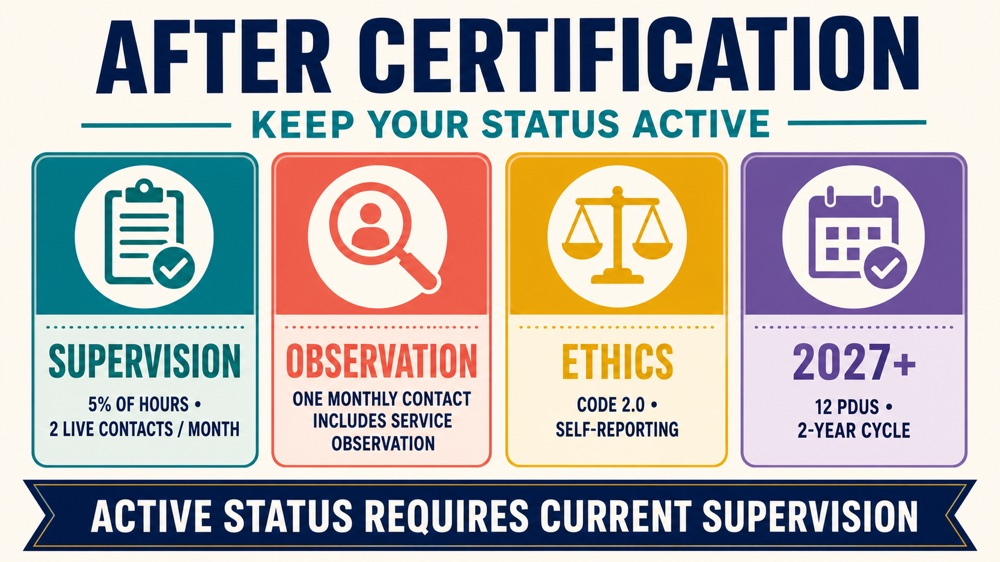
Certification is not the end of the Handbook. An RBT practices under the close, ongoing supervision of a qualified RBT Supervisor and/or RBT Requirements Coordinator responsible for the work. The current Handbook states that ongoing supervision must be at least 5% of the hours spent providing behavior-analytic services each calendar month.
- Supervision must include at least two face-to-face, real-time contacts each month.
- Your supervisor must observe you providing services in at least one monthly meeting.
- At least one of the two contacts must be individual; the other may be a qualifying small-group meeting.
- Video conferencing may be used when it meets the applicable requirements; passive video monitoring without real-time interaction and feedback may not count.
- Ongoing supervision and professional development are separate requirements and cannot simply be double-counted.
You must also follow the RBT Ethics Code (2.0) and self-reporting requirements. An active RBT is not an independent practitioner who can design behavior plans outside the assigned supervision structure. If you lose the required supervisor or coordinator record, the Handbook explains that your certification status can become inactive and you may not practice, bill, or represent yourself as active.
The 2026-to-2027 maintenance transition
The Handbook separates the transition requirements from the later two-year recertification cycle. RBTs who become certified or recertify in 2026 should read the current maintenance section carefully. After the 2026 recertification transition, the Handbook states that recertification applications will be submitted every two years beginning in 2027 and that RBTs must earn 12 professional-development units during each two-year cycle.
| Time period | What to watch | Practical record |
|---|---|---|
| 2026 certification or recertification | Use the current supervision, ethics, competency, and transition requirements. | Portal status, supervision records, and current competency documents. |
| After the 2026 recertification transition | Plan for a two-year cycle and 12 PDUs, in addition to ongoing supervision and ethics obligations. | PDU type, provider, date, hours, and supporting documentation. |
| At recertification | Submit through the existing BACB portal account by the applicable date. | Application confirmation and payment record. |
Do not count client-specific supervision as professional development unless the current Handbook expressly allows it; the current document distinguishes the two. Likewise, do not assume excess PDUs carry forward or that repeating the same activity creates new credit. Verify the current rules for the cycle in which you will apply.
Build an RBT handbook evidence ledger
- Version: write down the date shown on the current Handbook and TCO before studying.
- Eligibility: record age, education, background check, and abuse registry check status.
- Training: save the provider, certificate, curriculum version, start date, and end date.
- Competency: save the current packet version, assessor, completion date, and signatures.
- Application: save the portal submission, fee receipt, uploads, and action-item responses.
- Exam: record authorization, Pearson VUE appointment, location, and deadline.
- Maintenance: record monthly supervision, ethics/self-reporting actions, PDUs, and recertification date.
This ledger protects against the most common transition error: remembering the concept but losing the evidence. It also separates “I studied it” from “I completed the credential requirement.”
Common mistakes when using an RBT handbook checklist
- Using a handbook copy from the wrong year: check the update date and current BACB page.
- Calling a study guide the Handbook: independent prep materials cannot override BACB requirements.
- Ignoring the 5–180-day training window: the calendar dates matter.
- Scheduling competency before training is complete: the current initial assessment follows the qualifying training.
- Letting the 90-day assessment window lapse: compare the assessment date with the application submission date.
- Combining the two fees into one vague total: separate BACB and Pearson VUE charges and verify changes.
- Stopping at exam day: active practice requires supervision, ethics, and current maintenance.
- Assuming inactive means active: never practice, bill, or represent yourself as active when the portal or registry shows inactive.
Bottom line: use the RBT handbook as a versioned control document. Pair it with the current TCO for exam study, use original practice questions to build decision skills, and keep a private evidence ledger for every requirement. When a blog post conflicts with the current BACB Handbook, stop and verify the primary source before paying, uploading, scheduling, or claiming active status.
Study beside the current Handbook and TCO.
Use independent RBT study materials to review current domains, original scenarios, and explanation-led error correction before exam day.
Review the RBT study materials →
Frequently Asked Questions
What is the RBT Handbook?
The RBT Handbook is the BACB’s requirements document for obtaining and maintaining RBT certification. It should be read with the current TCO, Ethics Code, forms, and application instructions.
What are the 2026 RBT eligibility requirements?
The current Handbook identifies being at least 18, having at least a high-school education or equivalent, passing the required criminal background and abuse registry checks, completing qualifying 40-hour training, and completing the initial competency assessment before applying.
How long can the RBT 40-hour training take?
Under the current 2026 rules, the training must be completed in no fewer than 5 days and no more than 180 days, counting the start and end dates. Verify the provider and current curriculum requirements before relying on a course.
How much are the BACB and Pearson VUE fees?
The June 2026 Handbook lists a $65 BACB certification application processing fee and a $45 Pearson VUE RBT exam appointment fee. Training, checks, travel, taxes, and other costs are separate, and fees can change.
How many questions are on the current RBT exam?
The current format presents 85 questions: 75 scored questions and 10 unscored pilot questions, with four choices per question and 90 minutes. The exam is based on the 3rd-edition TCO with 43 tasks across six domains.
Does the RBT Handbook guarantee certification if I follow it?
No. The Handbook describes requirements, but it does not guarantee approval or a passing result. An independent study guide, course, or practice score cannot guarantee certification either.
References
- Behavior Analyst Certification Board. Registered Behavior Technician Handbook, updated 06/2026.
- Behavior Analyst Certification Board. RBT resource hub and examination resources.
- Behavior Analyst Certification Board. RBT Test Content Outline (3rd ed.).
- Behavior Analyst Certification Board. RBT Ethics Code (2.0).
- RBT Practice Exam study guide. Reviewed for competitor research; not an official BACB source.
- Career Employer RBT study guide. Reviewed for competitor research; not an official BACB source.
- RBT Mock Exam study guide. Reviewed for competitor research; not an official BACB source.