

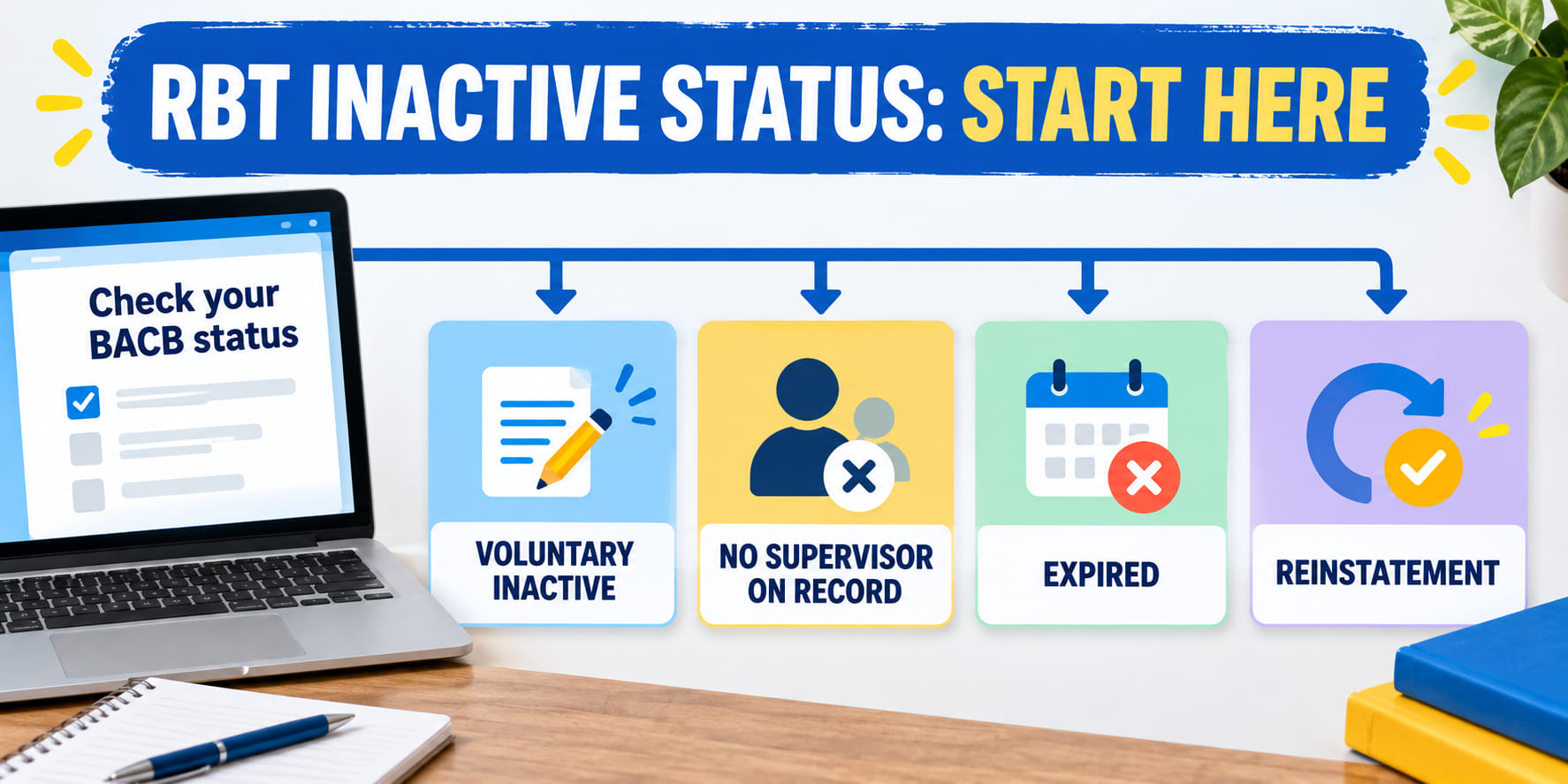
RBT inactive status is not a generic pause that lets an RBT keep working. The correct next step depends on whether the status is voluntary inactive, linked to a missing supervisor or requirements coordinator, expired, or part of a reinstatement process.
Table of Contents
- What does RBT inactive status mean?
- Voluntary inactive status is one specific option
- What you cannot do while inactive
- How to request voluntary inactive status
- What to do if your status changed unexpectedly
- Common mistakes that create confusion
- Inactive status versus no supervisor on record
- Inactive, expired, and reinstatement are not the same
- Checklist before you contact the BACB
- Need to verify your next RBT maintenance step?
- Frequently asked questions
RBT certification maintenance
RBT Inactive Status: What It Means and What to Do Next
If your RBT certification shows as inactive, the most important first step is to identify why. Voluntary inactive status, an inactive status caused by no supervisor or requirements coordinator on record, an expired certification, and reinstatement are not interchangeable.
What does RBT inactive status mean?
RBT inactive status means the BACB registry does not currently show the certification as active. That status affects what you may say and do in the RBT role. It is not simply a label that pauses paperwork while you continue working.
The reason behind the inactive status matters. The BACB distinguishes voluntary inactive status from an inactive status caused by having no RBT Supervisor or RBT Requirements Coordinator on record. An expired certification and a reinstatement period are separate situations as well.
Voluntary inactive status is one specific option
Voluntary inactive status is designed for an RBT who needs a temporary break from maintaining the certification and is still within the current recertification cycle. In practical terms, that means the expiration date has not been missed.
The current BACB application says that an RBT granted voluntary inactive status may remain inactive for up to two years. During that period, the RBT is not permitted to practice, bill, or represent themselves as an RBT. The status is also shown as inactive in the BACB Certificant Registry.
What you cannot do while inactive
- You cannot practice as an RBT.
- You cannot bill for services as an RBT.
- You cannot represent yourself as an active RBT.
- You should not assume that an employer’s schedule or a client’s authorization changes the BACB status restriction.
If your employer still lists you as active, pause and clarify the discrepancy. Your employer’s internal record does not replace the credentialing status shown by the BACB.
How to request voluntary inactive status
If voluntary inactive status is the option that fits your situation, use the current BACB application and instructions. The January 2026 application identifies the following sequence:
- Complete the current application for voluntary inactive status.
- Submit it through the BACB Contact Us Form before your certification expiration date.
- Watch the email address on file for payment instructions.
- Pay the stated nonrefundable processing fee within the period given in the BACB instructions.
- Wait for the BACB determination email and follow any additional instructions.
The application currently states a $25 nonrefundable processing fee and explains that processing does not begin until payment is received. Because forms, fees, and processing notices can change, verify the current version before submitting anything.
What to do if your status changed unexpectedly
Sometimes an RBT notices the inactive label while trying to update an account, schedule a client, or confirm a credential with an employer. Do not guess that the change is a voluntary pause. First, capture the wording exactly as it appears. “Inactive” is the visible result, but the account or BACB correspondence may identify a missing supervisor, a certification-cycle issue, an expired credential, or another administrative condition.
Next, compare the status with three dates: your certification expiration date, the date of your last renewal or recertification submission, and the date your supervisor or requirements coordinator was added or removed. Those dates give you a clean timeline to include in a BACB inquiry. Keep the timeline factual and avoid describing yourself as active while the status is unresolved.
If you are employed by a clinic, tell the appropriate supervisor or credentialing contact that you are verifying the status. Ask the organization to pause any assignment that requires you to act as an RBT until the BACB status is clear. This is a practical risk-control step, not a substitute for the BACB’s determination.
Common mistakes that create confusion
- Using an old form: Search results and saved downloads can display earlier versions. Use the current BACB resource and check its version date.
- Waiting until the expiration date: The voluntary inactive application is intended for an RBT who has not missed the expiration date. Leave time for submission, payment instructions, and processing.
- Assuming an inactive label is always voluntary: A supervision-record problem can create a different inactive situation.
- Continuing work while waiting: An email, employer schedule, or pending form does not make an inactive credential active.
- Mixing renewal and reinstatement: Renewal, voluntary inactive status, return from voluntary inactive status, and reinstatement have different triggers and documents.
Inactive status versus no supervisor on record
Not every inactive status is voluntary. The RBT Handbook explains that an inactive status caused by having no supervisor or requirements coordinator on record is different from voluntary inactive status.
This distinction changes the next step. Someone who became inactive because the required supervisor or coordinator is missing may need to resolve the supervision record rather than submit a voluntary inactive application. Do not choose a form based only on the word “inactive.” Start with the status explanation in your BACB account or contact the BACB for clarification.
Inactive, expired, and reinstatement are not the same
These terms describe different credential situations:
- Voluntary inactive: a temporary inactive period requested within the current recertification cycle.
- No supervisor or coordinator on record: an inactive condition linked to the supervision record.
- Expired: the certification has passed its expiration point and the applicable renewal or reinstatement rules must be checked.
- Reinstatement: a separate route governed by the current BACB requirements after expiration.
Do not use a voluntary inactive article as a substitute for an expired-certification or reinstatement guide. The correct route depends on the status shown in the BACB system and the current handbook.
Checklist before you contact the BACB
- Record the exact status wording shown in your BACB account or registry listing.
- Check your certification expiration date.
- Confirm whether an RBT Supervisor or RBT Requirements Coordinator is on record.
- Write down whether you have already submitted a renewal, reinstatement, or inactive-status request.
- Use the current BACB Contact Us Form and keep copies of your submission and email confirmation.

Need to verify your next RBT maintenance step?
Use the current BACB Handbook and inactive-status resources first. Then compare your status, expiration date, supervision record, and submitted documents before returning to RBT work.
Frequently asked questions
Can I work while my RBT status is inactive?
No. The current voluntary inactive application states that an inactive RBT may not practice, bill, or represent themselves as an RBT. Resolve the status before accepting work under the RBT credential.
Can every inactive RBT apply for voluntary inactive status?
No. Voluntary inactive status is a specific option for an RBT who is within the recertification cycle. An inactive status caused by no supervisor or coordinator on record is handled differently.
How long can voluntary inactive status last?
The current BACB materials state that voluntary inactive status may last up to two years if granted. Check the current application and handbook for the return requirements and deadlines that apply to your case.
Where should I submit the request?
The current application directs RBTs to submit the voluntary inactive request through the BACB Contact Us Form before the certification expiration date.
Does inactive status mean my certification is permanently gone?
Not necessarily. The answer depends on the reason for the inactive status and the deadline that applies. Voluntary inactive status is a temporary option when granted, while expiration and reinstatement follow different requirements. Check the current BACB materials instead of treating every inactive label as the same event.
Can my employer decide that I am active?
An employer can maintain its own credentialing records, but it cannot replace the BACB’s certification status. If the BACB record is inactive, resolve that status before representing yourself as an active RBT.
Sources: BACB RBT resources; BACB Application Processing Updates; RBT Handbook; BACB Contact Us. Retrieved September 27, 2026. Requirements and fees can change; verify the current official materials before acting.
Ready to practice the RBT concepts you just reviewed?
Try an independent, original RBT practice resource with exam-style questions, scoring, and answer explanations.
References
- Behavior Analyst Certification Board. RBT Test Content Outline, 3rd edition.
- Behavior Analyst Certification Board. RBT Handbook.
- Behavior Analyst Certification Board. RBT Ethics Code.