
An RBT mock test is useful when you need to practice the full testing experience: sustained attention, pacing, mixed domains, delayed feedback, and a structured review after submission. It is not useful when you treat the score as an official prediction or assume that matching the question count makes the items official.
Table of Contents
- What an RBT mock test should measure
- Set up an RBT mock test
- Manage RBT mock test pacing
- Map the mock result to six domains
- Review RBT mock test answers
- Original mock-test decisions
- Use two mocks without score inflation
- Decide whether you are ready
- Avoid RBT mock-test mistakes
- Frequently Asked Questions
- References
The current BACB RBT Test Content Outline, 3rd edition, describes 43 tasks across six domains. The current written-exam context includes 75 scored questions and 10 unscored pilot questions; the Handbook describes four answer options and a 90-minute examination. A third-party mock may present 85 items to mirror the total presented context or 75 items to mirror the scored length. Both are independent study formats.
RBT Training is an independent educational resource. It is not affiliated with or endorsed by the BACB, Pearson VUE, or the practice-test pages reviewed for this guide. The scenarios and explanations here are newly written for independent study. They are not official, recalled, leaked, or BACB-endorsed questions, and a mock score cannot guarantee eligibility, certification, or a passing result.
What an RBT mock test should measure
A useful RBT mock test measures more than whether you recognize a definition. It should give you evidence about five behaviors:
- Concept selection: Can you match the stem to the correct measurement, teaching, reduction, documentation, or ethics rule?
- Applied reasoning: Can you use observable facts instead of adding a motive or assumption?
- Role fidelity: Can you tell when the RBT should implement, record, report, ask, or stop safely?
- Pacing: Can you keep moving when an item is unfamiliar without sacrificing careful reading?
- Correction: Can you explain the answer and transfer the rule to a changed scenario?
| Simulation feature | What it can tell you | What it cannot tell you |
|---|---|---|
| Mixed 75- or 85-item set | Whether you can shift between domains and sustain attention. | Which secure questions will appear on the real exam. |
| 90-minute timer | Whether your reading and flagging strategy fits the practice window. | That your provider’s interface is identical to Pearson VUE. |
| Post-submit explanation | Which decision rules need repair. | That the explanation is correct merely because it is confident. |
| Domain breakdown | Where to prioritize another study block. | An official pass/fail prediction or scaled score. |
A high score on repeated items can be useful for fluency, but it is weak evidence of transfer if you remember the stem. A lower score on fresh scenarios can reveal the exact concept that needs work. Review both results with the same correction standard.
Set up an RBT mock test
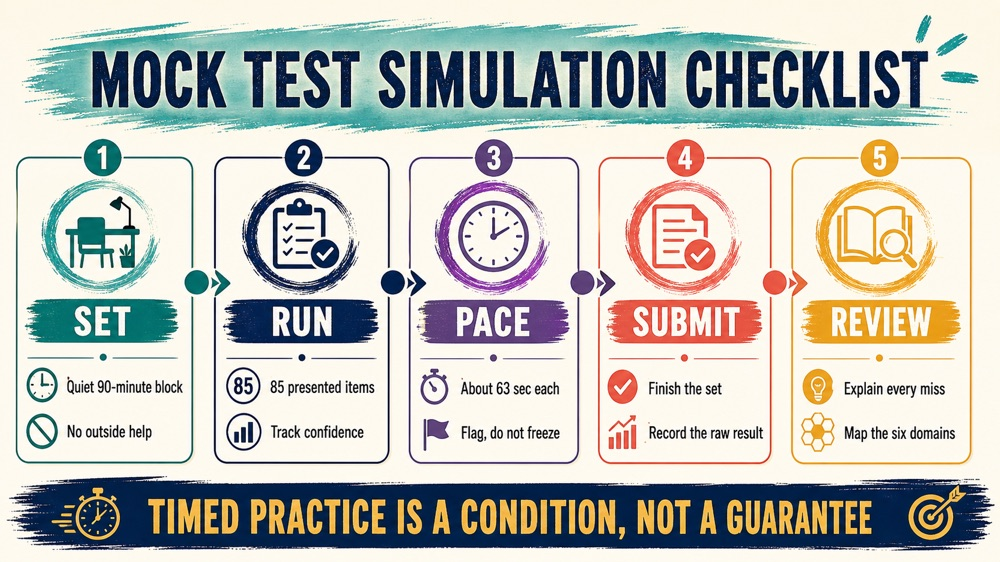
Use a consistent setup so the result answers a clear question. Before starting, record the date, resource name, edition claim, number of items, time limit, whether feedback is delayed, and whether you have seen the questions before.
| Before starting | Why it matters |
|---|---|
| Choose a quiet 90-minute block and silence non-study notifications. | Reduces interruptions that would otherwise contaminate the pacing signal. |
| Use exam mode or hide explanations until submission. | Separates retrieval and decision-making from immediate cueing. |
| Keep only permitted scratch materials and a simple time note. | Prevents searching from turning a simulation into an open-book quiz. |
| Write a confidence mark privately: high, medium, or low. | Shows whether a correct answer was secure or a lucky guess. |
| Set a stopping rule for one difficult item. | Protects the remaining questions from a single time sink. |
Do not search the web, consult a flashcard, or ask another person while the mock is running if your goal is exam-condition practice. If you need a learning session, choose study mode and label the result as untimed practice. The point is not to make every session stressful; the point is to know what question you are answering.
Check the source version before you begin. Current study should use the RBT Test Content Outline, 3rd edition. If a page mixes older domain labels with current exam claims, note the mismatch and use the official BACB sources to resolve it.
Manage RBT mock test pacing
The Handbook gives candidates 90 minutes for the exam. Dividing 90 minutes by 85 presented items gives roughly 63 seconds per item as a planning average. That is not a command to rush every question. It is a way to notice when one difficult item is consuming the time needed for several easier ones.
| Practice checkpoint | Approximate target | Action |
|---|---|---|
| Question 30 | About 32 minutes used | Continue if on pace; flag only items that need a real second look. |
| Question 60 | About 64 minutes used | Protect the final block; do not spend several minutes proving one uncertain definition. |
| Question 85 | About 85–88 minutes used | Leave a small review window if the platform allows it; submit according to the test rules. |
Use a three-pass approach:
- Pass one: answer items whose evidence and rule are clear. Flag genuine uncertainty.
- Pass two: return to flagged items, reread the verb and timeline, and eliminate unsupported choices.
- Pass three: check unanswered items and confirm that a role-boundary choice does not accidentally introduce an independent clinical decision.
These checkpoints are a private practice method, not a BACB policy and not a promise that every platform has the same navigation controls. If a resource does not let you flag or revisit items, practice the skill by marking the question number on scratch paper only when permitted.
Map the mock result to six domains
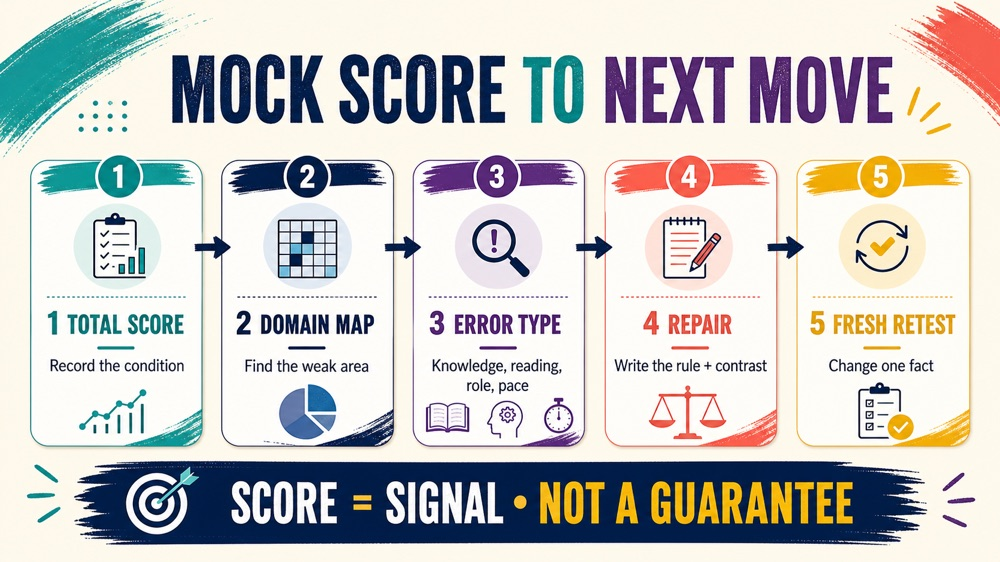
Do not stop at the total score. The current TCO gives you a six-domain map for interpreting the result:
| Domain | Tasks | What a mock error may reveal |
|---|---|---|
| A. Data Collection and Graphing | A.1–A.8 | Wrong unit, unreliable recording, calculation, graph, trend, or observable-definition rule. |
| B. Behavior Assessment | B.1–B.3 | Confusing preference, skill assessment, functional assessment, or the RBT’s assigned role. |
| C. Behavior Acquisition | C.1–C.11 | Prompt, reinforcement, teaching, chaining, discrimination, maintenance, shaping, or token-system confusion. |
| D. Behavior Reduction | D.1–D.7 | Plan-fidelity, antecedent, consequence, extinction, safety, or escalation error. |
| E. Documentation and Reporting | E.1–E.4 | Subjective language, missing data, delayed reporting, privacy, or inaccurate communication. |
| F. Ethics | F.1–F.10 | Competence, boundaries, supervision, dignity, confidentiality, or professional conduct issue. |
Mark each item with one primary error type: knowledge, reading, measurement unit, procedure fidelity, role boundary, documentation, ethics, or pacing. The same wrong answer can have different causes. A measurement question missed because you rushed needs a different repair than one missed because duration and latency are still mixed.
Review RBT mock test answers
Review the mock only after you have recorded the unassisted result. For every miss, guess, or low-confidence correct answer, complete this five-part review:
- Evidence: copy the smallest fact that controlled the answer.
- Rule: name the concept in plain language.
- Role: state what the RBT can do under the assigned plan and supervision route.
- Distractor: explain why the closest alternative is not supported.
- Transfer: change one fact and answer a new version.
For example, suppose the stem says the RBT is told to record the time between an instruction and the beginning of a response. If you chose duration, identify the timeline error: duration measures how long the response continues, while the described interval ends at response onset. Then create a changed-fact item that asks for time from response onset to offset. This is a better correction than memorizing two definitions in isolation.
Check explanations for four quality markers: they use the stem’s observable facts, identify the controlling rule, respect the RBT role, and distinguish the nearest contrast. A page that gives only “answer B” or calls its content official has not completed the learning job for you.
Original mock-test decisions
The following examples are newly written for this guide. They are not official, recalled, leaked, or BACB-endorsed questions.
- Timing: You are on question 41 and have spent six minutes on two items. What should the pacing correction target? Flag the difficult items, choose the best supported answers, and preserve time for the remaining questions.
- Data: A question describes “the number of seconds from the instruction until the learner begins.” Which clue controls the measurement? The interval ends at response onset, so identify latency rather than duration.
- Assessment: A preference procedure specifies an array and a fixed presentation rule. The answer choice says to replace the rule with a favorite method. What is wrong? It changes the assigned procedure; follow the protocol and ask when a deviation is needed.
- Acquisition: A learner responds independently after a prompt was removed according to the plan. What should be recorded? The response and prompt level as defined by the data system, not a vague statement that the learner “did well.”
- Reduction: A mock item suggests adding an unapproved consequence to make behavior stop faster. What should the RBT choose? Do not improvise; follow the written plan and report or ask through supervision.
- Documentation: A session note says, “The learner was lazy.” What is the best correction? Replace the label with observable behavior, context, program step, data, and communication.
- Ethics: A question asks what to do when a task exceeds current competence. What is the key role boundary? Seek appropriate direction or supervision rather than presenting unsupported competence or working outside authorization.
After scoring these items, write one answer that would be tempting if you ignored the role boundary. Then write the fact that rules it out. This keeps a mock test from becoming a vocabulary-only exercise.
Use two mocks without score inflation
Two fresh mock tests can serve different purposes. Use the first as a diagnostic simulation and the second as a later dress rehearsal. Avoid taking the same test repeatedly until the score becomes comfortable; repeated exposure can measure memory for the bank rather than readiness for new wording.
| Mock | When to use | What to compare |
|---|---|---|
| Mock 1: diagnostic | After initial concept review. | Pacing, domain spread, confidence, and error types. |
| Repair block | After the diagnostic. | Decision rules, nearest contrasts, role boundaries, and changed-fact items. |
| Mock 2: dress rehearsal | Near the end of preparation, with fresh items. | Whether errors shrink on new scenarios and whether pacing remains stable. |
If a second score is lower, do not interpret it automatically as failure. Compare item freshness, fatigue, domain distribution, and error type. If the same concept is missed in new wording, repair it. If the error is mostly late-session pacing, practice flagging and time allocation. If the score rises only on repeated items, do not overstate the evidence.
Decide whether you are ready
No third-party RBT mock test can issue an official readiness verdict. You can, however, use a transparent private checklist:
- Can you complete a fresh mixed set within the practice time without relying on outside help?
- Can you explain why the closest distractor fails, not only why your answer looks familiar?
- Are your errors concentrated in one repairable concept, or scattered across several domains?
- Can you distinguish implementation and reporting from independent clinical decisions?
- Do you have a plan for unanswered or flagged items that protects the remaining time?
- Have you checked current administrative facts with the official BACB Handbook and examination information?
Use a provider’s 80% or 85% threshold, if it offers one, only as a study benchmark. The BACB does not turn a third-party mock score into an official pass prediction. Your record should describe the conditions, date, resource, and error map so you can make a careful decision with your supervisor or training plan.
Avoid RBT mock-test mistakes
- Calling a mock official: independent questions are not BACB exam items.
- Confusing 75 and 85: separate scored questions, pilot questions, and third-party practice length.
- Using the timer as the only goal: accuracy, reasoning, and correction still matter.
- Reviewing only wrong answers: include guesses and low-confidence correct answers.
- Retaking the same bank too often: preserve fresh items for transfer and dress rehearsal.
- Trusting an unsupported pass percentage: treat provider thresholds as private study signals.
- Ignoring role boundaries: do not choose an answer that changes an assessment or intervention without authorization.
- Searching for recalled or leaked items: use original practice and protect examination integrity.
Bottom line: take an RBT mock test under a defined condition, record pacing and confidence, map the result to the six current domains, and repair the decision rule behind every error. A mock should make your next study action clearer; it should never pretend to know the secure exam or guarantee your result.
Ready for a full mock-test session?
Use an original RBT simulation, record pacing and confidence, and review every miss before you schedule another attempt.
See the Three RBT Mock Exams →
Frequently Asked Questions
What is an RBT mock test?
An RBT mock test is an independent practice simulation that may combine mixed domains, a timer, exam-mode navigation, and post-submit explanations. It is not an official BACB examination.
Should an RBT mock test have 75 or 85 questions?
Both formats can be useful. The current written-exam context includes 75 scored questions and 10 unscored pilot questions, while a third-party provider may use 85 presented items or 75 scored-length practice.
How much time should I spend on an RBT mock test?
The current Handbook gives candidates 90 minutes for the examination. Use a third-party timer as a practice condition, then review whether pacing, accuracy, and correction quality were stable.
Is 80% on an RBT mock test a guarantee?
No. A provider’s 80% or 85% target is a private study benchmark, not an official BACB pass prediction or guarantee.
How should I review a mock-test score?
Record misses, guesses, and low-confidence correct answers; map them to the six domains; write the evidence and rule; identify the nearest contrast; and retest with one changed fact.
References
- Behavior Analyst Certification Board. RBT Test Content Outline, 3rd edition.
- Behavior Analyst Certification Board. RBT Test Content Outline, 3rd-edition PDF.
- Behavior Analyst Certification Board. RBT Handbook.
- Behavior Analyst Certification Board. Examination information.
- Independent RBT mock-exam resource. Reviewed for competitor research; not an endorsement.
- Independent timed mock-exam simulator. Reviewed for competitor research; not an endorsement.
- Independent RBT practice-exam hub. Reviewed for competitor research; not an endorsement.