

This RBT ongoing supervision fact sheet turns the current BACB maintenance guidance into a practical monthly review. An RBT must practice under close, ongoing supervision, and the current RBT Handbook states a minimum of 5% of behavior-analytic service hours each calendar month. The percentage is only one part of the picture: the supervisor, organization, documentation, activities, and communication process also need to be clear.
Table of Contents
- RBT ongoing supervision fact sheet: the quick answer
- What the 5% monthly minimum means
- Why each organization matters
- What to check before and during a supervision month
- Documentation and communication questions
- What ongoing supervision does not authorize
- Frequently asked questions
- Official sources and scope
RBT certification maintenance, supervision, and documentation
RBT Ongoing Supervision Fact Sheet: What to Check Each Month
A practical monthly review of the current supervision minimum, organization responsibilities, records, and questions to ask.
This RBT ongoing supervision fact sheet is a monthly review tool for a current Registered Behavior Technician. BACB’s current public guidance describes RBT practice as occurring under the close, ongoing supervision of a qualified RBT Supervisor and/or RBT Requirements Coordinator who is responsible for the work performed. The current RBT Handbook also states a minimum of 5% of the hours spent providing behavior-analytic services each calendar month.
That percentage is important, but it is not the whole supervision system. An RBT also needs a clear responsible supervisor, an organization-by-organization plan, an approved way to document contacts and service hours, assigned activities within competence, and a communication path for questions or safety concerns. Use this article as an educational checklist, then confirm the current Handbook and workplace process.
RBT ongoing supervision fact sheet: the quick answer
For the current requirement summarized by BACB, check these five facts:
- Supervision is ongoing. It is part of practicing as an RBT, not only a one-time meeting for a new hire or a renewal form.
- The minimum is 5%. The Handbook describes a minimum of 5% of the hours spent providing behavior-analytic services each calendar month.
- Each organization matters. If an RBT provides services through more than one organization, the Handbook says the supervision requirements must be met at each organization where behavior-analytic services are provided.
- The supervisor is responsible for assigned work. A percentage calculation does not decide which activities an RBT is competent or authorized to perform.
- Records and questions matter. Keep the documentation required by the organization and ask promptly when the supervisor, activity, calculation, or record is unclear.
These points describe a compliance-oriented framework, not a promise that one meeting format will fit every employer, client, setting, or jurisdiction. An organization may have additional documentation, scheduling, quality, or safety procedures.
What the 5% monthly minimum means
The 5% figure is calculated against the hours spent providing behavior-analytic services during the calendar month, according to the current Handbook language. It is not automatically 5% of every hour on a payroll, every hour at a clinic, or every hour labeled “work.” Ask the organization how service hours are identified and what record supports the calculation.
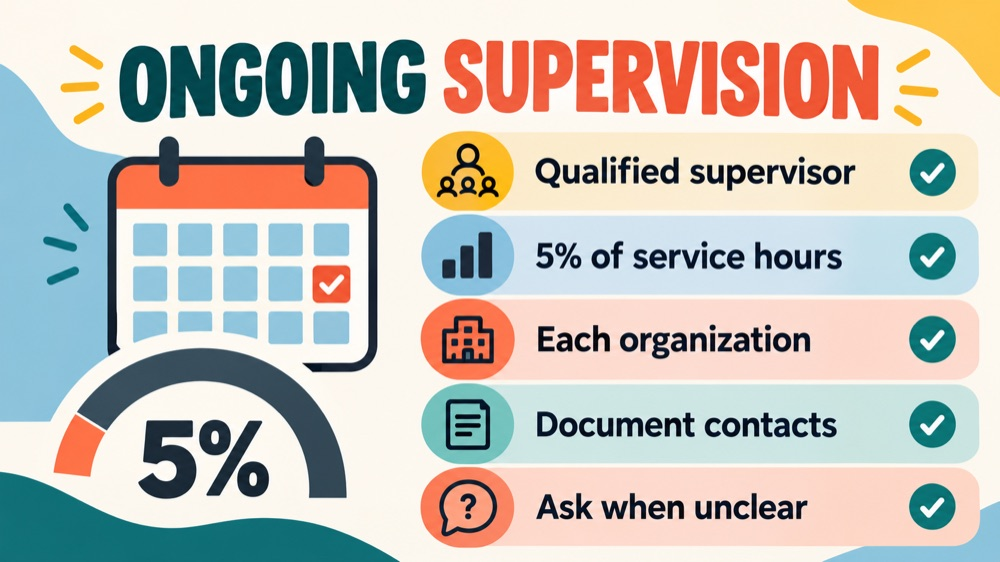
A simple educational example can show the arithmetic without becoming a personal compliance calculation. If an organization records 40 hours of behavior-analytic service delivery in a month, 5% of that number is 2 hours. The example does not decide how supervision must be scheduled, what counts as a contact, or whether other requirements apply. The supervisor and organization must determine the actual process under the current rules.
Do not wait until the last day of the month to discover that hours were recorded differently from what you expected. At the beginning of the month, ask how service hours will be tracked, who reviews the total, what supervision opportunities are available, and what to do if a session is canceled or the supervisor is absent.
Why each organization matters
An RBT may work with more than one employer, provider, clinic, school-related service, or organization. The current Handbook language says the supervision requirements must be met at each organization where the RBT provides behavior-analytic services. That means one organization’s supervision record should not automatically be assumed to cover services delivered through another organization.
Make a separate review line for each organization:
- Who is the RBT Supervisor or RBT Requirements Coordinator responsible for the work?
- How does that organization define and record behavior-analytic service hours?
- Where are supervision contacts, observations, and relevant communications recorded?
- Which activities has the supervisor assigned and confirmed as within the RBT’s competence?
- Who should be contacted if the supervisor is unavailable or the client’s service schedule changes?
This is especially important during a job change, a temporary caseload gap, a new service location, or a change in supervision personnel. An RBT should not assume that a familiar routine transfers automatically to a new organization. Confirm the arrangement before providing services there.
What to check before and during a supervision month
A useful month-end review can follow four stages:
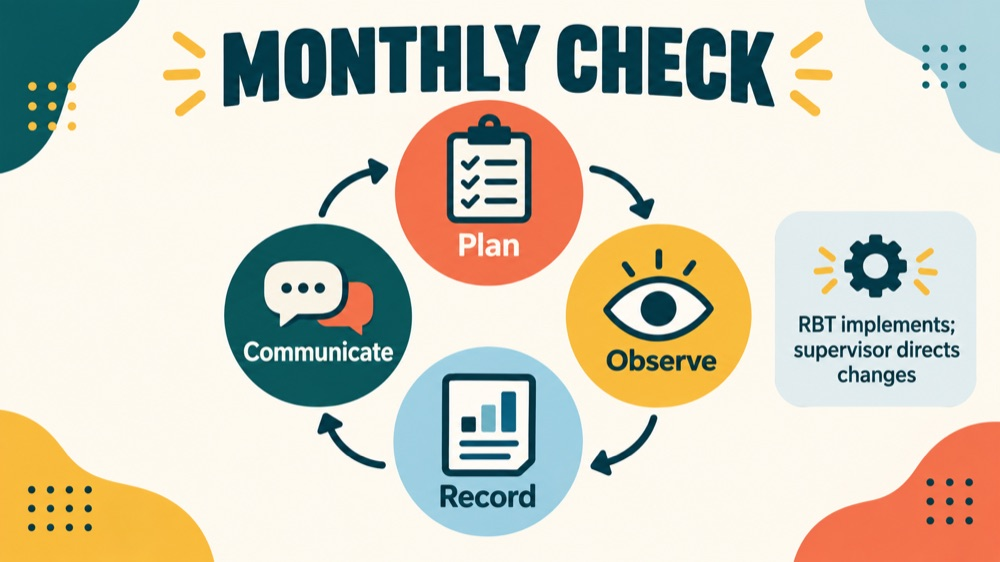
1. Plan
Confirm the responsible supervisor, the organization, scheduled service hours, supervision opportunities, and the approved documentation system. If the schedule changes, update the supervisor instead of silently assuming the minimum can still be met.
2. Observe and implement
Carry out assigned activities within competence and follow the current written program, safety procedures, and supervisor direction. Supervision is not only a signature; it should support professional, ethical, and behavior-analytic repertoires and the delivery of quality services.
3. Record
Use the organization’s approved record for service hours, contacts, observations, training, questions, and follow-up. Record facts accurately and promptly. Do not create a private shadow log containing unnecessary client information, and do not backdate a contact to make the month appear complete.
4. Communicate
Tell the supervisor about missing instructions, barriers to implementation, data irregularities, safety concerns, or activities that feel outside your competence. The goal of communication is not to prove that a month is complete; it is to support responsible practice and timely direction.
Documentation and communication questions
There is no single generic log that replaces every organization’s process. Before relying on a form, ask:
- Which document or portal records the monthly service-hour total?
- Who enters, reviews, and corrects supervision information?
- How are direct observation, meetings, feedback, and follow-up represented?
- What is the correction process if a session, contact, or hour was entered incorrectly?
- How should an RBT report that the planned supervision could not occur?
- What confidentiality limits apply when discussing a learner outside the approved system?
Use observable, neutral language. “The scheduled observation was canceled because the client was ill; I notified the supervisor at 9:10 a.m. and asked for a replacement time” is more useful than “supervision was a mess.” The exact documentation format belongs to the organization.
What ongoing supervision does not authorize
Meeting a monthly minimum does not mean an RBT may:
- work without current supervisory direction or outside the assigned service arrangement;
- design a new treatment program, change a target, or alter a mastery criterion independently;
- perform an activity that the supervisor has not assigned or that the RBT cannot perform competently;
- ignore a safety plan, ethics requirement, confidentiality rule, or workplace procedure; or
- treat a completed log as proof that every clinical, employment, or certification question has been resolved.
Supervision should make questions easier to raise, not make the RBT responsible for guessing. If a supervisor asks an RBT to perform an unfamiliar task, clarify the instruction, training, competency support, documentation, and escalation path before proceeding.
Frequently asked questions
What is the RBT ongoing supervision minimum?
The current RBT Handbook states that an RBT must obtain ongoing supervision for a minimum of 5% of the hours spent providing behavior-analytic services each calendar month. Confirm the current Handbook and organization-specific process because requirements and documents can be updated.
Does the 5% apply to every job separately?
BACB’s Handbook language says the supervision requirements must be met at each organization where the RBT provides behavior-analytic services. Ask each organization how it tracks hours and supervision rather than combining records without direction.
Can an RBT work alone after meeting the 5%?
No. The 5% figure is a minimum supervision requirement, not permission to practice independently. RBT practice remains under close, ongoing supervision and within the assigned role and competence.
What if a scheduled supervision meeting is canceled?
Follow the organization’s process, notify the responsible supervisor or coordinator, document the scheduling issue in the approved system, and ask how the contact will be rescheduled or otherwise addressed. Do not invent a replacement record.
Who can supervise an RBT?
BACB’s supervision materials identify qualified RBT Supervisors and RBT Requirements Coordinators and describe training expectations for people supervising RBTs. Check the current Handbook and the individual’s role and qualification rather than relying on a job title alone.
Official sources and scope
This fact sheet was checked against BACB’s current RBT Handbook page, the Supervision, Assessment, Training, and Oversight page, BACB’s RBT supervision resources, and the RBT Ethics Code. Requirements can change; the current BACB source, organization process, and supervisor direction control a particular situation.
Ready to practice the RBT concepts you just reviewed?
Try an independent, original RBT practice resource with exam-style questions, scoring, and answer explanations.
References
- Behavior Analyst Certification Board. RBT Test Content Outline, 3rd edition.
- Behavior Analyst Certification Board. RBT Handbook.
- Behavior Analyst Certification Board. RBT Ethics Code.