

An rbt to bcba pathway is a career plan, not an automatic promotion: a clear rbt pathway can use RBT experience to build practical skills, but BCBA certification has its own education, coursework, supervised fieldwork, application, and examination requirements. The BACB describes RBT and BCBA as different certification levels, so the strongest plan keeps those boundaries clear from the beginning.
Table of Contents
- RBT and BCBA are different roles
- RBT pathway to BCBA: the big picture
- Plan the degree and coursework stage
- Understand supervised fieldwork
- Build records before you need them
- Check current rules and timing
- Use RBT work strategically
- Common pathway planning mistakes
- Frequently asked questions
- References
RBT CAREER GUIDE · PROFESSIONAL DEVELOPMENT
RBT to BCBA Pathway: How to Plan Your Next Steps
Use RBT experience as a practical foundation while you map the separate education, fieldwork, application, and exam requirements for BCBA certification.
An rbt to bcba pathway is a career plan, not an automatic promotion: RBT experience can build practical skills, but BCBA certification has its own education, coursework, supervised fieldwork, application, and examination requirements. The BACB describes RBT and BCBA as different certification levels with different responsibilities, so the strongest plan keeps those boundaries clear from the beginning.
Requirements change. This guide explains how to organize your next questions and decisions; it does not determine whether a particular degree, course, job task, supervisor, or hour qualifies. Before enrolling or counting hours, read the current BACB handbook and confirm your situation with an appropriately qualified supervisor or program contact.
RBT and BCBA are different roles
An RBT is a paraprofessional who implements behavior-analytic services under close, ongoing supervision. An RBT may collect data, follow an assigned plan, communicate observations, and practice skills under direction. The RBT role is valuable, but it is not independent clinical practice.
A BCBA is a graduate-level behavior-analytic certification. BACB materials describe BCBAs as independent practitioners who can provide behavior-analytic services and supervise RBTs, BCaBAs, and other professionals. The difference is not simply a new job title. It involves a separate education and certification process, a broader scope of responsibility, and a different standard for demonstrating competence.
That distinction gives the pathway a useful starting point: ask which skills from your RBT work you want to deepen, then identify the formal requirements that must be completed separately.
RBT pathway to BCBA: the big picture
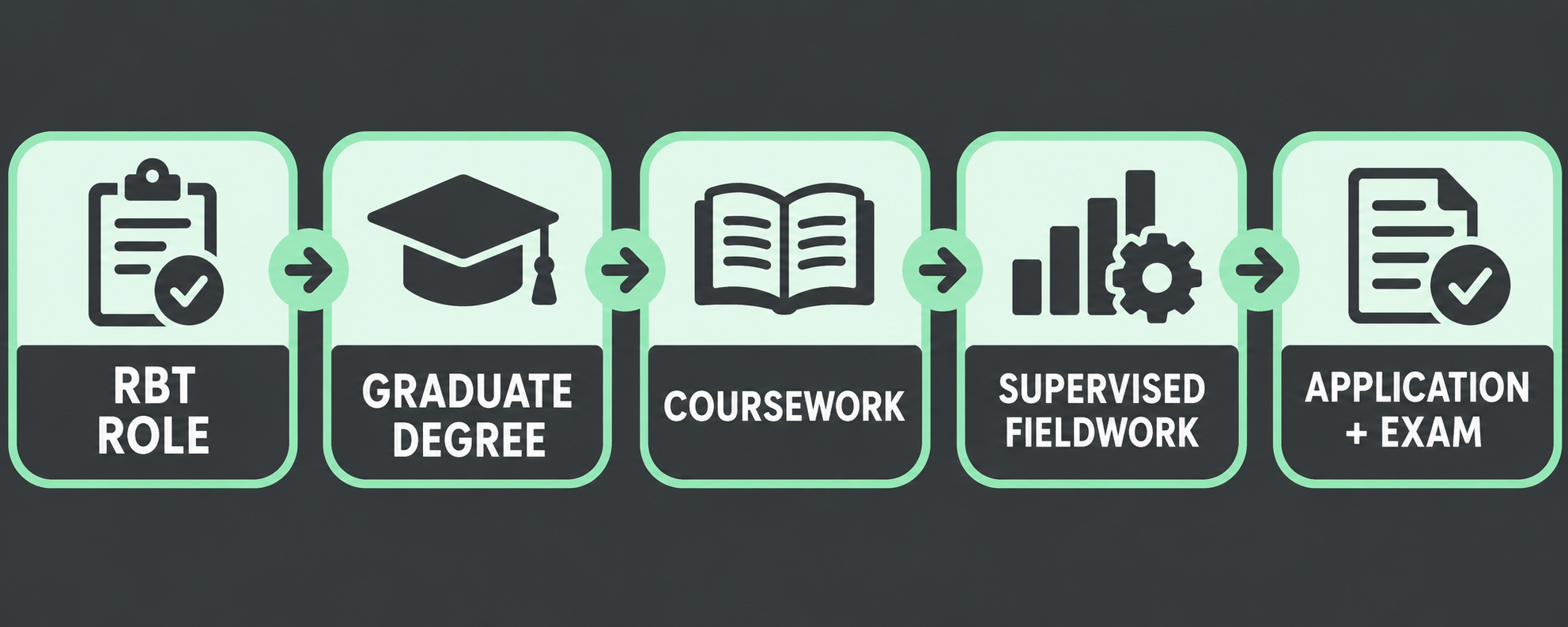
Although each applicant’s route depends on the rules in effect and their educational background, a practical planning map usually includes these stages:
- Clarify the goal: decide why BCBA certification fits your professional plans and what settings interest you.
- Review the current rules: read the BACB BCBA Handbook and upcoming-change notices before choosing a program or counting experience.
- Complete the required education: confirm degree and behavior-analytic coursework requirements for the pathway you intend to use.
- Arrange qualified supervision: use a written supervision agreement and verify that the planned fieldwork structure is eligible.
- Accrue and document fieldwork: complete qualifying activities, supervision, observations, and records under the applicable rules.
- Apply and prepare for the examination: submit the required materials, respond to any application process, and study for the current exam.
Plan the degree and coursework stage
Start with the degree requirement that applies to your intended BCBA pathway and the date when you expect to apply. Do not assume that an RBT certificate, an employer’s in-service training, or a collection of unrelated classes is equivalent to the required graduate education or behavior-analytic coursework.
When comparing programs, ask practical questions before paying a deposit:
- What degree does the program award, and does it fit the current BACB pathway?
- How does the program document behavior-analytic coursework?
- Who answers pathway or coursework-attestation questions?
- Can the program explain how students arrange eligible supervised fieldwork?
- What completion date will allow you to apply under the requirements you have reviewed?
Keep the answer to each question in writing. Program marketing language can be helpful for orientation, but the BACB handbook and the official application requirements control certification eligibility. If a program says that a job title or RBT employment automatically fulfills a requirement, ask for the exact current rule and confirm it independently.
Understand supervised fieldwork
Fieldwork is not simply time spent working in an ABA setting. The current BCBA Handbook describes requirements for qualified supervision, fieldwork activities, documentation, and verification. BACB fieldwork FAQs also direct trainees to review acceptable activities and ask their supervisor whether a planned activity meets the requirements.
Before starting, confirm:
- who the qualified supervisor is and what their responsibilities will be;
- whether a written supervision contract is required before hours begin;
- which activities are unrestricted, restricted, supervised, or otherwise classified under the current rules;
- how supervision meetings, observations, feedback, and documentation will be recorded;
- how corrections, audits, missed meetings, and changes in employment will be handled.
Your RBT job may provide useful context and opportunities to learn, but the supervisor must determine whether particular activities count. Do not label all RBT hours as BCBA fieldwork after the fact. If you want an RBT task to contribute to a fieldwork plan, discuss it before performing or recording the activity.
Build records before you need them
Certification planning becomes easier when records are organized monthly instead of reconstructed at application time. Keep copies of contracts, verification forms, supervision notes, coursework records, transcripts, activity descriptions, and any required audit log in a secure location approved for that information.
Use a simple review routine:
- At the start of each month, confirm the supervisor, setting, and documentation method.
- During the month, record activities close to when they occur and keep the descriptions objective.
- At the end of the supervisory period, review signatures, totals, meetings, observations, and corrections.
- Store the final version with the related agreement and supporting records.
Never backfill a record from memory as a routine shortcut. If a correction is needed, follow the approved process and preserve the original information when policy requires it. Accurate records protect both the trainee and the supervisor.
Check current rules and timing
The BACB has announced significant BCBA eligibility and maintenance changes beginning January 1, 2027. That means the date you apply matters. A plan built from an older blog post, a colleague’s experience, or a program page from a previous year may not match the rules in force when you submit your application.
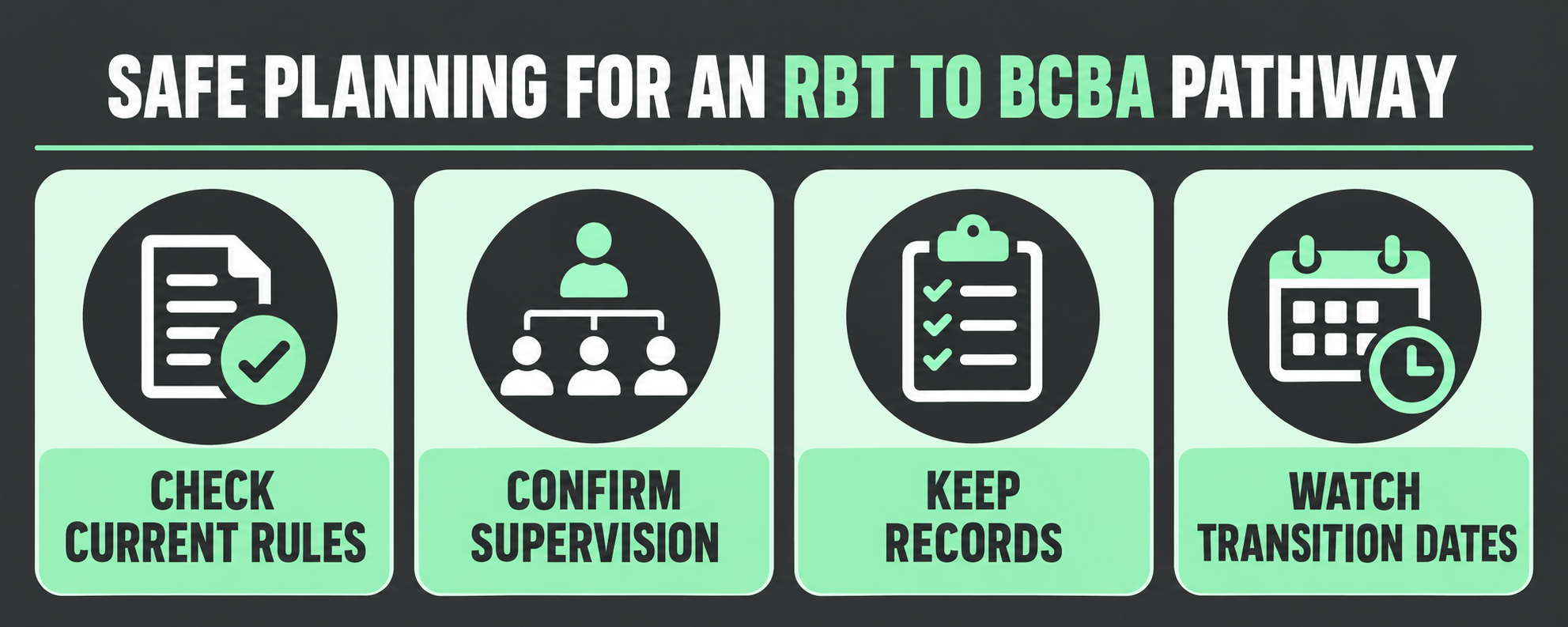
Use three checkpoints:
- Before enrollment: read the current handbook and confirm the education pathway.
- Before fieldwork: verify supervisor qualifications, contracts, activities, and documentation rules.
- Before application: check the current application-processing updates, forms, deadlines, and handbook version.
If your plan crosses a transition date, ask the BACB or your qualified supervisor which requirements apply. Do not assume that starting under one set of rules guarantees that every later application step will use that same set.
Use RBT work strategically
RBT work can help you test whether behavior analysis is a good professional fit. Notice which tasks energize you: direct teaching, measurement, caregiver communication, staff training, program review, or problem solving. Use supervision to ask for feedback on your observable skills and on the areas you need to study next.
It can also help you build habits that will matter later: precise documentation, respectful communication, confidentiality, willingness to ask for direction, and attention to treatment integrity. Those habits support professional growth even when a particular RBT task is not eligible BCBA fieldwork.
Keep the decision personal. Some RBTs want a BCBA career; others prefer direct implementation, education, administration, research, or another related path. The purpose of a pathway plan is to make the next choice informed, not to pressure every RBT toward the same destination.
Common pathway planning mistakes
Assuming experience equals eligibility: Practical RBT experience is useful, but certification requirements still need to be met and documented.
Choosing a program before checking the rules: Start with the current BACB handbook, then evaluate programs against it.
Counting hours before confirming them: Ask the qualified supervisor whether activities and dates fit the applicable fieldwork requirements.
Ignoring transition dates: Requirements can change while you are in school or fieldwork. Put review dates on your calendar.
Leaving records until the application: Missing signatures or unclear activity descriptions are harder to fix years later.
Frequently asked questions
Does being an RBT make someone eligible to become a BCBA?
No. RBT experience may inform your career decision and build practical skills, but BCBA eligibility has separate education, coursework, fieldwork, application, and examination requirements.
Do all RBT hours count toward BCBA fieldwork?
No automatic conversion should be assumed. Discuss specific activities with the qualified supervisor before counting them and use the current handbook’s requirements.
Can an RBT begin BCBA fieldwork while working?
Possibly, if the arrangement meets the current fieldwork requirements and is supervised and documented correctly. Employment alone does not make every task qualifying fieldwork.
Where should a future applicant check for changes?
Start with the BACB BCBA page, current BCBA Handbook, application-processing updates, and recent and upcoming changes page. Then discuss your individual plan with a qualified supervisor or program contact.
A strong RBT to BCBA pathway is built from verified requirements, qualified supervision, accurate records, and realistic timing. Use your RBT experience as a foundation for learning, then complete each BCBA requirement deliberately instead of assuming that one role automatically becomes the next.
Ready to practice the RBT concepts you just reviewed?
Try an independent, original RBT practice resource with exam-style questions, scoring, and answer explanations.
References
- Behavior Analyst Certification Board. RBT Test Content Outline, 3rd edition.
- Behavior Analyst Certification Board. RBT Handbook.
- Behavior Analyst Certification Board. RBT Ethics Code.