

Good RBT performance goals describe what the technician will do, how the behavior will be observed, what evidence will be reviewed, and when feedback will occur. They are different from a client’s treatment goals: an RBT performance goal may address accurate data collection, following a written procedure, objective communication, punctual preparation, or asking for help when a task is outside competence. The supervisor and employer set the actual expectations.
Table of Contents
- RBT performance goals: the quick meaning
- How to write an observable RBT performance goal
- RBT performance goals examples by skill area
- How to use feedback without changing the clinical plan
- A 30-60-90 day growth structure
- Common mistakes in performance goals
- Frequently asked questions
- Official sources and scope
RBT career development, supervision, and feedback
RBT Performance Goals: Measurable Examples for Growth and Feedback
Build observable workplace goals for data accuracy, plan implementation, communication, reliability, and professional growth.
RBT performance goals describe the technician’s own work behavior: what the RBT will do, how the behavior will be observed, what evidence will be reviewed, and when feedback will occur. They are different from a client’s treatment goals. An RBT goal may address accurate data collection, following a written procedure, objective communication, preparation, attendance, or asking for help when a task is outside competence.
A strong goal supports quality and professional growth without quietly turning an RBT into the designer of a clinical program. The employer and supervisor set the actual standard, review period, and support plan. The examples below are starting points for a conversation, not a universal BACB form or a substitute for workplace policy.
RBT performance goals: the quick meaning
A performance goal is a statement about an employee’s observable performance. “Be more confident” may be a meaningful aspiration, but it does not tell the RBT or supervisor what to observe. “Use the current prompt sequence as written during three observed opportunities and ask for clarification when a step is unclear” is easier to teach, practice, and review.
The best goals are collaborative. A supervisor can identify a quality gap from direct observation, data review, session notes, or team communication. The RBT can explain barriers, request modeling or rehearsal, and suggest evidence that reflects the real task. A goal should not be a surprise label added after a problem; it should make the expected behavior and support visible.
Keep the client’s dignity and privacy in the frame. A performance goal should measure the RBT’s implementation or communication, not pressure the technician to produce a particular client response, suppress a client’s communication, or continue an unclear procedure.
How to write an observable RBT performance goal
Use five parts when drafting a goal:
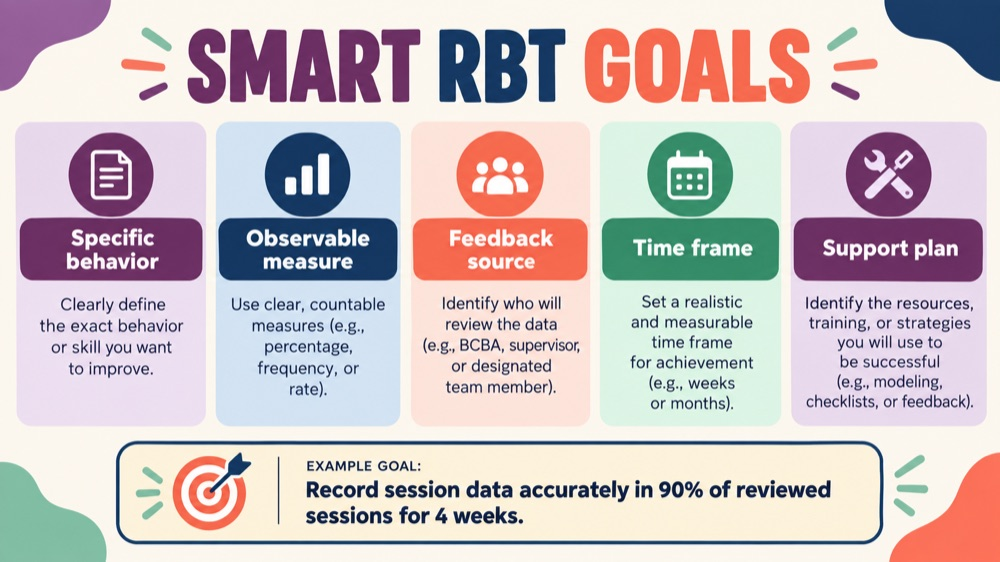
- Specific behavior. Name what the RBT will do, such as record required data before closing a session note or review the current program before running a new target.
- Observable measure. Choose evidence that another trained person can review: percentage of reviewed records, number of completed checks, punctuality across scheduled sessions, or documented use of a communication step.
- Feedback source. Identify who or what will provide the review, such as a supervisor observation, note audit, competency checklist, or team meeting follow-up.
- Time frame. Set a realistic period and review date. A new technician may need a shorter practice cycle and more frequent feedback than an experienced technician learning a new procedure.
- Support plan. State the modeling, rehearsal, written example, observation, or clarification path available. A goal without support may measure access to training rather than performance.
For example: “For the next four weeks, record session data accurately in at least 90% of reviewed sessions, using the current data definitions; the supervisor will review a sample weekly and provide one feedback meeting.” The percentage is an example, not a BACB universal standard. The employer should decide whether that measure, sample, and time frame fit the task.
RBT performance goals examples by skill area
These examples are written as workplace-development goals. Adjust the measure, time frame, and support to the setting.
Data collection and session notes
- Enter required session data using the current operational definitions and measurement system before completing the authorized note workflow.
- Describe observable events, conditions, responses, and actions taken without using unsupported mentalistic labels.
- Bring one data or documentation question to supervision each week until the supervisor confirms that the relevant rule is understood.
Program implementation
- Review the current written program and prepare the listed materials before implementing a newly assigned target.
- Use the approved prompt, reinforcement, error-correction, and break procedures during observed opportunities, and record the prompt level when required.
- Identify and report a missing or contradictory program step instead of inventing a replacement procedure.
Communication and teamwork
- Provide a concise, objective handoff that includes relevant data, changes in conditions, questions, and follow-up needed from the team.
- Respond to supervisor feedback by restating the expected behavior, practicing it, and reporting barriers before the next review.
- Use approved communication channels and protect client confidentiality when discussing services.
Reliability and preparation
- Arrive prepared with required materials and access to the current program for the agreed start time across the review period.
- Notify the appropriate person as soon as possible when a commitment cannot be met and document the communication according to workplace procedure.
- Complete required training, competency practice, or assigned professional-development activities by the agreed date.
Professional and culturally responsive practice
- Use respectful, person-first or identity-affirming language consistent with the learner’s and family’s preferences and the team’s guidance.
- Ask for training or consultation when a cultural, communication, accessibility, or competence issue affects service delivery.
- Identify a personal assumption or skill gap in supervision and agree on a concrete learning step rather than hiding uncertainty.
How to use feedback without changing the clinical plan
Feedback should connect an observation to an expected action. “You need to be better with prompting” is hard to use. “During the observed trials, the written program called for a least-to-most sequence; after the first incorrect response, review showed that the second prompt was skipped. We will model the sequence, rehearse three opportunities, and review the next observation” gives the RBT something concrete to practice.
The supervisor may change a performance goal, provide additional training, or clarify an implementation step. The RBT should not modify the client’s target, reinforcement schedule, prompt hierarchy, or safety procedure to improve a performance score. If a performance expectation conflicts with the written program or creates a concern about dignity, safety, competence, or confidentiality, bring the conflict to the supervisor or other appropriate workplace channel and document the communication as required.
Look for feedback that is timely, specific, and connected to the real work. A review of one note may reveal a documentation issue, but it may not explain performance across all sessions. A direct observation may show a prompting issue, but the supervisor should also consider whether the written program, training, materials, schedule, or client context contributed to the gap.
A 30-60-90 day growth structure
A 30-60-90 day structure can organize onboarding or a development conversation. It is an optional workplace framework, not a BACB certification requirement:
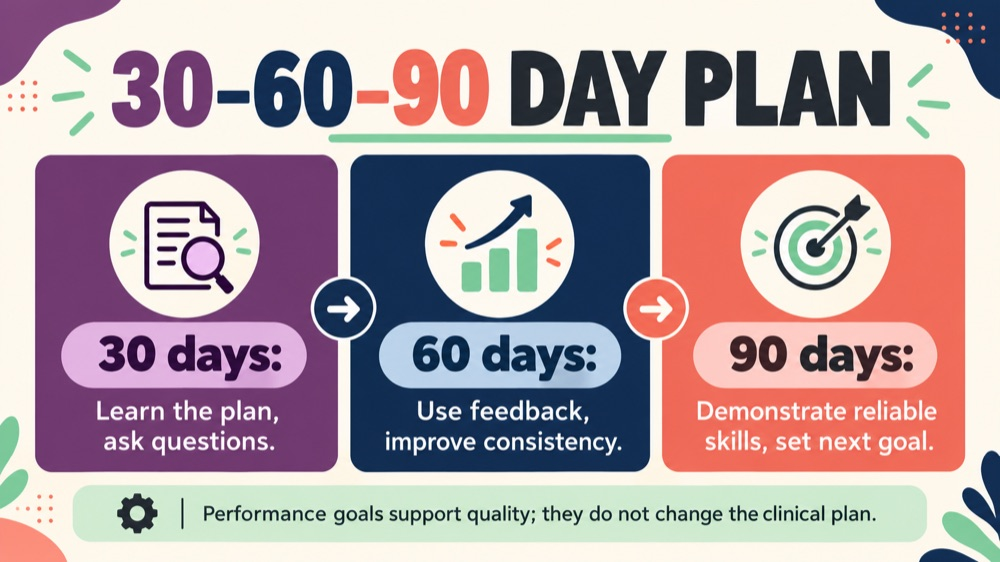
- First 30 days: learn and clarify. Locate current programs, documentation rules, supervision contacts, safety procedures, and escalation paths. Practice asking specific questions.
- By 60 days: use feedback consistently. Show that feedback from observation or note review is reflected in the next opportunities. Track barriers and request modeling when needed.
- By 90 days: demonstrate reliable skills. Meet the agreed implementation, communication, preparation, and documentation standards across the defined sample, then choose the next learning goal with the supervisor.
Some RBTs need more time, different supports, or a different sequence. A deadline should not encourage an RBT to hide a question or work outside competence. Reliable performance means knowing when to pause and seek direction as well as completing familiar tasks accurately.
Common mistakes in performance goals
- Using vague traits. Replace “be professional” with observable actions such as timely communication, respectful language, accurate records, or preparation.
- Measuring client outcomes as employee proof. An RBT contributes to services but does not control every variable affecting a client’s progress. Measure implementation and communication separately from clinical outcomes.
- Choosing a number without a baseline. A 90% target may be reasonable for one task and inappropriate for another. Review starting performance, task complexity, sample size, and support.
- Ignoring access and training. Do not judge an RBT on a procedure that was not taught, observed, or made available in the current program.
- Turning the goal into a clinical change. Performance goals describe the RBT’s work; they do not authorize changes to the client’s treatment plan.
Frequently asked questions
What are good RBT performance goals?
Good goals are observable, measurable, role-appropriate, supported by training or feedback, and tied to a review date. Common areas include accurate data, objective notes, faithful implementation of written procedures, communication, preparation, reliability, confidentiality, and continued competence.
Does BACB require a specific RBT performance review form?
This article does not identify a universal BACB performance-review form. Employers and supervisors may use their own evaluation, coaching, competency, or quality-assurance process. Check the current BACB materials and the employer’s policy.
Can an RBT performance goal be 90% accuracy?
It can be an example measure when the task, sample, baseline, and review process make it meaningful. It is not a universal standard for every RBT task. The supervisor or employer should set the criterion and explain how accuracy will be reviewed.
Can performance goals include client progress?
A team may discuss client outcomes, but an individual RBT goal should distinguish the technician’s observable implementation from variables the RBT does not control. Do not use a client outcome as permission to deviate from the written program.
What if I disagree with an RBT performance goal?
Ask what behavior is being measured, what evidence will be used, what support is available, and how the goal relates to your defined role. Raise concerns about competence, dignity, safety, confidentiality, or conflict with the written program through the appropriate supervisor or workplace channel.
Official sources and scope
This guide was checked against the BACB RBT Ethics Code (2.0), the RBT Test Content Outline, BACB’s supervision and training guidance, and a practitioner-facing discussion of measurable RBT goals from Praxis Notes. The examples are original workplace-development illustrations, not an employer form, BACB template, clinical protocol, or legal advice.
Ready to practice the RBT concepts you just reviewed?
Try an independent, original RBT practice resource with exam-style questions, scoring, and answer explanations.
References
- Behavior Analyst Certification Board. RBT Test Content Outline, 3rd edition.
- Behavior Analyst Certification Board. RBT Handbook.
- Behavior Analyst Certification Board. RBT Ethics Code.