

The current RBT renewal fee is best understood as a recertification application processing fee, not a bundle containing every cost connected with staying an RBT.
Table of Contents
- RBT renewal fee: quick answer
- The current 2026 renewal fee
- Late and returned-payment fees
- What does the renewal fee cover?
- Costs that are separate from the RBT renewal fee
- When do you pay the renewal fee?
- Why the 2026 transition changes the answer
- How to budget for renewal without surprises
- Common RBT renewal-fee mistakes
- Frequently asked questions
RBT recertification and budgeting
RBT Renewal Fee: 2026 Cost Breakdown
The current RBT renewal fee is best understood as a recertification application processing fee, not as a bundle containing every cost connected with becoming or staying an RBT. This 2026 guide separates the BACB recertification fee from late fees, returned-payment charges, examination costs, initial certification costs, and training expenses.
RBT renewal fee: quick answer
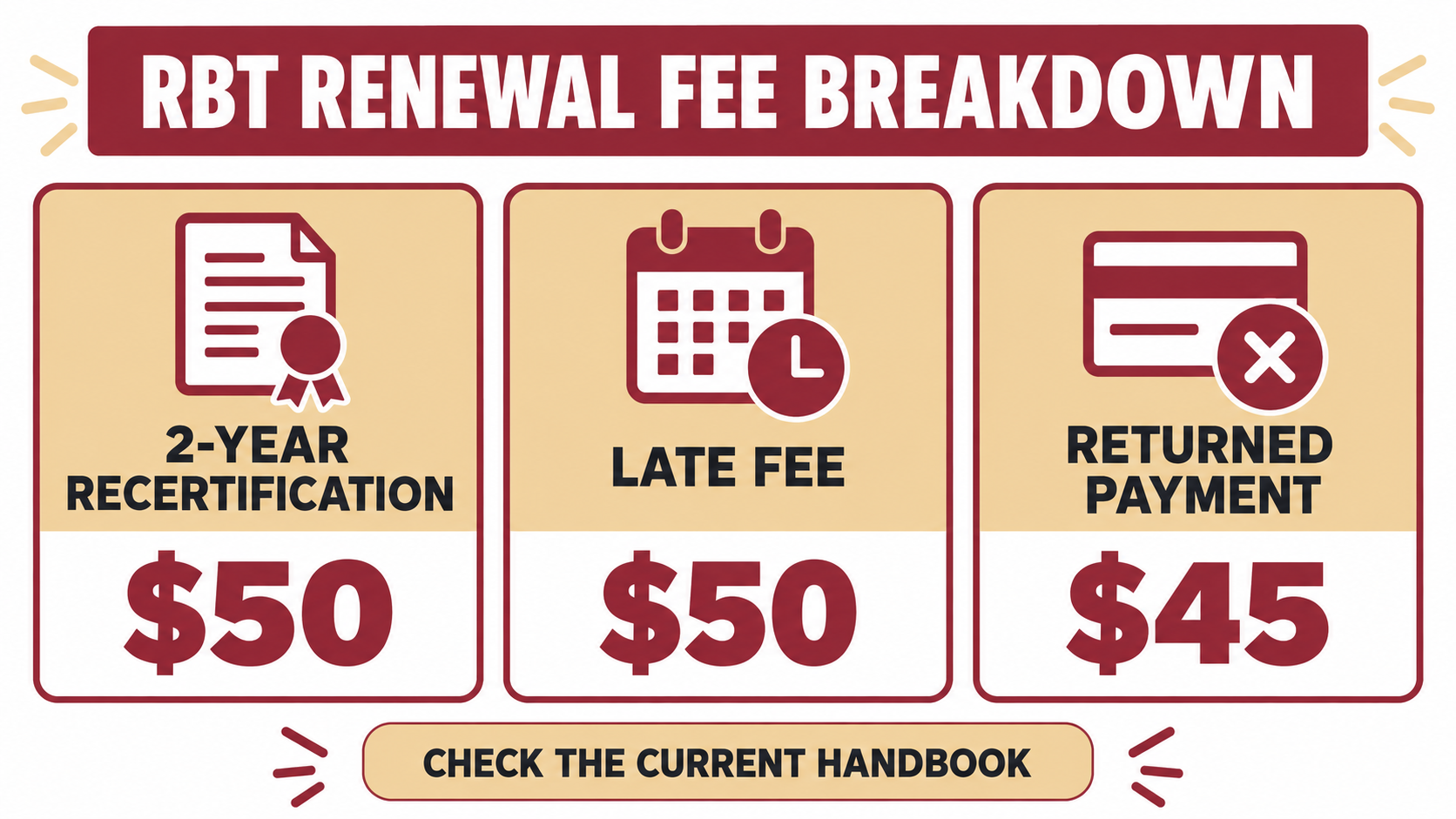
Under the current 2026 BACB fee schedule, the RBT two-year recertification application processing fee is $50. The same handbook lists a $50 recertification application late fee and a $45 fee for insufficient funds or a returned payment. These are official BACB charges and are separate from the costs of initial certification, an examination appointment, training, or employer-required professional development.
The most important budgeting rule is simple: pay the amount attached to the current recertification application in your own BACB account. Do not send money to a trainer because a social post or old checklist says the renewal fee is a different amount. The account and current handbook control.
The current 2026 renewal fee
The fee table in the current RBT Handbook identifies a 2-Year Recertification Application Processing Fee of $50, effective beginning January 1, 2026. This is the core RBT renewal fee for the two-year recertification application described in the 2026 transition materials.
The phrase “processing fee” matters. It is not a deposit held until the application is approved, and it is not a payment to reserve a testing appointment. The handbook states that BACB fees are nonrefundable and nontransferable. Read the application processing agreement before submitting the payment and make sure the application is being filed from the BACB account associated with your RBT certification.
If your account shows a different fee or a different certification cycle, stop and check the current handbook section that applies to your status. A transition year can produce outdated screenshots and conflicting search results.
Late and returned-payment fees
A late fee is not part of the normal on-time renewal budget. The current handbook lists a $50 recertification application late fee for an approvable application or additional documentation submitted during the reinstatement period. That means missing the expiration deadline can increase the amount due and can also place your certification into an inactive status while the matter is resolved.
The same table lists $45 for insufficient funds or a returned check. Treat payment details as part of the renewal checklist: use an accepted payment method, verify the account balance, and save the payment confirmation. A returned payment can create a new administrative problem even when the application documents themselves are complete.
Do not intentionally wait for the reinstatement period to pay later. The handbook says an RBT may not practice, bill, or represent themselves as an RBT while inactive. Late renewal is a status issue as well as a fee issue.
What does the renewal fee cover?
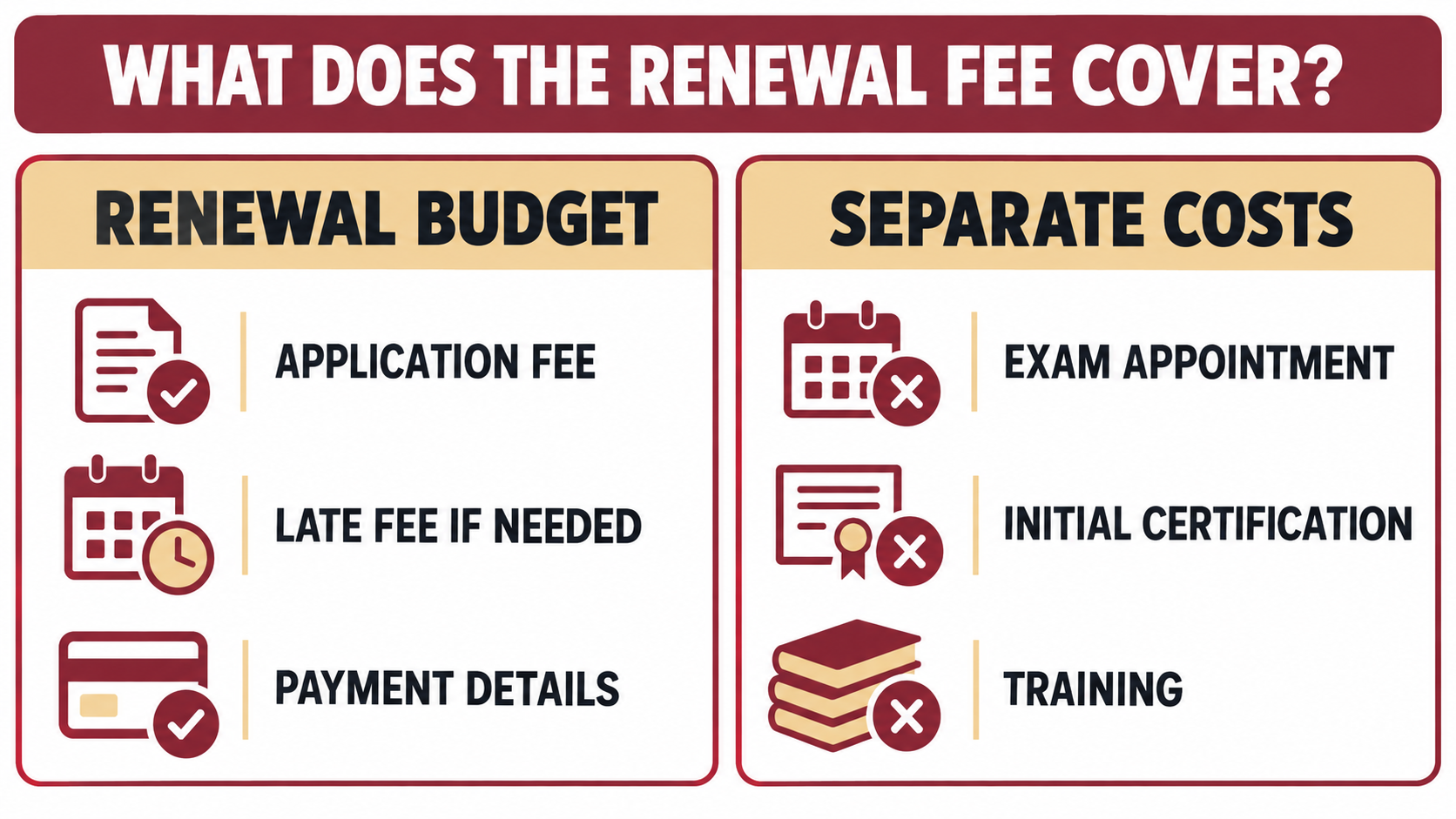
The $50 processing fee is associated with the RBT recertification application. The application also requires you to submit the documentation and attestations requested in the current BACB account workflow. Paying the fee does not replace the Recertification Competency Assessment, supervision reporting, ethics questions, or any other requirement shown in the application.
In practical terms, think of the fee as one line in a compliance process:
- Complete the current competency assessment in the permitted timing window.
- Open the recertification application in the existing BACB account.
- Upload the completed assessment and answer the required questions truthfully.
- Pay the processing fee and agree to the application processing terms.
- Watch for the BACB status email and any requested action items.
An application can still be placed on hold or require additional documentation after payment. Payment is necessary for the application, but it is not a promise of approval.
Costs that are separate from the RBT renewal fee
Searchers often use “RBT renewal fee” to mean the entire cost of maintaining a career. That broader budget can include expenses that are not the BACB recertification fee:
- Examination appointment: The RBT examination is part of initial certification or reapplication, not the ordinary recertification payment.
- Initial certification application: Becoming certified for the first time uses a different application pathway and fee.
- 40-hour training: A training provider may charge for instruction, materials, tutoring, or support. The BACB fee does not pay the provider.
- Employer expenses: An employer may require background checks, health documents, internal training, or other workplace costs.
- Professional development: The applicable 2026 transition and future cycle may include professional-development requirements. Check the current handbook rather than adding an old fee schedule to your budget.
When do you pay the renewal fee?
The current handbook places the payment inside the recertification application sequence. First complete the competency assessment no more than 45 days before your certification expiration date. Then use the existing BACB account to complete the recertification application, upload the assessment, answer the maintenance and ethics questions, and pay the processing fee.
Do not create a new BACB account to renew an existing certification. The handbook warns that the recertification application must be submitted through the account associated with the RBT certification. A new account can prevent the correct application from appearing.
After submission, allow the processing time stated in the current handbook and watch the email address in your BACB account. If the application is submitted close to expiration, an automated expiration notice may arrive while the documents are still under review; keep the submission record and respond to any action item promptly.
Why the 2026 transition changes the answer
Older pages may say the RBT renewal application fee is $35 because that was the earlier annual fee. The current 2026 materials describe a two-year recertification application processing fee of $50 beginning January 1, 2026. This is why a search result from an older handbook can conflict with the current fee shown in the account.
The transition also changes the value of asking “how often do I pay?” The fee is tied to the applicable recertification cycle, not just to a generic yearly reminder. Read the current handbook and your account together. If the account prompts you to complete a two-year recertification application, use the amount displayed in that workflow.
How to budget for renewal without surprises
Create a renewal line item that includes the $50 processing fee and a small document-preparation buffer. Keep the late fee out of the normal budget and treat it as an avoidable contingency. Set reminders 60 days before expiration and again when the 45-day assessment window opens. This gives you time to correct a signature or upload problem before the deadline.
If an employer pays the fee, confirm whether the reimbursement requires an invoice, receipt, or preapproval. The BACB’s fee does not change because an employer reimburses it. Keep personal copies of the receipt and completed assessment rather than relying entirely on an employer portal.
Common RBT renewal-fee mistakes
- Using an old $35 figure: Confirm the 2026 fee schedule.
- Confusing renewal with initial certification: The application pathways and costs are different.
- Adding the exam appointment to renewal: Examination costs are separate.
- Paying a training provider directly: Verify who is collecting the official BACB fee.
- Waiting until inactive status: A late fee and practice restrictions can follow.
- Creating a new account: Use the BACB account associated with your certification.
- Assuming payment guarantees approval: Documents and attestations still undergo review.
Frequently asked questions
How much is the RBT renewal fee in 2026?
The current BACB Handbook lists a $50 two-year recertification application processing fee beginning January 1, 2026.
How much is the late fee?
The current fee table lists a $50 recertification application late fee during the reinstatement period.
Is the RBT renewal fee refundable?
The handbook states that BACB fees are nonrefundable and nontransferable. Verify the current application processing agreement before paying.
Does the renewal fee include training?
No. Training-provider charges and employer expenses are separate from the BACB recertification application fee.
Why do I see an older $35 amount online?
Older materials describe the previous annual fee. The 2026 materials list a $50 two-year recertification application processing fee. Use the current handbook and account.
Official sources: BACB RBT Handbook; BACB Application Processing Updates; BACB RBT recertification resources. Retrieved September 28, 2026. Verify the current fee and application screen before payment.
Ready to practice the RBT concepts you just reviewed?
Try an independent, original RBT practice resource with exam-style questions, scoring, and answer explanations.
References
- Behavior Analyst Certification Board. RBT Test Content Outline, 3rd edition.
- Behavior Analyst Certification Board. RBT Handbook.
- Behavior Analyst Certification Board. RBT Ethics Code.