
The rbt return from inactive status process depends first on why the certification became inactive. A person on approved voluntary inactive status may use the BACB return-from-voluntary-inactive route, while a person whose status is inactive because a supervisor was removed, a requirement was missed, or an application is unresolved may need a different inquiry. The status shown in the BACB account controls the next step.
Table of Contents
- RBT return from inactive status: the short answer
- Identify which inactive status you have
- The voluntary inactive return route
- Check the current competency assessment rule
- Submit through the current BACB contact route
- What to prepare before requesting return
- Common reactivation mistakes
- Frequently asked questions
- Official sources and scope
RBT inactive status, voluntary return, and certification readiness
RBT Return from Inactive Status: A Careful Reactivation Checklist
Separate voluntary inactive status from other inactive conditions, then use the current BACB route to request a return.
The rbt return from inactive status process depends first on why the certification became inactive. A person on approved voluntary inactive status may use the BACB return-from-voluntary-inactive route, while a person whose status is inactive because a supervisor was removed, a requirement was missed, or an application is unresolved may need a different inquiry. The status shown in your BACB account controls the next step.
Do not practice, bill, or represent yourself as an active RBT while your certification is inactive. The BACB’s status guidance distinguishes active certification from inactive certification, and the current Contact Us form says the voluntary-inactive route is only for people who were approved for voluntary inactive status. Use the current RBT Handbook, portal, and Contact Us instructions before submitting anything.
RBT return from inactive status: the short answer
Use this order:
- Open the BACB portal and identify the exact inactive status and the inactivation date.
- Confirm whether the status is approved voluntary inactive status or another inactive condition.
- If it is voluntary inactive status, review the current return application, competency-assessment, fee, and timing instructions.
- Complete the current requirements, submit through the route BACB identifies, and keep the confirmation.
- Wait for the status to be reactivated and for the required supervisor or requirements-coordinator record to be in place before treating the certification as active.
A checklist cannot reactivate a credential by itself. BACB makes the status decision, and current forms or portal instructions can change. If the account does not say voluntary inactive status, stop and ask through the general question route rather than selecting a form because its title sounds close.
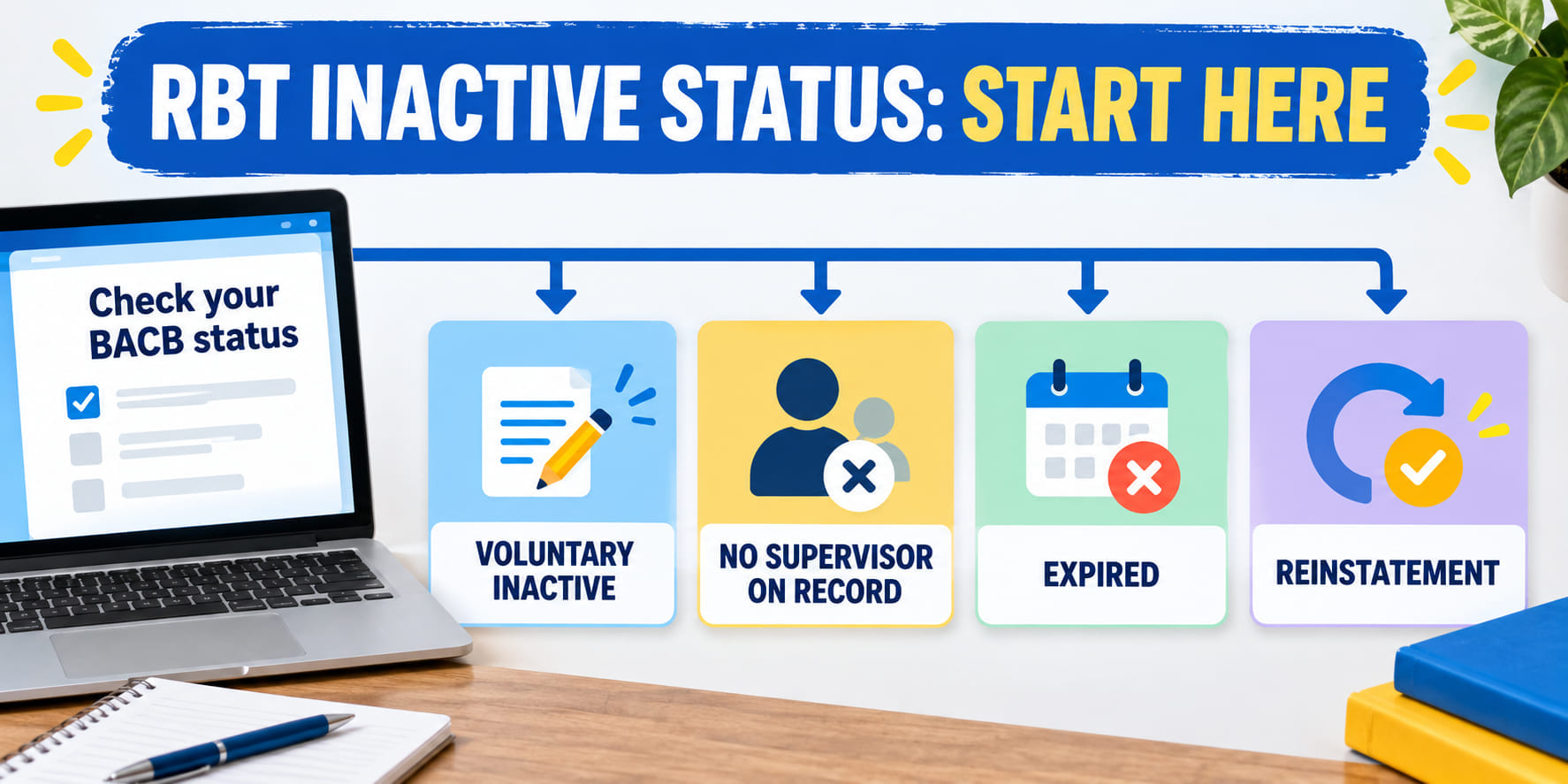
Identify which inactive status you have
“Inactive” is a status label, not a complete explanation. Review the account message, email, and recent supervisor history. Write down the exact wording before you choose a form.
| Status situation | What to do first | Practice boundary |
|---|---|---|
| Approved voluntary inactive status | Review the current return-from-voluntary-inactive instructions and the date the status began. | Do not practice, bill, or represent yourself as active while inactive. |
| No supervisor or requirements coordinator on record | Use the current RBT maintenance and portal instructions to resolve the supervision record. | Do not assume the voluntary-inactive application is the right route. |
| Missed renewal or reinstatement issue | Read the current Handbook and account notice for reinstatement or reapplication instructions. | Do not continue services based on a third-party grace-period claim. |
| Application or portal issue | Use the general BACB inquiry path and attach the requested account information. | Do not describe an unresolved application as active certification. |
The voluntary inactive return route
The BACB Contact Us form currently presents a specific option for an RBT who is on voluntary inactive status and wants to request a return. It also states that the voluntary-inactive form is for a temporary pause of up to two years and is not the correct form for every account that displays inactive.
For a voluntary return, prepare the information the current route requests, including the name and account details used by BACB. Read the current RBT Handbook for the applicable return application, fees, competency assessment, and date window. The form title, payment instructions, and document version should be checked on the day you submit, not copied from an old screenshot.
The return request is not complete merely because you filled a PDF. Follow the submission path the current BACB instructions identify. Save the submitted file, payment receipt, confirmation email, and any action-item message in a secure folder.
Check the current competency assessment rule
Voluntary inactive return requirements may include a renewal competency assessment and a timing relationship to the return request. The exact packet and timing are time-sensitive, so use the current RBT Handbook and portal instructions rather than an undated study article.
Before completing an assessment, verify:
- that your account actually shows approved voluntary inactive status;
- that you have the current recertification or renewal competency packet;
- that the qualified assessor meets the current role and relationship requirements;
- that the assessment date falls inside the current timing window; and
- that the return application and payment route are ready for the required submission relationship.
Do not use an initial competency assessment in place of a return or recertification assessment unless the current BACB instructions explicitly tell you to do so. Initial certification, recertification, voluntary inactive return, reinstatement, and reapplication are different administrative paths.
Submit through the current BACB contact route
The BACB’s current Contact Us form includes a return-from-voluntary-inactive option. It also tells people whose certification or application is inactive for another reason to return to the beginning of the form and select the general question route. That distinction protects you from sending a valid document to the wrong workflow.
Use the existing BACB account information consistently. If your email, legal name, or account access changed, resolve that issue through the current account process before assuming the return request is connected to the right record. Keep copies of every upload and use the exact status language from the portal in any message.
Processing is not the same as approval. BACB’s application-processing page explains that applications and action-item resubmissions are reviewed in the order received and that current processing information changes. Do not schedule services or tell an employer that you are active merely because a request was submitted.
What to prepare before requesting return
- Status evidence: save the account page or message showing voluntary inactive status and the inactivation date.
- Current source check: open the RBT Handbook, Contact Us form, and application-processing updates on the day you prepare the request.
- Assessment plan: confirm the current packet, eligible assessor, date window, signatures, and recordkeeping plan.
- Payment details: verify the current fee and payment path shown by BACB; do not rely on a remembered amount.
- Supervisor record: know how the RBT Supervisor or RBT Requirements Coordinator record will be restored or confirmed after reactivation.
- Confirmation folder: keep the application, receipt, uploaded documents, status messages, and any action-item response together.

Common reactivation mistakes
- Choosing the voluntary form for every inactive status. Confirm the exact reason shown in the account.
- Working while waiting. A submitted return request does not itself restore active status.
- Using an old packet. Check the current Handbook and application-processing page for document versions.
- Completing the assessment too early. Verify the current timing window before scheduling it.
- Forgetting the supervisor record. Reactivation and a qualified supervisor or requirements coordinator record are separate checks.
- Assuming inactive means expired. Read the account notice and current remedy before reapplying.
- Calling submission approval. Keep your professional status description accurate until BACB confirms the change.
Frequently asked questions
Can every inactive RBT use the return-from-voluntary-inactive form?
No. The current BACB Contact Us form says that route is for people approved for voluntary inactive status. If your account is inactive for another reason, use the general question route and follow the account-specific instructions.
Can I work while my return request is being reviewed?
Do not represent yourself as active or practice as an active RBT while the certification is inactive. Wait for BACB confirmation and the required supervision record before resuming within the applicable rules.
How long can voluntary inactive status last?
The current Contact Us form describes a temporary voluntary-inactive period of up to two years. Verify the current Handbook and the date in your account because a future rule or status reason may change what applies.
Is the renewal competency assessment the same as the initial assessment?
No. They serve different certification stages. Use the packet and instructions tied to your current status and return route.
Does submitting the return request guarantee reactivation?
No. BACB reviews the request under current requirements. A submission, payment, or assessment signature is not a promise of approval.
Official sources and scope
Review the current BACB RBT Handbook, the BACB Contact Us form, the RBT inactive-status resources, the application-processing updates, and the status-representation guidance. This is an educational preparation guide, not individualized certification, legal, employment, immigration, or financial advice.
Ready to practice the RBT concepts you just reviewed?
Try an independent, original RBT practice resource with exam-style questions, scoring, and answer explanations.
References
- Behavior Analyst Certification Board. RBT Test Content Outline, 3rd edition.
- Behavior Analyst Certification Board. RBT Handbook.
- Behavior Analyst Certification Board. RBT Ethics Code.