
RBT sample questions are useful when they teach you how to read a short scenario, identify the controlling clue, and explain why the nearest distractor fails. A score by itself is less useful. The best practice item shows what decision the current task list expects, what evidence is observable, and what an RBT should do within the written plan and supervision relationship.
Table of Contents
- What strong RBT sample questions measure
- Check the current RBT scope before practicing
- Read the clue before the answer choice
- Practice RBT sample questions across six domains
- Question one: data collection and graphing
- Question two: behavior assessment
- Question three: behavior acquisition
- Question four: behavior reduction
- Question five: documentation and reporting
- Question six: ethics
- Turn missed questions into a study action
- Choose the right practice format
- Audit a question set before trusting it
- Common RBT sample-question mistakes
- Frequently Asked Questions
- References
This guide uses the current RBT Test Content Outline, 3rd edition, as its academic anchor. The outline describes 43 tasks organized into six domains, and the current examination context includes 75 scored questions plus 10 unscored pilot questions. The sample items below are newly written for independent study. They are not official, recalled, leaked, real, or BACB-endorsed questions.
RBT Training is an independent educational resource. It is not affiliated with, operated by, or endorsed by the Behavior Analyst Certification Board (BACB). Use the current BACB TCO, Handbook, and examination pages for official scope and process information. A practice set can guide review, but no practice score or study schedule can guarantee a passing result.
What strong RBT sample questions measure
A strong practice item does more than place a term in a sentence. It asks you to use a fact, procedure, measurement, or role boundary. Before answering, ask what kind of decision the item requires:
| Question demand | Evidence to find | Weak answer habit |
|---|---|---|
| Define or identify | The observable feature that separates one term from a close neighbor. | Choosing a word that sounds familiar without matching the condition. |
| Select a measurement | The unit, time window, or recording rule named in the stem. | Using count, duration, or percentage interchangeably. |
| Apply a teaching or reduction procedure | The written plan, antecedent, consequence, prompt, or safety direction. | Inventing an intervention because it sounds helpful. |
| Document or communicate | What another observer could verify and which reporting route is appropriate. | Replacing facts with labels such as “uncooperative” or “lazy.” |
| Choose an ethical action | Privacy, dignity, competence, supervision, boundaries, and integrity. | Picking the most convenient option for the RBT. |
That is why a short set can be valuable. Six carefully explained questions can reveal whether you confuse frequency with rate, preference with function, prompting with reinforcement, a written behavior plan with an improvised response, observation with interpretation, or friendliness with an appropriate professional boundary.
Check the current RBT scope before practicing
The current RBT sample questions you choose should identify its edition and source. The BACB RBT Test Content Outline, 3rd edition, describes the knowledge, skills, and abilities for the certification examination beginning in 2026. It lists 43 tasks across six domains:
| Domain | Scored-question planning share | Study question |
|---|---|---|
| A. Data Collection and Graphing | 13 / 17% | What was directly observed, and which recording system fits? |
| B. Behavior Assessment | 8 / 11% | Which assigned assessment procedure is being implemented? |
| C. Behavior Acquisition | 19 / 25% | What teaching, prompting, reinforcement, or generalization step is written? |
| D. Behavior Reduction | 14 / 19% | What authorized plan or safety response matches the situation? |
| E. Documentation and Reporting | 10 / 13% | Could another person verify the note, data, or report? |
| F. Ethics | 11 / 15% | Which action protects dignity, privacy, competence, and professional boundaries? |
The numbers are a study map, not a promise about the order or wording of an item. Also separate official facts from provider format. An independent site may offer 10 sample questions, a 75-question set, an 85-question simulation, a PDF, or a timed quiz. Those labels describe that resource. They do not make the resource an official BACB examination or prove that its wording is retired or recalled content.
If you learned from the 2nd edition, do a quick label check. Older materials may use Measurement, Skill Acquisition, and Professional Conduct and Scope of Practice, while the current outline uses Data Collection and Graphing, Behavior Acquisition, and Ethics. The current source controls when a label, task number, weight, or process detail differs.
Read the clue before the answer choice
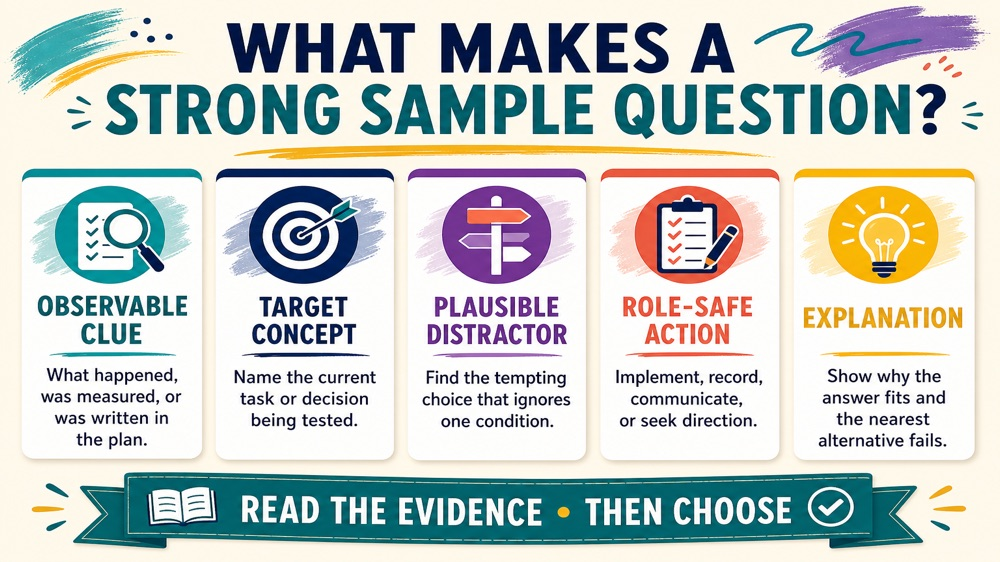
Use a five-line scratch routine for every set of RBT sample questions:
- Underline the observable clue: mark what happened, what was measured, what the plan says, or what was documented.
- Name the decision: identify the concept, task, or professional issue activated by the clue.
- Reject the nearest distractor: explain which condition it ignores or changes.
- Check the role: decide whether the RBT should implement, record, communicate, or seek direction.
- Mark confidence: label the item sure, narrowed-down, or guessed before reading the explanation.
Do not read the explanation only to see whether a letter is right. Ask whether the explanation names the evidence. If it only says “B is correct” or repeats a definition, it will not help you transfer the rule to a changed setting, time interval, behavior, or relationship.
Practice RBT sample questions across six domains
The six original items below are a compact diagnostic. They intentionally use different kinds of clues. Read each question, choose an answer before looking at the explanation, and then write one sentence explaining why the closest alternative fails.
Question one: data collection and graphing
Scenario: During a 20-minute session, an RBT records every occurrence of a target response. The supervisor asks for the number of responses per minute. Which measure should the RBT calculate?
- A. Duration
- B. Latency
- C. Rate
- D. Whole-interval recording
Answer: C, rate. The clue is “per minute.” A count tells how many responses occurred, while rate relates the count to a unit of time. Duration would require how long the behavior lasted, latency would require the time from an event to the response, and whole-interval recording is a discontinuous procedure rather than the requested calculation.
Study action: Write a four-row contrast for count, rate, duration, and latency. Add the information each one needs and one fact it cannot provide. This turns a vocabulary miss into an observable measurement decision.
Question two: behavior assessment
Scenario: A supervisor assigns an RBT to run a paired-stimulus preference assessment exactly as written. The learner chooses the blue ball more often than the other presented items. What is the best next action for the RBT?
- A. Record the selection according to the procedure and report the result through the assigned route.
- B. Conclude that the blue ball is the reinforcer for every skill.
- C. Change the array because the RBT believes another item would work better.
- D. Diagnose the function of the learner’s challenging behavior.
Answer: A. The clue is that the RBT has been assigned a defined preference-assessment procedure. The RBT should implement and record the procedure, then communicate the result. A preference result does not automatically prove that an item will reinforce every response, and it does not by itself identify the function of challenging behavior. Independent redesign or diagnosis exceeds the scenario’s role boundary.
Study action: Keep preference, reinforcement, and behavioral function in three columns. For each practice miss, write what the assessment can show and what it cannot establish by itself.
Question three: behavior acquisition
Scenario: The written teaching plan uses a least-to-most prompt sequence. After the instruction is delivered, the learner responds independently within the stated wait time. What should the RBT do next?
- A. Add the most intrusive prompt to make the response faster.
- B. Deliver the programmed consequence and record the response as specified.
- C. Skip reinforcement so the learner does not become dependent on it.
- D. Rewrite the prompt hierarchy during the session.
Answer: B. The observable clue is an independent response within the plan’s wait time. The RBT follows the written teaching and reinforcement arrangement, records the result, and does not add a prompt that was not needed. Prompting, fading, and reinforcement are plan-based decisions; they are not adjusted merely because one option sounds more efficient.
Study action: For each acquisition item, identify the instruction, response, prompt condition, consequence, and data point. If one element is missing, mark the question as incomplete rather than filling the gap with an assumption.
Question four: behavior reduction
Scenario: An RBT sees the target behavior named in a behavior-reduction plan. The plan includes an antecedent strategy, a response procedure, and a safety step. The situation is not an emergency, and the RBT is unsure whether a new consequence would be appropriate. What is the safest study answer?
- A. Add a consequence that has worked for another learner.
- B. Follow the written plan, use the stated safety and reporting route, and seek supervisor direction for uncertainty.
- C. Ignore the behavior so the data remain clean.
- D. Ask the caregiver to select a different intervention immediately.
Answer: B. The controlling clue is the existing written plan plus uncertainty about changing it. A practice question is testing plan fidelity, safety, communication, and role limits. An RBT should not improvise a new intervention from a different learner or treat missing certainty as permission to redesign the plan.
Study action: When you miss a reduction item, label the error as plan fidelity, antecedent, differential reinforcement, safety, or reporting. Then review only that distinction before taking another mixed set.
Question five: documentation and reporting
Scenario: A session note says, “The client was defiant during homework.” Which revision is most objective?
- A. “The client had a bad attitude about work.”
- B. “The client was unmotivated and wanted attention.”
- C. “After the instruction to begin math, the client pushed the worksheet to the floor twice and did not begin within 30 seconds.”
- D. “The client refused because the task was too hard.”
Answer: C. The revision describes an action, a count, an antecedent, and a time condition that another observer could check. The other options add an attitude, motive, or interpretation that is not directly established by the sentence. Objective documentation supports accurate communication without pretending that an RBT observed private thoughts.
Study action: Rewrite three subjective notes into observable descriptions. Keep the original time, setting, and response when available; do not invent details to make the note sound precise.
Question six: ethics
Scenario: A family member asks an RBT to post a photo from a session on a personal social-media account and says that the child’s first name can be included because the family is proud of the progress. What should the RBT do?
- A. Post it if the family gives verbal permission.
- B. Post it but crop the child’s face.
- C. Decline the personal post and follow the organization’s privacy and supervision process.
- D. Ask another RBT to post it instead.
Answer: C. The clue is the personal account, identifiable client information, and professional relationship. A friendly request does not erase privacy, boundary, or organization-policy requirements. Moving the post to another RBT would not solve the concern. When the correct route is unclear, protect confidentiality and seek guidance rather than guessing.
Study action: Make a small ethics decision list for privacy, gifts, dual relationships, competence, supervision, social media, and conflicts of interest. For every item, record the safe first step and the person or policy you would consult.
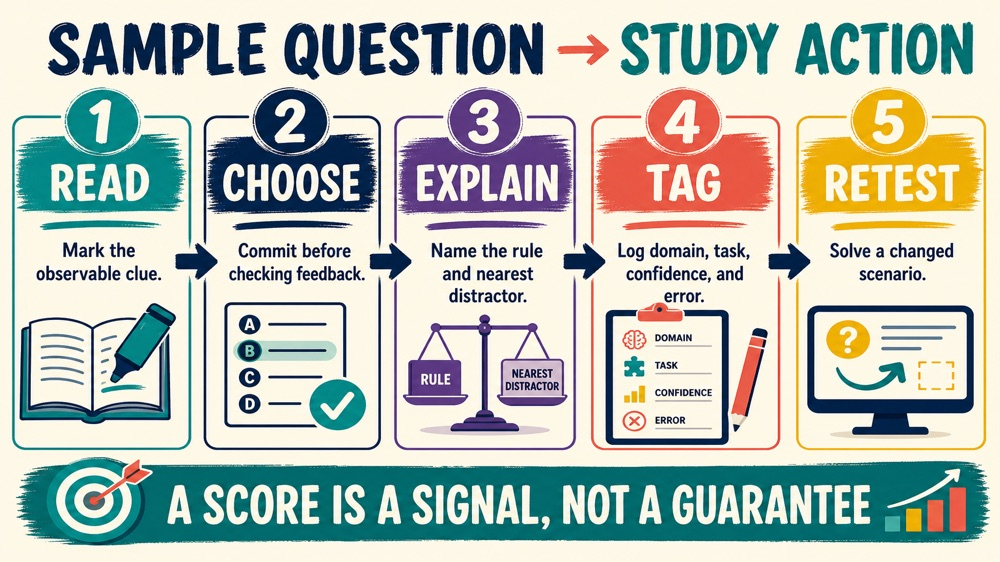
Turn missed questions into a study action
After a set of RBT sample questions, do not record only a percentage. Use a correction log with one row per item:
| Field | What to record |
|---|---|
| Source and edition | Provider, URL or PDF name, date, and whether the page states current 3rd-edition alignment. |
| Domain and task | The current domain and the narrow concept or task involved. |
| Controlling clue | The exact observable fact, unit, plan direction, or relationship that should control the answer. |
| Your choice and confidence | Answer selected plus sure, narrowed-down, or guessed. |
| Nearest distractor | Why the tempting alternative fails the condition. |
| Next study action | One contrast, rewrite, source reread, targeted quiz, or retest condition. |
A wrong answer with low confidence may be a normal knowledge gap. A wrong answer with high confidence may indicate that two rules have been reversed. A correct answer selected as a guess is not yet stable evidence. Retest the same concept in a new setting instead of repeating the same wording until it feels familiar.
Choose the right practice format
Search results for RBT sample questions include several formats. Pick the format based on the decision you need to make:
| Format | Best use | What it cannot prove |
|---|---|---|
| 5–10 question sample | Check whether the explanations, interface, and domain mix are worth using. | It cannot represent your full readiness from one short set. |
| Single-domain quiz | Repair one narrow distinction such as measurement or ethics. | It cannot show whether you can switch decisions across domains. |
| 75-item practice set | Build a longer mixed review and compare corrections across domains. | Its item count does not make it the official scored examination. |
| 85-item timed simulation | Practice pacing and attention after untimed reasoning is accurate. | A provider timer or threshold is not a universal BACB prediction. |
| Printable PDF | Annotate stems, hide answers, and maintain a paper correction log. | A PDF is not automatically current, accurate, readable, or official. |
Use short samples diagnostically, targeted quizzes for repair, and full simulations for transfer and pacing. If a resource says its questions are “real,” “recalled,” or “exact,” treat that as a reason to check the source and examination-security boundary, not as a quality badge.
Audit a question set before trusting it
Before investing hours in any practice bank, run this six-point check:
- Edition: Is the resource clearly mapped to the current RBT Test Content Outline, 3rd edition?
- Coverage: Does it show all six current domains rather than relying on a generic “all topics” claim?
- Originality: Does it state that the items are independently written rather than official or recalled?
- Explanation: Does each answer name the controlling clue and explain the nearest distractor?
- Integrity: Do the answer key, score, item count, and domain labels agree?
- Accessibility: Can you read, print, pause, and review the questions without a distracting paywall or unclear data practice?
These checks also protect academic quality. A polished page can still contain an old domain map, a mislabeled item count, an answer key that does not match its explanation, or an interpretation that an entry-level RBT should not make independently. Source checking is part of studying, not an extra step after studying.
Common RBT sample-question mistakes
- Memorizing answer letters: explain the clue and rule instead.
- Confusing preference with function: a selection result does not by itself identify why a behavior occurs.
- Confusing count with rate: check whether the stem asks for a time-based unit.
- Adding an intervention: follow the written plan and seek direction when the scenario does not authorize a change.
- Accepting subjective notes: replace labels with observable actions, time, count, or duration when the facts support it.
- Trusting a short score: record condition, confidence, domain, and correction rather than treating one percentage as a forecast.
- Using old labels without a crosswalk: compare the source with the current 3rd-edition TCO.
- Calling practice material official: independent questions are study tools, not BACB examination content.
Bottom line: Use RBT sample questions to practice decisions, not just recognition. Verify the current 43-task, six-domain TCO, distinguish 75 scored questions from 10 unscored pilot questions, read the observable clue, reject the nearest distractor, and turn every miss or guess into one specific study action. That process makes a small sample set more informative and keeps your preparation academically honest.
Ready to practice the clues?
Try fresh RBT practice questions, mark your confidence, and record the correction that determines your next review.
Try Free RBT Practice Questions →
Frequently Asked Questions
What makes RBT sample questions useful?
Useful RBT sample questions identify an observable clue, test a current concept or procedure, and explain why the nearest distractor fails. A score without that reasoning is limited feedback.
Are these RBT sample questions official?
No. The examples in this guide are newly written for independent study. They are not official, recalled, leaked, real, or BACB-endorsed questions.
How many tasks are in the current RBT outline?
The current RBT Test Content Outline, 3rd edition, describes 43 tasks organized into six domains.
How many questions are on the current RBT exam?
The current BACB TCO states that the examination includes 75 scored questions and 10 unscored pilot questions. Use the current BACB examination and Handbook pages for process details.
Should I start with a sample quiz or a full practice test?
Start with a short sample when you need a diagnostic or want to inspect explanation quality. Use a domain quiz for repair and a longer mixed or timed set after your clue-first reasoning is accurate.
Can RBT sample questions guarantee that I will pass?
No. Practice questions provide evidence under one set of conditions. They cannot guarantee a passing result, certification, or performance on the official examination.
References
- Behavior Analyst Certification Board. RBT Test Content Outline, 3rd edition.
- Behavior Analyst Certification Board. RBT Test Content Outline, 3rd-edition PDF.
- Behavior Analyst Certification Board. RBT Handbook.
- Behavior Analyst Certification Board. RBT examination resource hub.
- RBT practice-exam resource. Reviewed for competitor research; not an endorsement.
- RBT question-library resource. Reviewed for competitor research; not an endorsement.
- RBT practice-test resource. Reviewed for competitor research; not an endorsement.