
RBT schooling does not mean that every applicant needs a college degree. The current path separates the minimum education requirement from the training, assessment, application, examination, and supervision steps that make up RBT certification.
Table of Contents
- What RBT schooling means
- The minimum education requirement
- The 40-hour training is a separate step
- The complete path from school to certification
- Is college useful for an RBT?
- How to evaluate an education or training option
- Mistakes to avoid
- FAQ
- References
RBT CAREER GUIDE · EDUCATION PATH
RBT Schooling: What Education You Need Before Certification
Separate the education minimum from the 40-hour training, competency assessment, exam, application, and supervised practice steps.
The search phrase RBT schooling can mean several different things. Some people want to know whether they need college. Others are looking for a 40-hour training program, a behavior-analysis course, or a realistic education path before applying. Those are related questions, but they are not the same requirement.
The current BACB RBT Handbook separates education from training and certification. Use the latest handbook and application instructions as the controlling source. This article explains the path in plain language, but it does not replace a formal BACB review, employer policy, or supervision direction.
What RBT schooling means
RBT schooling is the education foundation someone brings to the certification process. It may include high school completion, adult education, college coursework, a certificate program, or a degree that supports longer-term professional goals. It can also include learning how to read instructions, communicate professionally, collect information accurately, and work under supervision.
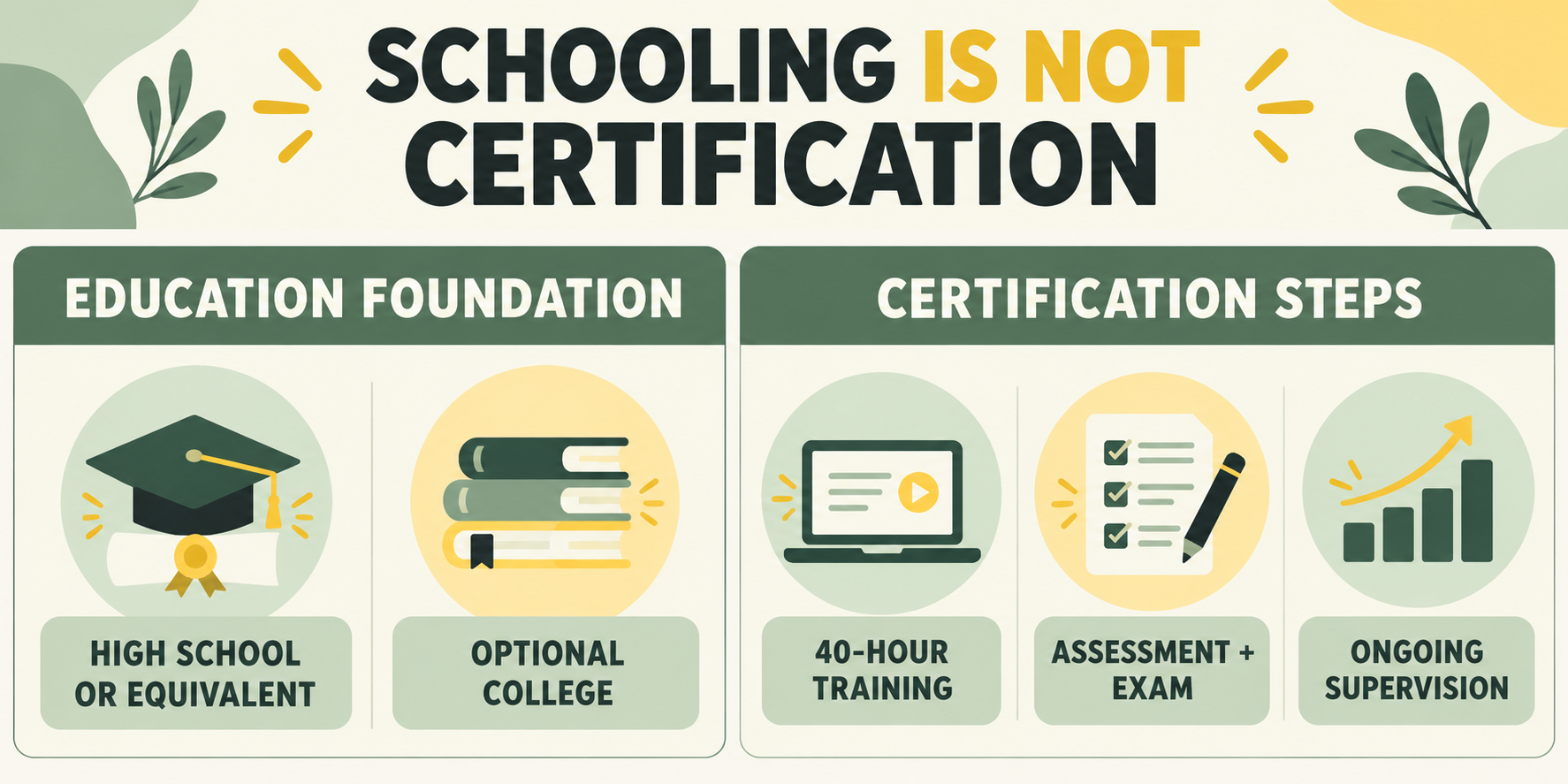
For certification purposes, schooling is only one part of the picture. A diploma does not prove that someone has completed the RBT 40-hour training, demonstrated competency, passed the RBT examination, or arranged the supervision needed to practice. Conversely, completing an RBT training course does not turn an applicant into an RBT without the remaining requirements.
The minimum education requirement
The current RBT Handbook states that an applicant must have at least a high school-level education or equivalent when applying for RBT certification. The current application process includes an attesting certificant who confirms completion of at least a high school education along with other eligibility information. The exact evidence and attestation process should be checked in the current application materials.
This means a four-year college degree is not a universal BACB prerequisite for RBT certification. It also does not mean that schooling is unimportant. A person needs enough educational preparation to understand the training, follow written procedures, communicate observations, use basic documentation, and continue learning under supervision.
If your education was completed outside the United States or does not use a familiar diploma system, do not guess at equivalency. Review the current handbook and ask the BACB through its official contact process what documentation is required. An employer’s hiring decision and BACB certification eligibility can involve different standards.
The 40-hour training is a separate step
The 40-hour RBT training is not the same thing as general schooling. Under the current 2026 requirements, applicants must complete a training program that meets the BACB curriculum requirements in no less than five days and no more than 180 days, counting the start and end dates as described in the handbook.
The current handbook says this training may be offered by an employer, a university, or an online training program. BACB does not provide the training, issue the completion certificate, or recommend a particular provider. That makes the certificate language and program documentation important. Before enrolling, ask the provider whether the program was designed to meet the current 2026 requirement and whether the completion certificate will contain the required statement.
Do not select a course because its page uses the words “RBT school” or “ABA school.” Check the current curriculum, delivery dates, trainer qualifications, completion record, and whether the provider is independent from the applicant in the way the current requirement specifies. A course that is educationally interesting may still fail to meet the certification requirement.
The complete path from school to certification
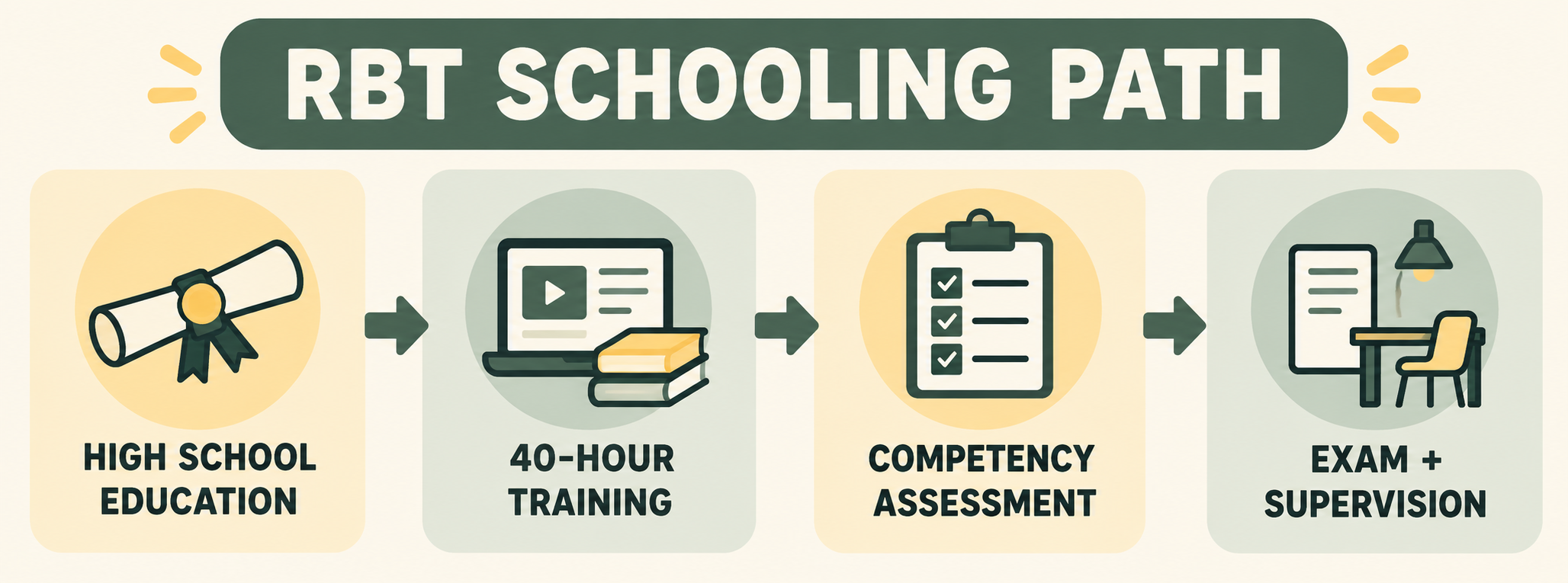
A practical way to understand RBT schooling is to place it beside the certification sequence:
- Meet the education and age requirements. Have at least a high school-level education or equivalent and meet the current age requirement.
- Complete the required checks. The application process includes a criminal background check and abuse registry check within the current time windows.
- Complete the current 40-hour training. Use a program that meets the applicable RBT curriculum and timing requirements.
- Demonstrate initial competency. Complete the current initial competency assessment after training and within the application window.
- Create the BACB portal account and submit the application. Upload the required attestation, training certificate, and competency assessment records.
- Pass the RBT examination. Application approval and examination instructions come through the BACB process.
- Practice with ongoing supervision. An active RBT works under the direction and close supervision of an RBT Supervisor or RBT Requirements Coordinator who is responsible for the work.
The order and timing are important. For example, the competency assessment follows the required training, and the application must use the current forms and documentation. Read the handbook at the time you apply because a course or checklist saved from a prior year may be outdated.
Is college useful for an RBT?
College can be useful without being universally required. Introductory coursework in psychology, education, child development, communication, or behavior analysis may help someone understand future learning. An associate or bachelor’s degree may also support a longer-term plan toward another role, depending on the person’s goals and the requirements of that later credential.
But college coursework should not be presented as an automatic substitute for the RBT 40-hour training or competency assessment. A university class may teach concepts at a broader level while the RBT training addresses the current entry-level curriculum. If a university offers a 40-hour RBT program, verify that specific program rather than assuming every course at the university qualifies.
College is most valuable when it matches a clear purpose. Ask whether you want immediate entry into supervised technician work, a foundation for future behavior-analytic education, stronger academic writing and data skills, or a credential required by a particular employer. The best choice depends on time, cost, schedule, and the next role you actually want.
How to evaluate an education or training option
Use a short pre-enrollment checklist before paying for a program:
- Requirement match: Does the provider clearly identify the current RBT requirement it is designed to meet?
- Curriculum: Does the program describe the required content rather than only promising a certificate?
- Timing: Can you complete the hours within the current minimum and maximum time window?
- Trainer: Does the program identify qualified trainers and the oversight structure required by the current guidance?
- Documentation: What certificate, transcript, syllabus, or assessment record will you receive?
- Support: Who answers questions about the application, and what is the refund or correction policy?
- Supervision plan: If the course is not connected to an employer, where will you receive the supervision needed after certification?
Be careful with marketing claims such as “guaranteed certification,” “BACB-approved school,” or “job included.” Training providers may explain their own program, but the certification decision belongs to the BACB process. Ask for evidence and verify the current source yourself.
Mistakes to avoid
The first mistake is assuming that a bachelor’s degree is mandatory for every RBT applicant. The second is assuming that a high school diploma is enough to use the RBT title. Both statements erase the distinction between education and certification.
Other common mistakes include buying an old training program without checking the 2026 requirements, confusing an ordinary college class with the required 40-hour curriculum, applying before the competency assessment is within the correct window, and choosing a program without a plan for ongoing supervision. Keep copies of your documents and compare them with the current handbook before submitting an application.
FAQ
Do I need a bachelor’s degree to become an RBT?
No universal bachelor’s-degree requirement appears in the current RBT education eligibility requirement. The current handbook requires at least a high school-level education or equivalent, plus the other certification requirements.
Can a university provide RBT schooling?
Yes, a university may offer the required 40-hour training, but verify that the specific program meets the current RBT training requirements. A university course that is not designed as the required training should not be assumed to qualify.
Does finishing RBT schooling make me certified?
No. Education and training are steps in the path. You still need the current assessment, application, examination, and supervision-related requirements.
What if my education is from another country?
Review the current handbook and contact BACB through its official process for documentation guidance. Do not rely on an informal equivalency claim from a school or recruiter.
Bottom line: choose RBT schooling based on your actual goal, but keep the categories separate. High school-level education or equivalent is the current minimum education foundation; the 40-hour training, competency assessment, application, exam, and supervised practice complete the certification path.
Ready to practice the RBT concepts you just reviewed?
Try an independent, original RBT practice resource with exam-style questions, scoring, and answer explanations.
References
- Behavior Analyst Certification Board. RBT Test Content Outline, 3rd edition.
- Behavior Analyst Certification Board. RBT Handbook.
- Behavior Analyst Certification Board. RBT Ethics Code.