

RBT service competence means delivering authorized behavior-technician support accurately, consistently, safely, and within close supervision—not simply holding a credential or completing a course.
Table of Contents
- RBT service competence: what it means
- Four pillars of reliable service
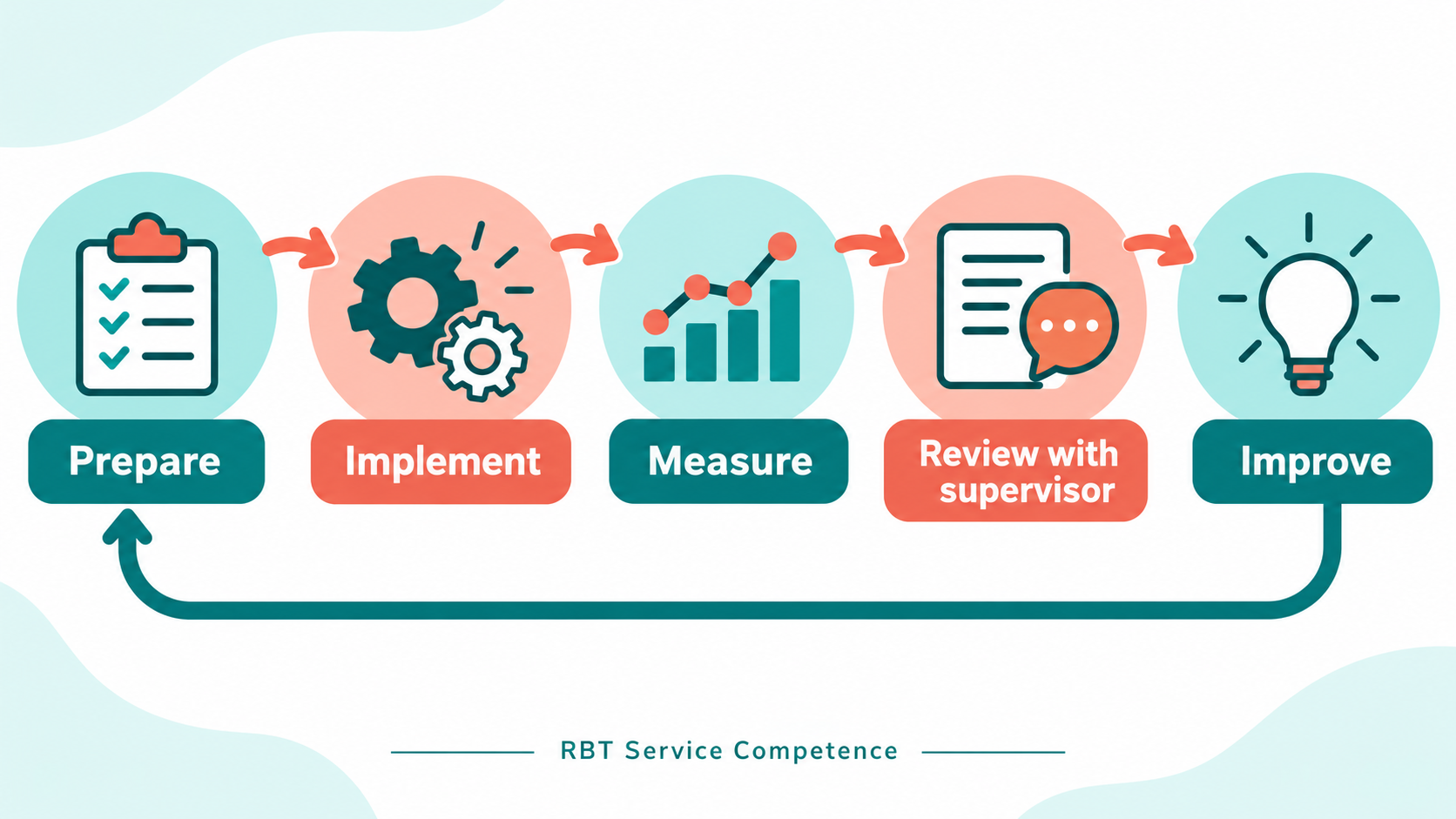
- Prepare before service begins
- Implement the authorized plan accurately
- Measure and document what happened
- Use supervisor review to improve
- Report barriers without hiding them
- Service-quality scenarios
- Frequently asked questions
- Sources and scope note
RBT SERVICE GUIDE · QUALITY, DATA, AND SUPERVISION
RBT Service Competence: Deliver Reliable Support
See how accurate implementation, consistent data, safe boundaries, and communication work together in daily service delivery.
RBT service competence means delivering authorized behavior-technician support accurately, consistently, safely, and within close supervision—not simply holding a credential or completing a course.
The RBT Ethics Code (2.0) connects competence to demonstrated performance, accurate implementation, required documentation, confidentiality, and communication with the supervisor. This article describes practical quality habits; it is not a clinical rating tool, certification decision, or individualized treatment direction.
RBT service competence: what it means
Service competence is broader than one isolated skill. It is the reliable delivery of an assigned service under the conditions that actually exist: the current plan, the client’s communication, the setting, the data system, the safety procedures, and the available supervision.
That does not mean the RBT controls every outcome. A learner’s progress depends on many factors, and an RBT does not independently determine whether a treatment plan is effective. The RBT’s responsibility is to implement as trained, collect useful information, notice barriers, protect rights and safety, and communicate what the supervisor needs to review.
A service-quality question is therefore not “Did everything work perfectly?” It is “Was the service delivered as authorized, measured accurately, and reviewed responsibly?”
Four pillars of reliable service
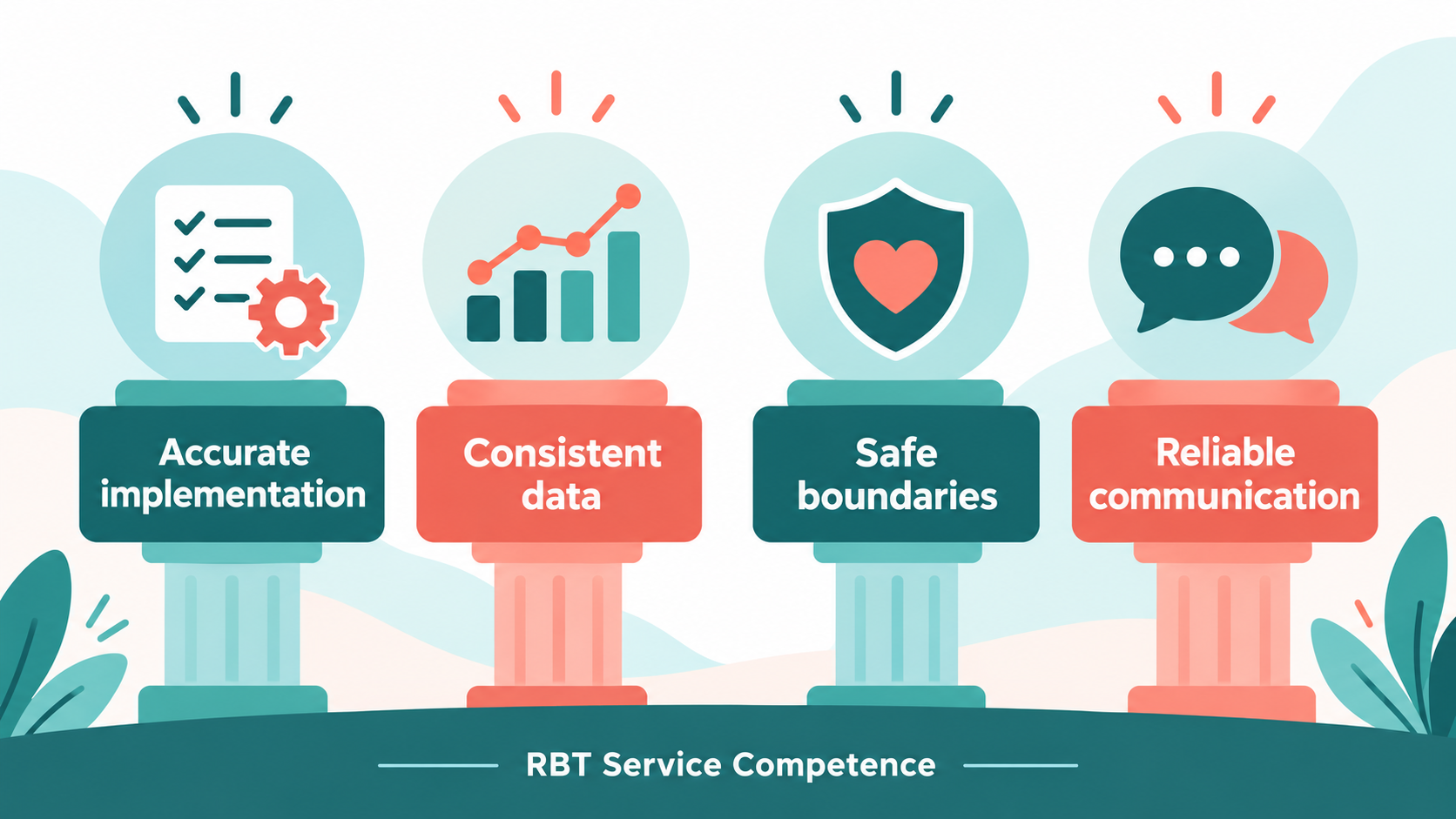
Use four connected pillars when thinking about RBT service competence:
- Accurate implementation: Follow the current procedure, definitions, prompts, reinforcement arrangements, and safety directions as trained.
- Consistent data: Use the assigned measurement system, record what occurred, and identify missing or unusual information.
- Safe boundaries: Stay within competence, protect confidentiality, and pause for supervisor direction when the context changes.
- Reliable communication: Share relevant observations, barriers, questions, and follow-up through the approved route.
These pillars support each other. Accurate implementation without reliable data is hard to review. Data without safe boundaries can encourage unsafe improvisation. Communication without accurate facts can mislead the team.
Prepare before service begins
Preparation reduces avoidable errors. Confirm the current plan or session instructions, the target definitions, materials, data form, reinforcement or communication supports, and any known safety or privacy requirements. Ask the supervisor about changes rather than relying on an old copy or memory.
Preparation also includes checking your own readiness. Are you trained on this procedure? Is the client or setting new? Is the data system working? Do you know how to contact the supervisor? A short preparation check can reveal a competence gap before it becomes a service problem.
Do not turn preparation into independent treatment planning. The RBT organizes and reviews what has been authorized; the supervisor and treatment team make clinical decisions.
Implement the authorized plan accurately
Implementation fidelity means delivering the assigned procedure as written and trained, while noticing when the plan cannot be implemented as intended. Follow the defined sequence, use the assigned prompts and materials, and avoid substituting a favorite technique because it feels more natural.
Accuracy is not mechanical obedience to a document when immediate safety or a major contextual change appears. Protect the learner, use the emergency or safety procedure, and contact the supervisor. Then report the observable barrier so the authorized team can decide whether the plan needs review.
When a learner communicates refusal, distress, pain, or confusion, treat that information as relevant. Do not hide it to make implementation look cleaner, and do not independently rewrite the plan in response. Document the context and ask for direction.
Measure and document what happened
Data are part of service competence because they give the team information to evaluate. Use the assigned operational definition and measurement system. Record the observation rather than a judgment about intention, attitude, or diagnosis.
Include relevant variables when they affect interpretation: a schedule change, illness report, unusual noise, missing materials, technology failure, or staffing change. Be concise and objective. Do not estimate a value that was not collected, backdate a note, or erase an error when the system requires a correction trail.
Documentation also protects confidentiality. Use approved systems, share only necessary information, and follow employer, school, payer, and applicable privacy requirements. A service record should help the authorized team review the work without exposing the learner unnecessarily.
Use supervisor review to improve
Competence is maintained through supervision and feedback. Bring questions about implementation, data, safety, communication, and barriers to the supervisor. A review may identify a need for modeling, rehearsal, direct observation, a material change, or clarification of the current procedure.
Ask specific questions: Which step was inaccurate? What should happen when the learner does not respond? Which data variable is most important? What should I do next time the material is unavailable? Specific feedback is easier to practice than a general instruction to “do better.”
After feedback, implement the agreed change and follow up. If the issue remains, report it again with new facts. Reliable service is a review-and-improvement process, not a claim that the RBT never needs help.
Report barriers without hiding them
Some barriers are ordinary: a late transition, a noisy room, missing materials, a changed schedule, or a data form that does not match the current plan. Other barriers involve competence, safety, rights, or confidentiality. All should be communicated through the right route when they affect service delivery.
Use a simple report: what happened, when, what you did, what data were affected, what risk you noticed, and what decision you need. Avoid exaggeration and avoid minimizing a problem because you fear criticism. The supervisor can only review information that is brought forward accurately.
Service-quality scenarios
The plan changed overnight. Read the current version, ask what changed, and confirm training before implementing a new step. Do not rely on a screenshot or an informal summary when the official plan is available.
The data form is missing a field. Record what the approved system allows, note the limitation, and tell the supervisor or data owner. Do not invent a number or silently redesign the form.
The client’s communication changes during service. Notice and document the observable change, protect safety and dignity, and seek direction about any clinical modification. Do not assume that a single response proves a new function or diagnosis.
You receive feedback about inconsistent prompting. Ask for a demonstration or practice opportunity, apply the corrected procedure, and request follow-up observation if needed.
Frequently asked questions
Is RBT service competence the same as certification?
No. Certification reflects specified requirements, while service competence concerns accurate performance of assigned tasks in a particular context under supervision.
How can an RBT show service competence?
Prepare with the current plan, implement as trained, collect accurate data, protect safety and confidentiality, communicate barriers, and respond to supervisor feedback. The supervisor determines the appropriate evidence for a task.
What if the service is not producing progress?
Do not independently change the treatment plan or claim a cause. Verify implementation and data, describe relevant variables, and bring the concern to the supervisor and treatment team for review.
Does consistency mean doing the same thing no matter what?
No. Consistency means following the authorized procedure and measurement system while responding to safety, communication, and contextual changes through the approved supervision route.
Sources and scope note
This guide is based on the BACB RBT Ethics Code (2.0), the BACB Registered Behavior Technician Handbook, and the RBT Test Content Outline (3rd ed.). Requirements can change, and employer, payer, school, state, and legal rules may add obligations. Check current sources and ask the appropriate supervisor about your situation.
Ready to practice the RBT concepts you just reviewed?
Try an independent, original RBT practice resource with exam-style questions, scoring, and answer explanations.
References
- Behavior Analyst Certification Board. RBT Test Content Outline, 3rd edition.
- Behavior Analyst Certification Board. RBT Handbook.
- Behavior Analyst Certification Board. RBT Ethics Code.