

RBT skill acquisition questions are strongest when they ask what the technician observes, implements, records, and reports in a specific teaching situation. Use current BACB materials for scope, original scenarios for practice, and the written program for the actual teaching sequence. This page is independent educational content, not an official BACB question bank or answer key.
Table of Contents
- Start an RBT skill acquisition questions plan
- Read the teaching condition first
- Practice reinforcement and prompting
- Practice shaping, chaining, and task analysis
- Practice discrimination, generalization, and maintenance
- Keep data and ethics in the question
- Review RBT skill acquisition questions actively
- Avoid skill-acquisition question mistakes
- RBT skill acquisition questions checklist
- Frequently Asked Questions
- References
Continue your RBT study with RBT exam study materials and original practice resources.
Quick answer: Treat rbt skill acquisition questions as a current-source RBT study topic. Define the concept, connect it to an observable action, use original examples, and keep the supervision boundary visible.
Study boundary: This independent guide is educational content. It is not a BACB policy, certification decision, legal opinion, answer key, or guarantee of examination success. It does not promise a passing score or certification outcome. Examples are original and are not official, recalled, leaked, or BACB-endorsed questions.
Current exam context: The current BACB RBT Test Content Outline describes 43 tasks across six domains; the examination includes 75 scored questions and 10 unscored pilot questions in a 90-minute testing period. Verify the current handbook and outline before relying on a time-sensitive detail.
Start an RBT skill acquisition questions plan
Begin with the current RBT Test Content Outline and Handbook. Record the source date, then decide whether a session will practice prompting, reinforcement, shaping, chaining, discrimination, generalization, maintenance, or data collection. A focused question set reveals more than a mixed set with no error labels.
Before answering, identify the learner response, the condition, the assigned procedure, and the data that matter. Keep program-specific details inside the written plan and supervision boundary.
Read the teaching condition first
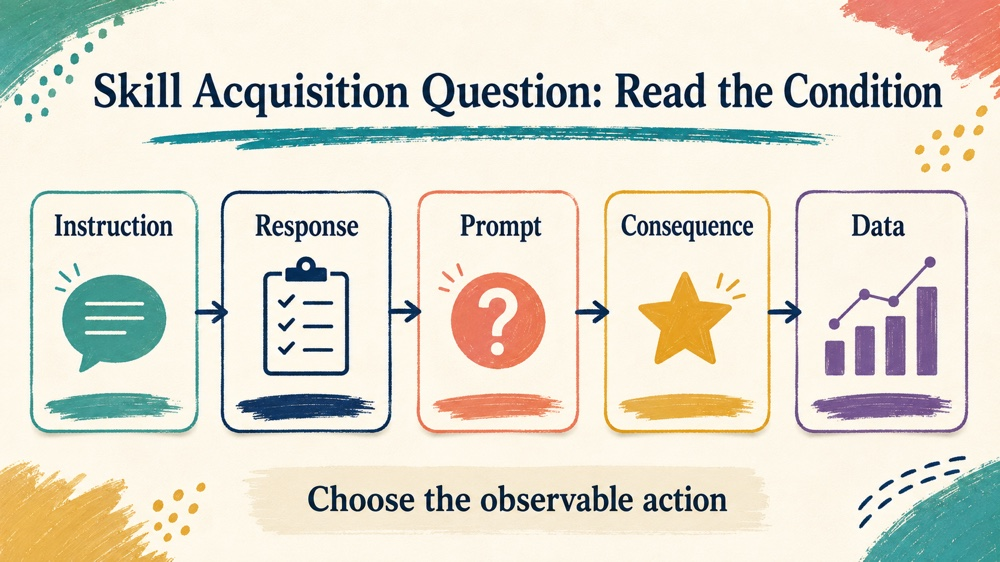
A good item contains a cue, learner response, current prompt or reinforcement arrangement, and a question about the next technician action. Read those facts before selecting a familiar term. The correct answer is usually the observable implementation that fits the plan, not the most ambitious clinical idea.
- Name the instruction or condition.
- Describe the response.
- Identify the programmed consequence or prompt.
- State what is recorded.
- Mark the handoff if the plan is unclear.
Practice reinforcement and prompting
Write original scenarios that distinguish reinforcement from a bribe, a prompt from an instruction, and prompt fading from simply removing assistance. Ask what the RBT does and what prompt level or independent response is recorded. The written program controls the schedule, materials, and criteria.
Use one changed variable at a time. If the consequence, prompt hierarchy, or mastery criterion is not given, the study answer should acknowledge the gap rather than invent a rule.
Practice shaping, chaining, and task analysis
For shaping, identify the successive approximation and the programmed consequence. For chaining, identify the step sequence and the direction of teaching. For task analysis, distinguish the listed steps from the learner’s performance. Examples should make the observable action and data rule clear.
Do not turn a definition into permission to redesign a task analysis. A technician implements as trained and reports barriers or unexpected patterns.
Practice discrimination, generalization, and maintenance
Ask whether the learner responds differently to relevant stimuli, whether a skill appears across people or settings, and whether it persists over time or after support changes. These terms refer to programmed conditions and observation, not automatic success.
Use scenarios that vary the instructor, materials, setting, or instruction. The learner should explain what is held constant, what changes, and what the RBT records.
Keep data and ethics in the question
Skill acquisition questions should include accurate data, objective notes, competence, supervision, confidentiality, and reporting. A teaching procedure cannot justify copying an answer, revealing client information, or skipping a required handoff. Put the ethical action beside the instructional action.
If a learner response or safety concern falls outside the plan, record the observation and follow the communication route rather than improvising.
Review RBT skill acquisition questions actively
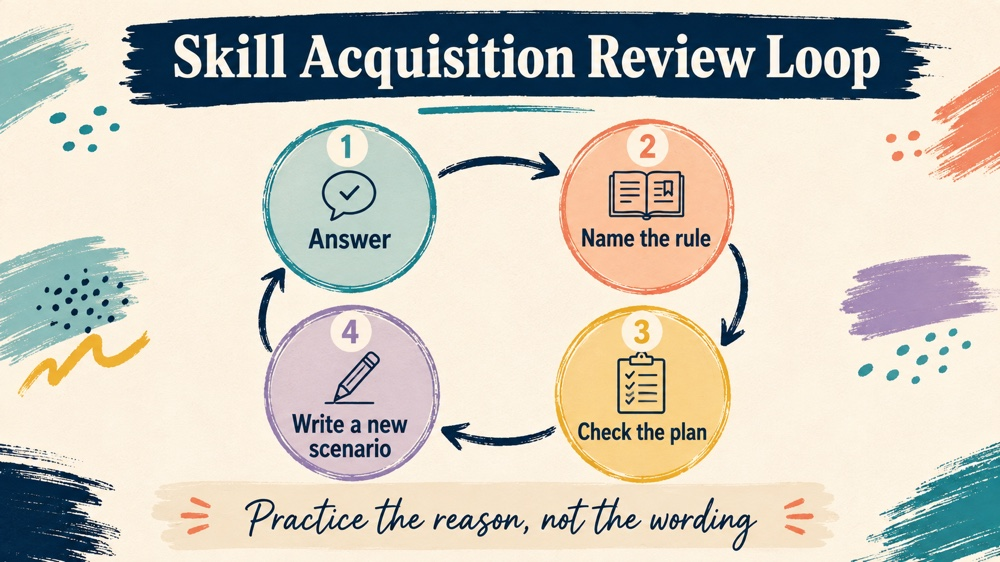
After each answer, explain why the chosen action fits the condition, name the data rule, and write a new scenario. Tag misses as vocabulary, prompt selection, reinforcement, sequence, generalization, data, or role boundary. Revisit the tag after a delay instead of memorizing the original wording.
The current examination includes 75 scored questions and 10 unscored pilot questions in a 90-minute testing period. Verify current official sources for time-sensitive exam context.
Avoid skill-acquisition question mistakes
- Choosing a procedure not stated in the plan.
- Confusing a prompt with reinforcement.
- Treating generalization or maintenance as automatic.
- Changing a mastery criterion independently.
- Ignoring data integrity or competence.
- Using recalled or protected examination questions.
- Writing an explanation without a role boundary.
RBT skill acquisition questions checklist
- Does each item include a clear teaching condition?
- Are prompting and reinforcement distinguished?
- Are shaping, chaining, discrimination, generalization, and maintenance represented?
- Is the data rule visible?
- Does the answer stay within implementation and supervision?
- Are examples original and privacy-safe?
- Does every miss create a new scenario?
Use RBT skill acquisition questions to practice reading conditions and choosing observable, source-linked actions. Keep program-specific decisions within the written plan and supervision. RBT Training is independent educational content and is not affiliated with or endorsed by BACB.
Practice the concept
Review rbt skill acquisition questions with original RBT scenarios, current-source reminders, and clear role boundaries.
Review the RBT study resource →
Frequently Asked Questions
What makes a skill-acquisition question useful?
It gives a clear condition, response, procedure, data implication, and role boundary.
Can an RBT question authorize a new teaching procedure?
No. The RBT follows the written program and supervision and reports barriers or concerns.
How should I review a missed item?
Name the controlling fact, check the source, explain the boundary, and write a new scenario.
Are these official questions?
No. They are original educational scenarios and are not official, recalled, leaked, or BACB-endorsed.
References
- Behavior Analyst Certification Board: Registered Behavior Technician Handbook, updated June 2026.
- Behavior Analyst Certification Board: RBT Test Content Outline (3rd ed.).
- Behavior Analyst Certification Board: RBT resources.
- Behavior Analyst Certification Board: ethics resources.
- Behavior Analyst Certification Board: RBT Ethics Code (2.0).