
RBT skills are easier to learn and evaluate when they are written as observable actions. “Be patient” may describe a helpful attitude, but it does not tell a trainee what to do, what a supervisor can observe, or what evidence shows improvement. A stronger skill statement is “waits for the programmed response interval, records the response using the defined code, and asks for direction when the plan is unclear.”
Table of Contents
- RBT skills: the six-domain map
- Data collection and analysis skills
- Assessment skills
- Behavior-change intervention skills
- Behavior-reduction intervention skills
- Documentation and reporting skills
- Ethics and professional skills
- How to build and measure RBT skills
- Original RBT skill examples
- Frequently Asked Questions
- References
The current RBT Test Content Outline, 3rd edition, describes 43 tasks across six domains. The current exam frame includes 75 scored questions and 10 unscored pilot questions among 85 presented questions. The skills below are an independent study map aligned to the current outline; they are not official, recalled, leaked, or BACB-endorsed questions. No skills list, practice score, or article guarantees certification or clinical results.
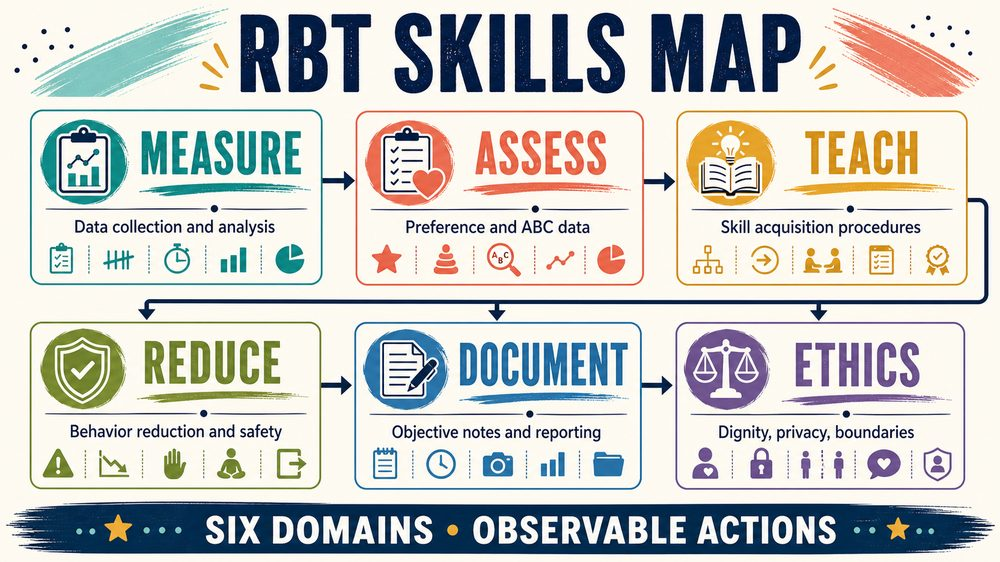
RBT skills: the six-domain map
| Domain | Observable skill family | Evidence of competence |
|---|---|---|
| Data Collection and Analysis | Measure, record, summarize, and notice data irregularities. | Accurate units, entries, graphs, and questions. |
| Assessment | Participate in preference, skill, and functional-assessment procedures as assigned. | Procedure fidelity and objective observation. |
| Behavior-Change Interventions | Teach skills using prompts, reinforcement, shaping, chaining, and generalization. | Correct steps, learner response, and programmed consequence. |
| Behavior-Reduction Interventions | Follow antecedent, differential-reinforcement, extinction, crisis, and safety procedures. | Plan fidelity, safety, and timely direction. |
| Documentation and Reporting | Write objective notes and communicate relevant changes or concerns. | Clear records that separate observation from interpretation. |
| Ethics | Protect dignity, privacy, boundaries, competence, and supervision relationships. | Stable role-safe decisions under pressure. |
If you are searching for RBT skills for a job interview, exam, or first session, use this map to move from a broad trait to a visible action and a way to check it.
Data collection and analysis skills
Data skills begin before the first trial. Read the operational definition, identify the measurement unit, check the data field, and ask about ambiguous examples. During the session, record close to the event and preserve distinctions such as independent versus prompted, correct versus incorrect, and no response when the program requires them.
- Select or use frequency, rate, duration, latency, interresponse time, interval, trial, or another defined measure accurately.
- Enter data without changing the graphing rule or silently filling missing values.
- Notice unusual patterns and report them rather than converting a guess into a fact.
- Use graphs and summaries to ask a useful question; do not make an independent treatment decision from a single data point.
For example: if a candidate records a response as correct because the learner eventually completed the task, the supervisor can ask whether the program defined prompted and independent responses separately. The skill is not just counting; it is matching the event to the measurement rule.
Assessment skills
An RBT may participate in assessment procedures under the assigned plan and supervision. Relevant skills include presenting choices for a preference assessment, recording selections, collecting ABC data, assisting with skill assessment procedures, and describing what was observed without claiming to identify function independently.
| Skill | Do | Do not infer |
|---|---|---|
| Preference assessment | Follow the presentation and recording procedure. | That a selected item will reinforce every response. |
| ABC data | Record antecedent, observable behavior, and consequence. | A confirmed function from one observation. |
| Skill assessment | Implement the assigned probe and record the response. | A new goal or treatment change outside direction. |
Behavior-change intervention skills
Teaching skills are procedural. The RBT should know the target response, instruction or opportunity, prompt, reinforcement, error-correction, and generalization components written in the plan. Common skill families include discrete-trial teaching, naturalistic teaching, chaining, shaping, discrimination training, prompt fading, token systems, and reinforcement.
Good implementation is neither mechanical nor improvised. Follow the procedure while observing communication, assent-related signals, motivation, safety, and barriers. If the learner’s response changes or the plan does not address the situation, document and seek clinical direction rather than inventing a new intervention.
Behavior-reduction intervention skills
Behavior-reduction skills require especially clear role boundaries. An RBT may implement antecedent interventions, differential reinforcement, extinction, crisis or emergency procedures, and replacement-skill teaching when trained and directed to do so. The RBT does not independently select an intervention because a behavior “looks like” a familiar function.
- Identify the antecedent or context the plan addresses.
- Deliver the programmed replacement response or consequence consistently.
- Follow safety and crisis protocols exactly, including when to pause and call for help.
- Record what occurred, what was implemented, and what needs supervisor review.
A skill is not demonstrated by suppressing a behavior at any cost. It is demonstrated by implementing the authorized plan accurately, protecting dignity, and escalating uncertainty.
Documentation and reporting skills
Documentation turns a session into information the team can evaluate. Strong notes describe observable events, relevant procedures, data patterns, communication, and safety or schedule changes. They avoid judgment labels, exaggeration, copied phrases that do not fit the session, and claims about thoughts or motives that were not measured.
| Weak wording | More useful wording |
|---|---|
| “The learner was manipulative.” | “After the instruction, the learner pushed the materials away and used the programmed break response.” |
| “The session went great.” | “The learner completed 8 of 10 independent opportunities after the programmed prompt delay.” |
| “Mom was difficult.” | “The caregiver requested a change to the target; the request was documented and routed to the supervisor.” |
Report errors and missing data through the authorized process. Accurate correction is a professional skill, not an admission that you cannot do the job.
Ethics and professional skills
Ethical RBT skills include protecting client information, maintaining dignity, staying within competence, using professional boundaries, responding to supervision, and self-reporting concerns. Communication is part of ethics: report facts clearly, avoid gossip, and use the approved channel for protected information.
- Privacy: protect records, devices, conversations, and media.
- Dignity: use respectful language and honor communication and choice procedures.
- Competence: request training or direction before performing an unfamiliar task.
- Boundaries: follow policy around gifts, relationships, social media, and personal contact.
- Supervision: bring specific questions and act on corrective feedback.
How to build and measure RBT skills
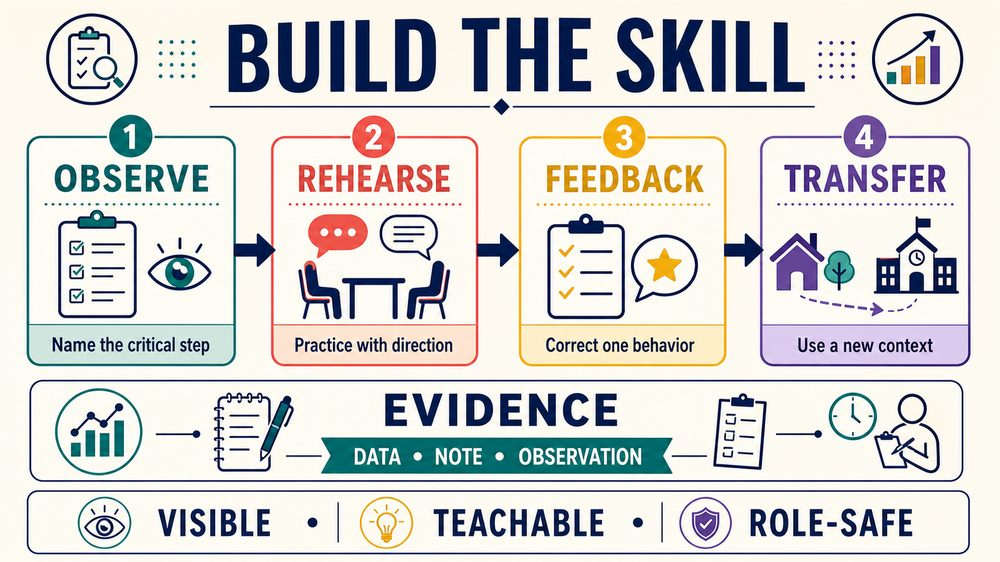
- Choose one action: “record prompted trials separately” is better than “improve data.”
- Define the criterion: decide what accuracy, timing, or fidelity will count as improvement.
- Observe a model: watch the supervisor or trainer perform the step and name the critical features.
- Rehearse: practice with role-play or an authorized client opportunity.
- Receive feedback: ask what to keep, what to change, and what to do if the context changes.
- Transfer: apply the skill with another permitted material, person, setting, or scenario.
- Document: record the next review rather than relying on confidence.
Use a simple matrix with columns for skill, current performance, feedback, next rehearsal, and evidence. Revisit it during supervision. A skill becomes useful when it stays accurate across appropriate contexts, not when it appears once in a flashcard.
Original RBT skill examples
Scenario 1—measurement: an RBT knows the definition of latency but starts the timer after searching for the stopwatch. Rehearse the timing setup and verify the program’s start and stop events.
Scenario 2—teaching: an RBT delivers a prompt immediately on every trial. Check the prompt-delay and fading procedure, then practice waiting for the defined opportunity.
Scenario 3—documentation: an RBT writes that a learner “refused to cooperate.” Rewrite the note with the observable response, context, consequence, and communication action.
Scenario 4—ethics: a colleague asks for a client video through a personal messaging app. Decline and use the authorized consultation channel.
These are newly written independent study examples, not official, recalled, leaked, or BACB-endorsed questions.
Bottom line: strong RBT skills are visible, teachable, measurable, and role-safe. Build them across all six current domains: measure accurately, implement the plan, document objectively, communicate clearly, use supervision, and protect the learner’s dignity and privacy.
Practice the skills behind the definition.
Use original RBT scenarios to apply data, teaching, behavior reduction, documentation, supervision, and ethics concepts.
Try free RBT practice questions →
Frequently Asked Questions
What are the most important RBT skills?
Start with accurate measurement, plan fidelity, teaching and behavior-reduction procedures, objective documentation, communication, supervision, and ethics. The current TCO organizes the work across six domains.
Are patience and empathy RBT skills?
They can support professional behavior, but convert them into observable actions such as waiting according to the plan, honoring communication, protecting dignity, and asking for direction.
Does an RBT need clinical decision-making skills?
An RBT needs to recognize uncertainty and seek clinical direction. The role does not authorize independent treatment design or unapproved changes.
How can I show RBT skills in an interview?
Give a specific situation, describe the observable action, explain the data or feedback, and state when you would involve the supervisor.
Are these skill examples official?
No. They are newly written independent study examples and are not official, recalled, leaked, or BACB-endorsed questions.
References
- Behavior Analyst Certification Board. RBT Test Content Outline (3rd ed.).
- Behavior Analyst Certification Board. RBT Handbook.
- Behavior Analyst Certification Board. Ethics Codes and RBT Ethics Code (2.0).
- Behavior Analyst Certification Board. RBT certification information.
- Behavior technician skills guide. Reviewed for competitor research; not an endorsement.