

RBT special education work is school-based behavior-analytic support delivered under ongoing supervision: the RBT implements authorized procedures, collects objective data, collaborates with the team, and stays within role boundaries.
Table of Contents
- What RBT special education work means
- The RBT role in a school day
- How to work with teachers and the school team
- Data collection and objective documentation
- Role boundaries: RBT, supervisor, and teacher
- Confidentiality in a special education setting
- When the classroom situation changes
- A school-based RBT workflow
- Common mistakes to avoid
- Frequently asked questions
- References
RBT PRACTICE GUIDE · SCHOOL-BASED SUPPORT
RBT Special Education: Roles, Boundaries, and School-Based Support
A practical guide to helping a school team implement behavior-analytic services while keeping instruction, supervision, data, and confidentiality clear.
RBT special education work is school-based behavior-analytic support delivered under ongoing supervision: the RBT implements authorized procedures, collects objective data, collaborates with the team, and stays within role boundaries. The setting can be busy, collaborative, and full of competing instructions, so the RBT needs a reliable way to know what to do, what to document, and when to ask for direction.
This article explains the professional role using the BACB RBT guidance and the 2026 Test Content Outline as a frame. A school district, employer, supervisor, or student’s authorized team may add procedures that vary by setting. This is not a legal interpretation of special education requirements, an IEP review, or permission to change a clinical or educational plan independently.
What RBT special education work means
The BACB describes an RBT as a paraprofessional who assists in delivering behavior-analytic services under the direction and close supervision of an RBT Supervisor and/or RBT Requirements Coordinator. In a special education setting, that work may occur in a classroom, resource room, hallway, cafeteria, playground, transportation routine, or another school-approved environment.
The word “support” is important. The RBT may help a student participate in instruction, practice communication, follow routines, use a replacement skill, or generalize a learned behavior across people and settings. The RBT is not automatically the student’s teacher, case manager, speech-language provider, or independent behavior analyst. The service arrangement and the authorized plan determine the RBT’s tasks.
Good school-based practice joins two kinds of information without confusing them: the teacher understands the educational routine and classroom demands, while the behavior-analytic team brings procedures, measurement, and supervisor direction. The RBT helps connect those perspectives through respectful communication and observable data.
The RBT role in a school day
A school-based RBT may be asked to implement teaching or behavior-reduction procedures, arrange materials, deliver reinforcement, prompt and fade assistance, collect data, and report what occurred. The 2026 TCO also emphasizes generalization, so the RBT may practice a skill across a classroom activity, a transition, a peer interaction, or another authorized routine.
Before a session or school block, confirm:
- which student and setting you are assigned to support;
- which current plan, targets, data definitions, and safety procedures apply;
- who is providing clinical direction and how to reach that person;
- which classroom routines or schedule changes the teacher wants you to know;
- what materials, data forms, and privacy rules the school or employer requires.
During the session, implement only procedures for which you have demonstrated competence and that are within the current direction. If a student presents a new concern, a dangerous situation, a medication or schedule change, or a request to improvise a new intervention, pause at the appropriate point and seek supervisor direction rather than treating confidence as authorization.
How to work with teachers and the school team
The TCO asks RBTs to communicate concerns and suggestions from the intervention team with a supervisor in a timely manner. In practice, a teacher may notice that a transition is unusually difficult, a paraprofessional may report a change in routine, or a related-service provider may suggest a different opportunity to practice a skill. Listen, clarify the observable information, and route clinical decisions to the supervisor.
Use a short handoff structure:
- Situation: identify the activity, time, and relevant change.
- Observation: describe what the student did or what the environment did.
- Current response: state the procedure you used from the authorized plan.
- Question: ask the supervisor or designated team member for the next direction.
For example, “During independent math at 10:10, the fire drill announcement interrupted the planned transition. The student covered their ears and left the assigned area. I followed the current safety procedure and notified the teacher. Should I record this as a schedule variable and what follow-up should I send to the supervisor?” is more useful than “The student was noncompliant today.”
Data collection and objective documentation
School activity can make data collection difficult because lessons move quickly and several adults may speak at once. Confirm the operational definition, measurement method, and recording window before the activity starts. If the definition is unclear, ask the supervisor. Do not change the measurement method mid-session just to make the data easier.
Objective notes describe observable behavior and relevant conditions. Include the activity, who was present when relevant, what happened before and after, the procedure implemented, the measurement, and any unusual variable that may affect progress. Avoid diagnosing a student, guessing a motive, blaming a teacher, or writing that a student “wanted attention” unless the authorized documentation specifically requires a defined clinical term and you have direction to use it.
The TCO’s documentation and reporting domain includes reporting variables that might affect progress and communicating objectively what occurred during the session. A schedule change, illness notice, substitute teacher, missing material, unusual noise, or altered staffing may be relevant. Report it as a fact and let the supervisor determine how it affects interpretation or treatment.
Role boundaries: RBT, supervisor, and teacher
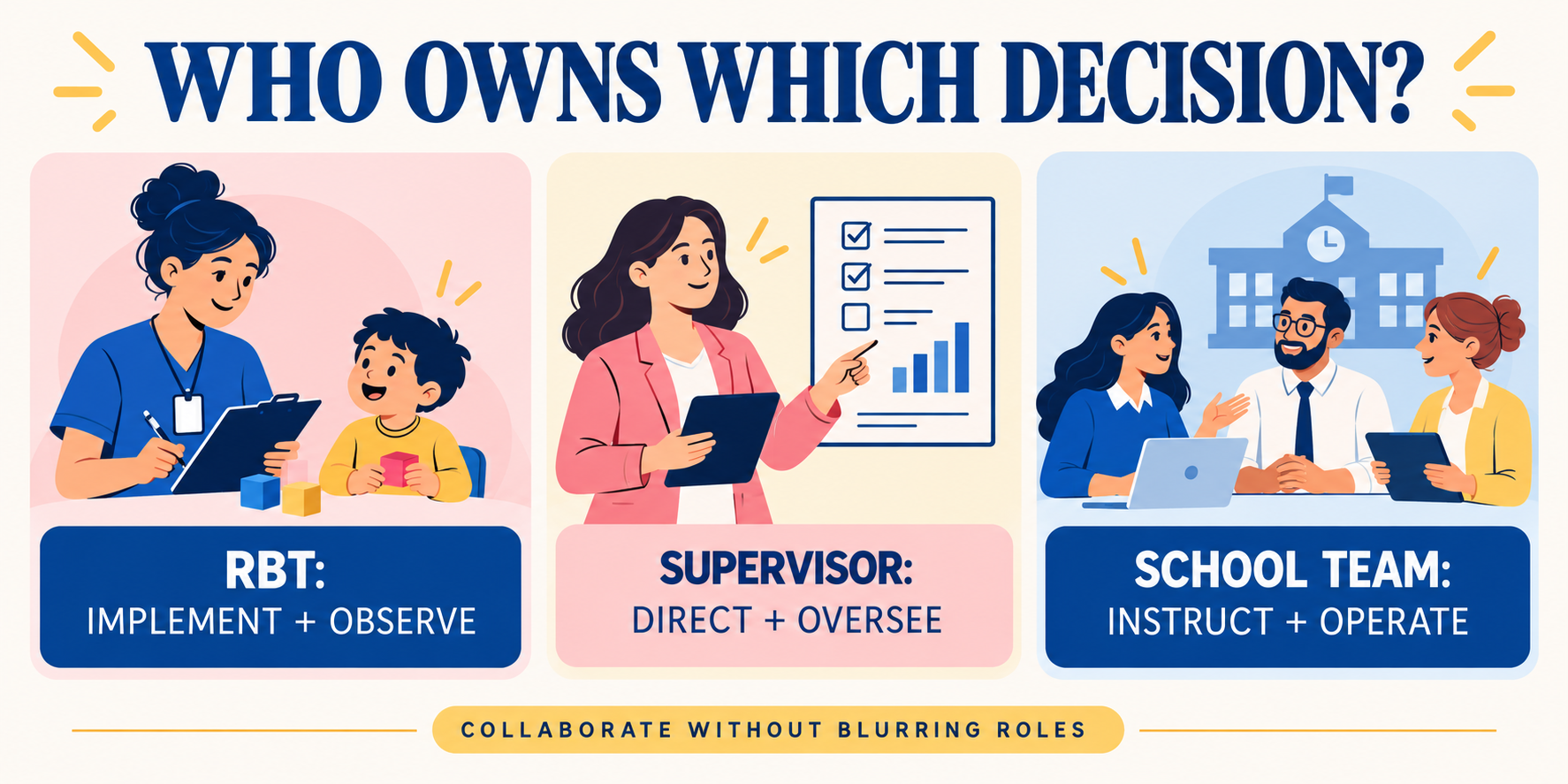
Clear boundaries make teamwork safer. The RBT can implement, measure, observe, communicate, and ask for direction. The supervisor provides clinical oversight and decides whether a procedure, target, or modification is appropriate. The teacher and school team manage instruction, classroom operations, and school responsibilities within their roles. These responsibilities can overlap in conversation, but overlap does not mean everyone has the same authority.
Do not independently rewrite a behavior plan, create a new target, remove a procedure, promise a school accommodation, or tell a family that a service will continue in a particular way. If a teacher asks you to try something outside the current direction, acknowledge the request, protect the student’s safety, and contact the supervisor or designated chain of command. If an immediate safety procedure applies, follow that procedure first and document what occurred.
Confidentiality in a special education setting
Schools contain sensitive information: student names, disability-related information, progress data, family communications, health details, and classroom records. The RBT must follow applicable confidentiality requirements as well as employer and school procedures for collecting, using, storing, protecting, and disclosing information.
Use only approved systems and share information with people who are authorized and need it for their role. Avoid discussing a student’s case in hallways, staff rooms, personal messaging apps, or public social media. Do not take classroom photographs or copy school records to a personal device unless the authorized policy specifically permits it. When asking a supervisor for help, remove unnecessary identifying details from informal notes and use the secure route for records.
When the classroom situation changes
A school day rarely follows the plan perfectly. The student may be absent, the schedule may change, the teacher may be replaced, a fire drill may occur, or an activity may be moved to a different room. First identify whether the current plan includes a response. Then tell the responsible school contact and supervisor what changed, what you observed, and what you did.
If the change creates an immediate risk, use the approved safety or crisis procedure and notify the appropriate person. If it simply changes the opportunity for a target, record the variable and ask whether to reschedule, collect a different authorized measure, or end the block. The RBT’s responsibility is not to make the day look typical; it is to provide accurate, safe, and supervised service.
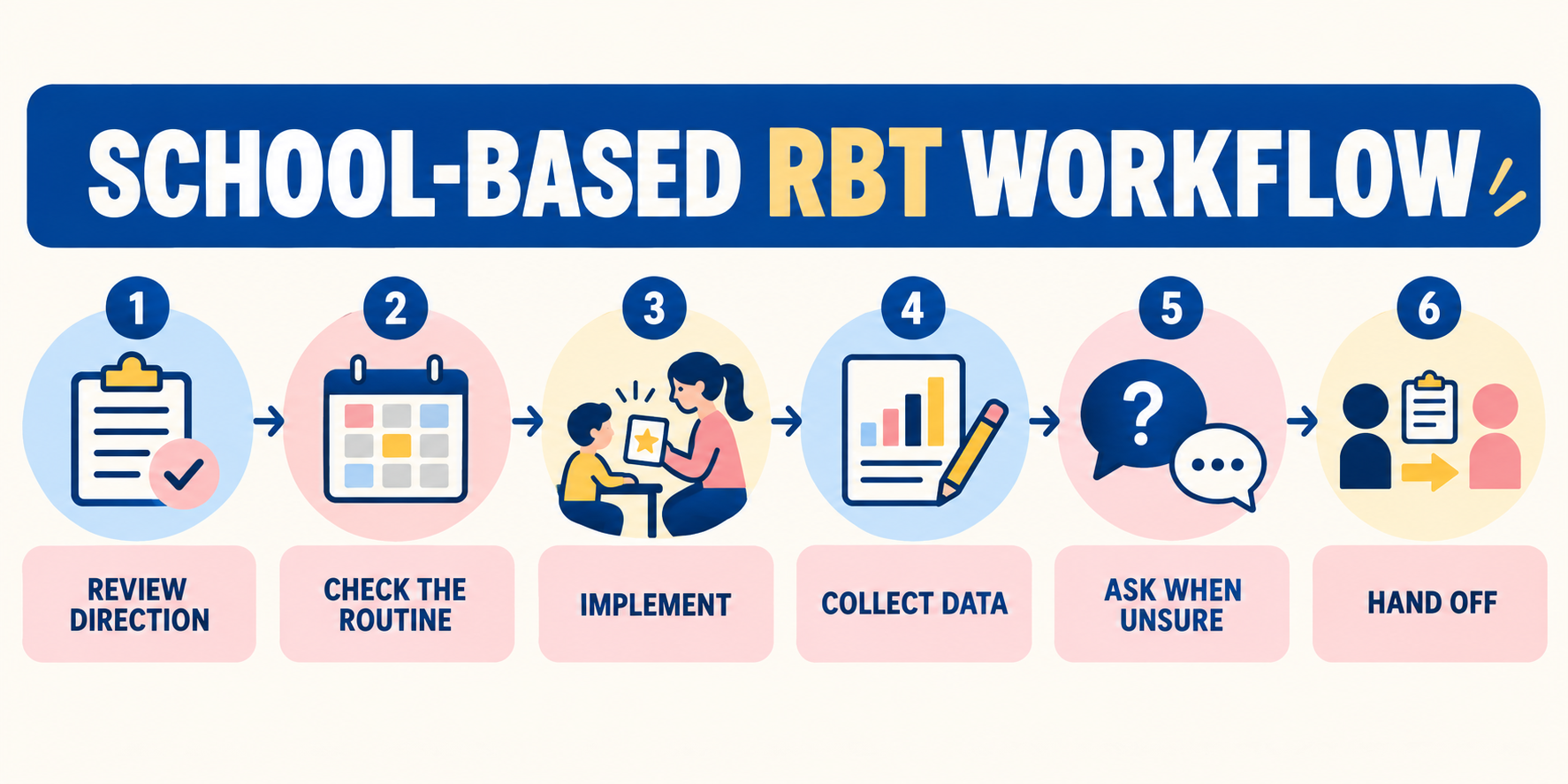
A school-based RBT workflow
- Before the block: review current direction, targets, materials, data definitions, and school-specific procedures.
- At handoff: ask the teacher about relevant routine changes and share the communication route for concerns.
- During instruction: implement authorized procedures, support participation, and collect the planned data.
- When uncertain: pause, use the chain of command, and seek clinical direction before improvising.
- At documentation: record observable events, data, variables, and follow-up actions without unnecessary student details.
- After the block: give a concise handoff and identify any item that needs supervisor review.
Common mistakes to avoid
- Acting as the classroom’s independent behavior expert: the RBT works under supervision and within the assigned role.
- Changing a procedure because it seems logical: report the problem and seek direction before modifying the plan.
- Writing school labels instead of observations: record what happened, the context, and the measurement.
- Ignoring educational context: a lesson, transition, peer activity, or schedule change can affect the data and should be communicated.
- Sharing information casually: use authorized systems and follow the school and employer’s privacy procedures.
- Promising a family or teacher a clinical answer: acknowledge the question and route it to the supervisor or responsible school team.
Frequently asked questions
Does an RBT replace a special education teacher?
No. An RBT assists with behavior-analytic services under supervision. The teacher and school team retain their educational and classroom responsibilities, while the supervisor provides clinical direction for behavior-analytic services.
Can an RBT change a student’s IEP or behavior plan?
An RBT should not independently change educational goals, accommodations, or clinical procedures. Share observations and concerns through the designated team and supervisor channels so an authorized person can decide what happens next.
What should an RBT do if a teacher gives a different instruction?
Clarify whether the instruction is a routine classroom direction or a request to change the behavior-analytic procedure. Follow immediate safety procedures, avoid arguing in front of the student, and contact the supervisor or chain of command when the request conflicts with the current plan or your training.
Is every school-based RBT arrangement the same?
No. Employers, districts, supervisors, classroom models, schedules, data systems, and authorization arrangements differ. Use this guide for role principles, then follow the current written direction and local procedures for the specific setting.
Strong RBT work in special education is visible in the details: accurate implementation, respectful collaboration, objective documentation, protected student information, and timely questions when the situation falls outside the current direction. Those habits help the school team support the student without blurring who is responsible for each decision.
Ready to practice the RBT concepts you just reviewed?
Try an independent, original RBT practice resource with exam-style questions, scoring, and answer explanations.
References
- Behavior Analyst Certification Board. RBT Test Content Outline, 3rd edition.
- Behavior Analyst Certification Board. RBT Handbook.
- Behavior Analyst Certification Board. RBT Ethics Code.