
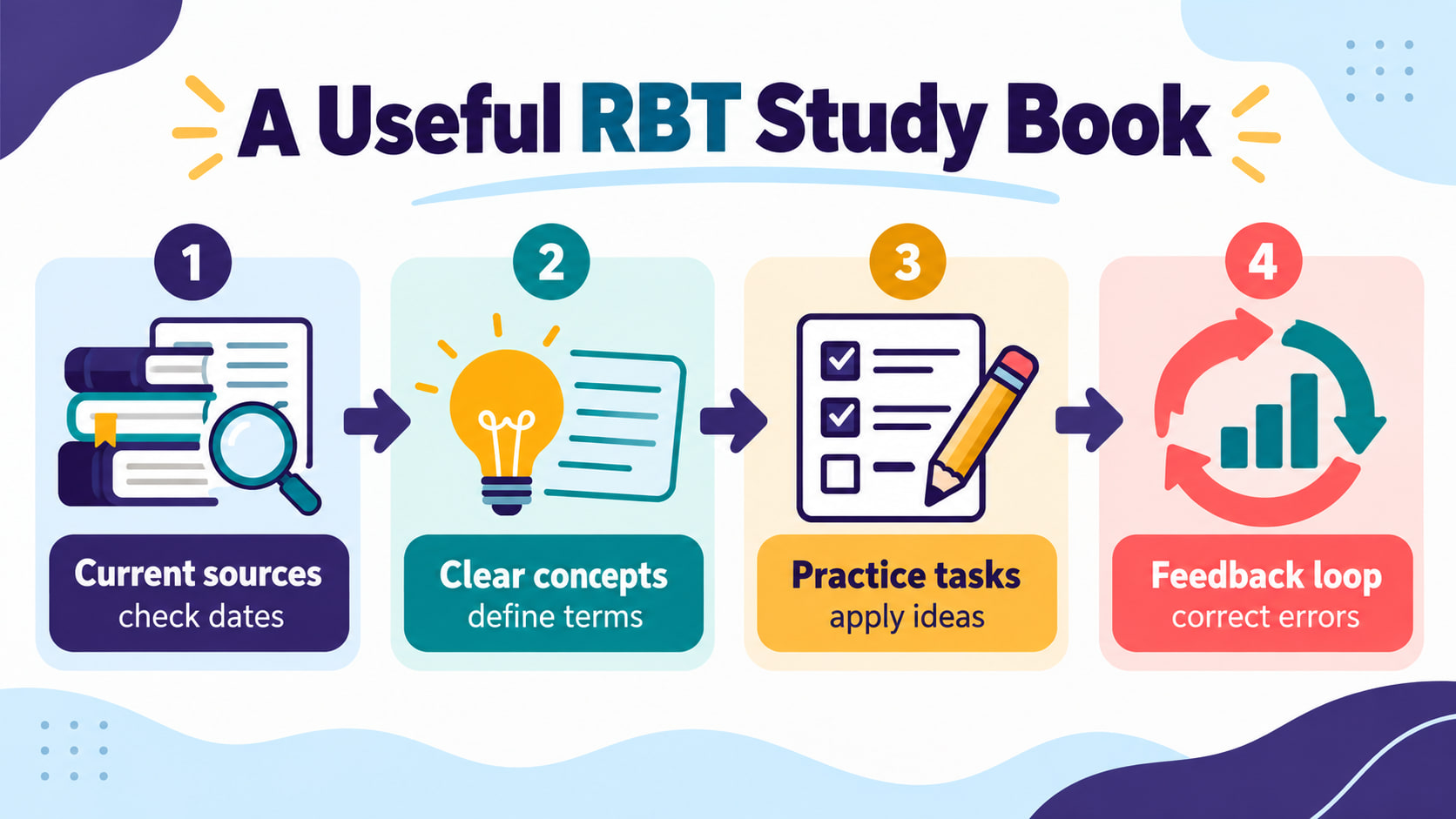
An RBT study book is most useful when it turns current source material into clear concepts, practice tasks, feedback, and a realistic review routine.
Table of Contents
- Start with the purpose of an RBT study book
- Check whether the resource is current
- Look for clear concepts
- Choose practice over passive reading
- Use feedback to find gaps
- Build a realistic study session
- Avoid common study-book mistakes
- Frequently asked questions
- References
RBT STUDY · RESOURCE REVIEW
RBT Study Book: How to Choose a Useful Resource
A practical way to compare study resources and build review sessions that improve understanding.
An RBT study book is most useful when it turns current source material into clear concepts, practice tasks, feedback, and a realistic review routine. A book can organize learning, but it is not automatically an official source, an examination, a credential, or a guarantee. Use it as a study aid and keep current BACB materials as the reference for process and content.
Before choosing a resource, decide what you need. You may want an introduction, a topic-by-topic review, practice questions, a quick refresher, or a way to organize notes. A book that is excellent for a beginner may be too broad for final review, while a question bank may be useful only after you understand the underlying concepts.
Start with the purpose of an RBT study book
Write one sentence describing your study goal. For example: “I need to understand measurement terms and explain when each system is appropriate.” This is more useful than “I need to read everything.” Your goal helps you select chapters, take notes, and decide whether an explanation actually answered your question.
Separate learning from testing. During learning, pause to define terms, compare examples, and explain a procedure in your own words. During testing, answer without looking at the explanation and then review why each option is correct or incorrect. If a book encourages memorizing a phrase without understanding the situation, add your own example or consult the current source material.
Check whether the resource is current
Look for a publication date, revision date, edition information, and a statement about how updates are handled. Then compare the resource’s claims with current official materials. A website or book can remain online long after a process, handbook, content outline, or ethics document has changed.
Pay special attention to claims about eligibility, application steps, examination content, supervision, renewal, and ethics. Those claims should be checked rather than accepted because a cover says “complete” or “latest.” If a resource links to primary materials, open the links and record the date you checked them.
Look for clear concepts
A useful resource defines terms in observable, practical language. It should help you distinguish what was seen or measured from an interpretation about a person’s motivation. It should explain how examples connect to a procedure, not merely list vocabulary.
Review the organization of each chapter. Are objectives stated? Are key terms revisited? Are examples fictional and clear about what is being measured? Does the chapter identify common errors? A good structure lets you return to one topic later without rereading the entire book.
Look for balanced coverage. An attractive resource may spend many pages on familiar introductory terms and very little on documentation, professional conduct, or role boundaries. Use the current content outline to identify topics that deserve attention, then mark any area the book treats briefly or ambiguously for additional review.
Choose practice over passive reading
Reading feels productive, but retrieval and application show whether you can use the information. After a section, close the book and write a short definition. Then create a fictional example, identify the observable behavior, choose a measurement approach, or explain what question you would take to a supervisor.
Practice questions are valuable when explanations teach a decision process. Do not treat a question bank as a list of answers to memorize. Ask what information in the scenario matters, what information is missing, and why a tempting answer is not appropriate. Never assume that a commercial question is an official or recalled examination item.
Protect privacy while practicing. Use original or fully fictional scenarios. Do not paste real client notes, photographs, identifiers, or screenshots into a study document or online group. A study resource should improve knowledge without creating a confidentiality problem.
Use feedback to find gaps
When you miss a question, label the error. Was it a definition problem, a measurement problem, a reading mistake, a role-boundary mistake, or a failure to notice a condition in the scenario? This turns a wrong answer into a next action. Write the corrected principle in one sentence and revisit it later.
Feedback can come from an answer explanation, instructor, supervisor, or peer study partner, but the source matters. A peer can help you notice a confusing phrase; a supervisor or responsible professional should guide questions about actual assigned work, client-specific procedures, or uncertain ethics decisions. A book cannot replace that direction.
Build a realistic study session
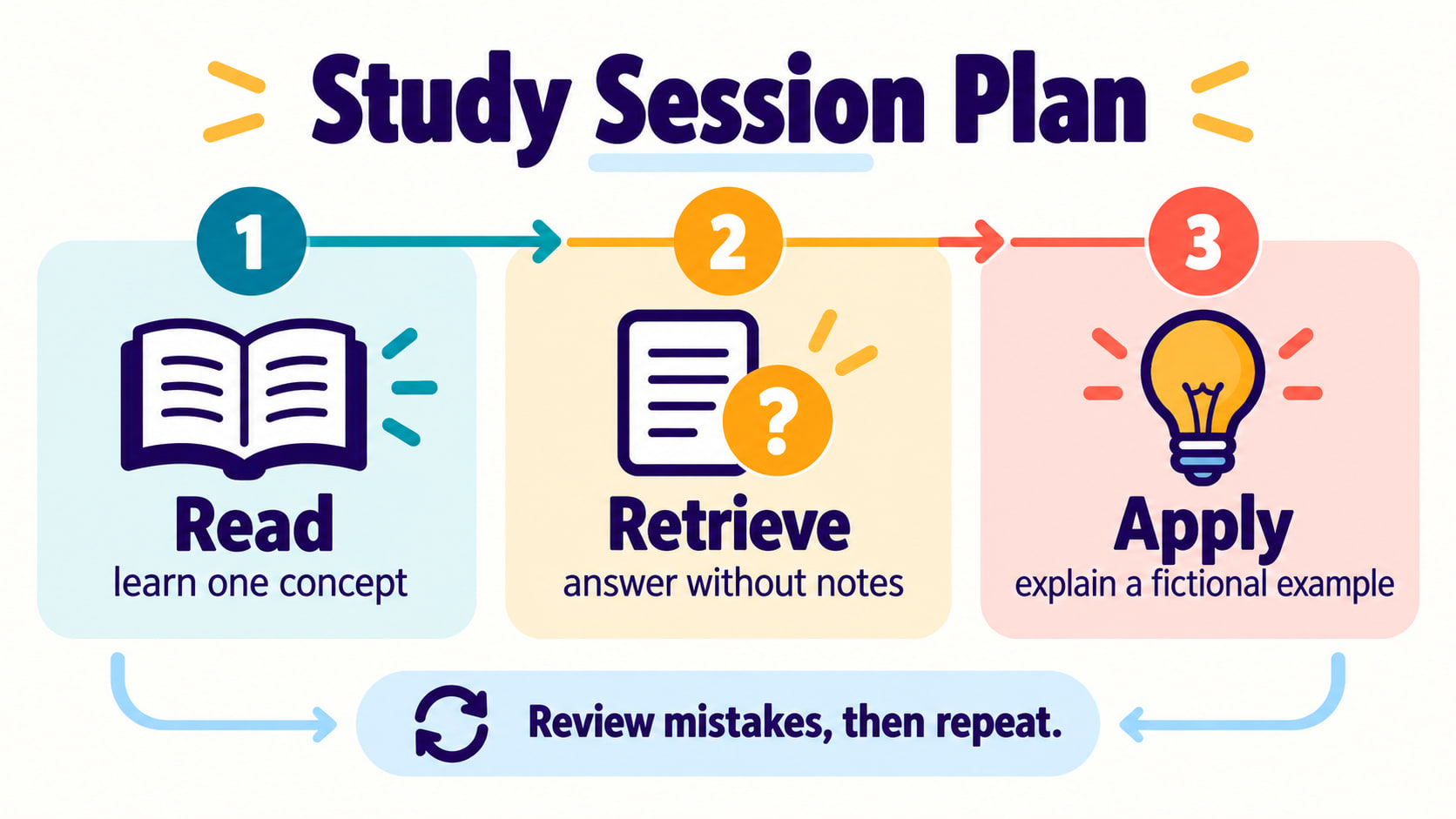
A short repeatable routine often works better than an ambitious schedule that collapses. Start with one concept, retrieve it without notes, apply it to a fictional example, and review the mistake. Keep a list of terms or questions that need another pass. End by choosing the next small target, not by trying to cover every chapter.
Use mixed review after you have learned several topics. For example, alternate a measurement question with a skill-acquisition question and a professional-conduct question. This helps you practice identifying which concept applies instead of relying on the order of a chapter.
Keep a source log. Record the title or link, edition or revision date, topic checked, and any question that remains open. When a resource and an official source disagree, pause and verify the current source. Do not resolve the conflict by choosing the sentence that sounds more confident.
Avoid common study-book mistakes
- Choosing by cover alone: attractive design does not show current coverage or useful feedback.
- Reading without retrieval: familiarity can feel like mastery when you have not explained the idea yourself.
- Memorizing unofficial questions: commercial practice items are not automatically official examination material.
- Ignoring role limits: a study example should not encourage independent clinical decisions.
- Using old process advice: confirm current requirements through official materials.
- Studying real client information: replace it with fictional examples to protect privacy.
The best RBT study book is the one you can use critically. Check its currency, map it to current sources, practice retrieval, review mistakes, and ask a qualified person when a question reaches beyond general study. That process is more durable than chasing a promise that one book contains every answer.
Frequently asked questions
Is a commercial RBT study book official?
Not automatically. Check the publisher and compare claims with current BACB materials. A commercial resource should not be treated as an official examination source unless the relevant authority explicitly identifies it that way.
Should I read an entire book before practicing?
Usually, no. Short cycles of reading, retrieval, application, and feedback can show gaps earlier and keep study focused.
Can a study book replace supervision?
No. A book can support general learning, but it cannot replace required supervision, feedback on assigned work, or direction for client-specific and ethical questions.
How do I know whether a study resource is outdated?
Check its edition and revision date, inspect its links, and compare process claims with current official materials. Ask the provider how updates are communicated.
Source note: Review current BACB materials, employer requirements, applicable policies, approved systems, and supervisor direction for your setting. This article is educational and does not provide individualized legal, clinical, employment, or credentialing advice.
Ready to practice the RBT concepts you just reviewed?
Try an independent, original RBT practice resource with exam-style questions, scoring, and answer explanations.
References
- Behavior Analyst Certification Board. RBT Test Content Outline, 3rd edition.
- Behavior Analyst Certification Board. RBT Handbook.
- Behavior Analyst Certification Board. RBT Ethics Code.