
An rbt study guide pdf can be a useful center for exam preparation because it is searchable, printable, and easy to annotate. The file itself is not the study method, though. Before you rely on one, check its edition, source links, six-domain coverage, examples, and correction space. Then use it to make decisions instead of reading pages passively.
Table of Contents
- What an RBT study guide PDF should contain
- Check an RBT study guide PDF source
- Map an RBT study guide PDF to the TCO
- Separate official facts from PDF notes
- Use an RBT study guide PDF weekly
- Make an RBT study guide PDF printable
- Turn PDF misses into new practice
- Avoid these RBT study-guide PDF mistakes
- Frequently Asked Questions
- References
This guide gives you a practical way to choose and use an RBT study guide PDF with the current BACB RBT Test Content Outline, 3rd edition, as the content map. The current BACB Handbook and official assessment materials control credentialing, examination, and competency-assessment information. An independent study guide can organize learning; it cannot replace those primary documents, supervision, an initial competency assessment, or the written plan for client services.
RBT Training is not affiliated with, operated by, or endorsed by the Behavior Analyst Certification Board (BACB). The examples below are newly written for independent study. They are not official, recalled, leaked, or BACB-endorsed questions, and no PDF or practice score can guarantee a passing result or certification.
What an RBT study guide PDF should contain
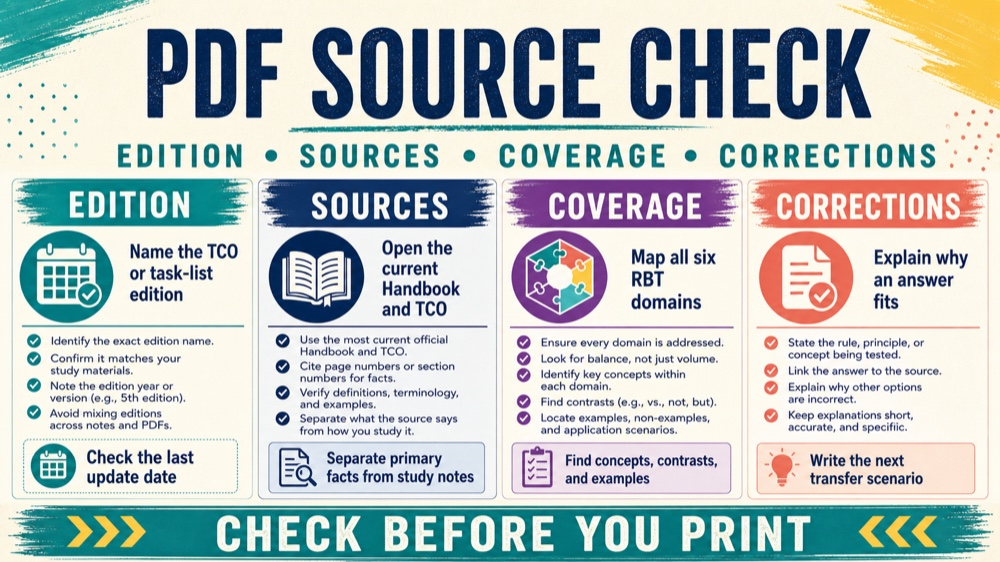
A useful rbt study guide pdf should answer five questions before you download or print it:
- Which edition? Does it state the task-list or TCO edition and its last update date?
- Which source? Can you open links to the current Handbook, TCO, and applicable ethics or assessment materials?
- Which coverage? Does it identify all six current domains instead of using a vague “RBT topics” label?
- Which decision? Do explanations connect concepts to observable facts, procedures, and role-safe actions?
- Which correction? Is there space to record the error, the contrast, and the next example to solve?
Page count is not evidence of quality. A short file with clear source labels and useful contrasts may teach more efficiently than a long download that mixes old requirements, definitions, and unsupported claims. Look for the author, publication date, version label, references, and independent-content disclaimer.
| Feature | Good signal | Warning signal |
|---|---|---|
| Edition | Names the current TCO or explains an older edition. | Uses “updated” without a date or edition. |
| Sources | Links to primary BACB documents. | Only cites search snippets or anonymous summaries. |
| Examples | Original scenarios with observable clues. | Claims to reproduce real or recalled questions. |
| Coverage | Maps concepts to domains and task areas. | Repeats one favorite topic and ignores documentation or ethics. |
| Corrections | Explains why distractors fail and what to review next. | Lists an answer without a reason. |
For example, a guide that defines frequency but never asks you to distinguish frequency from rate has not finished the measurement decision. Add a contrast note: frequency is a count, while rate relates a count to a unit of time. The card or page should state exactly what the scenario gives you.
Check an RBT study guide PDF source
Run a source check before highlighting an rbt study guide pdf:
- Write down the file name, edition, author, and update date.
- Open the linked current BACB TCO and compare the domain names.
- Open the current Handbook and compare any examination-format numbers.
- Separate official requirements from independent explanations and original practice.
- Mark claims that use “official,” “real,” “recalled,” “leaked,” or “endorsed” language for removal or verification.
- Save the next source-review date on the first page.
An older PDF is not automatically useless, but its credentialing details, blueprint language, or examples may require a careful update. Do not assume that a current-looking cover means current content. A hosted document, marketplace listing, or review page is not a substitute for reading the primary source.
The initial competency assessment also has its own official boundary. A study guide may help you review concepts, but it does not complete the assessment, attest to performance, or authorize an RBT to perform a procedure outside training and supervision. Keep that distinction visible in your notes.
Map an RBT study guide PDF to the TCO
Use the current RBT Test Content Outline, 3rd edition, as a coverage audit. It organizes 43 tasks across six domains:
| Domain | Tasks / outline share | What to locate in the PDF |
|---|---|---|
| A. Data Collection and Graphing | 13 / 17% | Operational definitions, measurement systems, data sheets, and graphs. |
| B. Behavior Assessment | 8 / 11% | Assigned assessment procedures, direct observation, preference, and skill assessment. |
| C. Behavior Acquisition | 19 / 25% | Teaching steps, prompting, reinforcement, maintenance, and generalization. |
| D. Behavior Reduction | 14 / 19% | Plan fidelity, antecedent or replacement-skill procedures, safety, and reporting. |
| E. Documentation and Reporting | 10 / 13% | Objective notes, data accuracy, privacy, and communication routes. |
| F. Ethics | 11 / 15% | Competence, supervision, dignity, confidentiality, and boundaries. |
The percentages help you distribute study time; they do not create a separate personal score for each domain on the certification examination. Also keep the official exam format separate from a PDF’s practice set. The current Handbook describes 75 scored questions, 10 unscored pilot questions, four answer choices, and a 90-minute time limit. A PDF may contain 20, 60, or 85 independent practice questions, but that count does not reproduce or predict the secure examination.
For example, if a guide contains ten pages on skill acquisition but only one paragraph on documentation, flag the imbalance and add original practice for objective notes, data integrity, confidentiality, and reporting. “All six domains” should mean usable decisions, not only six headings in a table of contents.
Separate official facts from PDF notes
Use three labels while reading:
- PRIMARY SOURCE: a current statement checked against a BACB document, with the title, edition, and date.
- STUDY NOTE: an independent explanation that translates the concept into plain language.
- ORIGINAL PRACTICE: a newly written scenario, answer explanation, or contrast.
This system prevents a study note from quietly becoming a made-up requirement. It also makes maintenance faster: if the Handbook changes, you can update the primary-source box without rewriting every concept page.
Use the same labels for images, worksheets, and flashcards. A graphic can be colorful and easy to remember without being official. The label should tell a learner whether it is a source fact, an interpretation, or practice created for learning.
Use an RBT study guide PDF weekly
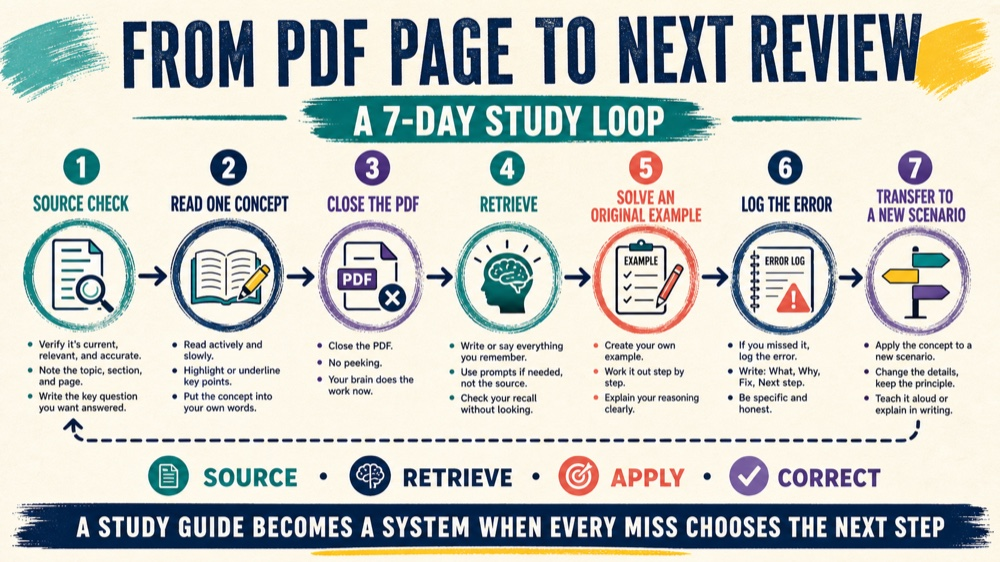
A practical weekly cycle keeps the file connected to retrieval and application:
| Day | Study action | Evidence to save |
|---|---|---|
| Day 1 | Source and edition check; map the six domains. | One-page source register and missing-coverage list. |
| Day 2 | Review one measurement or assessment concept. | One plain-language rule and one contrast. |
| Day 3 | Review acquisition and reduction procedures. | One plan-based scenario and one correction. |
| Day 4 | Review documentation, reporting, and ethics. | One objective-note rewrite and one boundary decision. |
| Day 5 | Close the PDF and retrieve mixed concepts. | Confidence mark and error category for each miss. |
| Day 6 | Complete original scenario practice. | Changed-fact transfer item for each repeated error. |
| Day 7 | Review corrections and choose the next domain. | Next week’s three highest-value targets. |
For example, after studying latency, close the file and describe a timeline from instruction to response onset. Then contrast it with duration, which begins at response onset and continues until the response ends. If your explanation cannot name the start and stop points, return to the concept page before adding more terms.
Keep the role boundary visible. If a scenario asks what to do when the written plan is unclear, the study answer may be to follow existing direction, record observable facts, and contact the responsible supervisor. A PDF is not permission to change a prompt hierarchy, assessment, intervention, or safety procedure.
Make an RBT study guide PDF printable
Before printing, test one page in color and grayscale. A useful page should have:
- A heading that identifies one concept or task area.
- Readable body text with enough spacing for annotation.
- A source label that can be checked later.
- An observable example and a nearest contrast.
- A correction box with room for the next transfer scenario.
- Page numbers and a simple domain tag.
Do not let visual polish hide academic gaps. A page can use a strong color system while still needing a source check. If a diagram uses arrows or icons, confirm that the direction matches the written explanation. Keep important text as selectable text when possible, and do not rely on color alone to communicate a distinction.
For a digital PDF, add bookmarks or a linked table of contents. For a printed PDF, add tabs or a domain index. The goal is to reduce search friction so more of your time goes to retrieval, application, and correction.
Turn PDF misses into new practice
For every missed page or question, record five fields:
- Concept: the domain and term.
- Observable clue: what the scenario actually gave you.
- Your error: wrong measurement, unsupported interpretation, plan change, scope problem, or privacy risk.
- Correct rule: one sentence that explains the decision.
- Transfer item: a new original scenario with one fact changed.
The examples below are newly written for independent study. They are not official, recalled, leaked, or BACB-endorsed questions:
- Measurement: a response occurs 12 times during a session. Identify the count before choosing a measure that includes time.
- Assessment: an assigned preference procedure lists the order, but one item is missing. Follow the procedure and ask the supervisor rather than silently replacing it.
- Acquisition: a learner responds independently under the written teaching plan. Record the response and do not add an unnecessary prompt.
- Documentation: replace “was unmotivated” with observable events, the presented instruction, the response, and the consequence.
- Ethics: do not share a recognizable client story with a friend; protect confidentiality and use approved professional communication.
When an error repeats, create a contrast page or flashcard instead of rereading the same paragraph. That turns a static PDF into a living study system.
Avoid these RBT study-guide PDF mistakes
- Using an older edition without a comparison: identify what needs updating against the current TCO.
- Confusing a PDF with an official document: verify the publisher and follow primary BACB links.
- Studying only page summaries: close the file and retrieve the concept from an observable scenario.
- Counting pages instead of decisions: add contrasts, explanations, and next actions.
- Using official-sounding or recalled material: write original practice instead.
- Changing procedures from a study note: follow the written plan and supervision route.
- Sharing identifying examples: keep practice fictional and non-identifying.
Bottom line: choose an RBT study guide PDF by its source, edition, six-domain coverage, decision quality, and correction design. Use the current BACB documents for official facts, convert every reading into retrieval and application, and let each mistake determine the next page or practice item.
Ready to compare study materials?
Compare the RBT exam-prep pack with your source checklist, six-domain map, and correction plan.
Compare RBT Exam Prep Materials →
Frequently Asked Questions
Is every RBT study guide PDF current?
No. Check the edition, update date, source links, and relationship to the current BACB Handbook and TCO.
Can an RBT study guide PDF replace the Handbook?
No. Use the primary BACB documents for credentialing, assessment, and examination facts. Use an independent guide as a learning aid.
How should I study from a PDF?
Read one concept, close the file, retrieve the rule, solve an original example, and record the correction and next transfer item.
Can a study guide guarantee a passing result?
No. A study guide or practice score cannot guarantee assessment completion, a passing result, or certification.
References
- Behavior Analyst Certification Board. RBT Test Content Outline, 3rd edition.
- Behavior Analyst Certification Board. RBT Handbook, updated June 2026.
- Behavior Analyst Certification Board. RBT Initial Competency Assessment Packet.
- Behavior Analyst Certification Board. RBT Ethics Code.