

RBT supervision and training work together: training builds knowledge and practice, while supervision connects that learning to the current program, client context, data system, feedback, and role boundaries. A strong process makes expectations clear and gives the RBT a route to ask, correct, and improve.
Table of Contents
- RBT supervision and training: the short answer
- Start with clear direction
- Turn knowledge into practice
- Use observation to check performance
- Make feedback specific and usable
- Document questions and follow-up
- Supervision and training checklist
- Frequently asked questions
RBT training, supervision, practice, feedback, and follow-up
RBT Supervision and Training: Direction, Practice, and Feedback
Connect learning to the current program through observable practice, review, feedback, and documentation.
RBT supervision and training work together, but they are not the same activity. Training builds knowledge and practice. Supervision connects that learning to the current program, client context, data system, feedback, and role boundaries. A strong process makes expectations clear and gives the RBT a route to ask, correct, and improve before a small uncertainty affects service quality.
BACB describes RBTs as paraprofessionals who deliver behavior-analytic services under the direction and close supervision of an RBT Supervisor and/or RBT Requirements Coordinator responsible for their work. The current Handbook, supervisor relationship, employer process, written program, payer requirements, and applicable law control the details. This article is an educational workflow, not an official supervision plan.
RBT supervision and training: the short answer
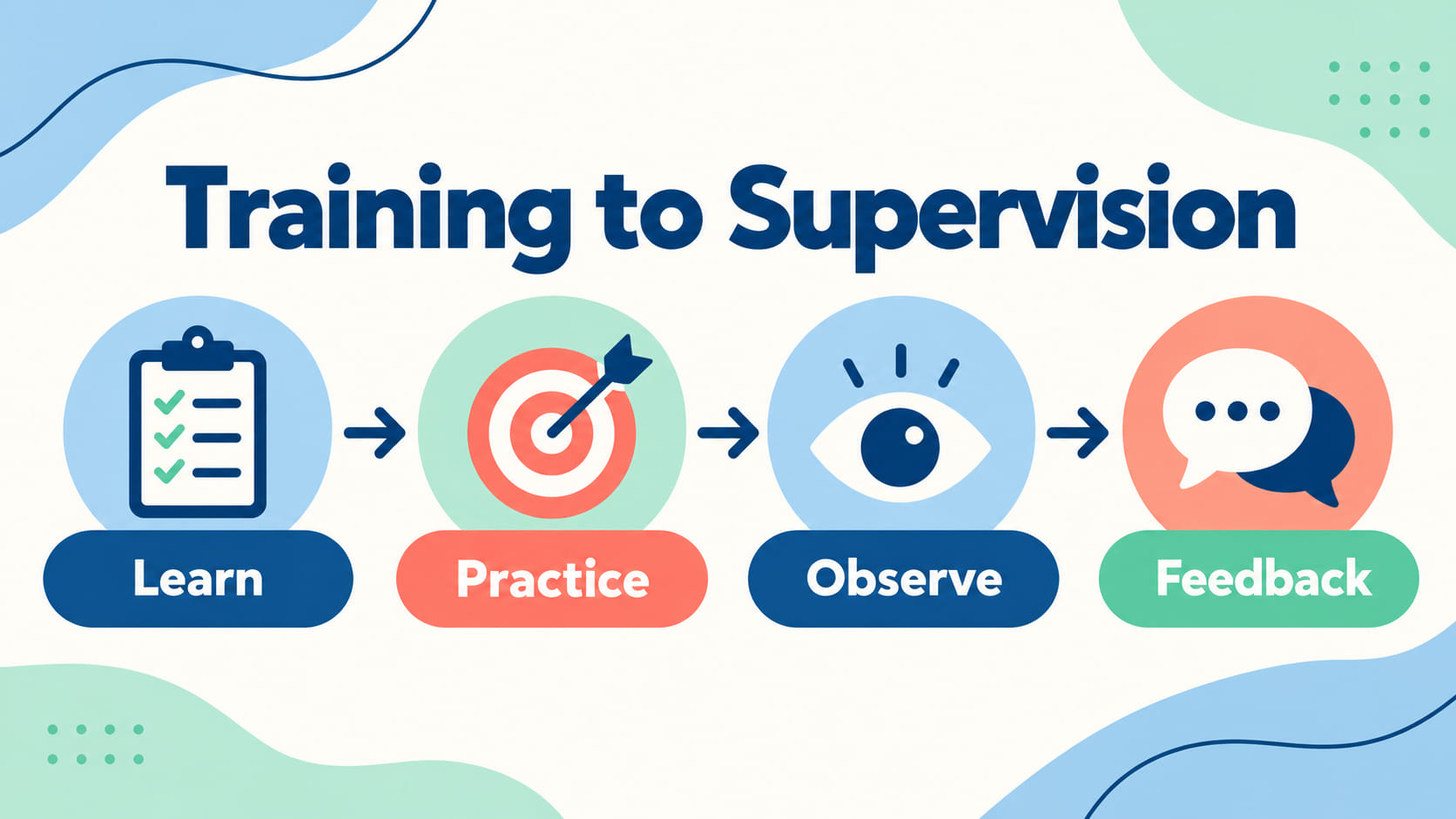
A useful learning cycle has four parts:
- Learn: review the definition, purpose, steps, safety conditions, and data rule.
- Practice: rehearse the procedure with feedback before relying on it in service delivery.
- Observe: demonstrate performance so the supervisor can check accuracy in the relevant context.
- Feedback: receive a specific next step, document it when required, and practice again.
Passing a course or hearing an explanation is not the same as demonstrating every task with every program. Ask what must be trained, observed, documented, and reviewed before implementation.
Start with clear direction
Direction should answer what the RBT is expected to do, why the procedure is in the program, what counts as a response, how to measure it, and what to do when the situation differs. The written program and data sheet should be current and accessible. If the instruction is only an informal memory or a message with ambiguous shorthand, ask for clarification.
Good direction is specific without pretending that every situation can be predicted. It can include the materials, prompt sequence, reinforcement arrangement, safety steps, data fields, and escalation route. It should also identify the boundaries of the RBT role: what to implement, what to report, and what requires a supervisor decision.
Before a session, the RBT can ask: “Which program version should I use, what is the response definition, and what should I record if a required material is unavailable?” This question prevents a preventable mismatch between training and service delivery.
Turn knowledge into practice
Practice should resemble the task closely enough to reveal errors before they affect a client’s service. Rehearse the sequence, timing, materials, prompt code, data entry, and communication. If a safety step matters, practice recognizing the condition that triggers it rather than memorizing only the final response.
Use feedback during practice rather than waiting for a formal review. A supervisor or trainer may ask the RBT to explain why a step occurs, identify the observable definition, or show how a missed opportunity is recorded. The goal is not to perform a script for approval; it is to build accurate, flexible performance within the written procedure.
Practice does not authorize an unassigned intervention. Keep examples fictional and de-identified. Do not take a real client record home, copy a session video into a personal folder, or use a public worksheet to store information outside the approved system.
Use observation to check performance
Observation shows how training holds up in the actual context. The supervisor may observe the RBT’s preparation, instruction, prompting, reinforcement, measurement, documentation, and response to barriers. The exact observation and supervision process follows the current requirements and organization plan.
Observation should produce usable information. “Good job” may encourage the RBT but does not identify what to repeat. “You started the timer at the defined onset, recorded the duration, and described the interruption in the note” links the feedback to observable performance. If a step was missed, describe the step and the next practice opportunity without humiliating the learner or technician.
The RBT should bring questions to observation. If the program definition is unclear, say so. If the setting prevents the planned procedure, report it. If the data system does not match the instruction, ask before making a personal workaround. Observation is a chance to surface uncertainty, not a test that requires hiding it.
Make feedback specific and usable
Effective feedback identifies the behavior, the condition, the expected standard, and the next step. It can be positive when performance is accurate and corrective when a step needs practice. Feedback should stay connected to the role and program rather than becoming a personality judgment.
For example: “During the transition, you presented the instruction and waited the programmed interval. Next time, record the prompt code immediately after the response so the data match the trial.” This is more actionable than “be more careful.” The RBT can repeat the trial, ask questions, and confirm the data-entry rule.
Feedback also flows upward. An RBT can tell the supervisor that a material is unavailable, a timing rule is difficult to apply, a target is not observable in the setting, or a client response creates a safety concern. Reporting a barrier is part of responsible supervision, not a sign of failure.
Document questions and follow-up
Use the approved system to record the supervision date, duration, format, observation, direction, or other fields the organization requires. Do not create a personal supervision log containing unnecessary client information. The employer and current Handbook determine the required records and retention process.
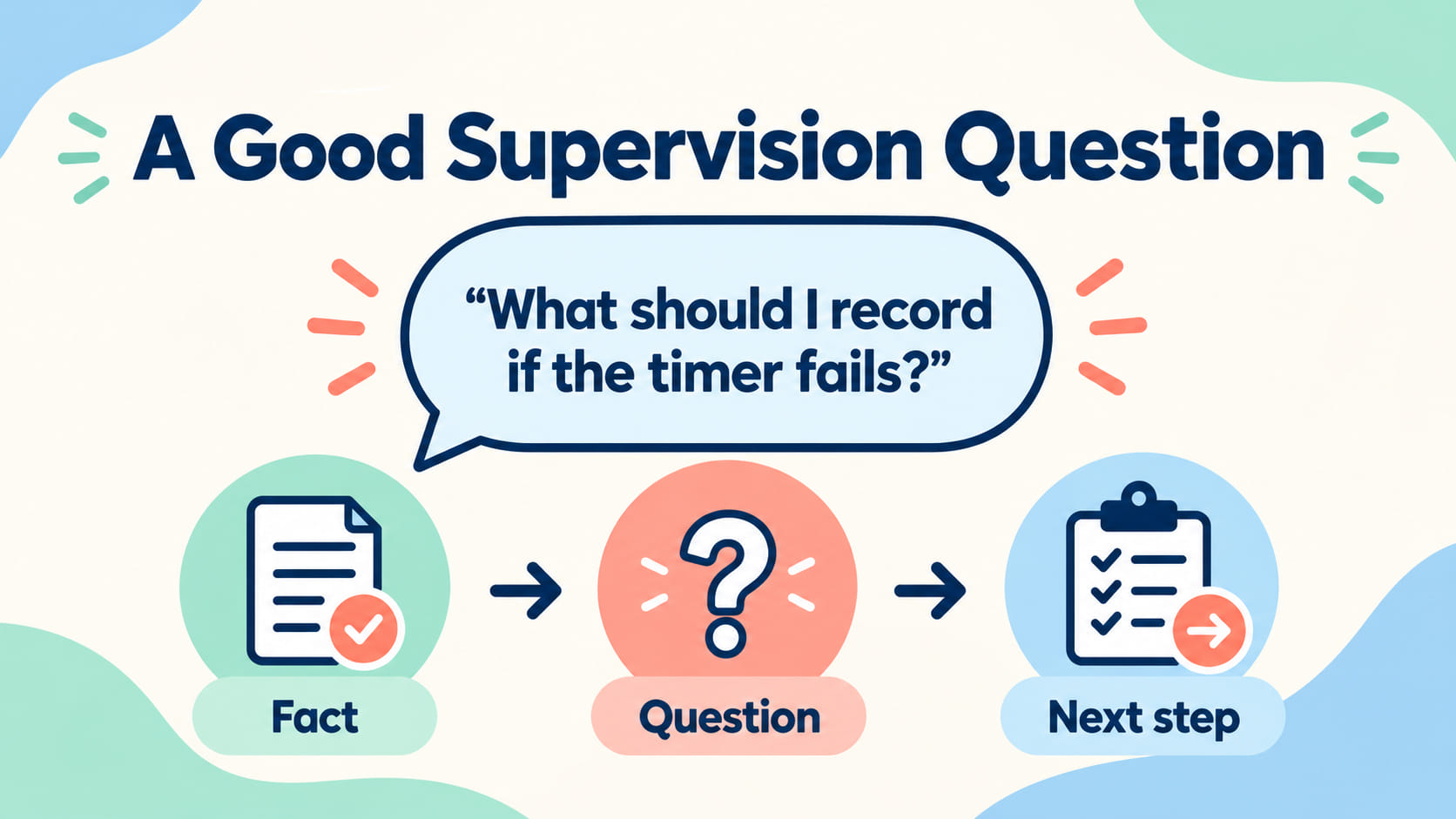
When a question affects service delivery, document the relevant fact and direction. “The timer failed during one duration event; the RBT marked the trial incomplete and asked the supervisor how to record it” is more useful than “technology problem.” Do not backfill data or alter a signed note to make the record appear uninterrupted.
If direction is unclear, outside scope, or connected to safety or privacy, pause before acting and use the escalation route. Supervision works when the RBT can bring accurate information and the supervisor can provide a clear next step.
Supervision and training checklist
- The current program, definition, data rule, and safety steps are available.
- The RBT knows what the task is, what the role boundary is, and who provides direction.
- Practice includes the relevant materials, timing, prompts, data, and communication.
- Performance is observed in the context required by the current plan and policy.
- Feedback identifies observable behavior and a concrete next practice step.
- Questions, barriers, missing data, and deviations are reported honestly.
- Supervision and training records use the approved system and protect privacy.
- No training discussion is treated as permission for an independent clinical change.
Frequently asked questions
Is RBT training the same as RBT supervision?
No. Training teaches knowledge and skills; supervision connects performance to the current role, program, observation, feedback, documentation, and ongoing direction.
Does completing training authorize every procedure?
No. The task, client context, demonstrated competence, written program, supervisor, employer, and applicable requirements still control authorization.
What should an RBT ask during supervision?
Ask about definitions, prompts, data rules, barriers, safety steps, privacy, role boundaries, and the next practice step. Give the supervisor the relevant facts without unnecessary identifying information.
What if the supervisor’s feedback conflicts with the data sheet?
Pause and ask which current instruction controls and how the difference should be documented. Do not silently change the data system or program.
Role reminder: This article is educational content, not an official supervision plan, legal advice, or individualized training direction. Follow the current Handbook, written program, supervisor, employer, payer, and applicable law.
Official starting points: BACB supervision and training resources, the RBT Handbook, and the RBT Ethics Code (2.0).
Ready to practice the RBT concepts you just reviewed?
Try an independent, original RBT practice resource with exam-style questions, scoring, and answer explanations.
References
- Behavior Analyst Certification Board. RBT Test Content Outline, 3rd edition.
- Behavior Analyst Certification Board. RBT Handbook.
- Behavior Analyst Certification Board. RBT Ethics Code.