

RBT supervision best practices turn a required relationship into a clear learning and service-quality system with goals, observation, feedback, records, and follow-up.
Table of Contents
- What good supervision is meant to do
- RBT supervision best practices: the five-part framework
- Set observable goals
- Use observation, rehearsal, and feedback
- Make documentation useful
- Protect privacy and role boundaries
- Create a timely escalation route
- Common supervision mistakes
- Frequently asked questions
- Sources and further reading
RBT SUPERVISION GUIDE · PRACTICE QUALITY
RBT Supervision Best Practices: A Practical Guide
Build clearer goals, useful observation, respectful feedback, objective records, and reliable follow-up.
RBT supervision best practices turn a required relationship into a clear learning and service-quality system with goals, observation, feedback, records, and follow-up. Supervision should help an RBT implement assigned procedures accurately, recognize when direction is needed, and communicate objective information without independently redesigning a plan.
The current BACB RBT Test Content Outline connects supervision with instruction, modeling, rehearsal, feedback, observation of service delivery, timely clinical direction, and objective communication. The exact arrangement depends on the current requirements, organization, supervisor, and written service plan. This article is educational and does not replace those sources.
What good supervision is meant to do
Effective supervision should make the next correct action easier to see. It can clarify a procedure, demonstrate a skill, observe implementation, identify a training need, review data, or help the RBT communicate a concern. It should also create a respectful route for saying, “I do not know how to perform this step yet,” without encouraging concealment or improvisation.
Good supervision is not only a meeting on a calendar. It includes the preparation before a session, the observation or practice during service delivery, the feedback afterward, and the follow-up that shows whether the direction was applied. The record should make that sequence understandable without exposing unnecessary client information.
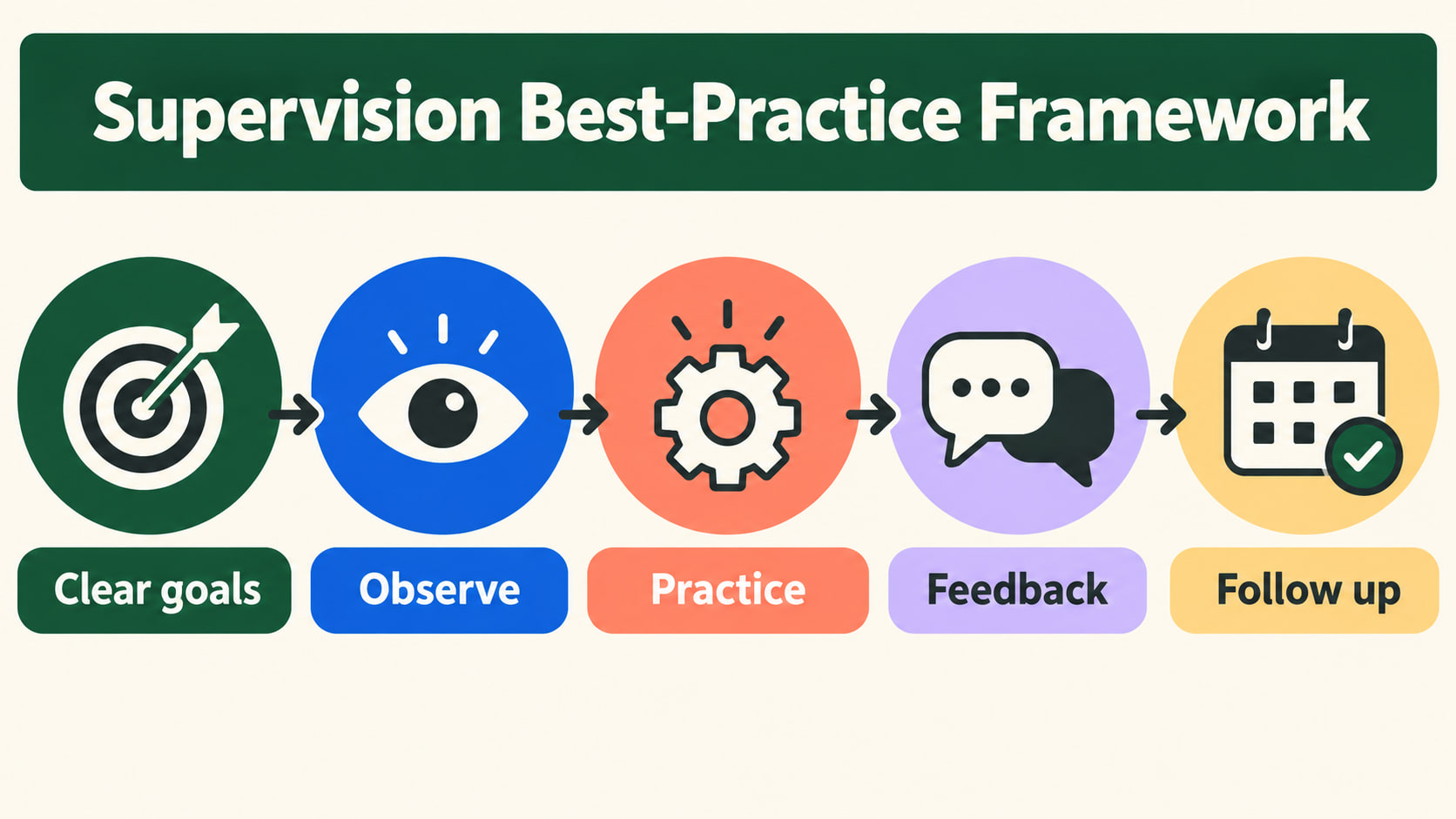
RBT supervision best practices: the five-part framework
- Clear goals: define the procedure or professional skill in observable language.
- Observe: watch the relevant action or review a permitted record.
- Practice: use instruction, modeling, rehearsal, or guided implementation.
- Feedback: identify what to keep, what to change, and why the change matters.
- Follow up: document the direction and check the next opportunity for implementation.
Set observable goals
A goal such as “be more confident” may be useful as a personal intention but is difficult to observe directly. A supervision goal can translate it into an action: identify the operational definition before recording, deliver the instruction and wait the specified interval, use the prompt code correctly, or state a data question with a date and example.
Before a meeting, identify one or two questions that can be answered through observation or practice. Bring the relevant written procedure, a de-identified data question, or a description of the step that was unclear. A focused agenda reduces the temptation to discuss every concern without deciding what happens next.
Goals should remain within the RBT role. An RBT can practice implementation, objective documentation, communication, and safe response to direction. Designing a new treatment plan, diagnosing a condition, changing mastery criteria, or selecting an unapproved intervention requires the responsible clinical process.
Use observation, rehearsal, and feedback
Instruction explains what to do. Modeling shows an example. Rehearsal gives the RBT a chance to practice. Feedback connects the observed performance to the next change. These elements work better together than a vague reminder to “do it correctly.”
For example, if an RBT delivers a prompt too soon, the supervisor can identify the defined response interval, model one trial, ask the RBT to rehearse the timing, and observe the next trial. Feedback can then state, “You waited the interval and recorded the response category; continue that sequence,” or identify the one step that still needs practice.
Feedback should be timely, specific, respectful, and connected to the procedure. It should not label the person, hide an error, or promise a client outcome. If a practice attempt reveals that the RBT needs more training, document the training need and use the agreed follow-up route.
Make documentation useful
A supervision record should answer what was reviewed, what was observed, what direction was provided, and what will happen next. Use the organization’s approved system and required level of detail. Do not copy identifying client information into personal notes or informal messages.
Objective language separates facts from interpretation. “The RBT recorded the response as prompted on three trials; the supervisor reviewed the prompt code and scheduled another observation” is stronger than “the RBT struggled with data.” If a record is corrected, preserve the correction according to policy rather than quietly replacing the original information.
Documentation also helps with continuity. When a supervisor is unavailable or a team member changes, a clear record shows the current procedure, pending question, and responsible follow-up person. It should not become a private dossier or a substitute for the official record.
Protect privacy and role boundaries
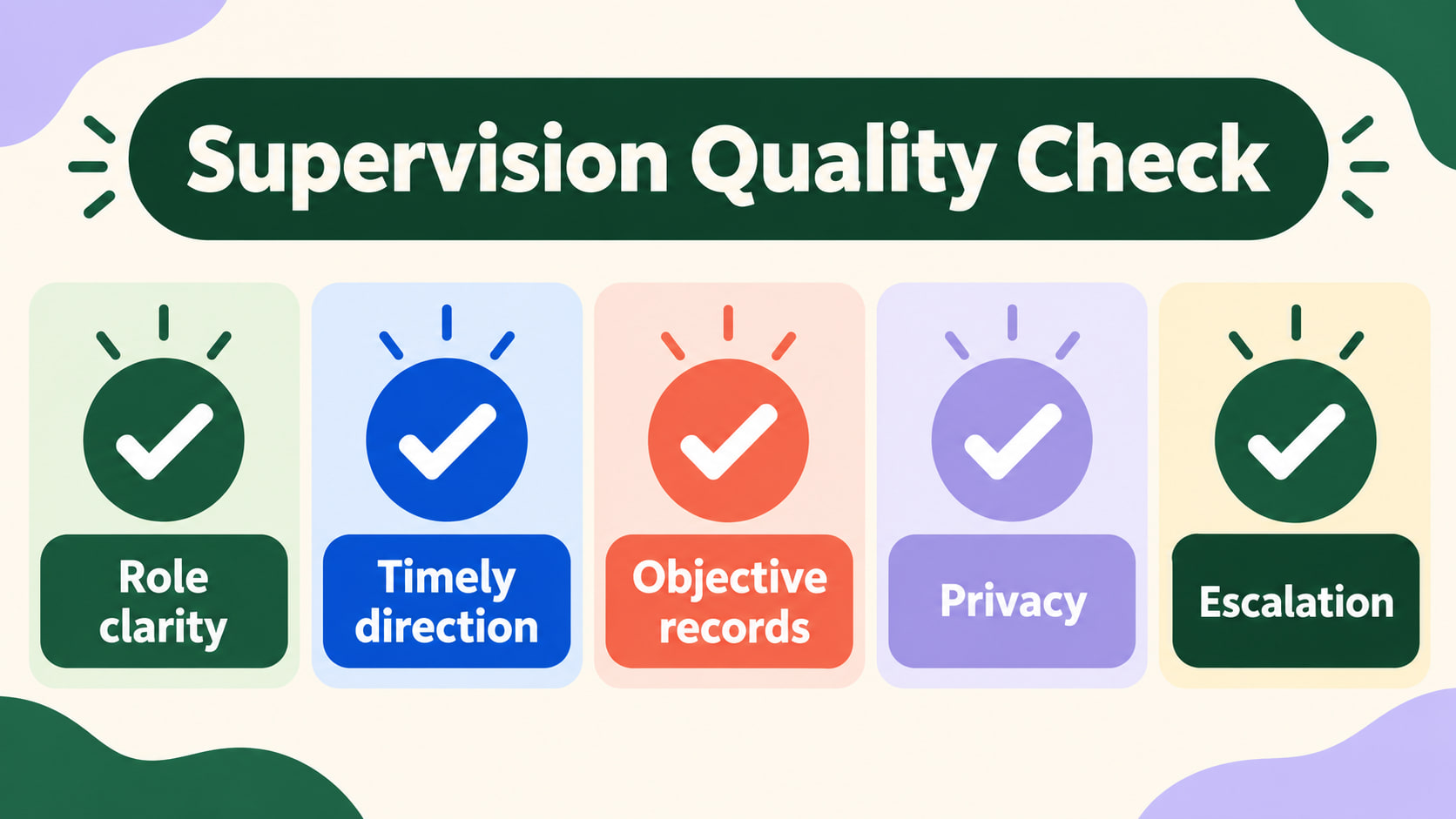
Supervision can involve client records, health information, employment details, and performance feedback. Verify recipients before sending information, use approved systems, and share only what the recipient needs. A training example can be de-identified without weakening the learning point.
Role clarity protects both the learner and the RBT. The RBT implements assigned services after demonstrating competence and under ongoing supervision. The RBT should ask for direction when a plan is unclear, when data change unexpectedly, when safety conditions change, or when a task exceeds training. Asking is not a failure; it is part of safe implementation.
Create a timely escalation route
Every supervision arrangement should make it clear where an urgent concern goes when the named supervisor is unavailable. Ask who receives a safety concern, data-integrity problem, conflicting instruction, privacy issue, or sudden change in the service setting. Record the approved route and use it promptly.
Urgent danger, medical needs, safeguarding concerns, or emergencies may require emergency or organizational procedures in addition to supervision. A supervision meeting does not replace emergency services, mandated reporting, medical care, or workplace escalation. Address immediate risk first, then document the actions and seek the appropriate follow-up.
Common supervision mistakes
- Meeting without a question: bring a procedure, observation, or data point that can be discussed.
- Using vague feedback: name the observable step to keep or change.
- Skipping rehearsal: understanding a description does not always show implementation skill.
- Waiting too long to escalate: use the timely route for safety, privacy, or data concerns.
- Changing the plan independently: document the uncertainty and ask the responsible supervisor.
- Over-sharing records: protect client and employee information through approved systems.
Frequently asked questions
What are the most important RBT supervision best practices?
Use clear observable goals, direct observation, instruction and rehearsal, specific feedback, objective records, privacy protection, and timely follow-up.
Does feedback prove that an RBT is competent?
No. Feedback supports learning, but competence decisions follow the applicable training, observation, assessment, and supervision process.
Can an RBT change a procedure when supervision is unavailable?
Do not independently change a treatment, measurement, prompt, reinforcement, or safety procedure. Use the approved escalation route and document the question.
Is this an official BACB supervision checklist?
No. It is independent educational content. Current BACB materials, the written arrangement, and the responsible organization control a specific situation.
Sources and further reading
Ready to practice the RBT concepts you just reviewed?
Try an independent, original RBT practice resource with exam-style questions, scoring, and answer explanations.
References
- Behavior Analyst Certification Board. RBT Test Content Outline, 3rd edition.
- Behavior Analyst Certification Board. RBT Handbook.
- Behavior Analyst Certification Board. RBT Ethics Code.