

An RBT supervision checklist can turn a short meeting into a clear cycle: prepare, observe, practice, receive feedback, and follow up.
Table of Contents
- What an RBT supervision checklist is for
- Before the supervision meeting
- What to observe and bring
- Practice and competency feedback
- Questions that make supervision useful
- Document follow-up clearly
- Know the role boundary
- Frequently asked questions
- References
RBT WORKFLOW · SUPERVISION
RBT Supervision Checklist: A Practical Routine
Use a repeatable checklist to prepare, observe, practice, receive feedback, and document follow-up without replacing the supervisor or written plan.
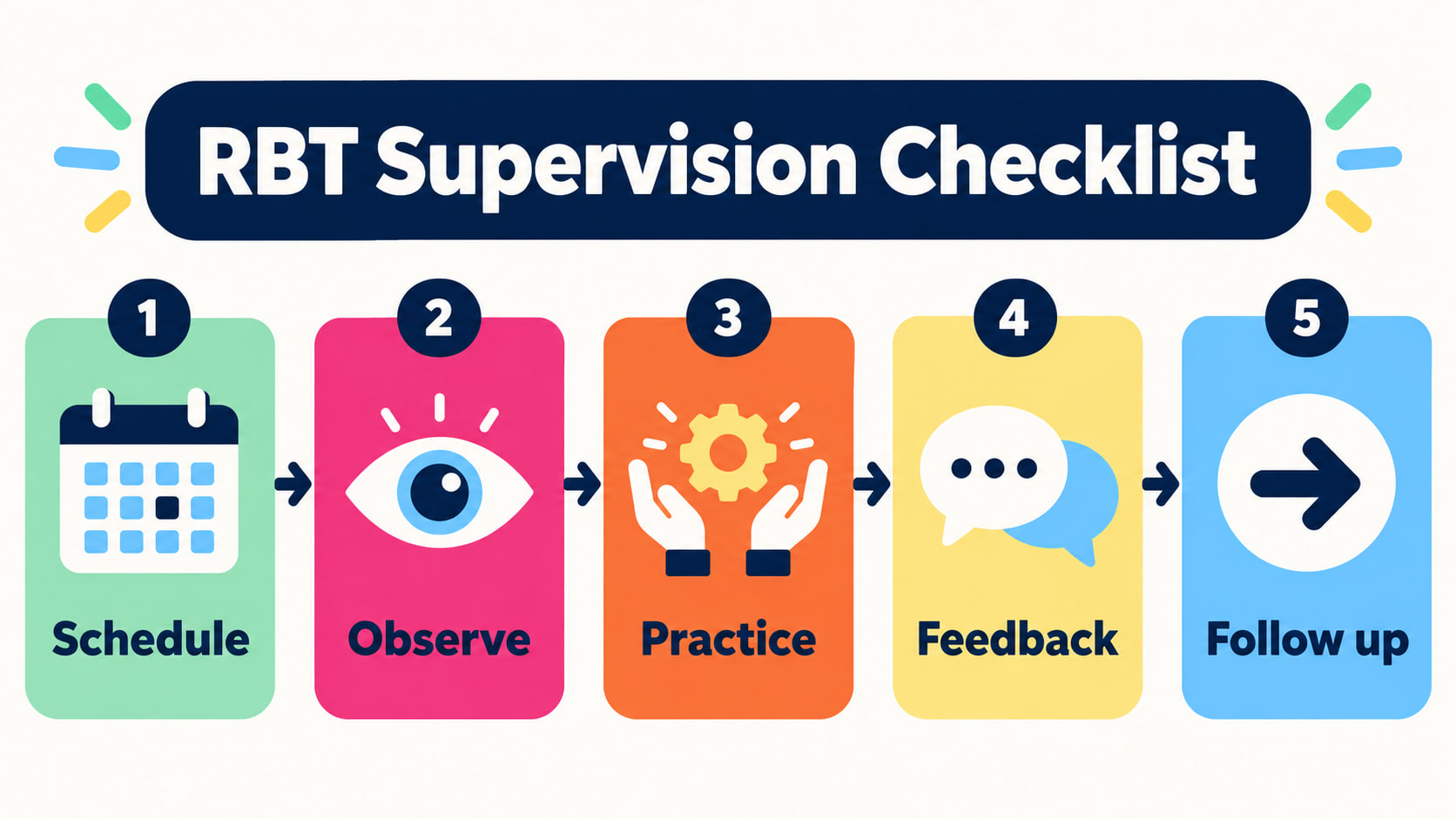
An RBT supervision checklist can turn a short meeting into a clear cycle: prepare, observe, practice, receive feedback, and follow up. It helps an RBT bring specific questions and objective examples instead of relying on memory. The checklist does not replace the BACB requirements, the employer’s process, the client’s current plan, or the direction of the qualified supervisor.
Supervision is more useful when the RBT can identify what happened, what was recorded, what remains unclear, and what action was assigned. Keep notes private, use approved systems, and avoid placing identifying client information into a public template or personal study file.
What an RBT supervision checklist is for
A checklist is a preparation and follow-up tool. It should help answer five practical questions: When is supervision scheduled? What service-delivery behavior or skill will be observed? What should be practiced? What feedback was given? What will be checked next time?
The checklist is not a treatment plan and it is not a substitute for a supervisor’s clinical judgment. It should not tell an RBT to change a target, invent a measurement rule, alter a prompt hierarchy, or interpret a risk independently. Those decisions belong in the authorized plan and supervision process.
Before the supervision meeting
Start with logistics. Confirm the date, time, location or approved video platform, participants, and the purpose of the meeting. If the meeting includes direct observation, confirm what setting and activity are appropriate and how privacy and consent are handled.
Review the instructions you are expected to implement. Bring the current data form, a list of terms or steps that were unclear, and objective examples from recent work. Do not rewrite data to make a session look better. If a record is incomplete, identify the gap and ask how it should be corrected according to the organization’s process.
Prepare two or three questions rather than a long list of general concerns. A useful question names the context: “During the transition routine, I was unsure whether the prompt should be repeated after the waiting interval. Which step in the current procedure controls that situation?”
What to observe and bring
Observation should focus on service delivery, not on judging a person. Notice whether the materials, instruction, prompt, response definition, consequence, timing, and data recording match the current procedure. Record what you can actually see or hear.
- Setting: Was the environment, schedule, and material arrangement consistent with the plan?
- Instruction: Was the relevant cue or direction delivered as trained?
- Response: Was the target response described in observable terms?
- Prompting: Was the authorized prompt used at the planned time and intensity?
- Data: Was the specified measure recorded using the correct start, stop, and scoring rule?
- Communication: Were questions, changes, and safety concerns routed through the correct person?
Do not infer motivation, intent, diagnosis, or treatment effectiveness from one brief observation. Bring patterns and uncertainties to the supervisor, who can decide what additional review or training is needed.
Practice and competency feedback
Supervision should create opportunities to demonstrate a skill, receive feedback, and try again when appropriate. Practice may involve role-play, rehearsal with materials, a data-collection exercise, or observation of implementation. Follow the exact instructions for the activity and ask what standard is being evaluated.
When feedback is given, separate the behavior from the person. “Record the duration from the first observable onset to the defined offset” is actionable; “be more careful” is not. Ask for an example, a nonexample, or a chance to repeat the step. If you disagree or remain uncertain, document the question and request clarification rather than silently choosing a different procedure.
A checklist can include a status such as reviewed, practiced, needs clarification, or follow-up scheduled. Those labels are reminders, not official competency determinations unless the authorized supervisor uses them that way.
Questions that make supervision useful
Good supervision questions are specific and connected to the current work. Examples include:
- Which operational definition should I use when two responses occur close together?
- What should I record if the planned opportunity does not occur?
- Which prompt and fading step is authorized in this teaching procedure?
- What is the correct escalation route when a safety concern interrupts implementation?
- How should I document a deviation, missed data point, or caregiver question?
- What will you observe or review at the next supervision contact?
Bring the source of the confusion. It may be a line in the plan, a data form, a training example, or a difference between two instructions. The supervisor can resolve the conflict and identify which instruction is current.
Document follow-up clearly
After supervision, write a short approved note while the details are fresh. Include the date, the topic, the objective observation or question, the feedback received, the assigned action, and the next check. Use the organization’s required system and minimum necessary information.
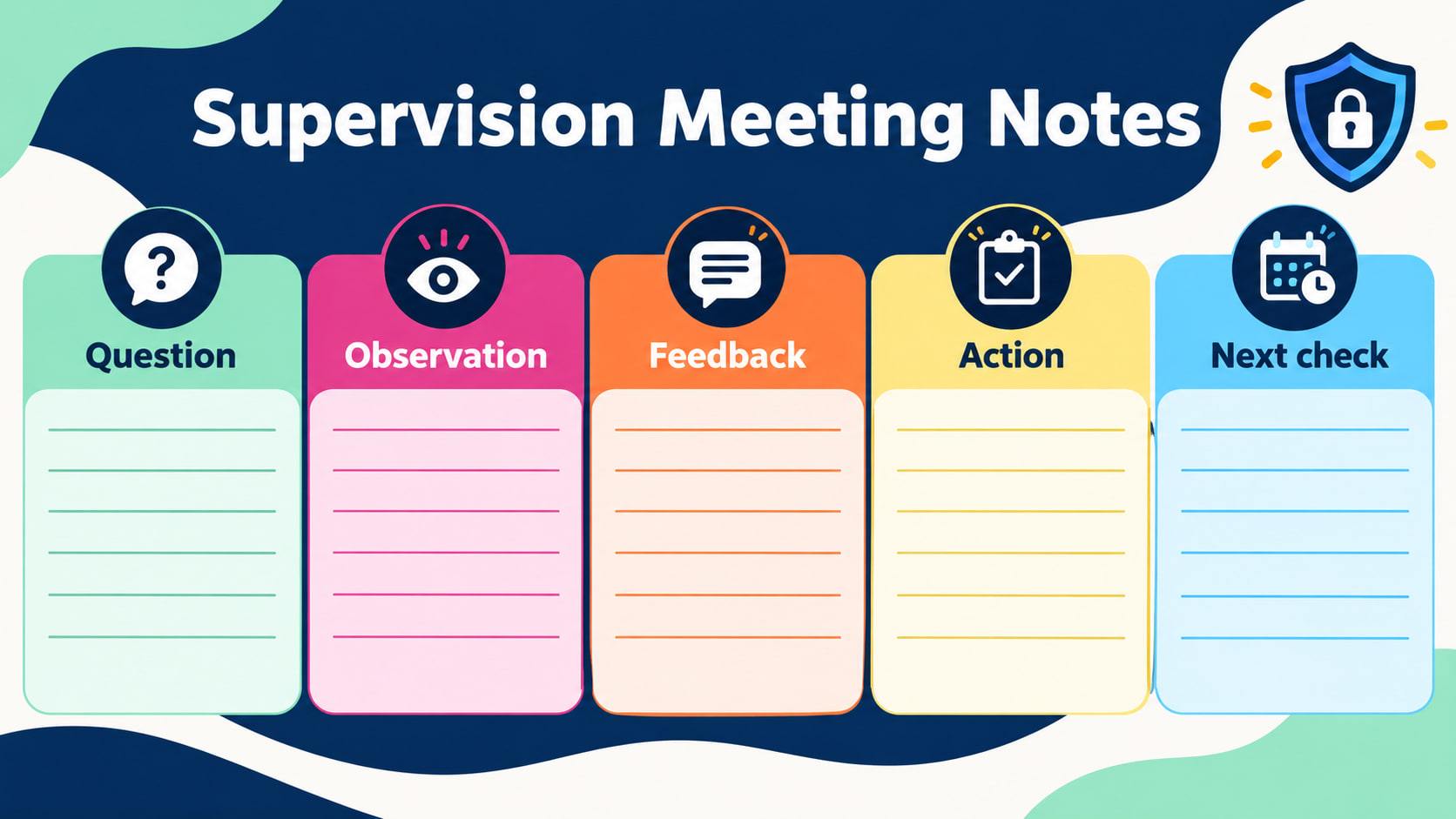
For example: “Reviewed duration-recording start and stop rules. Practiced two scenarios. Supervisor clarified that the current procedure uses the defined onset and offset. Recheck one data form at the next meeting.” This is more useful than “supervision completed” because it records what changed in understanding and what remains to be checked.
Do not use supervision notes to diagnose a client, make a new treatment recommendation, or promise an outcome. If the supervisor assigns a new step, confirm when it takes effect, where it is documented, and what support is available.
Know the role boundary
An RBT implements services after appropriate training and under ongoing supervision. A checklist supports preparation, communication, and accurate follow-through; it does not make the RBT an independent assessor, treatment designer, policy interpreter, or substitute supervisor.
When an instruction is missing, contradictory, unsafe, or outside training, pause as safely as possible and use the designated escalation route. Protect dignity and confidentiality. Follow the current plan and supervisor direction, and report objective facts rather than conclusions.
Frequently asked questions
Can I use the same RBT supervision checklist for every workplace?
You can use the same broad headings, but the organization’s required records, supervision format, privacy rules, and escalation process control. Adapt the template only through approved procedures.
What should I do if I missed a supervision meeting?
Follow the employer’s and supervisor’s scheduling process promptly. Do not backdate a record or mark supervision complete without the required contact and documentation.
Should I record client names on my personal checklist?
No. Use the approved system and minimum necessary information. A public or personal template should use de-identified placeholders unless the organization explicitly authorizes otherwise.
Does a checklist prove competency?
No. It can organize evidence and follow-up, but competency is determined through the authorized assessment, training, observation, and supervisor process.
Source note: Review the current BACB RBT Handbook, RBT content outline, ethics materials, employer procedures, client plan, and supervisor direction for your situation. This article is educational and does not provide individualized legal, clinical, employment, or credentialing advice.
Ready to practice the RBT concepts you just reviewed?
Try an independent, original RBT practice resource with exam-style questions, scoring, and answer explanations.
References
- Behavior Analyst Certification Board. RBT Test Content Outline, 3rd edition.
- Behavior Analyst Certification Board. RBT Handbook.
- Behavior Analyst Certification Board. RBT Ethics Code.