

RBT supervision requirements 2026 should be studied from the current BACB RBT Handbook, official transition guidance, and the RBT Ethics Code rather than from an undated summary. BACB’s current RBT resources describe RBTs as practicing under the direction and close supervision of an RBT Supervisor and/or RBT Requirements Coordinator. The updated handbook also describes ongoing supervision requirements, including a minimum amount tied to hours providing behavior-analytic services; exact implementation, transition dates, documentation, and maintenance rules must be checked in the current official handbook. This guide is educational content, not a certification decision or substitute for the supervisor responsible for a technician’s work. The practical study goal is to understand who is responsible, what must be documented, how to raise a gap, and why a 2026 transition makes source dates important. Requirements can change, so use the official BACB page and handbook at the time of application, practice, renewal, or examination.
Table of Contents
- Start with the current official sources
- Understand the supervision relationship
- Track the percentage and time period carefully
- Know what effective supervision looks like
- Document supervision and follow-up
- Handle gaps in supervision
- Study 2026 changes without overgeneralizing
- Avoid supervision myths
- RBT Supervision Requirements 2026 Checklist
- Frequently Asked Questions
- References
Then reinforce the concepts with free RBT mock exams and review the explanations.
Quick answer: Treat rbt supervision requirements 2026 as a source-controlled RBT study topic. Define the issue, connect it to observable action, use original examples, and keep the supervision boundary visible.
Study boundary: This independent guide is educational content. It is not a BACB policy, certification decision, legal opinion, answer key, or guarantee of examination success. Examples are original and are not official, recalled, leaked, or BACB-endorsed questions.
Current exam context: The current BACB RBT Test Content Outline describes 43 tasks across six domains; the examination includes 75 scored questions and 10 unscored pilot questions in a 90-minute testing period. Verify the current handbook and outline before relying on a time-sensitive detail.
Start with the current official sources
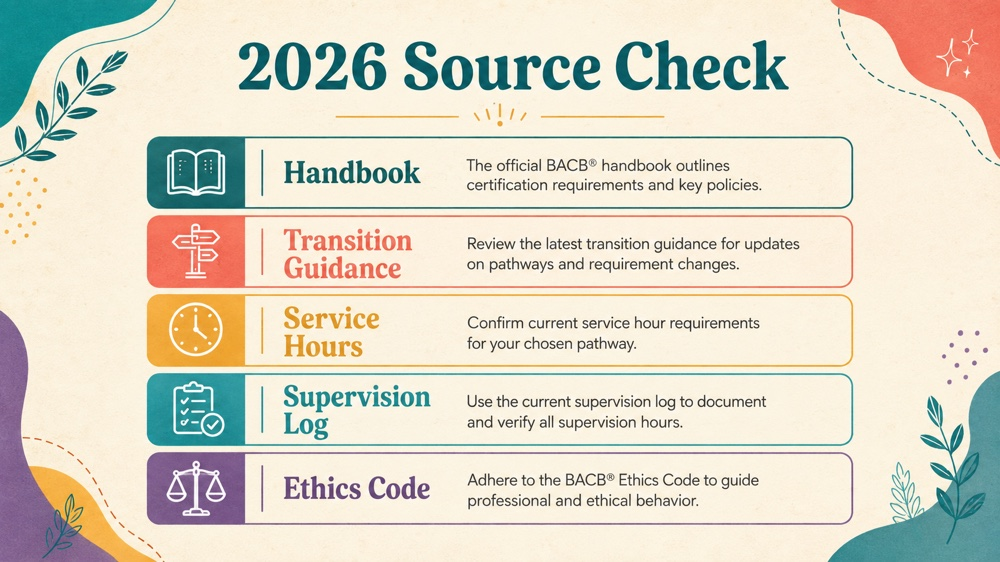
Open the current RBT Handbook, the BACB RBT page, any 2026 transition guidance, and the RBT Ethics Code. Record the update date and the organization where services are provided. A social post, course slide, or old PDF can be useful as a question prompt, but it should not control a current certification decision.
Understand the supervision relationship
An RBT provides assigned behavior-analytic services under direction and close supervision. The supervisor or requirements coordinator is responsible for the relevant oversight, while the technician is responsible for implementing within demonstrated competence, communicating accurately, protecting privacy, and following the written program. Supervision is a working relationship, not merely a signature.
Track the percentage and time period carefully
The current handbook describes ongoing supervision as a minimum percentage of hours spent providing behavior-analytic services each calendar month. Do not memorize a number without reading the current handbook’s definitions, calculation rules, exceptions, and transition language. Track service hours and supervision activities using the organization’s approved record system.
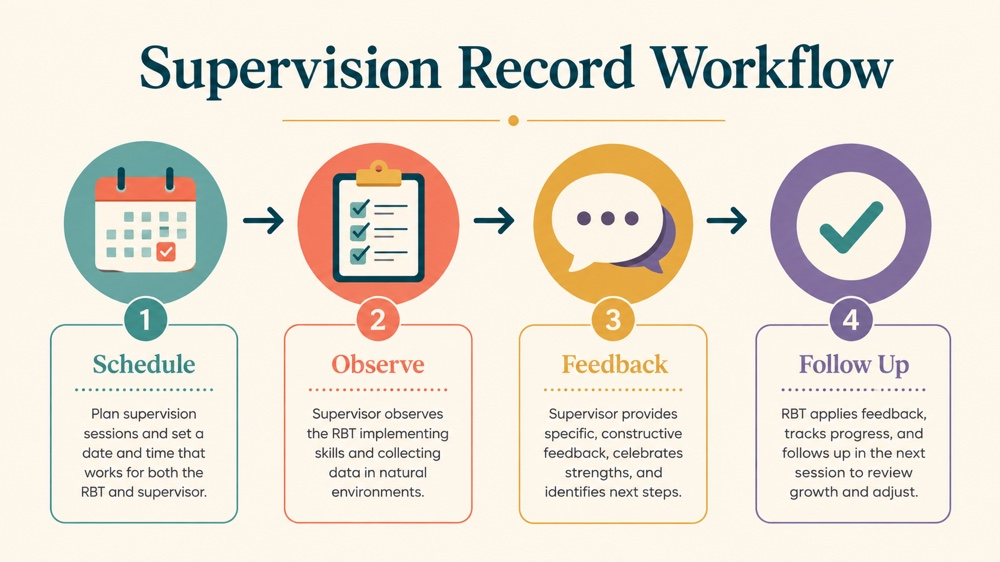
Know what effective supervision looks like
Effective supervision can include observation, feedback, modeling, competency checks, review of documentation, discussion of ethics, and planning for skill development. A meeting that produces no opportunity to observe, practice, ask questions, or receive feedback may not address the technician’s actual needs. Keep questions concrete and connected to current work.
Document supervision and follow-up
Maintain accurate dates, participants, activities, competencies reviewed, feedback, corrective actions, and follow-up according to the approved process. Do not fabricate a contact, alter a record, or sign for someone else. If a record is incomplete, report the issue promptly and preserve the correction trail.
Handle gaps in supervision
If required supervision is missed, the plan is unclear, or you are asked to work outside competence, notify the responsible supervisor or requirements coordinator through the designated route. Keep an objective record of what occurred. If the concern is not addressed, use the organization’s escalation and ethics channels.
Study 2026 changes without overgeneralizing
Transition rules may apply to different groups, dates, or maintenance periods. Separate current requirements from historical rules and label each note with its source date. A good study sheet has a verification column: requirement, official source, effective period, local implementation, and question for follow-up.
Avoid supervision myths
- Treating one old percentage as the complete current rule.
- Counting a casual message as every form of required supervision.
- Assuming a supervisor can retroactively fix an inaccurate record.
- Working independently because a supervisor is hard to reach.
- Ignoring local procedures at organizations where services are provided.
- Using a social post instead of the current BACB handbook.
- Presenting study scenarios as official BACB examination items.
RBT Supervision Requirements 2026 Checklist
- Did I open the current handbook and note its update date?
- Do I know my supervisor or requirements coordinator?
- Are service hours and supervision activities tracked accurately?
- Do I understand the current calculation and transition language?
- Is supervision producing observation, feedback, and competency support?
- Do I know how to report a missed or inadequate requirement?
- Have I checked the official source before making a certification decision?
Use the official BACB handbook for current RBT supervision requirements 2026. RBT Training is independent educational content and is not affiliated with or endorsed by BACB.
Practice the concept
Review rbt supervision requirements 2026 with original RBT scenarios, current-source reminders, and clear role boundaries.
Review the RBT study resource →
Frequently Asked Questions
RBT Supervision Requirements 2026: What Should I Check?
Use the current BACB RBT Handbook and transition guidance. The handbook describes ongoing supervision and a minimum percentage tied to service hours; verify the exact current calculation and effective period in the official source.
Who is responsible for RBT supervision?
RBTs practice under the direction and close supervision of an RBT Supervisor and/or RBT Requirements Coordinator, as described by current BACB resources.
What should an RBT do if supervision is missed?
Document the objective facts and contact the responsible supervisor or requirements coordinator through the approved escalation route.
Is this page official BACB guidance?
No. It is independent educational content. Use the current BACB handbook, official pages, and responsible supervisor for decisions.
References
- Behavior Analyst Certification Board: Registered Behavior Technician Handbook, updated June 2026.
- Behavior Analyst Certification Board: RBT Test Content Outline (3rd ed.).
- Behavior Analyst Certification Board: RBT resources.
- Behavior Analyst Certification Board: ethics resources.
- Behavior Analyst Certification Board: RBT Ethics Code (2.0).