

rbt terminology is easier to learn when each term is tied to an observable decision. Memorizing isolated definitions can feel productive, but exam stems often ask you to distinguish neighboring concepts: frequency from rate, reinforcement from bribery, prompting from modeling, or objective documentation from interpretation. This guide organizes the vocabulary by the RBT work it supports.
Table of Contents
- rbt terminology: why precise words matter
- The six TCO domains and their vocabulary
- Measurement and data collection terms
- Acquisition, prompting, and reinforcement terms
- Assessment and behavior-reduction terms
- Documentation, ethics, and the RBT role
- Nearest-neighbor terms that are easy to confuse
- A practical rbt terminology study system
- Frequently Asked Questions
- References
Quick answer: Start with the current RBT Test Content Outline, group terms by domain, define each term in plain language, and practice applying it to an original scenario. Keep the RBT role boundary visible: an RBT implements approved procedures, collects and communicates data, protects confidentiality, and seeks direction when assessment, interpretation, or plan changes are required.
Study boundary: This is independent exam-preparation content, not an official BACB handbook, application determination, or answer key. The examples in this article are newly written for study. They are not official, recalled, leaked, or BACB-endorsed exam questions. Requirements and policies can change, so use the current BACB handbook and your supervisor or requirements coordinator for decisions about an individual application or client program.
rbt terminology: why precise words matter
Behavior-analytic language is precise because small wording changes can change a measurement or a clinical decision. “The learner was aggressive” is a label. “The learner hit the table with an open hand three times” is an observable description. “The behavior was reinforced” is a functional conclusion. “The teacher delivered 20 seconds of attention immediately after the response” is an event that can be recorded.
When a question uses a technical term, look for three pieces: the defining feature, what is measured or changed, and who is authorized to make the decision. This prevents a familiar-sounding word from pulling you toward an answer that exceeds the scenario.
The six TCO domains and their vocabulary
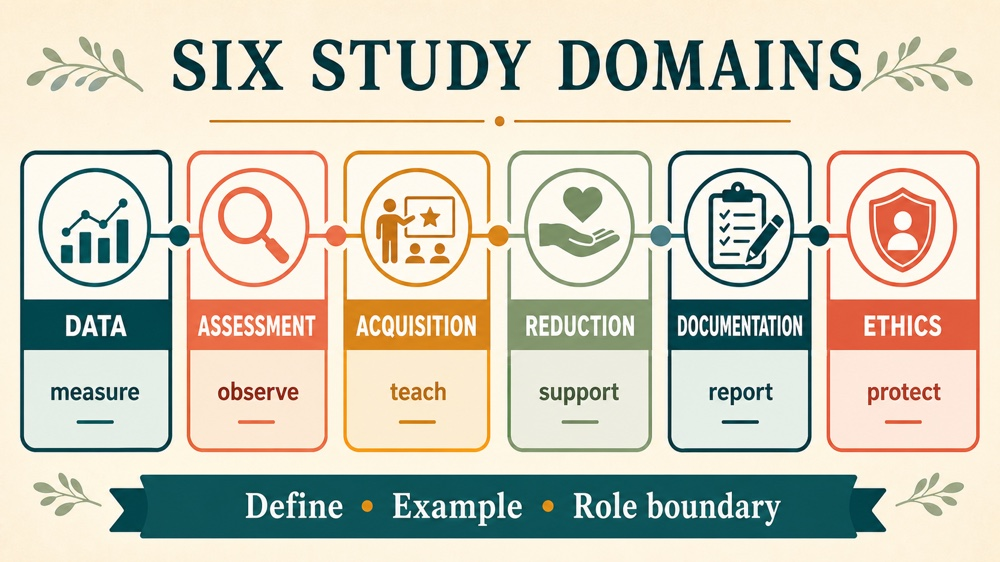
The current outline organizes RBT examination tasks into six domains. The table below is a study map, not a replacement for the official outline or your training materials.
| Domain | Terms to connect | Study question |
|---|---|---|
| A. Data Collection and Graphing | operational definition, frequency, rate, duration, latency, interval, graph, trend | What is measured, for how long, and how is the pattern displayed? |
| B. Behavior Assessment | preference assessment, ABC recording, descriptive assessment, skill assessment | What information is collected, and what decision belongs to the supervisor? |
| C. Behavior Acquisition | reinforcement, prompting, fading, shaping, chaining, generalization, maintenance | How is a new skill taught and transferred to relevant settings? |
| D. Behavior Reduction | antecedent strategy, consequence, replacement behavior, crisis procedure, extinction | What written procedure is implemented, and what safety boundary applies? |
| E. Documentation and Reporting | objective note, incident report, confidentiality, data integrity, communication | What happened, what was recorded, and who must be informed? |
| F. Ethics | scope of practice, supervision, dignity, cultural responsiveness, conflicts | What action protects the client and follows professional requirements? |
Measurement and data collection terms
Operational definition: A description of a response that tells observers what to include and exclude. Frequency: the count of responses. Rate: count divided by a unit of time. Duration: how long a response lasts. Latency: the time from a cue or event to the start of the response. Interval recording: a rule for marking whether a response occurred during defined intervals; whole-interval, partial-interval, and momentary time sampling are not interchangeable.
Use the unit in the question. If two sessions have different lengths, raw frequency may mislead, while rate may allow a fairer comparison. If the concern is how long crying continues, duration is more relevant than count. If the concern is responding after an instruction, latency may be the better measure. The RBT follows the written measurement system and checks unclear definitions with the supervisor.
Acquisition, prompting, and reinforcement terms
Reinforcement is a consequence that increases the future likelihood of a behavior; it is not the same as a reward promised in advance or a bribe. Prompting adds an antecedent support to evoke a response. Prompt fading systematically reduces that support. Shaping differentially reinforces successive approximations toward a target. Chaining teaches the steps of a sequence, while generalization means the skill occurs across relevant people, materials, settings, or examples. Maintenance means the skill continues over time after teaching conditions change.
For a study example, suppose a learner is learning to request a break. A visual card may be a prompt, the break may function as reinforcement if requesting increases, and practicing with a parent and teacher may test generalization. Do not call the break reinforcement from one observation; check the pattern in the data and the program definition.
Assessment and behavior-reduction terms
ABC recording organizes observations around antecedent, behavior, and consequence. It can help describe patterns but does not automatically establish function. A preference assessment identifies items or activities that may be selected for further evaluation; it does not guarantee that an item will function as a reinforcer. A replacement behavior is a safer or more effective response taught to meet a relevant need, when the plan defines it.
Extinction is a technical procedure in which reinforcement for a previously reinforced behavior is discontinued according to a plan. It should never be reduced to “ignore the learner,” and an RBT must not start or modify an extinction procedure independently. Antecedent strategies, differential reinforcement, and safety responses also require precise written instructions.
Documentation, ethics, and the RBT role
An objective note separates direct observation from interpretation and records the procedure, response, data, and relevant communication. A correction made after discovering an error should preserve the original record according to the organization’s documentation policy; it should not silently erase data. Confidentiality means using approved systems and disclosing only what is necessary for the professional purpose.
An RBT is a paraprofessional who provides behavior-analytic services under the direction and close supervision of the responsible supervisor or requirements coordinator. A strong answer therefore separates what an RBT can implement as written from what requires assessment, clinical interpretation, plan changes, or supervisor direction. If you do not know whether a procedure applies, ask before acting.
Nearest-neighbor terms that are easy to confuse
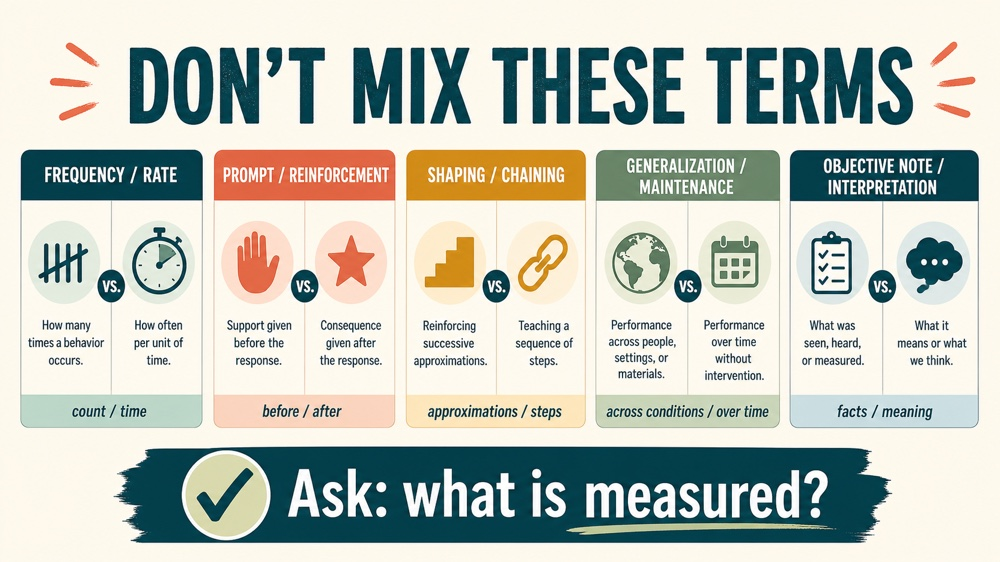
| Pair | Distinction | Memory check |
|---|---|---|
| Frequency vs rate | Frequency is a count; rate includes a time unit. | Could two unequal sessions have the same frequency but different rates? |
| Prompt vs reinforcement | A prompt comes before or with a response to help evoke it; reinforcement follows and changes future probability. | Ask “before or after?” then ask whether future behavior increased. |
| Shaping vs chaining | Shaping builds one response through approximations; chaining links steps in a sequence. | One target form or a sequence of steps? |
| Objective note vs interpretation | An objective note reports observable events; interpretation proposes meaning or function. | Could another observer verify the wording? |
| Generalization vs maintenance | Generalization concerns conditions or people; maintenance concerns persistence over time. | Across where or across when? |
A practical rbt terminology study system
- Choose one term and write a definition without copying the handbook.
- Add one observable example and one nonexample.
- Connect the term to its TCO domain and an RBT task.
- Write a role-boundary sentence: what can be implemented, and what requires direction?
- Test the term in a new scenario and explain why two distractors fail.
- Revisit errors after 24 hours and after one week.
Current exam frame: The current RBT Test Content Outline (3rd ed.) applies beginning January 1, 2026. It describes 43 tasks across six content domains. The current examination format is 75 scored questions plus 10 unscored pilot questions, four answer choices per item, and a 90-minute testing period. These facts explain the study frame; they do not turn an independent guide into an official BACB resource.
Use the official outline and current training materials to decide which terms and task details are controlling. Independent flashcards can support retrieval, but they are not official BACB resources and cannot replace supervision or a current policy document.
Turn terminology into retrieval practice
Use original RBT-style questions and explanations to find which terms need another pass, then verify the rule against the current official materials.
Review the RBT resource →
Frequently Asked Questions
What is the best way to study RBT terminology?
Group terms by the six current TCO domains, define each in plain language, add an observable example and nonexample, and practice explaining the RBT role boundary.
What is the difference between reinforcement and a reward?
Reinforcement is defined by its effect on future behavior. A reward is a common-language label and does not prove that the behavior will increase.
Why are operational definitions important?
They make the target response observable and measurable so different observers can record it consistently.
Can an RBT change a behavior plan after studying a term?
No. An RBT implements the written plan and communicates data. Assessment, clinical interpretation, and plan changes require the appropriate supervisor or qualified professional.
Are these terms and scenarios official exam content?
The terms are explained for independent study, but the examples are newly written and are not official, recalled, leaked, or BACB-endorsed exam questions.
References
- Behavior Analyst Certification Board: Registered Behavior Technician Handbook, updated June 2026.
- Behavior Analyst Certification Board: RBT Test Content Outline (3rd ed.).
- Behavior Analyst Certification Board: RBT resources.
- Behavior Analyst Certification Board: RBT Ethics Code.
- RBT Training: independent practice resource.