

An RBT vocabulary PDF can be a useful quick-reference tool, but a download is not automatically a complete study plan. The strongest vocabulary resources help you identify a term, compare it with a nearby concept, and apply it to an observable situation. A long list of words without edition information, examples, or correction guidance can create false confidence.
Table of Contents
- What an RBT vocabulary PDF should do
- Start with the current RBT Test Content Outline
- Map vocabulary to the six current domains
- How to audit an RBT vocabulary PDF before printing
- Build a decision-ready term card
- Study high-value contrast pairs
- Turn an RBT vocabulary PDF into scenario practice
- Use a printable review workflow
- Common RBT vocabulary PDF mistakes
- Frequently Asked Questions
- References
The current RBT Test Content Outline, 3rd edition, describes 43 tasks across six domains. The current examination context includes 75 scored questions and 10 unscored pilot questions. Use the current BACB TCO and Handbook for official scope and process facts, then use an independent vocabulary resource to organize learning and review.
RBT Training is an independent educational resource. It is not affiliated with, operated by, or endorsed by the Behavior Analyst Certification Board (BACB). The definitions, examples, and study prompts in this article are newly written for independent study. They are not official, current, retired, recalled, leaked, or BACB-endorsed questions. No RBT vocabulary PDF, practice score, or study schedule can guarantee certification or a passing result.
What an RBT vocabulary PDF should do
Vocabulary is the entry point to RBT exam preparation, not the finish line. A useful PDF should make a term easier to recognize, explain, contrast, and apply. It should also make its source boundary visible. A card may define a concept for learning, but that does not make the card an official BACB definition or an official examination item.
| Quality feature | What to look for | Why it matters |
|---|---|---|
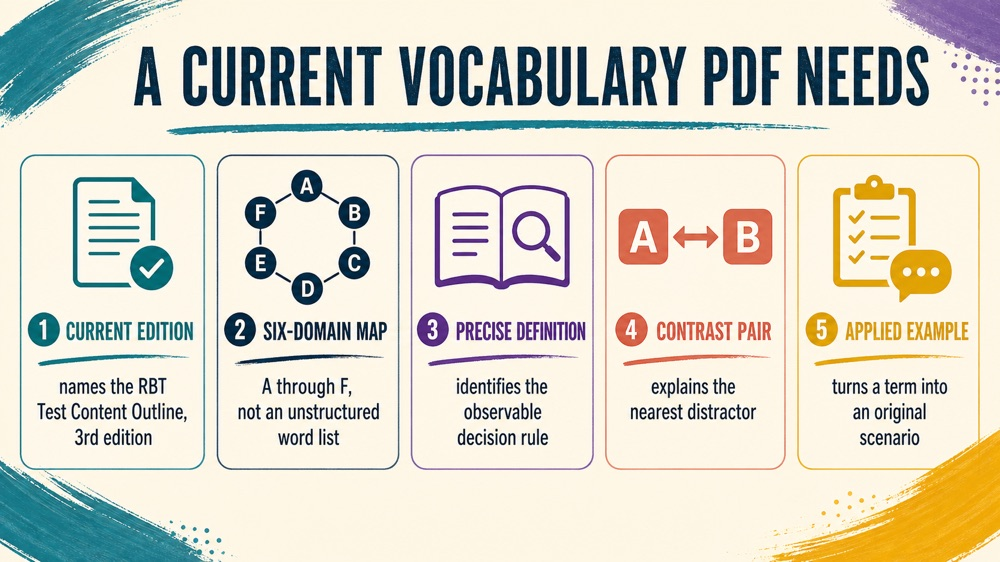
| Current edition | The resource states which TCO edition it follows and shows an update date or review note. | Old labels and weights can mislead a learner who assumes every PDF is current. |
| Domain map | Terms are organized under current A–F domain names, not only under a long alphabetical list. | A domain map connects vocabulary to the scope you must study. |
| Precise definition | The definition identifies the observable feature or decision rule, not only a synonym. | Precise wording helps you reject a near-miss answer. |
| Contrast pair | The card explains what the term is and what a commonly confused term is not. | Many multiple-choice distractors are built from a close contrast. |
| Original example | A short scenario shows the term in action without claiming to reproduce an exam item. | Application is stronger evidence than recognizing a definition on a page. |
| Readable print design | There is enough space, strong contrast, clear headings, and a usable print or screen layout. | A study tool that cannot be read or annotated will not support repeated review. |
Search results for “RBT vocabulary PDF” commonly emphasize free downloads, flashcard counts, or printable lists. Those features satisfy the first click, but they do not answer whether the resource is current, accurate, or useful under a scenario. Evaluate the learning design before counting pages or cards.
Start with the current RBT Test Content Outline
The current RBT Test Content Outline, 3rd edition, is the scope anchor. It contains 43 tasks across six domains. A vocabulary PDF can support those tasks, but it should not replace the outline or imply that its term list is the official exam blueprint.
| Official boundary | Study implication | Do not infer |
|---|---|---|
| 43 tasks in the current TCO | Use the task map to check what your term list covers and what it leaves out. | A PDF with 50, 79, or 108 cards is not automatically more complete. |
| 75 scored questions | Practice concepts across the full scope, including smaller domains. | A provider’s 75-card set is not the official scored form. |
| 10 unscored pilot questions | Understand the official 85-question context when planning practice pacing. | You can identify which questions are unscored during the exam. |
| Four choices per question | Study the reason a distractor is wrong, not only the definition of the correct term. | The most familiar vocabulary word is automatically the answer. |
The Handbook and current BACB examination instructions remain the authority for eligibility, applications, scheduling, accommodations, security, and test-day procedures. A vocabulary PDF is an independent study aid. It cannot create the required training, initial competency assessment, application approval, or certification.
Keep a simple source note on the first page of your own study set: “Independent study aid; checked against the current TCO and Handbook on [date]; not an official BACB resource.” That note does not make the PDF authoritative, but it prevents you from forgetting its role.
Map vocabulary to the six current domains
Organize terms by the current domain names before organizing them alphabetically. The task ranges below add to 43 and provide a practical coverage check:
| Domain | Task range | Vocabulary families to connect | Application question |
|---|---|---|---|
| A. Data Collection and Graphing | A.1–A.8 | Observable behavior, frequency, duration, latency, rate, interval recording, graphing. | What is being measured, in what unit, and how will the data be summarized? |
| B. Behavior Assessment | B.1–B.3 | Preference assessment, skill assessment, descriptive observation, assessment data. | What procedure is assigned, what did the observer see, and what requires supervisor interpretation? |
| C. Behavior Acquisition | C.1–C.11 | Reinforcement, prompting, fading, shaping, chaining, discrimination, maintenance, generalization. | Which teaching step is written in the plan, and what learner response contacts reinforcement? |
| D. Behavior Reduction | D.1–D.7 | Antecedent, consequence, function, replacement behavior, crisis or safety response, reduction data. | What does the written plan direct the RBT to do, and what must be reported rather than improvised? |
| E. Documentation and Reporting | E.1–E.4 | Objective note, data integrity, communication, documentation, records. | Can another professional tell what happened without guessing what the learner “felt”? |
| F. Ethics | F.1–F.10 | Confidentiality, dignity, competence, supervision, boundaries, cultural responsiveness, integrity. | Which action protects the client and stays within the RBT role and supervision structure? |
This map also exposes a common weakness in vocabulary lists: they may contain many acquisition terms but very few documentation or ethics terms. Count coverage by domain, then check whether the terms support decisions. A balanced list is not enough if every card is a one-line definition.
How to audit an RBT vocabulary PDF before printing
Before you download, print, or pay for an RBT vocabulary PDF, run this seven-point audit. Save the result with the file so you know why you kept or rejected it.
- Edition: Does the PDF state the current RBT Test Content Outline, 3rd edition, or clearly identify that it is an older cross-reference?
- Source hierarchy: Does it link to the current BACB TCO and Handbook for official facts, while labeling the provider’s definitions as independent?
- Domain coverage: Can you find current A–F headings and trace terms to task families?
- Definition precision: Does each card distinguish an observable response, a measurement system, a teaching procedure, or an ethical action as appropriate?
- Contrast quality: Does the card state the feature that separates it from the nearest distractor?
- Example integrity: Are examples original and clearly presented as study examples rather than current, recalled, leaked, or official questions?
- Print and privacy: Can you read it at normal size, annotate it, and understand what personal information a download or account collects?
A resource that fails one point is not necessarily useless. If the definitions are strong but the edition is unclear, add a review date and cross-check it against the TCO before studying. If the layout is attractive but the examples are vague, use the cards only for first-pass recall and write your own scenarios. The audit lets you use a partial resource without mistaking it for a complete authority.
Build a decision-ready term card
If the PDF you find is too thin, convert each term into a six-line card. This produces a smaller but more useful study set:
| Card line | Prompt | Example for the writer |
|---|---|---|
| Term | What is the exact word? | Rate |
| Plain definition | What observable relation or decision does it describe? | Count per unit of time. |
| Unit or feature | What makes it identifiable? | The time denominator is explicit. |
| Nearest contrast | What similar term could be confused with it? | Frequency is a count without a time standard. |
| Original scenario | What would it look like in a session? | Six responses in 30 minutes equals 12 per hour. |
| Role-safe action | What should the RBT record, follow, or ask? | Use the assigned measurement definition and ask the supervisor if the plan is unclear. |
The role-safe action matters because a vocabulary word can tempt a learner to make a decision outside the RBT role. Knowing the word “function,” for example, does not authorize an RBT to independently change an intervention. Knowing “reinforcer” does not mean every preferred item will reinforce every response. The card should preserve the boundary between recognizing a concept and independently modifying a plan.
Study high-value contrast pairs
Contrast pairs are efficient because they turn a broad term list into decision points. Use the following as original study explanations, then check your course materials and the current TCO for scope:
| Pair | Decision boundary | Typical clue to mark |
|---|---|---|
| Frequency vs. rate | Frequency is the number of events; rate expresses events relative to a time unit. | “Per hour,” “per minute,” or another denominator. |
| Partial-interval vs. whole-interval | Partial-interval records whether behavior occurred at any time; whole-interval records whether it occurred for the entire interval. | “At any point” versus “throughout the interval.” |
| Momentary time sampling vs. interval recording | Momentary time sampling checks at a specified moment; interval recording considers behavior across an interval rule. | The exact observation moment versus the full interval. |
| Preference vs. reinforcer | A preference assessment identifies selections; a reinforcer is demonstrated when a consequence increases future behavior under stated conditions. | Selection alone versus a measured behavior change. |
| Prompt vs. reinforcement | A prompt helps evoke a response; reinforcement follows a response and changes its future probability when effective. | Before or after the target response. |
| DRA vs. DRI vs. DRO | DRA reinforces an alternative response, DRI an incompatible response, and DRO the absence of a target response for a defined period. | What response or absence is contacted by the consequence. |
| Acquisition vs. maintenance | Acquisition builds a new skill; maintenance checks whether the skill continues after teaching conditions change or support is reduced. | New learning versus continued performance. |
| Objective description vs. interpretation | An objective note reports observable events; an interpretation adds an unmeasured explanation or mental-state claim. | What a second observer could verify. |
| Confidentiality vs. convenience | Confidentiality protects client information; convenience does not justify sharing it through an unauthorized channel. | Who is authorized to receive the information and why. |
Do not memorize the table as a collection of answer phrases. Cover the middle column, read the pair, and explain the difference aloud. Then change one detail in the scenario. If your answer changes only because a familiar word appears, the contrast is not stable yet.
Turn an RBT vocabulary PDF into scenario practice
After a first definition pass, use the PDF as a prompt generator. Pick one card, write a two-sentence session situation, and ask a single decision question. Keep the situation observable and avoid pretending that your practice item is official.
- Name the domain: identify whether the term belongs primarily to data, assessment, acquisition, reduction, documentation, or ethics.
- Add one controlling clue: include the time unit, plan instruction, response definition, prompt condition, or privacy boundary.
- Ask one question: request the measurement, next plan-based action, objective note, or ethical response.
- Write a nearest distractor: choose a plausible option that ignores one clue.
- Explain the correction: state why the correct choice fits and why the distractor fails.
For example: A learner makes 8 target responses during a 20-minute observation. If the prompt asks for frequency, use the count of 8. If it asks for rate per hour, convert the count to 24 per hour. If it asks for duration, the scenario still lacks start and stop times. The same card becomes three different decisions because the requested measure changes.
For another example: A card defines a preference assessment. The scenario says an RBT presents the assigned choices, records the learner’s selection, and notices that the learner later responds more often after one item is delivered. The RBT can record the assessment and the observed response pattern, but should not independently declare that the item will reinforce every behavior or rewrite the plan. The distinction between selection and demonstrated reinforcement is the controlling clue.
Use a three-column correction log: “term or pair,” “clue I missed,” and “next changed scenario.” This prevents rereading the same definition without testing whether the distinction transfers.
Use a printable review workflow
A printable study set works best when each pass has a different purpose. The following sequence is short enough to repeat and specific enough to reveal weak terms:
| Pass | Action | Evidence to keep |
|---|---|---|
| Preview | Check the edition, source note, domain headings, and page readability. | One sentence on whether the resource is current enough to use. |
| Sort | Put cards into A–F piles and create a “needs source check” pile. | Domain counts and unresolved labels. |
| Recall | Define each term without looking, then mark sure, narrowed-down, or guessed. | Confidence beside each card. |
| Contrast | Compare each missed term with its nearest pair. | The one feature that separates them. |
| Apply | Answer an original scenario with a changed clue. | Chosen action and rejected distractor. |
| Retest | Return to missed cards after a delay and use a new example. | Whether the error is repaired or merely familiar. |
Keep the PDF and the correction log together. If a page has no room for notes, print a separate log rather than writing over definitions. If the file is large, select a small set from one domain for a focused session, then use a mixed set later. The goal is not to carry every term in working memory at once; it is to build reliable discrimination across the full scope.
Common RBT vocabulary PDF mistakes
- Counting cards instead of checking coverage: a bigger list can still omit documentation, ethics, or assessment decisions.
- Using an older edition without a label: legacy domain names may be useful for cross-reference but should not be presented as current TCO facts.
- Learning synonyms instead of boundaries: a near-synonym rarely explains why the nearest distractor fails.
- Confusing preference with reinforcement: a selected item is not automatically a demonstrated reinforcer.
- Confusing a definition with competence: reading a term does not prove the learner can implement the procedure.
- Copying paid or secure content: use original explanations and scenarios; do not seek or reproduce current, recalled, leaked, or official questions.
- Ignoring print accessibility: tiny text, low contrast, and crowded cards make repeated retrieval harder.
- Treating a high practice score as a guarantee: record the condition, domain, clue, and correction instead.
Bottom line: Choose an RBT vocabulary PDF as a current, source-aware study aid. Check it against the RBT Test Content Outline, 3rd edition; map terms to all six domains and 43 tasks; study contrast pairs; write original scenarios; and keep a correction log. That workflow gives a vocabulary list a real job: helping you recognize the controlling clue and choose a role-safe, evidence-based action.
Ready to apply the terms?
Use current-domain practice questions to turn vocabulary recall into clue-based decisions and a focused correction plan.
Try Free RBT Practice Questions →
Frequently Asked Questions
What should an RBT vocabulary PDF include?
Look for current-edition labeling, all six domain headings, precise definitions, contrast pairs, original examples, and a readable format. Card count alone does not show quality or coverage.
Does a vocabulary PDF cover the whole RBT exam?
No. It can organize terms related to the current RBT Test Content Outline, 3rd edition, but it does not replace training, supervised learning, the initial competency assessment, the current Handbook, or application instructions.
How many tasks should my RBT vocabulary list map to?
The current RBT Test Content Outline, 3rd edition, describes 43 tasks across six domains. Use that scope as a coverage check, while remembering that a vocabulary list is an independent study aid.
Are RBT flashcards official BACB questions?
Independent flashcards are not official BACB questions. They should not claim to contain current, recalled, leaked, retired, or BACB-endorsed items. Use original explanations and scenarios for study.
How should I use a vocabulary PDF with practice questions?
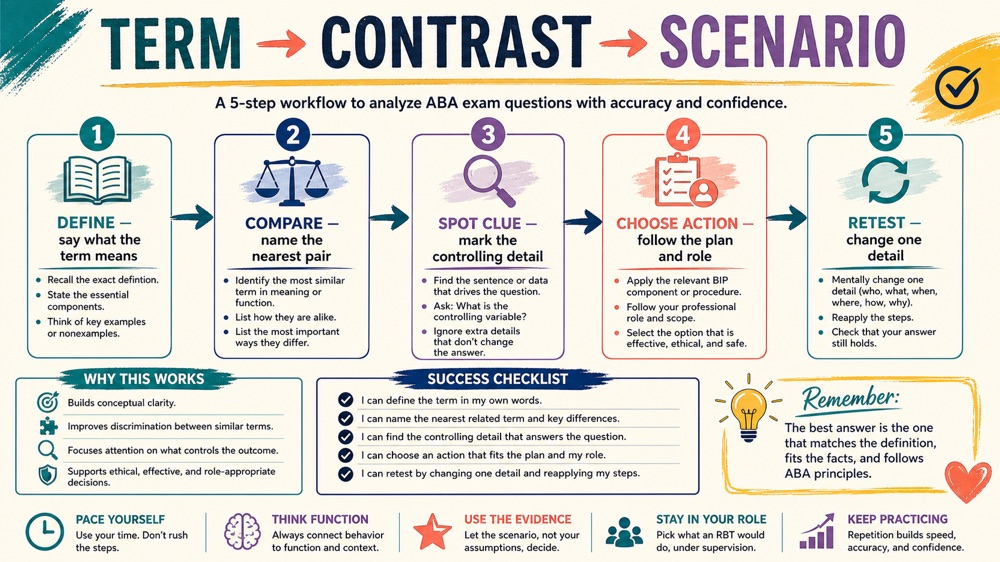
Define the term, identify its nearest contrast, mark the controlling clue in an original scenario, choose the plan-based action, and write why the distractor fails. Then retest with a changed detail.
Can an RBT vocabulary PDF guarantee a passing score?
No. A PDF, card set, or practice score cannot guarantee a passing result, certification, or performance on the official examination.
References
- Behavior Analyst Certification Board. RBT Test Content Outline, 3rd edition.
- Behavior Analyst Certification Board. RBT Test Content Outline, 3rd-edition PDF.
- Behavior Analyst Certification Board. RBT Handbook.
- Behavior Analyst Certification Board. Examination Information.
- Independent RBT flashcard page. Reviewed for competitor research; not an endorsement.
- Independent 3rd-edition flashcard page. Reviewed for competitor research; not an endorsement.
- Independent RBT vocabulary-PDF page. Reviewed for competitor research; not an endorsement.