

RBT vocabulary is more useful when it helps you make a decision, not just recognize a word. A study list can introduce measurement terms, assessment procedures, teaching concepts, reduction strategies, documentation language, and ethics vocabulary. The next step is to connect each term to its domain, nearest contrast, observable example, and role-safe action.
Table of Contents
- What RBT vocabulary needs to do
- Start with the current RBT Test Content Outline
- Map RBT vocabulary to six current domains
- How to choose a quality vocabulary resource
- Build term cards that support decisions
- Study RBT vocabulary with contrast pairs
- Turn RBT vocabulary into scenario practice
- Use a seven-day recall, contrast, apply, and retest loop
- Common RBT vocabulary study errors
- Frequently Asked Questions
- References
The current RBT Test Content Outline, 3rd edition, describes 43 tasks across six domains. The current examination context includes 75 scored questions and 10 unscored pilot questions. Use the current BACB TCO and Handbook for official scope and process facts, then use independent vocabulary resources for recall, application, and correction.
RBT Training is an independent educational resource. It is not affiliated with, operated by, or endorsed by the Behavior Analyst Certification Board (BACB). The definitions, examples, and study prompts in this article are newly written for independent study. They are not official, current, retired, recalled, leaked, or BACB-endorsed questions. No RBT vocabulary list, practice score, or study schedule can guarantee certification or a passing result.
What RBT vocabulary needs to do
A glossary gives you labels. Exam preparation requires discrimination: noticing which feature controls the answer when two options sound reasonable. A strong vocabulary system therefore gives every term a small job in a larger reasoning sequence.
| Vocabulary layer | What to record | Why it matters |
|---|---|---|
| Label | The term and the domain where it is most relevant. | It creates a retrieval cue without pretending the word is the whole concept. |
| Definition | The observable feature, measurement rule, procedure, or boundary. | It prevents a vague synonym from standing in for a decision rule. |
| Contrast | The nearest term and the one feature that separates the pair. | Many distractors are built from a close but incorrect contrast. |
| Example | A short original situation with one controlling clue. | It tests whether the term transfers beyond the page. |
| Role boundary | What an RBT records, implements, communicates, or escalates. | It keeps application aligned with supervision and the written plan. |
| Retest cue | A changed detail for the next practice round. | It tests learning rather than familiarity with one sentence. |
Search results for “RBT vocabulary” commonly offer flashcards, printable PDFs, broad ABA glossaries, or paid term decks. Those formats can be useful, but the number of cards is not the same as quality. Ask whether the resource is current, traceable to the current outline, readable, balanced across domains, and written for application.
Start with the current RBT Test Content Outline
The current RBT Test Content Outline, 3rd edition, is the scope anchor for study planning. It describes 43 tasks across six domains. An independent vocabulary set can organize learning around that scope; it should not present its own list as an official BACB vocabulary list or as a copy of the secure exam.
| Current fact | Vocabulary implication | Do not infer |
|---|---|---|
| 43 tasks in the TCO | Check whether your terms touch all six domains and the relevant task families. | A list with 50, 76, or 102 cards is automatically complete. |
| 75 scored questions | Build broad concept coverage instead of drilling only the most familiar terms. | A 75-card deck is the official scored examination. |
| 10 unscored pilot questions | Understand the 85-question exam context when planning later practice. | You can identify which questions are unscored. |
| Four answer choices | Study why the nearest distractor fails, not just which word appeared in the answer. | The longest or most technical option is correct. |
The Handbook and current examination instructions remain the authority for eligibility, training, assessment, applications, scheduling, accommodations, security, and test-day procedures. Vocabulary study cannot replace those steps or prove hands-on competence. Keep an edition note with any resource you use so an old glossary is not mistaken for current scope.
Map RBT vocabulary to six current domains
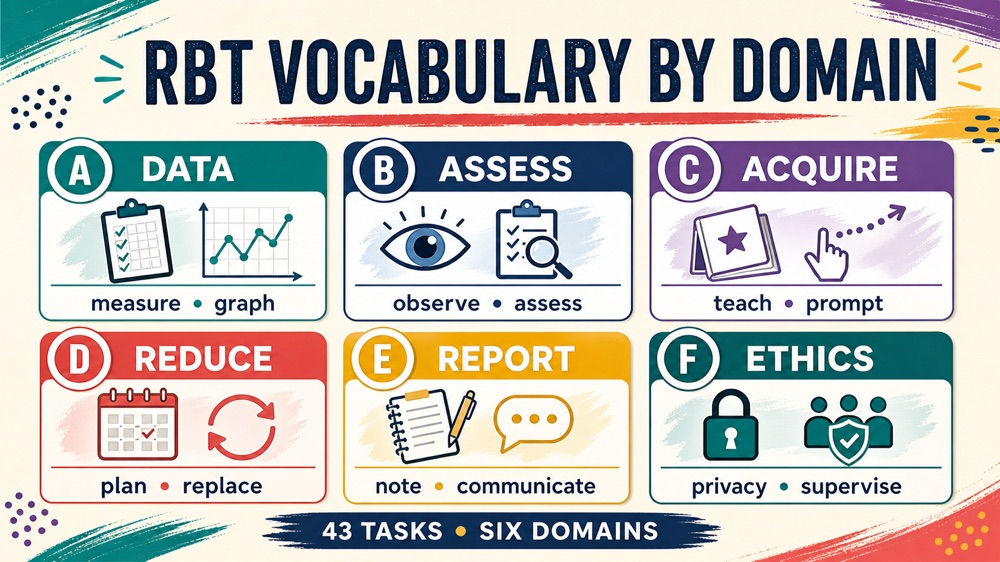
Organize terms by current domain before sorting them alphabetically. The task ranges below form a practical coverage map:
| Domain | Task range | Vocabulary families | Decision question |
|---|---|---|---|
| A. Data Collection and Graphing | A.1–A.8 | Observable definition, frequency, rate, duration, latency, IRT, interval recording, graphing. | What is measured, in what unit, and how is it displayed? |
| B. Behavior Assessment | B.1–B.3 | Preference assessment, skill assessment, descriptive observation, assessment data. | What procedure was assigned, what was observed, and what interpretation needs supervision? |
| C. Behavior Acquisition | C.1–C.11 | Reinforcement, prompting, fading, shaping, chaining, discrimination, maintenance, generalization. | Which teaching step and consequence match the written plan? |
| D. Behavior Reduction | D.1–D.7 | Antecedent, consequence, function, replacement behavior, reduction procedures, safety response. | What does the plan direct, and what must be reported rather than improvised? |
| E. Documentation and Reporting | E.1–E.4 | Objective note, data integrity, communication, records, reporting. | Could another professional verify the description? |
| F. Ethics | F.1–F.10 | Privacy, dignity, competence, supervision, boundaries, cultural responsiveness, integrity. | Is the action authorized, respectful, and within role? |
A balanced map is a better starting point than an enormous alphabetical list. Count your terms by domain, then mark which ones have examples and contrasts. A deck may contain many acquisition words while leaving documentation, assessment, and ethics too thin for decision practice.
How to choose a quality vocabulary resource
Before downloading, printing, or paying for an RBT vocabulary resource, run a short audit. Keep the audit with the file so you remember what the resource is—and is not—designed to do.
- Edition check: Does the page state the current RBT Test Content Outline, 3rd edition, or clearly label itself as legacy or cross-reference material?
- Source check: Does it send official scope and process questions to the current BACB TCO and Handbook?
- Coverage check: Can you trace terms to domains A–F and the 43-task scope?
- Definition check: Does each definition identify an observable feature or a procedure rather than a loose synonym?
- Contrast check: Does the resource explain the nearest confused term?
- Application check: Is there an original example or a prompt that makes you use the term?
- Design check: Can you read, print, annotate, and revisit the pages without tiny type or low contrast?
- Security check: Does it avoid claims of current, recalled, leaked, retired, or BACB-endorsed questions?
For example, a resource may advertise 100 terms and still fail the coverage check if most cards are broad ABA definitions with no current-domain labels. Another may have fewer cards but offer a definition, contrast, scenario, and correction prompt for each. Choose the tool that supports the next learning action, not the one with the largest number on the sales page.
Build term cards that support decisions
Whether you use a PDF or create your own cards, use a consistent template. The template keeps vocabulary from becoming passive reading:
| Card field | Prompt | Example of the kind of answer to write |
|---|---|---|
| Term and domain | What is the label and where does it fit? | Latency — a measurement term in Data Collection and Graphing. |
| Decision definition | What feature controls the meaning? | Time from an instruction or event to the start of the response. |
| Nearest contrast | What could it be confused with? | Duration measures how long the response lasts; latency measures the delay before it starts. |
| Observable example | What would an observer record? | Record 12 seconds from the instruction to the first correct response. |
| Role-safe action | What should the RBT do under the plan? | Record according to the assigned procedure and ask the supervisor when the plan is unclear. |
| Changed clue | What detail would force a different answer? | Change “before the response” to “until the response ends.” |
Keep a confidence mark beside each card: sure, narrowed down, or guessed. A correct answer that was guessed is not the same as stable knowledge. When you review, start with guessed cards and incorrect cards, then mix in a few sure cards to check that retrieval remains broad.
Study RBT vocabulary with contrast pairs
Contrast pairs are high-value because a scenario often turns on one boundary. Use these as original study explanations and verify details against your course materials and the current TCO:
| Pair | Decision boundary | Clue to mark |
|---|---|---|
| Frequency vs. rate | Frequency is the number of events; rate expresses events relative to a time unit. | “Per minute,” “per hour,” or another denominator. |
| Duration vs. latency | Duration measures how long a response lasts; latency measures the delay before it begins. | “Until it stops” versus “before it starts.” |
| Partial-interval vs. whole-interval | Partial-interval records whether behavior occurred at any point; whole-interval records whether it occurred throughout the interval. | “At any time” versus “the entire interval.” |
| Preference vs. reinforcer | A preference assessment identifies selections; a reinforcer is demonstrated when a consequence increases future behavior under conditions. | Selection alone versus measured behavior change. |
| Prompt vs. reinforcement | A prompt helps evoke a response; reinforcement follows a response and may increase future responding when effective. | Before or after the target response. |
| Acquisition vs. maintenance | Acquisition builds a new skill; maintenance checks whether performance continues after teaching conditions change. | New learning versus continued performance. |
| Objective note vs. interpretation | An objective note reports observable events; an interpretation adds an unmeasured explanation or mental-state claim. | What another observer could verify. |
| Confidentiality vs. convenience | Confidentiality protects client information; convenience does not authorize sharing it through an unapproved channel. | Who is authorized and why. |
Do not memorize the middle column as a set of answer phrases. Cover it, name the boundary aloud, then change one detail in the situation. If the answer changes only because a familiar word appears, the contrast needs another retrieval round.
Turn RBT vocabulary into scenario practice
After a first recall pass, use one term to write a short original scenario. Keep the scenario observable and do not present it as an official or recalled question. Use five steps:
- Choose the domain: label the primary A–F area.
- Add one controlling clue: include a time unit, written-plan instruction, response definition, prompt condition, or privacy boundary.
- Ask one decision question: request the measure, next plan-based action, objective note, or ethical response.
- Write a nearest distractor: make it plausible but change one controlling feature.
- Explain the correction: state why the correct action fits and what the distractor ignored.
For example: a learner makes 8 target responses during a 20-minute observation. If the question asks for frequency, the count is 8. If it asks for rate per hour, the count is converted to 24 per hour. If it asks for duration, the situation lacks onset and offset data. The same vocabulary word becomes three different decisions because the requested unit changes.
For another example: an RBT notices that the written prompt no longer produces the expected response. The role-safe action is to record the observation and contact the supervisor through the established route, not to invent a new hierarchy or rewrite the program independently. The vocabulary connection is not just “prompt”; it is prompt, plan fidelity, documentation, and supervision.
Use a correction log with four columns: term or pair, clue I missed, why the distractor was tempting, and next changed scenario. This makes every missed item produce a new study action.
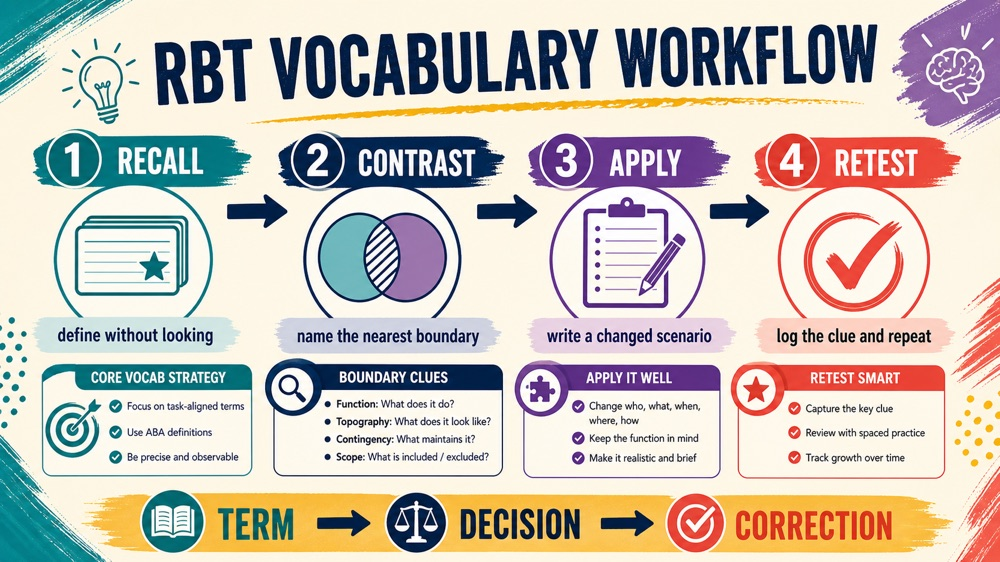
Use a seven-day recall, contrast, apply, and retest loop
A short review loop works with a printed list, a digital deck, or a personal notebook. Give each pass a different job:
| Day or pass | Action | Evidence to keep |
|---|---|---|
| Day 1 — map | Check edition, source note, A–F headings, and unresolved terms. | Domain counts and a “source check” pile. |
| Day 2 — recall | Define terms without looking and mark sure, narrowed down, or guessed. | Confidence beside each card. |
| Day 3 — contrast | Pair missed terms with their nearest boundary. | One separating feature per pair. |
| Day 4 — apply | Write and answer original two-sentence scenarios. | Controlling clue and rejected distractor. |
| Day 5 — mix | Shuffle domains so the heading no longer gives away the answer. | Error type: definition, measurement, application, reading, or role. |
| Day 6 — repair | Return to guessed and incorrect cards using a changed clue. | Source reread or new correction action. |
| Day 7 — retest | Use a short mixed set and compare reasoning, not only percentage. | Whether the distinction transfers after a delay. |
After the seven-day loop, keep a small maintenance set and rotate in new terms. Do not let a vocabulary session turn into an unending card-count project. The purpose is stable discrimination across the current scope, followed by mixed scenario practice and later pacing work when the untimed reasoning is reliable.
Common RBT vocabulary study errors
- Counting terms instead of checking coverage: a large list can still omit assessment, reporting, or ethics decisions.
- Using an old edition without a label: legacy material can be a cross-reference, but it should not be presented as current TCO scope.
- Learning synonyms instead of boundaries: a definition is weaker when it cannot explain why the nearest distractor fails.
- Confusing preference with reinforcement: a selected item is not automatically a demonstrated reinforcer.
- Confusing a term with competence: recognizing a word does not prove hands-on implementation under supervision.
- Memorizing answer letters: record the controlling clue and the condition that would change the answer.
- Copying secure or paid content: use original explanations and scenarios; do not seek or reproduce current, recalled, leaked, or official questions.
- Treating a practice score as a guarantee: use it to choose the next correction action, not to promise certification.
Bottom line: Build RBT vocabulary around the current RBT Test Content Outline, 3rd edition, not around a card count. Map terms to all six domains and 43 tasks, learn the nearest contrast, apply the word to an original scenario, and retest after a delay. That turns a broad keyword into a practical study system without confusing an independent resource with the BACB examination.
Ready to apply the terms?
Use current-domain practice questions to turn vocabulary recall into clue-based decisions and a focused correction plan.
Try Free RBT Practice Questions →
Frequently Asked Questions
What should RBT vocabulary include?
Useful RBT vocabulary includes precise definitions, current-domain labels, nearest contrasts, original examples, role boundaries, and a correction prompt. Card count alone does not establish quality or coverage.
Is there an official BACB RBT vocabulary list?
The current RBT Test Content Outline, 3rd edition, defines the exam scope and tasks, but an independent flashcard or glossary page should not be presented as an official BACB vocabulary list. Use official BACB sources for scope and process.
How many tasks should RBT vocabulary map to?
The current RBT Test Content Outline, 3rd edition, describes 43 tasks across six domains. Use that scope as a coverage check while remembering that a vocabulary resource remains an independent study aid.
Should I use RBT flashcards or a vocabulary PDF?
Either format can work. Choose the resource that states its edition, maps terms to current domains, explains contrasts, provides original examples, and is readable enough for repeated retrieval and annotation.
How do I turn vocabulary into practice questions?
Choose one term, add a controlling clue, write one decision question, create a plausible distractor that changes the boundary, and explain the correction. Then retest with a changed detail.
Can RBT vocabulary guarantee a passing score?
No. A glossary, flashcard set, practice score, or study schedule cannot guarantee certification, a passing result, or performance on the official examination.
References
- Behavior Analyst Certification Board. RBT Test Content Outline, 3rd edition.
- Behavior Analyst Certification Board. RBT Test Content Outline, 3rd-edition PDF.
- Behavior Analyst Certification Board. RBT Handbook.
- Behavior Analyst Certification Board. Examination Information.
- Independent RBT flashcard page. Reviewed for competitor research; not an endorsement.
- Independent RBT flashcard resource. Reviewed for competitor research; not an endorsement.
- Independent RBT terminology deck. Reviewed for competitor research; not an endorsement.