

RBT words become easier to remember when a definition is paired with an observable example, a data connection, the relevant plan, and one question for a supervisor.
Table of Contents
- What RBT words are for
- Definition, example, and nonexample
- Words for measurement and data
- Words for teaching and prompting
- Words for behavior change
- Words for ethics and supervision
- Build an RBT vocabulary card
- Review similar terms safely
- Frequently asked questions
- References
RBT KNOWLEDGE · STUDY GLOSSARY
RBT Words: Study Glossary
A practical vocabulary routine for defining terms, recognizing examples, connecting data to the plan, and asking focused supervision questions.
RBT words become easier to remember when a definition is paired with an observable example, a data connection, the relevant plan, and one question for a supervisor. A vocabulary list by itself can produce memorization without accurate application. The routine in this article turns each term into a small study card while keeping client-specific decisions with the authorized plan and supervising professional.
This is an educational study guide, not a substitute for the current BACB materials, employer procedures, client plan, or supervision. Terms can look simple while their recording rules and implementation limits depend on context.
What RBT words are for
“RBT words” can mean vocabulary from training, terms in the current RBT content outline, language used during supervision, or a phrase found in a client’s written procedure. Begin by identifying which of those jobs the word is doing. A definition for an exam concept may be brief; a definition used during implementation must also connect to observable behavior and the written instruction.
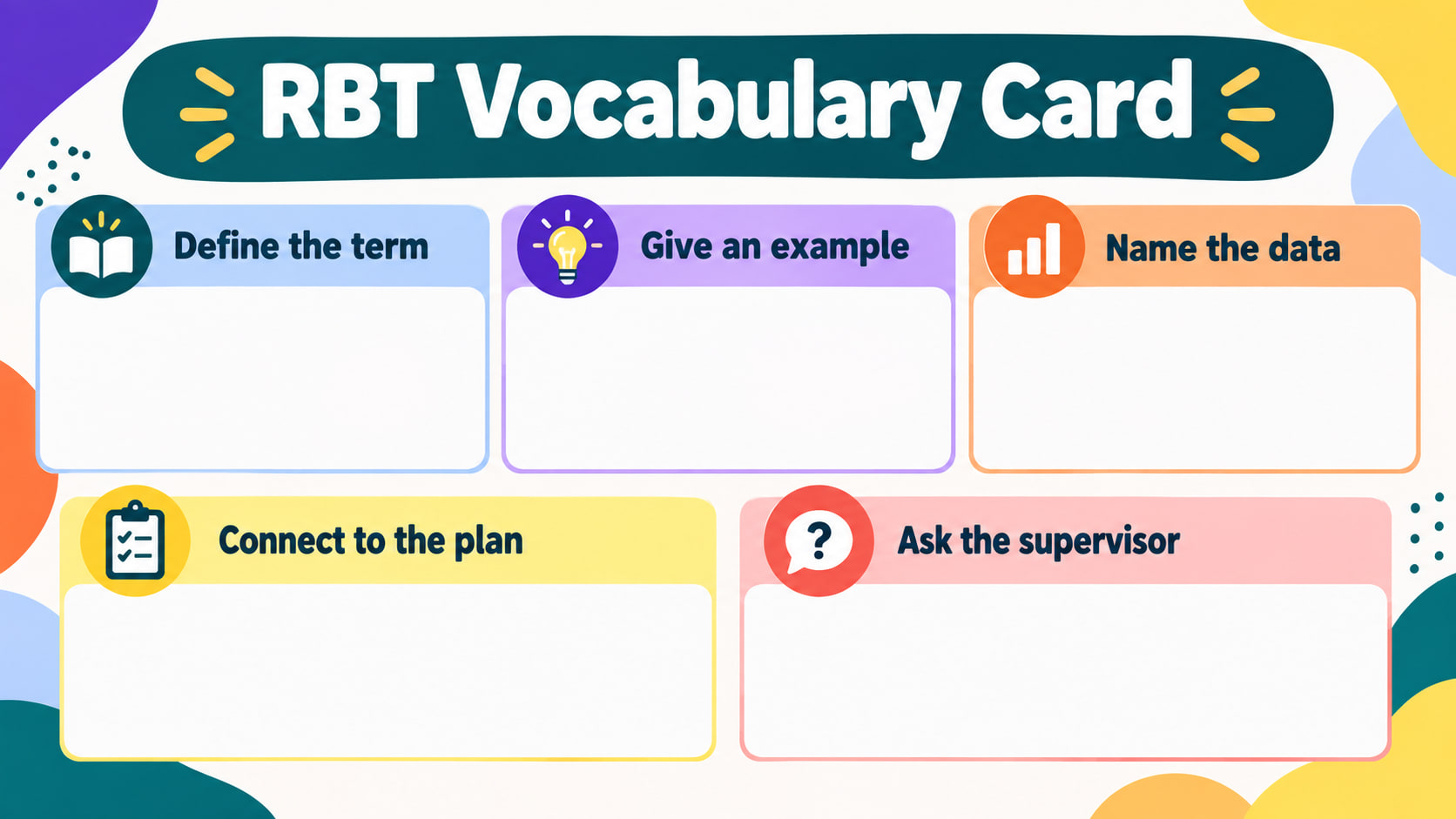
For each new term, ask five questions: What does it mean? What would an observer see? What would count as an example and a nonexample? What data or record relates to it? What part of the plan or supervision controls the next action?
Definition, example, and nonexample
A useful definition names the essential feature without adding an unsupported conclusion. For example, a measurement term should explain what is recorded and when, rather than simply saying that it “tracks behavior.” A teaching term should describe the relation between the instruction, learner response, prompt, consequence, or correction when those features are part of the term.
An example makes the definition visible. A nonexample shows a nearby situation that does not meet the definition. Both should be original and de-identified. Do not copy a client’s name, schedule, diagnosis, or private notes into a public flashcard or online study document.
Use neutral language. “The learner touched the red card within five seconds of the instruction” is more useful than “the learner understood.” Observable wording improves communication and makes it easier to decide what should be recorded.
Words for measurement and data
RBT study materials commonly use words such as frequency, duration, latency, rate, interval recording, percentage, and permanent product. The important study question is not only what each word means, but also what starts and stops the recording, which response counts, and how the result is summarized.
Frequency describes how many times a defined response occurs. Duration describes how long it lasts. Latency describes the time between a specified event and the response. Rate adds a time dimension to a count. Percentage compares a number of correct or completed opportunities with the relevant total. These are general study descriptions; the operational definition and recording rule come from the current plan or supervisor.
Before collecting data, confirm the target definition, recording window, device or form, and what to do when an event is ambiguous. Do not switch from duration to frequency because it is easier, and do not fill a blank with an estimate after the fact unless the authorized procedure tells you how to handle missing data.
Words for teaching and prompting
Skill-acquisition vocabulary may include task analysis, prompting, prompt fading, shaping, chaining, discrimination, generalization, maintenance, and reinforcement. Study each term as a relationship, not as an isolated label. Ask what behavior is being taught, what cue is present, what assistance is delivered, and what the plan says about reinforcement and prompt changes.
Prompting means providing assistance that helps evoke a response; the exact prompt hierarchy and fading procedure must be trained and specified. Generalization concerns responding across people, materials, settings, or examples when the skill is expected to transfer. Maintenance concerns performance continuing over time. An RBT should implement the programmed steps and communicate observations rather than invent a new prompt level or mastery rule.
Words for behavior change
Behavior-change vocabulary can include antecedent, behavior, consequence, reinforcement, extinction, differential reinforcement, replacement behavior, preference, and motivating operation. The safest way to study these terms is to separate the definition from the decision to use a procedure.
An antecedent occurs before the response and a consequence follows it. Reinforcement is defined by an increase in future behavior, not by whether a consequence seems pleasant to an observer. Extinction and differential reinforcement are procedures with specific conditions and risks; knowing their definitions does not authorize an RBT to start, stop, or modify them independently.
When the observed situation does not match the written procedure, protect safety, follow the designated escalation route, and ask the supervisor. Do not treat a vocabulary word as permission to improvise.
Words for ethics and supervision
Some of the most important RBT words describe professional behavior: confidentiality, informed consent, dignity, competence, supervision, documentation, boundaries, and conflicts of interest. These terms connect study to how information is handled and how responsibilities are shared.
Confidentiality means protecting private information and using approved communication channels. Competence means working within training and authorization. Supervision is not a last-minute answer source; it is part of ongoing support, feedback, and accountability. Boundaries help prevent personal, financial, or dual relationships from interfering with services.
If an ethical question is urgent, safety-related, or unclear, document objectively and use the current reporting and supervision process. Online summaries should not replace the applicable ethics code, employer policy, or direct guidance.
Build an RBT vocabulary card
Create one card for one term. Keep the fields short enough to review, but specific enough to prevent vague memorization.
- Term: write the exact word or phrase.
- Definition: explain the essential feature in plain language.
- Example: describe an observable, original scenario.
- Data: name what would be counted, timed, scored, or recorded.
- Boundary: state what requires the plan or supervisor before action.
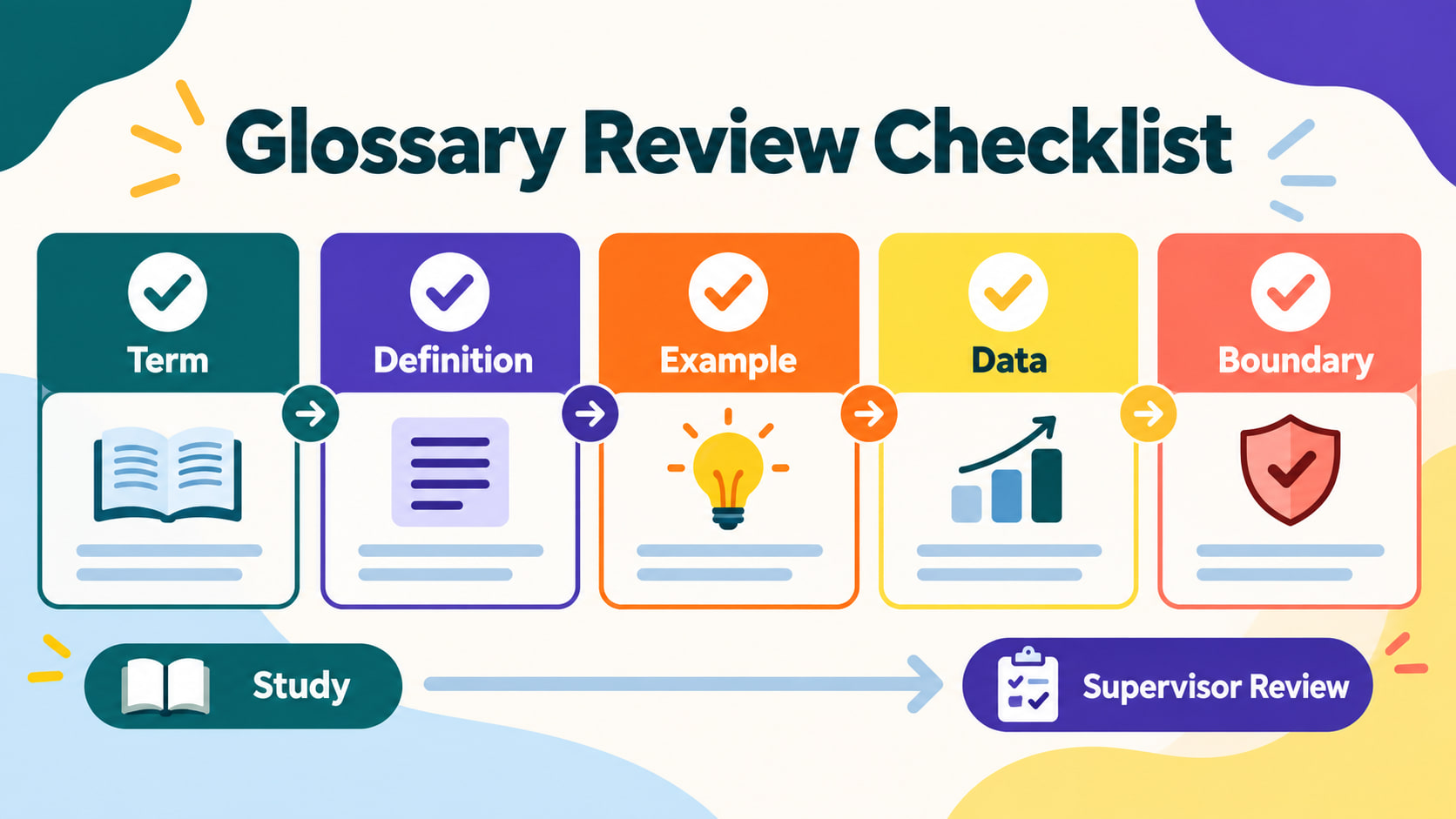
Read the card aloud, then cover one field at a time and reconstruct it. If you cannot name the data or boundary, the card is not finished. Ask a supervisor to review terms that affect implementation, safety, measurement, prompting, or client communication.
Review similar terms safely
Many errors happen between related words. Compare them in a small table or paired card: frequency versus rate, prompt versus instruction, preference versus reinforcer, antecedent versus setting event, acquisition versus maintenance, and confidentiality versus consent. For each pair, write the feature that separates them and one example that would be misleading.
Use current official materials when terminology has changed or when a study resource disagrees with the current content outline. Then bring the discrepancy to supervision. A search result, social post, or old flashcard may be useful for locating a question but is not automatically the controlling source.
Frequently asked questions
How many RBT words should I study at once?
Use a small set you can define, exemplify, connect to data, and explain within your role. Quality and accurate retrieval matter more than a long list of unreviewed terms.
Should every vocabulary word have a client example?
No. Use de-identified educational examples unless a supervisor directs a client-specific review through an approved channel. A public article should never expose private client information.
Can a definition tell me what to do during a session?
Usually not by itself. The current written procedure, training, safety instructions, and supervisor direction determine implementation. A definition helps you ask a precise question.
What if two study resources define a term differently?
Check the date and authority of each source, compare the exact context, and ask the supervisor which current source applies. Do not silently combine conflicting instructions.
Source note: Review the current BACB RBT content outline, RBT Handbook, ethics materials, client plan, and supervisor direction for your situation. This article is educational and does not provide individualized legal, clinical, employment, or credentialing advice.
Ready to practice the RBT concepts you just reviewed?
Try an independent, original RBT practice resource with exam-style questions, scoring, and answer explanations.
References
- Behavior Analyst Certification Board. RBT Test Content Outline, 3rd edition.
- Behavior Analyst Certification Board. RBT Handbook.
- Behavior Analyst Certification Board. RBT Ethics Code.