

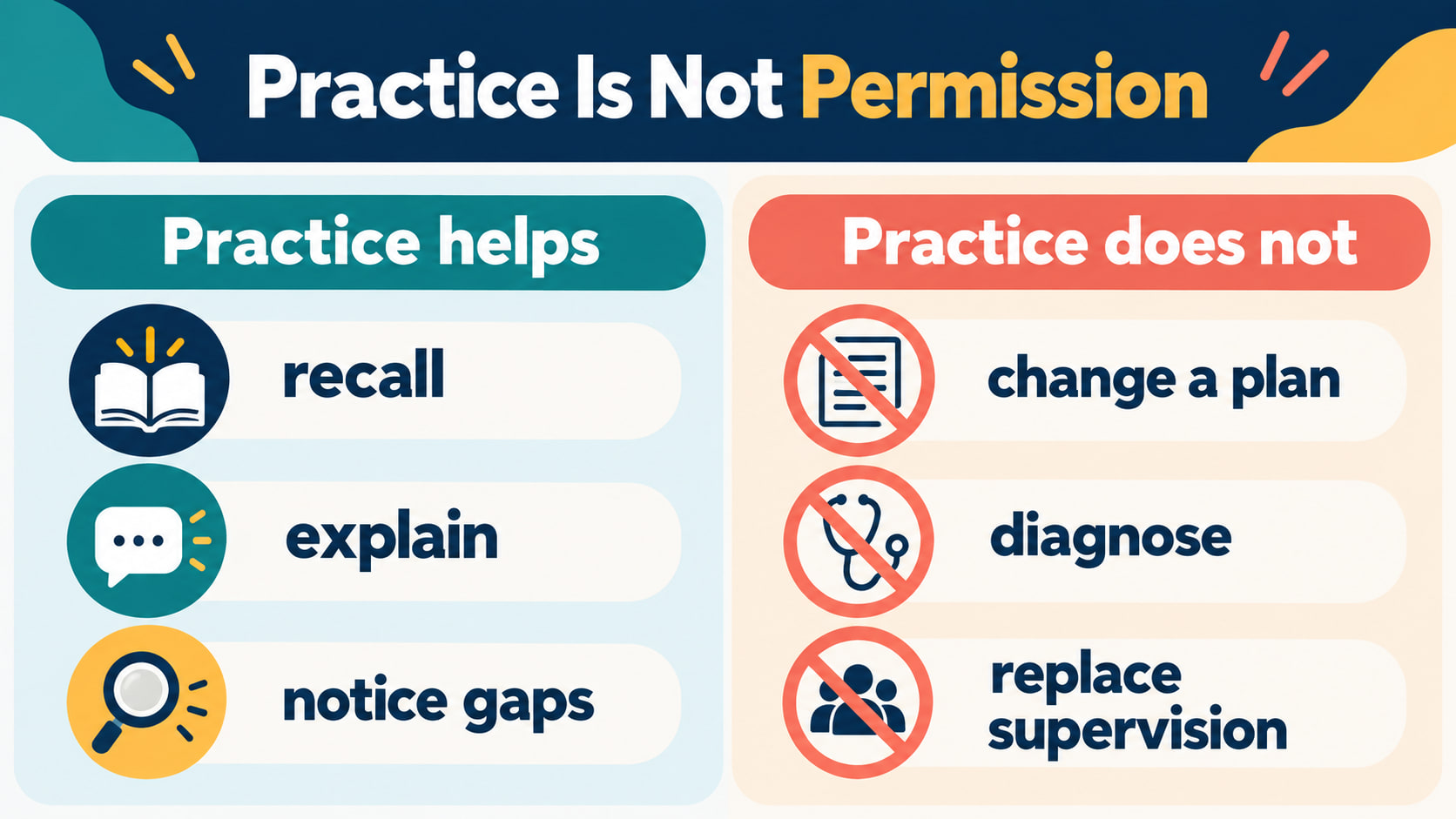
An RBT workbook can turn reading into active practice, but practice remains separate from competence, supervision, and permission to change a plan.
Table of Contents
- What an RBT workbook can do
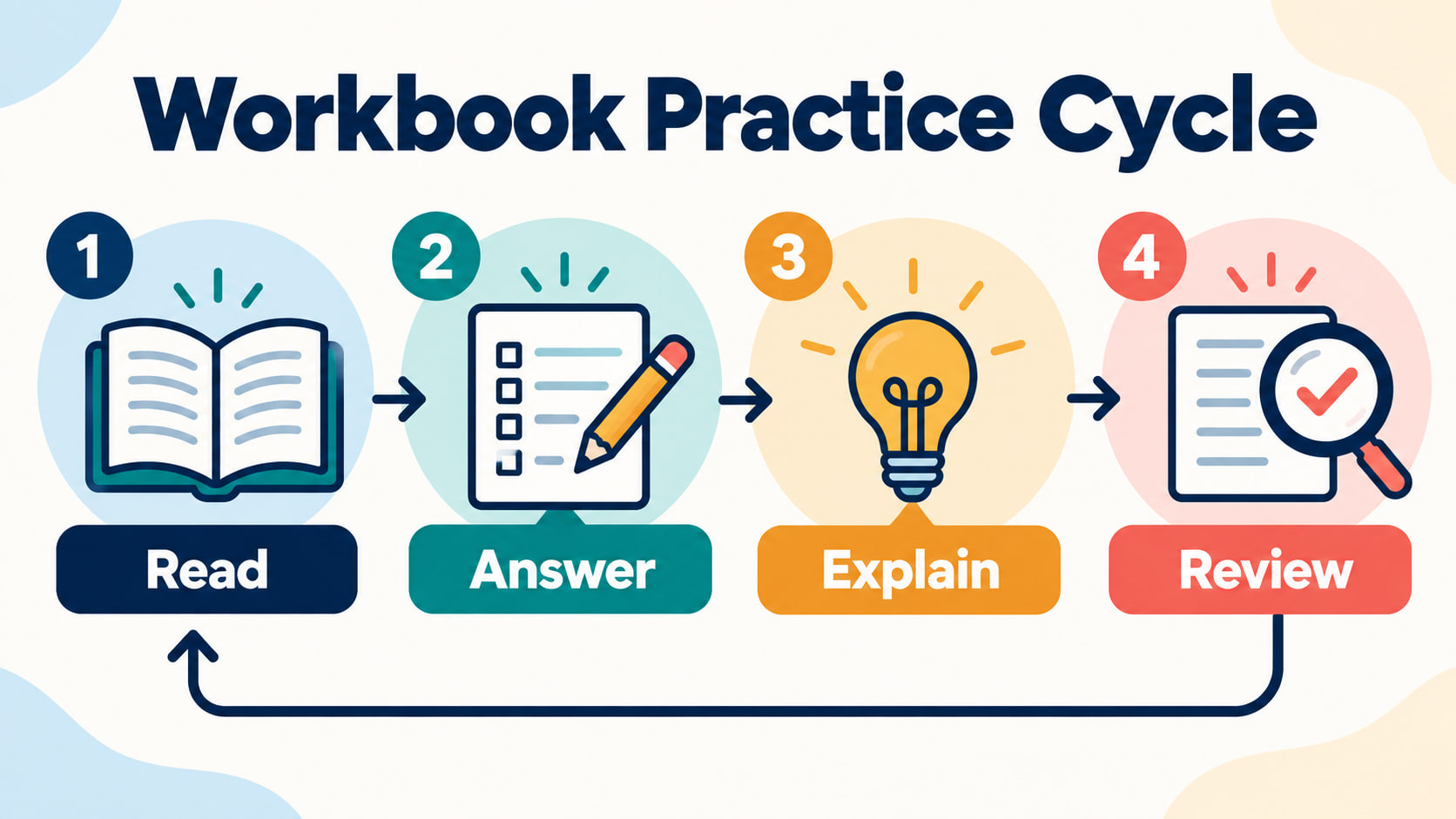
- Use a four-part practice cycle
- Define the target
- Practice with original examples
- Explain the reasoning
- Review gaps and ask questions
- Keep practice separate from service decisions
- Common workbook mistakes
- Frequently asked questions
- References
RBT STUDY · ACTIVE PRACTICE
RBT Workbook: Turn Study Into Practice
Use a workbook to practice recall, explain concepts, notice study gaps, and prepare focused questions.
An RBT workbook can turn reading into active practice. Instead of only rereading a definition, a learner can recall it, explain it in plain language, apply it to an original scenario, and identify what still needs review. That process can reveal study gaps more clearly than highlighting alone.
Practice remains separate from competence, supervision, and permission to change a plan. A workbook may be a personal study tool, a course supplement, or an employer training aid. Before using one, check its date, source notes, purpose, and alignment with current official materials.
The current official content outline and handbook, organizational policy, assigned procedures, written service plan, supervision, and observation control decisions in your setting. A workbook supports preparation; it does not replace those sources or guarantee an examination result.
What an RBT workbook can do
A useful workbook gives the learner a place to answer questions, draw distinctions, write original examples, and track uncertainty. It can support review of measurement, prompting, reinforcement, skill acquisition, behavior reduction, documentation, ethics, privacy, communication, and supervision.
Choose practice tasks that have a visible purpose. “Define frequency,” “identify an observable description,” and “explain when to seek direction” are different tasks. Mark which one you completed so a check mark does not falsely suggest that every kind of understanding is complete.
Use a four-part practice cycle
- Define: identify the term, skill, or decision you are studying.
- Practice: answer an original prompt or work through a neutral example.
- Explain: state why the answer fits and which source supports it.
- Review: mark the gap, correction, or question that comes next.
Define the target
Start with one narrow target. Broad goals such as “learn data collection” are difficult to measure. A narrower target might be “distinguish frequency from duration,” “write an objective description,” or “identify which question belongs with a supervisor.” A narrow target makes practice and feedback easier.
Write the source beside the target. If the target comes from a current official outline, record that. If it comes from a textbook or course, label it as a supporting explanation and compare it with the primary source. This habit helps prevent a workbook from becoming an isolated set of rules.
Practice with original examples
Use original educational scenarios that do not include client names, photographs, schedules, diagnoses, or other identifying details. A scenario can ask what information is observable, which measurement fits, what a prompt means, or when a question should be routed to supervision.
Do not copy a workbook example into a client program or record. A generic example is not a written service plan. If a real situation raises the same concept, use the approved procedure and ask the responsible supervisor how the concept applies.
Explain the reasoning
After answering, explain the reasoning in one or two sentences. State the relevant fact, the source or rule checked, and the role-appropriate action. For example, an answer about a missing data value should distinguish what was observed from what was not recorded and identify the approved correction or escalation route.
Explanation is especially useful when two answers sound plausible. Ask what assumption each answer makes, whether the source is current, and whether the option gives the RBT authority that the role does not provide. This turns a wrong answer into a useful study note.
Review gaps and ask questions
Use a simple review code such as “know,” “practice,” “verify,” and “ask.” “Know” means you can explain the concept. “Practice” means you need another example. “Verify” means the source or date is uncertain. “Ask” means the issue depends on current policy, supervision, or service context.
Bring focused questions to supervision. Include the topic, the source checked, the original scenario, and the exact uncertainty. Do not send client-identifying details through a personal workbook or unapproved channel. If the question involves safety, privacy, data integrity, or a task beyond competence, follow the designated escalation process.
Keep practice separate from service decisions
A workbook can help you rehearse a general skill, but it cannot authorize a plan change, diagnosis, assessment, supervision, or independent clinical advice. If a practice answer conflicts with the current written instruction, pause and ask which source controls.
Keep personal study notes separate from official records. Do not paste a workbook answer into a session note, label a learner from a practice scenario, or use a practice score as proof of competence. Observation, feedback, and the approved competency process establish what you are ready to do.
Common workbook mistakes
- Completing without understanding: boxes are checked but answers cannot be explained.
- Using outdated prompts: old wording is memorized without checking current sources.
- Copying generic examples: study content is treated as a client-specific instruction.
- Practicing with private details: identifying information is placed in personal notes.
- Confusing practice with competence: a score is treated as authorization to work independently.
- Hiding uncertainty: an unresolved question is marked correct instead of routed for review.
A strong workbook makes learning visible: what you can define, what you can explain, what you still need to practice, and what requires another source or supervisor conversation.
Keep the review cycle small enough to repeat. One well-explained scenario can be more useful than a page of guesses. After a correction, try a similar but different scenario so you can tell whether you learned the principle or only memorized the original wording.
When sharing a workbook with another learner, label the material honestly. Say whether it is a personal study aid, a course supplement, or an employer training tool. Include the date and source when possible, and invite readers to verify current requirements rather than presenting a worksheet as official authority.
A workbook can also support a calm supervision conversation. Bring the item you missed, the explanation you attempted, and the source you checked. Ask whether the issue is a vocabulary gap, a measurement problem, a policy question, or a setting-specific implementation decision. The distinction helps the supervisor give useful feedback without turning study practice into an unauthorized instruction.
Frequently asked questions
Is an RBT workbook an official BACB document?
Not necessarily. Check the publisher, source, date, and purpose. Use current official BACB materials for controlling requirements.
Can completing a workbook prove competence?
No. It can show study and practice, but competence requires the applicable training, observation, feedback, and supervision process.
Can I use workbook answers during a session?
Use the current written procedure, service plan, policy, and supervisor direction for service decisions. A study answer is not an implementation instruction.
How should I track a wrong answer?
Record the concept, correction, source checked, and next practice step. Ask for clarification when the answer depends on current setting-specific direction.
Source note: Review current BACB materials, organizational policy, assigned procedures, the written service plan, and supervisor direction for your setting. This article is educational and does not provide individualized legal, clinical, employment, or credentialing advice.
Ready to practice the RBT concepts you just reviewed?
Try an independent, original RBT practice resource with exam-style questions, scoring, and answer explanations.
References
- Behavior Analyst Certification Board. RBT Test Content Outline, 3rd edition.
- Behavior Analyst Certification Board. RBT Handbook.
- Behavior Analyst Certification Board. RBT Ethics Code.