

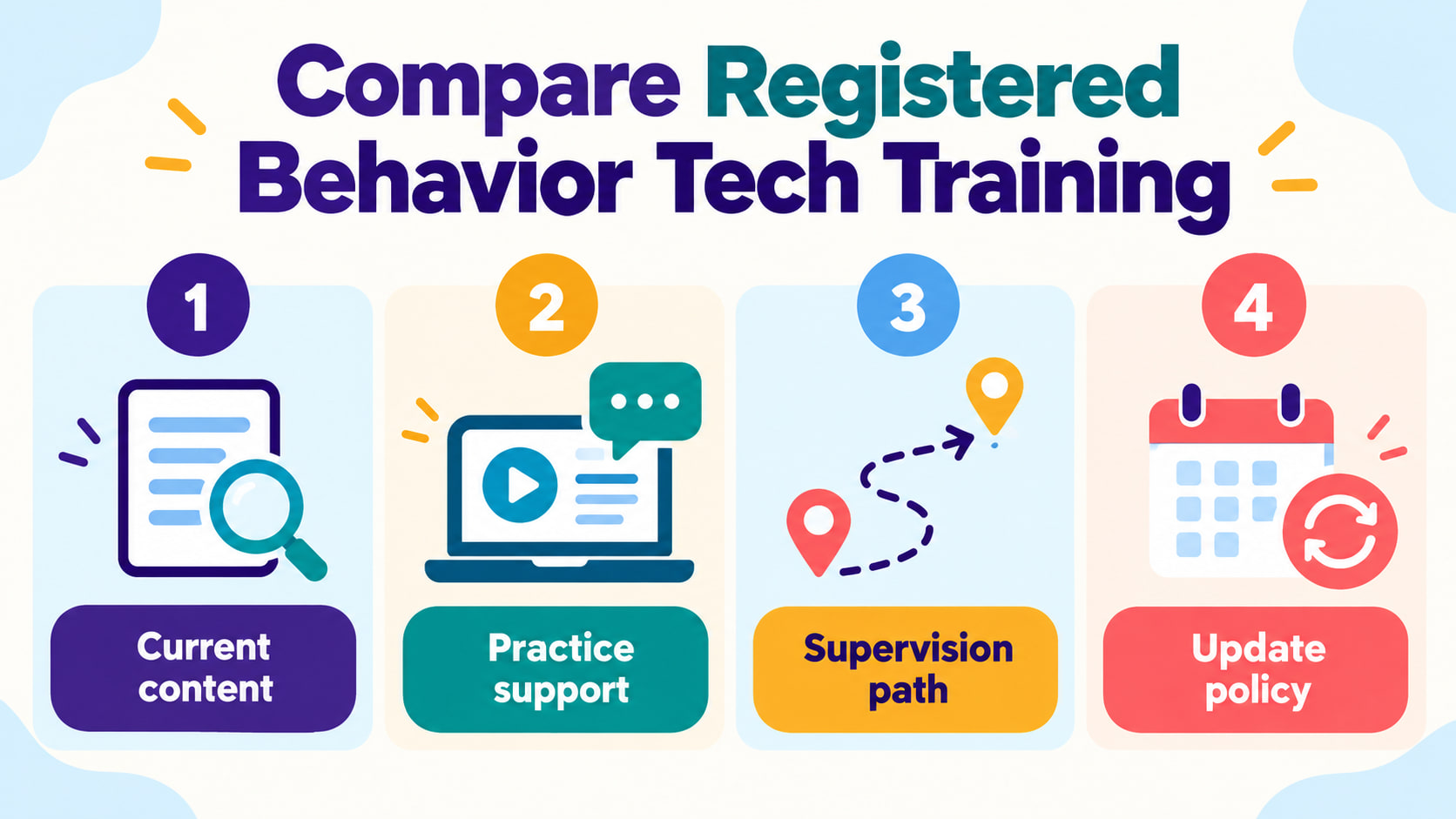
Registered behavior tech training should be compared by what you learn, how practice is supported, how supervision is arranged, and what the role allows after training.
Table of Contents
- Start with the pathway, not the promise
- How to compare registered behavior tech training content
- Look for practice and feedback
- Ask how supervision is arranged
- Check current evidence and updates
- Questions to ask before enrolling
- Common comparison mistakes
- Frequently asked questions
- References
RBT TRAINING · PROGRAM REVIEW
Registered Behavior Tech Training: What to Compare
A practical framework for comparing course content, practice support, supervision, and role boundaries.
Registered behavior tech training is easier to evaluate when you separate four things: what a course teaches, how you practice, how supervision is provided, and what steps remain after training. A polished sales page can describe a useful class, but a class alone is not the same as eligibility, competency, an application, an examination, or ongoing supervision.
The current BACB materials should be your reference point for the pathway and content. Course descriptions, prices, schedules, and support models can change. This article gives you a comparison method so you can check a program against current requirements instead of choosing only by a badge, countdown timer, or broad promise.
Start with the pathway, not the promise
Before comparing providers, write down the result you actually need. Are you looking for introductory knowledge, preparation for a supervised role, an employer-sponsored pathway, or a review resource? These goals are related but not interchangeable. A short overview may be appropriate for exploration, while a person preparing for a formal credentialing process needs to verify each required step from current official materials.
Also check who is responsible for each step. A training provider may teach content. An employer or supervisor may arrange practice and oversight. An applicant may need to submit forms, meet eligibility conditions, complete an assessment, and follow current instructions. When a website says “become certified” without explaining those distinctions, treat the phrase as a prompt for questions rather than a guarantee.
How to compare registered behavior tech training content
Strong registered behavior tech training should make its learning objectives visible. Look for clear coverage of measurement, assessment concepts, skill acquisition, behavior reduction, documentation, professional conduct, and the role of supervision. The exact organization can vary, but a reader should be able to map lessons to the current BACB content outline or explain why a topic is included.
Do not judge depth by the number of videos alone. Ask whether lessons define terms, demonstrate how concepts are used, identify common errors, and give you a way to check understanding. A long slide deck can still leave a learner unable to distinguish an operational definition from an interpretation, or reinforcement from simply giving a preferred item.
Content should also show appropriate limits. An RBT implements assigned procedures and communicates observations; training should not encourage a learner to independently redesign a plan, diagnose a person, promise outcomes, or make a complex ethical decision without the required direction. Clear boundaries are a quality signal because they connect knowledge to safe practice.
Look for practice and feedback
Reading about a procedure is different from practicing it. When reviewing a program, find out whether you will work through original examples, identify observable behavior, select a measurement approach, interpret a simple data display, or rehearse professional communication. Practice does not need to expose real client information. Fictional scenarios can teach the decision structure while protecting privacy.
Feedback matters as much as practice. A quiz score can show that you selected an answer; it may not show whether you can perform a task accurately. Look for explanations of incorrect answers, opportunities to retry, instructor access, or a defined route for questions. If a provider promises “hands-on” learning, ask what hands-on means, who observes it, and how performance is documented.
Use a small test before enrolling. Read one lesson, complete one activity, and see whether the explanation is specific enough to improve your next attempt. Notice whether the examples use precise language and whether the course distinguishes what is directly observable from a guess about why someone behaved a certain way.
Ask how supervision is arranged
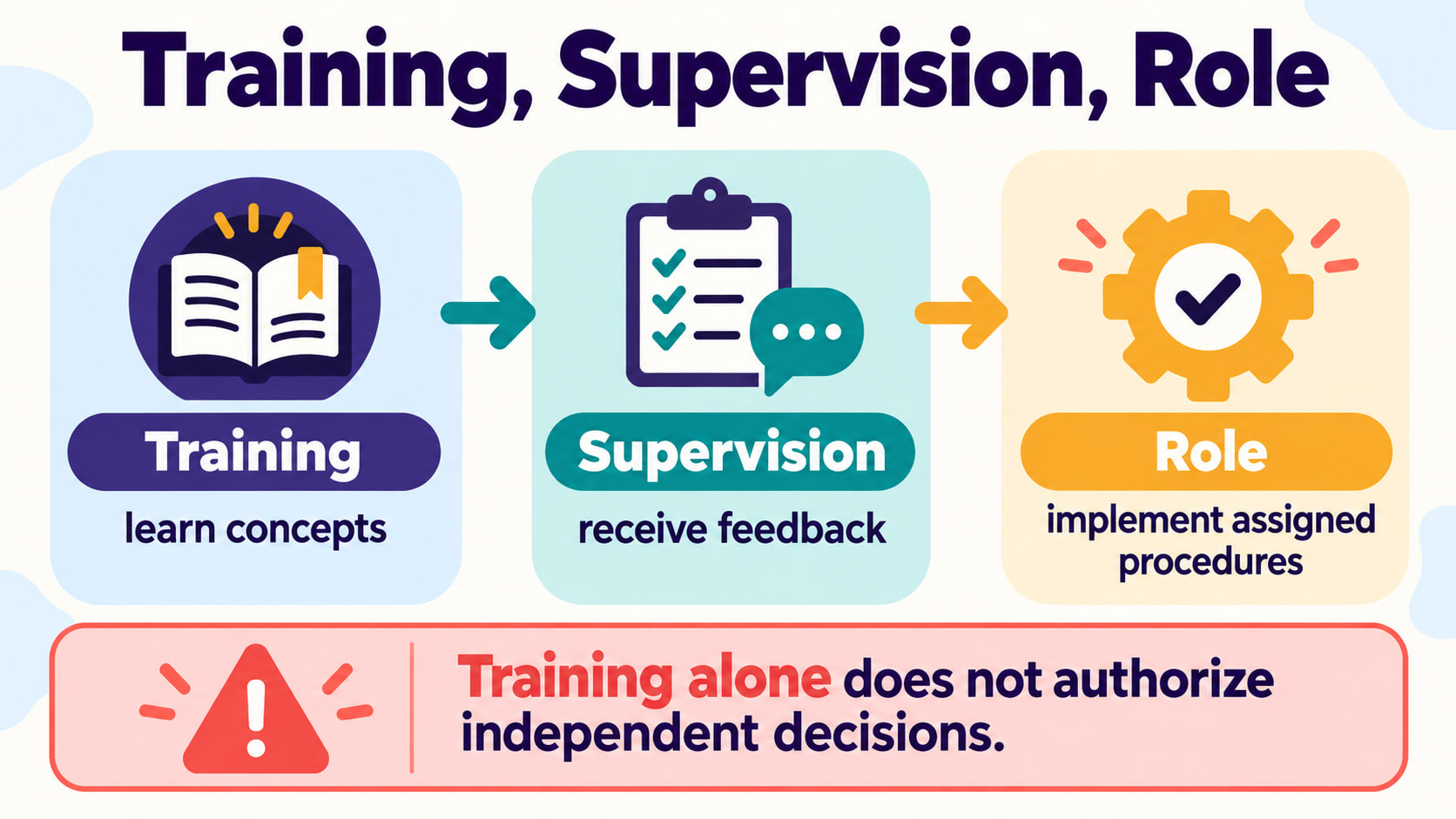
Training and supervision answer different needs. Training introduces concepts and procedures. Supervision connects assigned work to feedback, competence, documentation, and the service setting. Ask whether the provider supplies supervision, whether an employer supplies it, or whether you must arrange it separately. Get the answer in writing before paying.
Clarify who the supervisor is, how often contact occurs, what activities can be observed, how feedback is recorded, and what happens if a session is canceled. Ask how concerns are escalated and how privacy is protected during remote meetings. A program that says “supervision included” but does not explain the responsible person or process leaves an important gap.
If a course is self-paced, understand what it can and cannot do. Self-paced lessons may help you study, but they cannot replace required oversight or authorize independent decisions. Treat the course as one component in a larger pathway and confirm the next step with the responsible organization.
Check current evidence and updates
Use official BACB materials as the anchor for claims about current content, applications, examinations, ethics, and handbook instructions. A course should tell you when its lessons were reviewed and how updates are communicated. Version dates, revision notes, and links to primary sources are more useful than a vague statement that material is “always current.”
Be cautious with testimonials that imply a universal result. A learner’s experience can help you understand support and usability, but it does not prove that every student will meet the same requirements or find employment. Compare what is promised with what is actually included: lessons, practice, feedback, documentation, supervision, and support after enrollment.
Questions to ask before enrolling
- Which current official content or handbook materials does the course use?
- What topics are taught, and where can I see the learning objectives?
- How do I practice measurement, documentation, and professional communication?
- Who provides feedback, and how can I ask a question about an activity?
- Is supervision included, arranged by an employer, or separate from this purchase?
- What are the total costs, renewal terms, refund rules, and access period?
- How are privacy, recordings, account access, and learner data handled?
- When requirements change, how will the provider notify current learners?
Common comparison mistakes
Choosing only by price: a lower price may be reasonable, but compare what support and feedback are included. Choosing only by duration: a shorter course is not automatically more efficient if it omits practice. Confusing completion with authorization: finishing lessons does not itself permit independent clinical decisions. Ignoring supervision: a strong content library cannot answer who observes and guides actual work. Using old advice: eligibility and process details should be checked against current official materials.
A useful comparison can fit on one page. Make columns for content, practice, feedback, supervision, updates, privacy, cost, and next steps. Save the provider’s answers and the date you checked them. Revisit the official sources before beginning a formal application or relying on a course’s statement about what is required.
Frequently asked questions
Is registered behavior tech training the same as becoming an RBT?
No. Training is one part of preparation. Other eligibility, assessment, application, examination, and supervision steps may apply, so verify the current pathway in official materials.
Can a self-paced course replace supervision?
Do not assume that it can. Ask who provides supervision and how actual performance is observed and documented.
What is the most important feature to compare?
Compare the complete pathway: specific content, meaningful practice, feedback, supervision responsibilities, current updates, and clear role boundaries.
Can a course guarantee a job or credential?
A course should not guarantee an outcome it does not control. Treat guarantees as a reason to verify the exact terms and current official requirements.
Source note: Review current BACB materials, employer requirements, applicable policies, approved systems, and supervisor direction for your setting. This article is educational and does not provide individualized legal, clinical, employment, or credentialing advice.
Ready to practice the RBT concepts you just reviewed?
Try an independent, original RBT practice resource with exam-style questions, scoring, and answer explanations.
References
- Behavior Analyst Certification Board. RBT Test Content Outline, 3rd edition.
- Behavior Analyst Certification Board. RBT Handbook.
- Behavior Analyst Certification Board. RBT Ethics Code.