
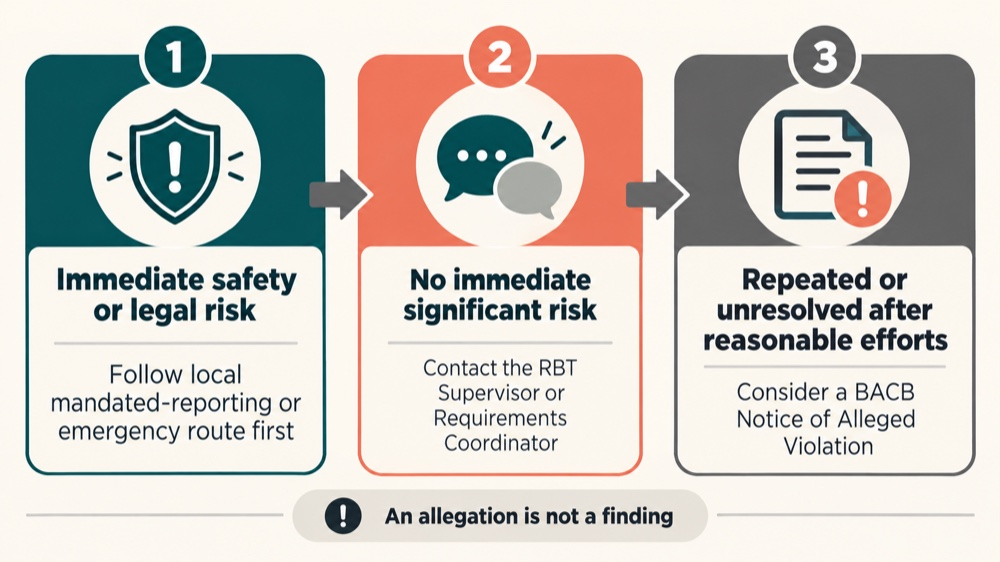
To report an alleged violation against an RBT responsibly, start with triage rather than accusation. The current BACB guidance separates immediate safety or legal reporting, supervisor or Requirements Coordinator review, and a possible Notice of Alleged Violation to the BACB. The right route depends on risk, jurisdiction, the RBT’s status, the evidence available, and whether reasonable efforts have already been made to address the concern.
Table of Contents
- What it means to report an alleged violation against an RBT
- How to report an alleged violation against an RBT: triage immediate risk
- How to report an alleged violation against an RBT: choose the route
- How to report an alleged violation against an RBT: prepare the record
- Step 4: Understand what a BACB Notice does and does not do
- Common reporting mistakes
- Frequently asked questions
- Official sources and scope
RBT ethics reporting and escalation guide
Report an Alleged Violation Against an RBT: What to Do First
Triage risk, choose the correct reporting route, document facts, and protect privacy before deciding whether a BACB Notice may be appropriate.
Report an alleged violation against an RBT is not the same as declaring that a violation occurred. The current BACB guidance asks the person with a concern to choose the right route based on risk, jurisdiction, the RBT’s status, the facts available, and whether reasonable efforts have already been made to address the issue.
Some situations require immediate action through law enforcement, a state regulator, safeguarding, or another mandated-reporting route. Other concerns should first be brought to the RBT’s Supervisor or Requirements Coordinator. A BACB Notice of Alleged Violation may be appropriate in some cases, but it is one part of a process—not a substitute for local obligations and not a finding of misconduct.
What it means to report an alleged violation against an RBT
A report communicates a concern about a possible ethics or certification-related violation to the person or organization that has authority to respond. The RBT Ethics Code (2.0), BACB reporting guidance, employer policy, state regulation, and the facts of the event all matter. A good report makes it easier for the appropriate reviewer to understand what was observed, what risk may exist, and what action has already been taken.
It is useful to separate four labels:
- Concern: an observation, report, document, or event that needs review.
- Allegation: a stated claim that a person may have violated an applicable requirement.
- Notice: a formal submission to the BACB Ethics Department through the applicable process.
- Finding or sanction: an outcome determined through an authorized review, not by the reporter.
This distinction protects everyone involved. It prevents a reporter from overstating uncertain information, and it prevents a supervisor from dismissing a potentially serious concern simply because the first account is incomplete.
How to report an alleged violation against an RBT: triage immediate risk
Before deciding where to send a report, ask whether someone may be in immediate danger or whether a separate legal or regulatory duty applies. BACB’s current RBT reporting-considerations document highlights abuse or neglect, a charge or conviction of a violation of law, certain RBT Ethics Code (2.0) sections, and significant risk as situations that may require action beyond an ordinary workplace conversation.
- Protect immediate safety. Follow the organization’s emergency, safeguarding, and supervisory procedures. If a person is in immediate danger, use the appropriate emergency route.
- Check mandated reporting. If the situation may trigger a state or federal mandated-reporting duty, report to the required local entity before treating a BACB Notice as the only response. The BACB document does not replace local law.
- Check professional regulation. If the RBT lives or practices in a state with relevant behavior-analytic licensure or regulation, identify the state agency’s role and current reporting instructions.
- Check BACB jurisdiction. BACB enforces its ethics requirements against applicants and certificants within its jurisdiction. A trainee, employer, or company may require a different route.
Do not delay an urgent protective action while trying to choose perfect wording for a BACB form. Record what you did, when you did it, and which authority or organization you contacted. Then use the applicable BACB guidance for the certification-related portion of the concern.
How to report an alleged violation against an RBT: choose the route
If the concern does not pose significant risk, the RBT’s Supervisor or Requirements Coordinator is often the right first contact. BACB’s guidance explains that they are responsible for investigating the allegation and determining next steps. If you are not the RBT’s Supervisor or Requirements Coordinator, address the concern with that person directly rather than trying to run a private investigation.
You can use the BACB Certificant Registry to help identify the RBT’s supervisor or certification information. Verify that you have the correct person before sending sensitive material. A name match alone is not enough, and a public record should not become an excuse to circulate private client information.
When internal review may be appropriate
A supervisor, Requirements Coordinator, or employer may need to clarify the facts, speak with the people involved, review records, provide feedback or training, and document a corrective or performance-management plan. The purpose is not to punish automatically; it is to understand what happened, protect clients, correct the problem, and decide whether a formal BACB report is necessary.
If you are the supervisor or Coordinator, document your efforts and outcomes. If you are a coworker, client, family member, or other observer, share the concern through the approved route and avoid asking for confidential details that you do not need to know.
When a BACB Notice may be appropriate
The current BACB checklist points toward a Notice when the concern fits the applicable reporting considerations, such as significant risk, certain serious ethics or legal issues, or repeated misconduct that continues despite reasonable attempts to resolve it. The current Reporting to the Ethics Department page and the RBT-specific document control the live route.
Do not send a Notice simply because an interpersonal disagreement feels unfair, a workplace policy was inconvenient, or a person made an error that was promptly corrected. Describe the event and let the authorized process decide whether it meets a reportable standard.
How to report an alleged violation against an RBT: prepare the record
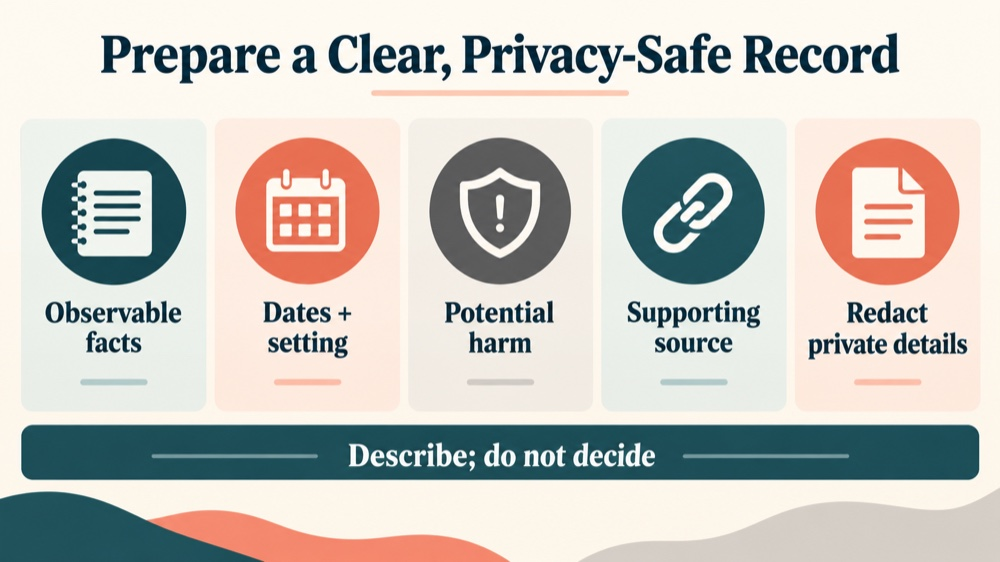
A useful record is specific without becoming a narrative of assumptions. Start with the event, not the conclusion. Write what you directly observed, what was reported to you, what document or message supports it, and what you did next.
- Observable facts: state the action, words, record entry, or event without guessing intent.
- Date and setting: note when and where it happened, the service context, and who had direct knowledge.
- Potential harm or risk: describe the actual or perceived impact, separating evidence from concern.
- Supporting source: identify the relevant note, message, policy, public page, or witness, and keep the original where authorized.
- Privacy review: redact client-identifying and unrelated confidential details before sharing through a reporting route that does not require them.
You do not need to be certain about the exact ethics subsection before raising a concern. The current RBT reporting-considerations document says the report should clearly describe the potential violation and context; if you identify standards, use the current Ethics Code and do not list more than the form allows. Accuracy is more valuable than a dramatic label.
Step 4: Understand what a BACB Notice does and does not do
A Notice of Alleged Violation starts an authorized review. It does not itself prove the allegation, guarantee a sanction, or guarantee that the reporter will receive updates. The BACB may share an accepted Notice and supporting documentation with the subject, who receives an opportunity to respond and provide supporting documentation.
If the evidence is publicly available and the subject is clearly identified, BACB provides a separate publicly documented alleged-violation route. That route is anonymous, which means the notifier cannot request an update. Read the current form requirements carefully and submit only documentation that is genuinely public and relevant.
BACB states that it cannot provide legal or ethics advice. If you need to know whether a state law, employment rule, client-safety duty, or legal privilege applies, use the appropriate qualified adviser or regulatory route. Do not present a BACB submission as a court finding or publish the allegation on social media.
Common reporting mistakes
- Skipping urgent local action: sending a BACB form does not replace emergency or mandated reporting.
- Reporting the company instead of the person: BACB certifies people, not companies as entities.
- Using the wrong subject: verify the RBT’s identity and certification information before sharing a concern.
- Writing a verdict: replace “the RBT committed fraud” with the observable facts and the source that supports the concern.
- Sharing unredacted client data: remove unnecessary identifying information and follow the official submission instructions.
- Investigating beyond your role: share the concern with the responsible supervisor or Coordinator instead of interviewing clients or accessing records without authorization.
- Promising confidentiality or updates: reporting routes have different disclosure and notification rules; do not promise an outcome you cannot control.
Frequently asked questions
Should every concern about an RBT go directly to BACB?
No. Immediate safety, mandated-reporting, state-regulatory, supervisor, Coordinator, employer, and BACB routes can all have different roles. Use the current BACB RBT considerations document to choose the path that fits the risk and facts.
What if I am not the RBT’s supervisor?
If there is no immediate risk requiring another authority, address the concern with the RBT’s Supervisor or Requirements Coordinator. The BACB Registry may help you identify the responsible person. Do not conduct an unauthorized investigation.
Do I have to identify the exact ethics code section?
No. A clear description of the potential violation and context is more important than guessing a subsection. If you identify a standard, use the current RBT Ethics Code and the current form’s limits.
Will I receive updates after submitting a report?
Not necessarily. Some routes, including the publicly documented route, are anonymous and do not provide notifier updates. Read the current instructions before submitting.
Is an allegation the same as a disciplinary action?
No. An allegation is a concern submitted for review. A disciplinary action is an official outcome or sanction recorded through the applicable process.
Official sources and scope
This article was checked against BACB’s current Considerations for Reporting an Alleged Violation Against an RBT, the Reporting to the Ethics Department page, the RBT ethics resources, and the BACB Ethics Codes page. Requirements and forms can change. Use the current official route and appropriate local procedures for a live concern.
Ready to practice the RBT concepts you just reviewed?
Try an independent, original RBT practice resource with exam-style questions, scoring, and answer explanations.
References
- Behavior Analyst Certification Board. RBT Test Content Outline, 3rd edition.
- Behavior Analyst Certification Board. RBT Handbook.
- Behavior Analyst Certification Board. RBT Ethics Code.