
To report intervention concerns RBT practitioners need a clear way to describe the issue, contact a supervisor, and protect the client without changing the plan independently.
Table of Contents
- Report intervention concerns RBT: quick answer
- What it means to report an intervention concern
- When an RBT should speak up
- Separate facts from conclusions
- A four-step reporting workflow
- Urgent safety and ethics concerns
- Follow up without changing the plan
- Common reporting mistakes
- Frequently asked questions
- Official source note
RBT documentation, intervention-team communication, and supervisor direction
Report Intervention Concerns RBT: A Clear Escalation Guide
When an intervention plan is hard to implement, a team member raises a concern, or a client response changes unexpectedly, an RBT needs a clear way to report the issue. This guide explains how to separate observation from interpretation, contact the right supervisor, document the concern, and avoid making silent clinical changes.
Report intervention concerns RBT: quick answer
To report intervention concerns as an RBT, describe what you observed, identify who raised the concern or what changed, explain when and where it happened, and communicate it to the supervisor in a timely manner. The RBT Test Content Outline places this responsibility in documentation and reporting: concerns and suggestions from caregivers, teachers, and service providers should be communicated to a supervisor; variables that may affect progress should be documented; and what occurred during a session should be communicated objectively.
Reporting is not the same as diagnosing a problem or rewriting an intervention. Your job is to preserve useful information, protect the client’s dignity and safety, and request direction through the appropriate chain of command. Unless an immediate safety procedure says otherwise, do not quietly change reinforcement, prompts, consequences, targets, or data definitions just because an intervention feels difficult.
What it means to report an intervention concern
An intervention concern is information suggesting that the team needs to review implementation, context, risk, or the client’s response. It can come from the RBT’s direct observation or from another member of the intervention team. The concern may be about a mismatch between written instructions and what is possible in the setting, a repeated barrier to implementation, a change in a client’s response, or a safety issue that needs immediate attention.
The word “concern” does not mean that the plan is wrong. It means that relevant information should reach the person responsible for clinical direction. A caregiver may report a new routine at home. A teacher may explain that a classroom transition is different. Another service provider may describe a schedule change. The RBT should not dismiss those observations or treat them as an unauthorized instruction. Capture the information and route it to the supervisor.
This distinction is important because an RBT works under ongoing supervision. The current BACB Handbook describes the supervisor or RBT Requirements Coordinator as responsible for the work an RBT performs. That structure gives the RBT a safe path: report clearly, ask for direction, and implement the authorized response once it is explained and documented.
When an RBT should speak up
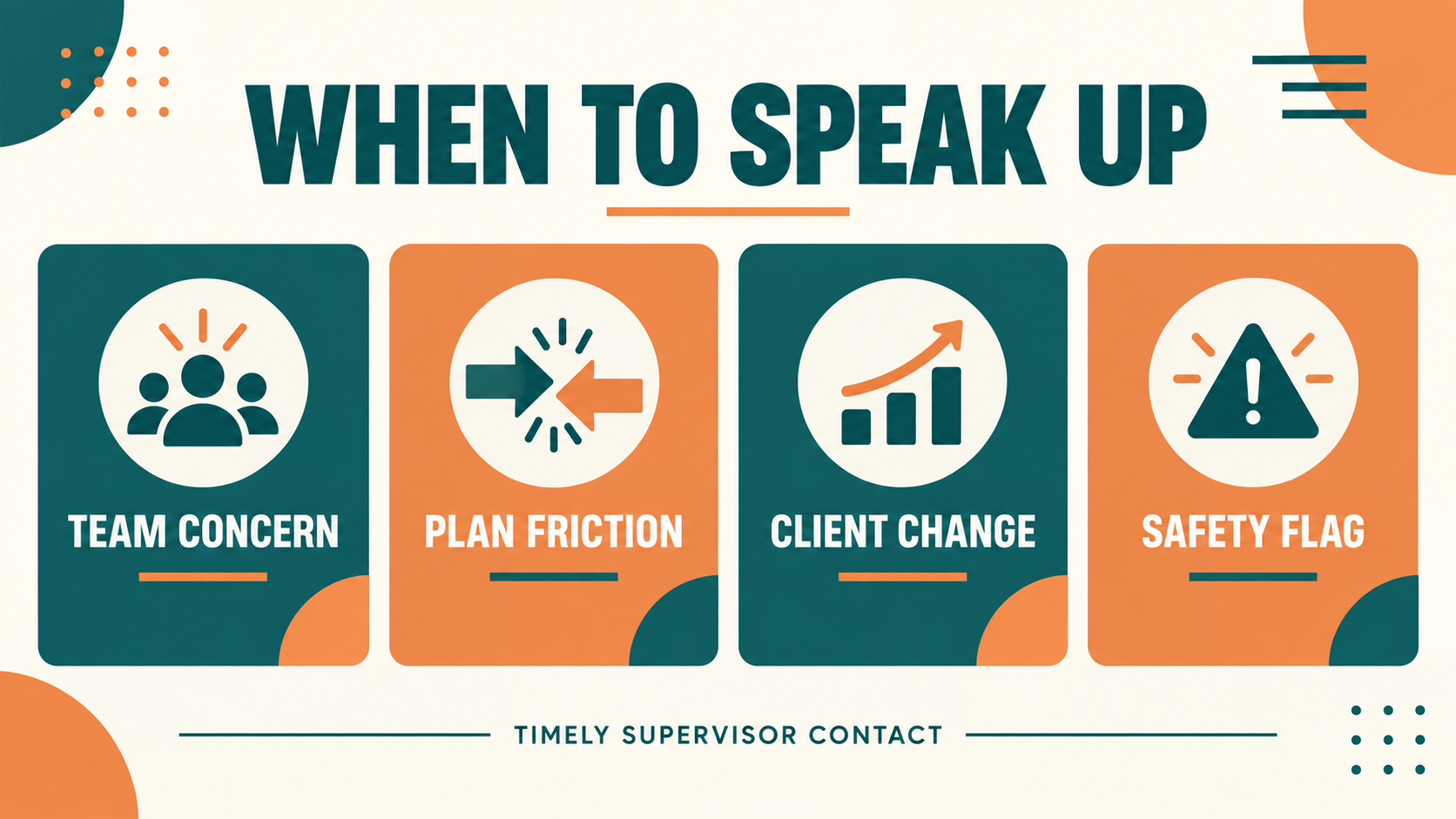
Use a low threshold for communicating information that could affect service quality or client progress. The following signals are practical prompts, not a substitute for your organization’s emergency policy:
- Team concern: a caregiver, teacher, or provider reports that the target behavior, routine, setting, or response pattern looks different.
- Plan friction: written instructions are unclear, materials are unavailable, a step cannot be completed as written, or different staff are using different versions.
- Client change: illness, medication change, sleep disruption, schedule change, unusual distress, or another variable may affect participation or progress.
- Data or fidelity signal: the data pattern changes suddenly, a measurement is hard to apply consistently, or the RBT realizes a step was missed.
- Safety flag: there is an immediate risk, a crisis procedure is needed, or the RBT is being asked to act outside competence or authorization.
Reporting early is especially useful when the concern is repeated. One difficult trial may be a normal part of service delivery; the same barrier across several sessions may require training, materials, or plan review. Give the supervisor enough context to see the pattern without exaggerating it.
Separate facts from conclusions
A strong report starts with observable facts. Include the date, setting, activity, people present when relevant, instruction or intervention step, client response, consequence or next event, and any environmental variable you noticed. If another team member raised the concern, identify the role of the person and use their words accurately without adding a conclusion.
Compare these two statements:
- Weak: “The intervention is not working because the client was defiant.”
- Stronger: “During the transition from the table to the group area at 10:15, the client left the designated area twice after the direction was delivered. The visual schedule was missing, and the teacher reported that the usual transition routine changed today.”
The second version does not decide why the behavior occurred or prescribe a new intervention. It gives the supervisor variables to evaluate. Avoid labels that imply a diagnosis, motive, or treatment decision unless that language is already part of an authorized documentation system. Also avoid copying unnecessary identifying details into informal messages.
If you made an implementation error, report that plainly. “I delivered the prompt after the interval instead of before it” is more useful than hiding the mistake or rewriting the record. Preserve the original data and follow the workplace correction process. Accurate reporting protects the client and gives the supervisor a chance to provide feedback or retraining.
A four-step reporting workflow
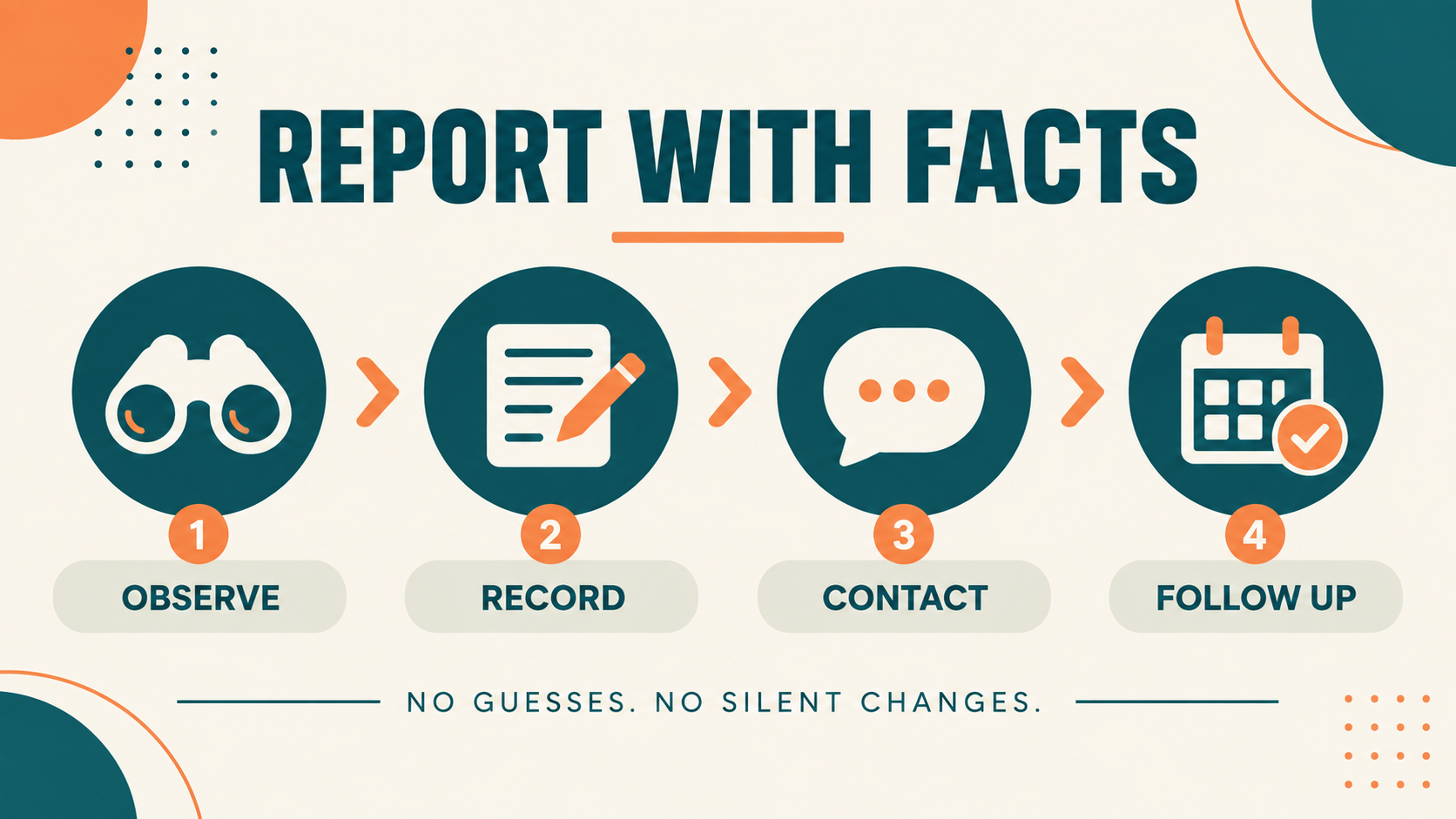
A repeatable workflow helps an RBT report intervention concerns without turning every observation into an argument. Use these four steps:
- Observe: identify the exact event, response, context, and immediate safety status. If there is an emergency, follow the emergency procedure first.
- Record: write objective notes through the approved system. Include timing, relevant variables, data, and the source of a team member’s concern. Do not estimate missing values.
- Contact: send the concern to the supervisor or designated chain-of-command contact in the required channel. State whether you need routine direction or urgent help.
- Follow up: confirm the direction you received, ask questions about any unclear step, and document the authorized response according to workplace requirements.
A concise message can use this structure: “I observed [observable event] during [activity and time]. The relevant variable was [context or change]. [Caregiver, teacher, or provider role] reported [accurate concern, if applicable]. The immediate safety status is [status]. I have [recorded the event / preserved the data]. Please advise whether [specific direction needed].” This is a communication template, not a replacement for your organization’s required form.
Urgent safety and ethics concerns
Routine intervention questions and immediate safety concerns should not be handled the same way. If someone is at immediate risk, follow the organization’s emergency or crisis procedure, contact the designated supervisor or emergency resource, and obtain help according to the setting. Do not delay urgent action to compose a perfect progress note.
After the immediate response, document what happened objectively and notify the supervisor through the required channel. A safety concern can involve a dangerous escalation, an environmental hazard, a missing safeguard, an instruction beyond your training, or a request to conceal or falsify information. The RBT should not improvise a new clinical procedure or use a restrictive response that is not authorized and trained.
Confidentiality still matters. Use approved systems, limit the audience to people who need the information, and avoid discussing identifiable client details in public spaces, personal social media, or unsecured group chats. If your concern involves an ethical or workplace conflict, ask for direction through the chain of command and use the applicable reporting policy.
Follow up without changing the plan
After you report, the next step may be clarification, modeling, rehearsal, feedback, a materials change, a scheduled plan review, or a decision that the current procedure remains appropriate. The RBT can support that process by restating the direction in their own words and asking for confirmation before the next session.
Keep the report and the response connected. If the supervisor says to continue the current procedure, record that direction according to local requirements and continue collecting data. If the supervisor authorizes a change, make sure you know the effective date, exact step, measurement rule, and what to do if the same concern returns. If no response arrives and the issue is urgent, follow the designated escalation route rather than treating silence as permission to change the plan.
Intervention concerns are also useful for supervision. Bring recurring questions to a supervision meeting, but do not wait for a routine meeting when the concern is time-sensitive. The BACB Handbook distinguishes ongoing supervision from other activities and emphasizes that supervisors are responsible for the services delivered. Timely communication is part of competent practice, not an admission of failure.
Common reporting mistakes
- Waiting for certainty: you can report an observation without knowing its cause.
- Changing the plan silently: a difficult step calls for direction, not an undocumented replacement.
- Using judgmental labels: observable descriptions help the supervisor evaluate the situation.
- Leaving out the source: identify whether the information came from direct observation or a caregiver, teacher, or provider.
- Overloading a group chat: use the approved confidential channel and the right escalation contact.
- Failing to close the loop: record the direction and ask again if the response is unclear or the risk continues.
Frequently asked questions
Does reporting an intervention concern mean the RBT is criticizing the supervisor?
No. A timely, objective report supplies information for clinical direction. It should describe what happened and what help is needed rather than assign blame.
Should an RBT report a caregiver’s suggestion?
Yes, when it may affect the intervention, routine, or client progress. Identify it as a caregiver suggestion or concern, preserve the wording accurately, and ask the supervisor how to proceed.
Can an RBT pause a procedure?
Follow the written safety and emergency rules for the setting. Outside those rules, do not invent a new clinical pause or replacement; contact the supervisor and request direction.
What if the supervisor does not answer?
Use the organization’s chain of command and escalation policy. For immediate danger, use the emergency route. For a routine question, document the attempt, continue only within current authorization, and ask for guidance before changing the plan.
Official source note
This educational guide was checked against the BACB RBT Test Content Outline (3rd ed.), the current RBT Handbook, and the 2026 RBT training curriculum retrieved September 28, 2026. Requirements and workplace procedures can change. Review the current RBT Test Content Outline, RBT Handbook, 2026 RBT 40-Hour Training Curriculum, and RBT Ethics Code (2.0) before making a practice or reporting decision.
Role boundary: This article is general education, not individualized clinical, legal, or emergency advice. Follow your organization’s safety policy and obtain supervisor direction for client-specific decisions.
Ready to practice the RBT concepts you just reviewed?
Try an independent, original RBT practice resource with exam-style questions, scoring, and answer explanations.
References
- Behavior Analyst Certification Board. RBT Test Content Outline, 3rd edition.
- Behavior Analyst Certification Board. RBT Handbook.
- Behavior Analyst Certification Board. RBT Ethics Code.