

Session events documentation RBT is the practice of turning what happened during a service period into an accurate, reviewable record. The goal is to capture the relevant setting, observable event sequence, assigned procedure, required data, barriers, communication, and next step while staying inside the RBT role.
Table of Contents
- Session events documentation RBT: the short answer
- Record the event sequence
- Connect events to the required data
- Separate procedure from interpretation
- Document barriers and changes
- Record communication and follow-up
- Protect the record
- Final review checklist
- Common documentation mistakes
- Frequently asked questions
- Official sources and scope
RBT event documentation, sequence, data, and follow-up
Session Events Documentation RBT: How to Record What Happened
Build a traceable record from the setting, event sequence, assigned procedure, measurement, and communication.
Session events documentation RBT is the practice of turning what happened during a service period into an accurate, reviewable record. The goal is not to write every thought that occurred during the session. The goal is to capture the relevant setting, observable event sequence, assigned procedure, required data, barriers, communication, and next step while staying inside the RBT role.
A real record must use the employer’s system, payer requirements, written program, supervisor direction, and privacy policy. This article uses original educational examples and does not provide a universal note template. Never put identifying client information into a public worksheet or example.
Session events documentation RBT: the short answer
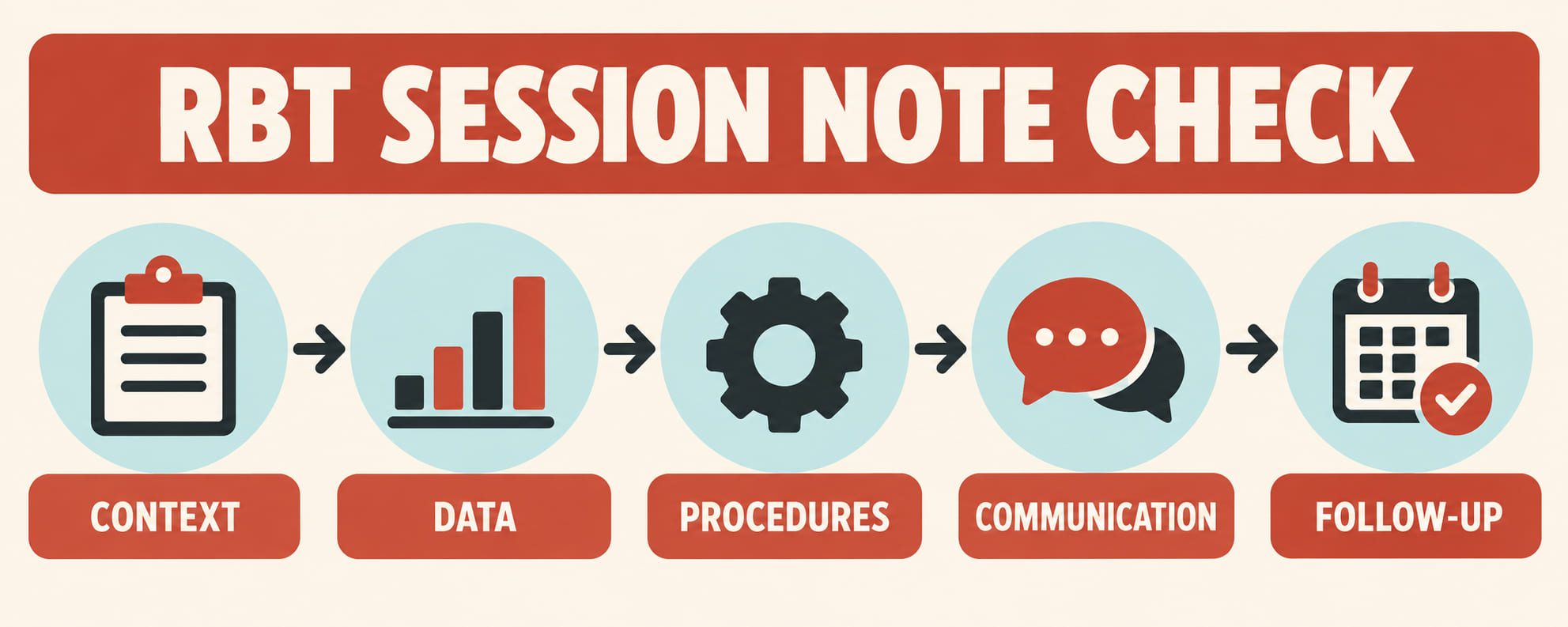
For each important event, document:
- Context: when and where the event occurred and who was authorized to participate.
- Antecedent or preceding condition: what was happening immediately before, described without guessing intent.
- Observable response: what the learner or environment did, using the operational definition when one exists.
- Consequence or next event: what followed and what the RBT implemented under the written plan.
- Measure: count, duration, latency, interval result, opportunity, prompt level, or other required data.
- Communication: what was reported, to whom, and what direction or follow-up was requested.
This sequence helps the reader distinguish an observation from an interpretation. “The learner refused because he wanted attention” contains a guess. “After the instruction was presented, the learner pushed the materials away and looked toward the door; the response lasted 20 seconds” records events that another authorized reviewer can evaluate.
Record the event sequence
Start with a timeline rather than a conclusion. A short sequence can include the activity, instruction, response, prompt, consequence, and return to the program. Use the smallest amount of detail that makes the event understandable and matches the data system.
| Sequence point | Question | Example language |
|---|---|---|
| Before | What activity, instruction, transition, or condition preceded the event? | “During the transition from table work to the group area…” |
| Response | What observable action occurred? | “The learner dropped to the floor and did not move toward the group area.” |
| Support | What assigned prompt, safety step, or procedure was implemented? | “The RBT followed the written transition procedure and used the trained prompt.” |
| After | What happened next and what data were recorded? | “The learner stood after 40 seconds and returned with the programmed support.” |
Connect events to the required data
Events and data are related, but they are not interchangeable. A note can describe a transition while the data sheet records duration. A skill program can require opportunities and independent responses. A behavior-reduction program can require frequency, duration, latency, or interval data. Use the measurement system trained by the supervisor and written in the program.
Example: “Across 8 requesting opportunities, the learner responded independently on 5, used a model prompt on 2, and did not respond on 1. During the final transition, the defined response occurred once for 30 seconds. The RBT recorded the skill data and duration on the approved forms.”
Do not backfill numbers from memory because the note “sounds right.” If data were missed, mark the gap according to policy, describe what prevented collection, and notify the supervisor. An honest missing-data note is more useful than a precise-looking number with no observation behind it.
Separate procedure from interpretation
Use the note to show fidelity to the assigned procedure. Name the prompt, materials, reinforcement arrangement, or safety step only to the level needed for the record. Do not imply that the RBT selected the intervention, changed the criterion, or concluded that a function was proven.
Compare these two sentences:
- Too interpretive: “The learner was manipulative and the new consequence fixed the problem.”
- More objective: “After the request was denied under the written procedure, the defined response occurred twice. The RBT followed the approved response plan and recorded the duration; no new consequence was introduced.”
If the written plan appears unclear or does not fit the event, document the observable problem and seek clinical direction. Do not solve the ambiguity by improvising a treatment change and describing it as routine implementation.
Document barriers and changes
A session may include a room change, unavailable material, late arrival, technology problem, illness report, staffing change, or safety concern. Include only information relevant to the service record and permitted by the organization’s policy.
Example: “The session began 10 minutes late because the scheduled room was unavailable. The RBT confirmed the alternate room with the designated contact, checked the approved materials, and began the matching program. The planned group activity was not run because the required materials were unavailable. The RBT recorded the completed opportunities and notified the supervisor.”
This records the barrier, action, impact, and communication without blaming a person or exposing unnecessary personal information. If the change affects safety or service quality, follow the urgent reporting route in addition to the ordinary note.
Record communication and follow-up
Write who was notified, when, why the communication was relevant, and what direction was received. A vague statement such as “told supervisor” may not be enough for the approved record. Use the fields and level of detail required by your system.
Example: “At 3:20 p.m., the RBT notified the supervisor through the approved channel that the transition response occurred three times during the first activity and that one data interval was missed because the materials were removed for safety. The RBT followed the supervisor’s direction to preserve the completed data and review the program at the next supervision contact.”
Do not use a session note as a substitute for an urgent incident report, mandated reporting route, or formal ethics process. If the event requires immediate escalation, follow the organization’s emergency and reporting procedures first, then document the permitted facts.
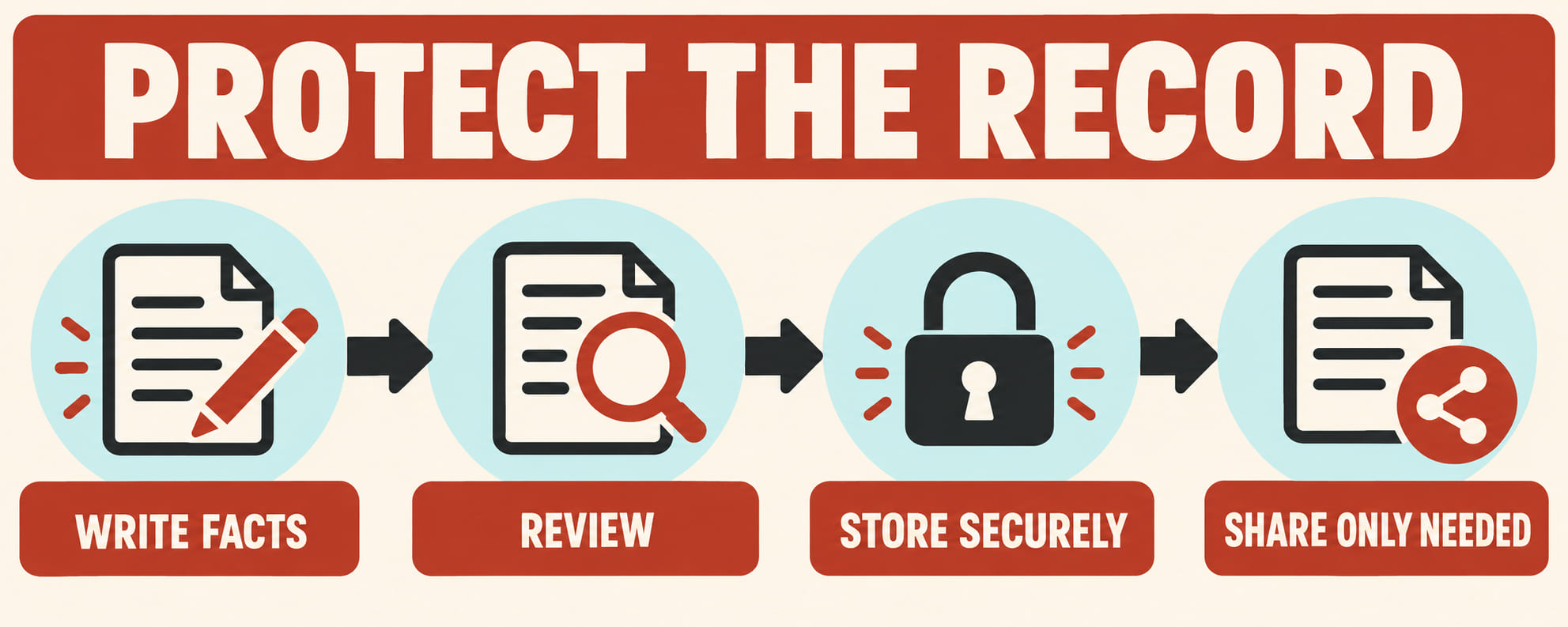
Protect the record
Use the approved record system and authorized access. Avoid copying full names, addresses, school details, medical information, or photographs into a public draft, personal notes app, or unapproved messaging channel. Store and correct records according to the employer, payer, and applicable privacy rules.
Final review checklist
- The event has a date, time or service period, setting, and relevant context.
- The preceding condition and observable response are clear.
- The procedure implemented matches the written program and training.
- The required data are entered accurately, with gaps explained through policy.
- Barriers, safety events, and deviations are reported through the correct route.
- The note avoids diagnoses, motives, unsupported functions, and independent treatment changes.
- Communication and follow-up are recorded clearly enough for an authorized reviewer.
- Privacy, access, retention, and correction rules are followed.
Common documentation mistakes
- Starting with a conclusion. Write the observable sequence first.
- Mixing data systems. Do not substitute a count for a duration or interval measure.
- Hiding a gap. Explain missing data and notify the supervisor instead of inventing a value.
- Turning implementation into treatment design. Record the assigned procedure; escalate proposed changes.
- Over-documenting private details. Use minimum necessary information in the approved system.
- Skipping communication details. Identify the relevant report, route, time, and direction.
Frequently asked questions
What should session events documentation include?
Include the relevant context, event sequence, observable response, assigned procedure, required data, barriers, communication, and follow-up according to the approved record system.
Should an RBT write why a behavior happened?
Do not present an unsupported explanation as fact. Record the observable conditions and response, then report a clinical question to the supervisor.
What if a data point is missing?
Follow the organization’s missing-data policy, document what prevented collection, and notify the supervisor when required. Do not reconstruct a number simply to make the note look complete.
Can a session note document a program change?
It can document that a change or deviation occurred and that it was reported. An RBT should not independently create or approve a clinical program change.
Is a session note the same as an incident report?
No. A session note documents service events. A safety, incident, ethics, or mandated-reporting concern may require a separate urgent route under organization and applicable rules.
Official sources and scope
Review the current BACB RBT Handbook, the RBT Test Content Outline, the BACB ethics resources, and your organization’s documentation and privacy policies. This is educational content, not an official BACB form, legal advice, or individualized supervision direction.
Ready to practice the RBT concepts you just reviewed?
Try an independent, original RBT practice resource with exam-style questions, scoring, and answer explanations.
References
- Behavior Analyst Certification Board. RBT Test Content Outline, 3rd edition.
- Behavior Analyst Certification Board. RBT Handbook.
- Behavior Analyst Certification Board. RBT Ethics Code.