

A skill acquisition plan ABA document explains how a team will teach a new skill, how performance will be measured, and how the team will decide whether to adjust, generalize, or maintain the program. For an RBT, the key skill is usually identifying the plan’s components, preparing for the session, implementing the written procedure, recording data, and seeking direction when the plan is unclear.
Table of Contents
- Skill acquisition plan ABA: what it is and what it is not
- Skill acquisition plan ABA: who designs the plan and who implements it?
- Essential components of a skill acquisition plan
- How an RBT prepares before the session
- Implement the plan without losing the learner
- Measure, review, and communicate
- Generalization and maintenance are part of the plan
- Original skill-acquisition-plan scenarios
- Frequently Asked Questions
- References
RBTs do not independently design treatment or create an unapproved program because they have an idea. The responsible supervisor or qualified clinical team determines the plan. An RBT may contribute observations and questions, then implements the authorized plan under the current supervision structure.
The current RBT Test Content Outline, 3rd edition, describes 43 tasks across six domains. The current exam frame includes 75 scored questions and 10 unscored pilot questions among 85 presented questions. This is independent study content, not an official BACB plan, treatment recommendation, recalled item, leaked item, or guarantee of certification or clinical results.
Skill acquisition plan ABA: what it is and what it is not
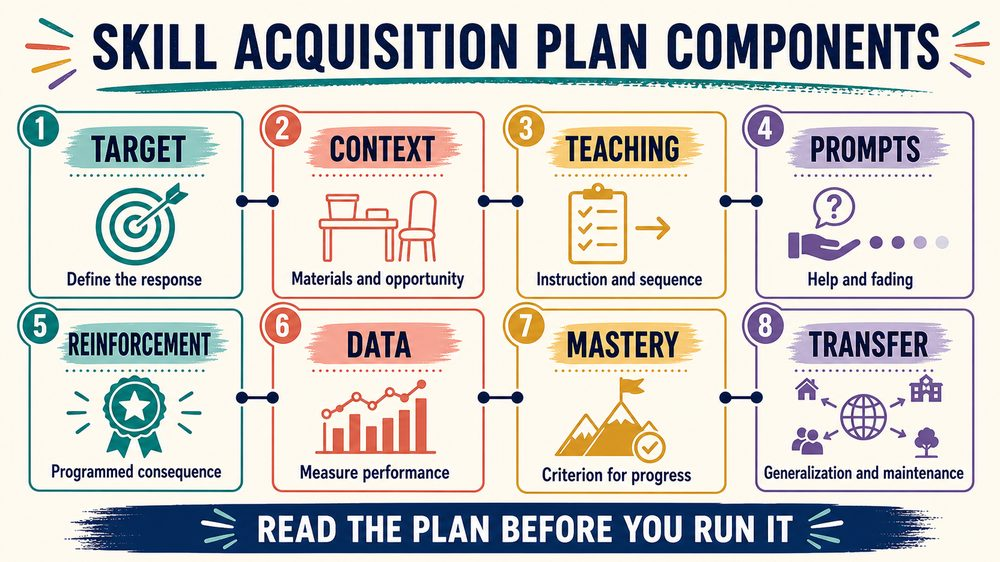
A skill acquisition plan is a written teaching plan for a defined response or skill. It may describe the target, learner-relevant context, materials, instruction or opportunity, prompt, reinforcement, error correction, measurement, mastery criterion, generalization, and maintenance. The exact format varies by organization and clinical program.
| Plan component | Question it should answer | RBT implementation check |
|---|---|---|
| Target and operational definition | What response counts? | Can I identify an example and nonexample? |
| Materials and context | What do I prepare and when? | Are the materials and setting available? |
| Teaching procedure | What is the instruction, opportunity, and sequence? | Can I follow the steps without improvising? |
| Prompt and fading | What help is delivered and how is it reduced? | What timing, hierarchy, or criterion is written? |
| Reinforcement | What consequence follows the defined response? | What is programmed, and when is it delivered? |
| Measurement and mastery | How is performance recorded and judged? | What unit and criterion do I use? |
| Generalization and maintenance | Where and when should the skill continue? | What transfer opportunities are authorized? |
If you are studying skill acquisition plan ABA content, do not reduce the plan to “teach, reward, and repeat.” The measurement and role instructions are part of the plan.
Skill acquisition plan ABA: who designs the plan and who implements it?
Plan design requires clinical judgment, assessment information, treatment decisions, and responsibility for the overall service. The RBT’s role is to understand the written plan, prepare as directed, implement assigned procedures, collect data, document, and communicate. The RBT can report that a target seems unclear, a material is unavailable, or a learner’s response changed. Reporting is not the same as independently rewriting the program.
| Situation | Role-safe RBT response | Role-risk response |
|---|---|---|
| The target is ambiguous. | Ask for an example, nonexample, or written clarification. | Invent a definition and continue. |
| The learner is not responding. | Follow the programmed correction and contact the supervisor if needed. | Add a new prompt or consequence because it worked elsewhere. |
| A caregiver requests a new goal. | Listen, document, and route the request. | Promise a plan change. |
| The data are unusual. | Record honestly and ask for review. | Delete or smooth the data. |
Essential components of a skill acquisition plan
Target: the plan names a useful skill and defines what counts. A broad goal such as “improve communication” needs a measurable response that the team can observe.
Context and materials: the plan identifies the relevant setting, materials, motivation or opportunity arrangement, and starting conditions. Preparation prevents a session from becoming improvised.
Teaching sequence: the plan states how the opportunity is arranged, what instruction or cue is delivered, what response is expected, and what happens next. It may use discrete-trial teaching, naturalistic teaching, chaining, shaping, discrimination training, or another procedure.
Prompts and fading: prompts support a response but should follow the written hierarchy, timing, and fading plan. More help is not automatically better if it prevents independence.
Reinforcement: the plan identifies the programmed consequence for the defined response. Do not label every preferred item a reinforcer or change the contingency without direction.
Error correction: the plan explains what to do after an incorrect response, no response, or prompted response when applicable. Ask before using a correction from another program.
Measurement and mastery: the plan identifies the data system and criterion for progress. Mastery is not the same as one successful trial or a good impression.
Generalization and maintenance: the plan states how the skill will be practiced with new people, materials, settings, or times and how it will be checked later.
How an RBT prepares before the session
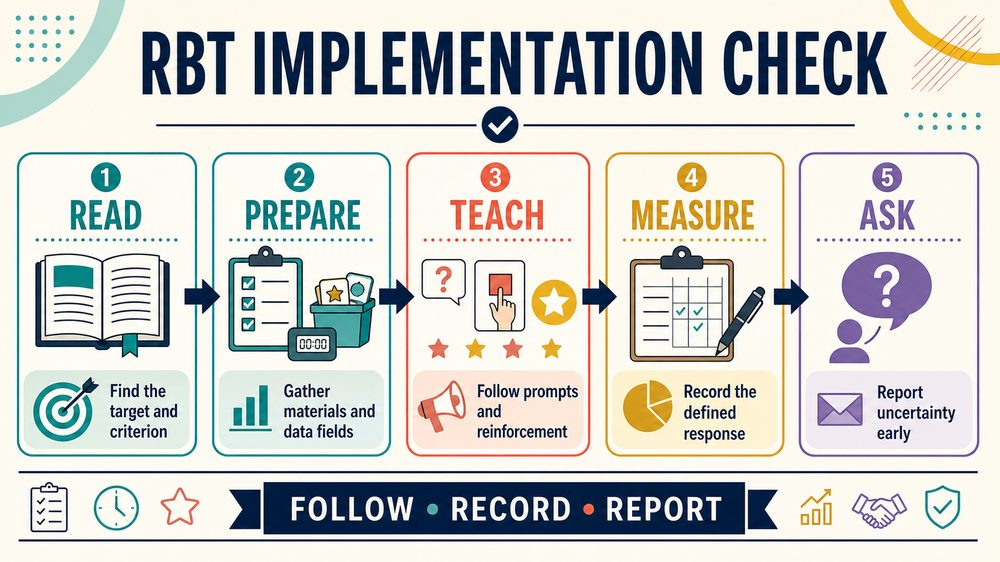
- Read the current program and target definition.
- Gather the listed materials and confirm the environment.
- Review the instruction, prompt, reinforcement, error-correction, and safety steps.
- Check the data fields and know the measurement unit.
- Identify what to do if the response is independent, prompted, incorrect, absent, or unsafe.
- Bring one specific question to supervision if anything is unclear.
For example: a plan teaches a learner to request a break but does not say whether a gesture counts as the target response. The RBT should ask for the operational definition and record the response according to the clarification, not choose whichever interpretation makes the data look best.
Implement the plan without losing the learner
Fidelity does not mean ignoring the person in front of you. Implement the written steps while observing communication, choice, assent-related signals, safety, and barriers. If the learner indicates a need for a break or the situation becomes unsafe, follow the programmed communication and safety procedure and seek direction as required.
| Teaching procedure | Implementation focus | Question to ask |
|---|---|---|
| Discrete-trial teaching | Instruction, response opportunity, prompt, consequence, transition. | What is the inter-trial or readiness rule? |
| Naturalistic teaching | Arrange an opportunity in a meaningful routine and follow the programmed consequence. | What learner choice or motivation cue is part of the plan? |
| Chaining | Follow the task analysis and assigned forward, backward, or total-task format. | Which step is prompted and reinforced? |
| Shaping | Reinforce the current approximation toward the target. | What is the next criterion? |
| Prompt fading | Reduce help according to the written schedule. | What prompt delay or hierarchy is authorized? |
Measure, review, and communicate
Data make the plan testable. Record the defined response with the correct unit and preserve distinctions such as independent versus prompted. When a graph changes, the RBT can report the observation and ask the supervisor to review it; the RBT should not independently declare that a program has failed or should be changed.
- Compare the note with the data sheet before submission.
- Mark missing, unusual, or interrupted data honestly.
- Report barriers such as unavailable materials, schedule changes, or unclear instructions.
- Bring a concise example to supervision: what happened, what the plan said, what you did, and what question remains.
A clear communication statement is: “Across six opportunities, two responses were independent and four were prompted using the written hierarchy. The learner used the break response after the third opportunity. Please confirm whether the current prompt-fading step applies to this material.”
Generalization and maintenance are part of the plan
A skill that appears only with one therapist, material, or room may not be ready for a new context. Generalization should be programmed and safe, not improvised. The plan may specify new materials, people, settings, examples, or natural routines. Maintenance checks whether the skill continues after time or reduced teaching intensity according to the program.
Do not create a generalization test without direction. Ask which changes are authorized and which data should be recorded. The same measurement rule should remain clear when the context changes.
Original skill-acquisition-plan scenarios
Scenario 1—reinforcement: an RBT gives a preferred item after an incorrect response because the learner looks frustrated. Check the plan’s error-correction and communication procedure, then ask for direction before changing the contingency.
Scenario 2—mastery: an RBT sees three correct responses and tells the caregiver the skill is mastered. Review the written mastery criterion and report the actual data instead.
Scenario 3—generalization: an RBT moves a mastered table task into a new setting without authorization. Pause and ask whether the plan includes that generalization context and what data to collect.
Scenario 4—role boundary: a team member asks the RBT to write a new skill-acquisition plan. The RBT can share observations and request supervision, but should not create or implement clinical programming outside the authorized role.
These are newly written independent study examples, not official, recalled, leaked, or BACB-endorsed questions.
Bottom line: a skill acquisition plan ABA document links a meaningful target to teaching steps, prompts, reinforcement, measurement, mastery, generalization, and maintenance. The RBT’s job is to understand and implement the authorized plan with fidelity, collect accurate data, protect dignity, and ask for clinical direction before changing it.
Practice plan-reading decisions.
Use original RBT scenarios to review targets, prompts, reinforcement, data, generalization, and role boundaries.
Try free RBT practice questions →
Frequently Asked Questions
What is a skill acquisition plan in ABA?
It is a written teaching plan that defines the skill, teaching procedure, prompts, reinforcement, measurement, mastery, and generalization or maintenance expectations as applicable.
Does an RBT write the skill acquisition plan?
The RBT typically implements the authorized plan under supervision and can share observations and questions. Independent treatment design is outside that role boundary.
What should an RBT do when a plan is unclear?
Pause at the decision point, follow any applicable safety direction, document the question, and seek clinical direction rather than guessing.
How does a skill acquisition plan differ from a behavior-reduction plan?
A skill acquisition plan teaches a new response or skill. A behavior-reduction plan addresses reduction of a defined behavior and its replacement or safety procedures. The written plan and supervisor direction control implementation.
Are these plan examples official?
No. They are newly written independent study examples and are not official, recalled, leaked, or BACB-endorsed questions or treatment plans.
References
- Behavior Analyst Certification Board. RBT Test Content Outline (3rd ed.).
- Behavior Analyst Certification Board. RBT Handbook.
- Behavior Analyst Certification Board. Ethics Codes and RBT Ethics Code (2.0).
- Skill acquisition plan guide. Reviewed for competitor research; not an endorsement.
- RBT skill-acquisition study guide. Reviewed for competitor research; not an endorsement.