
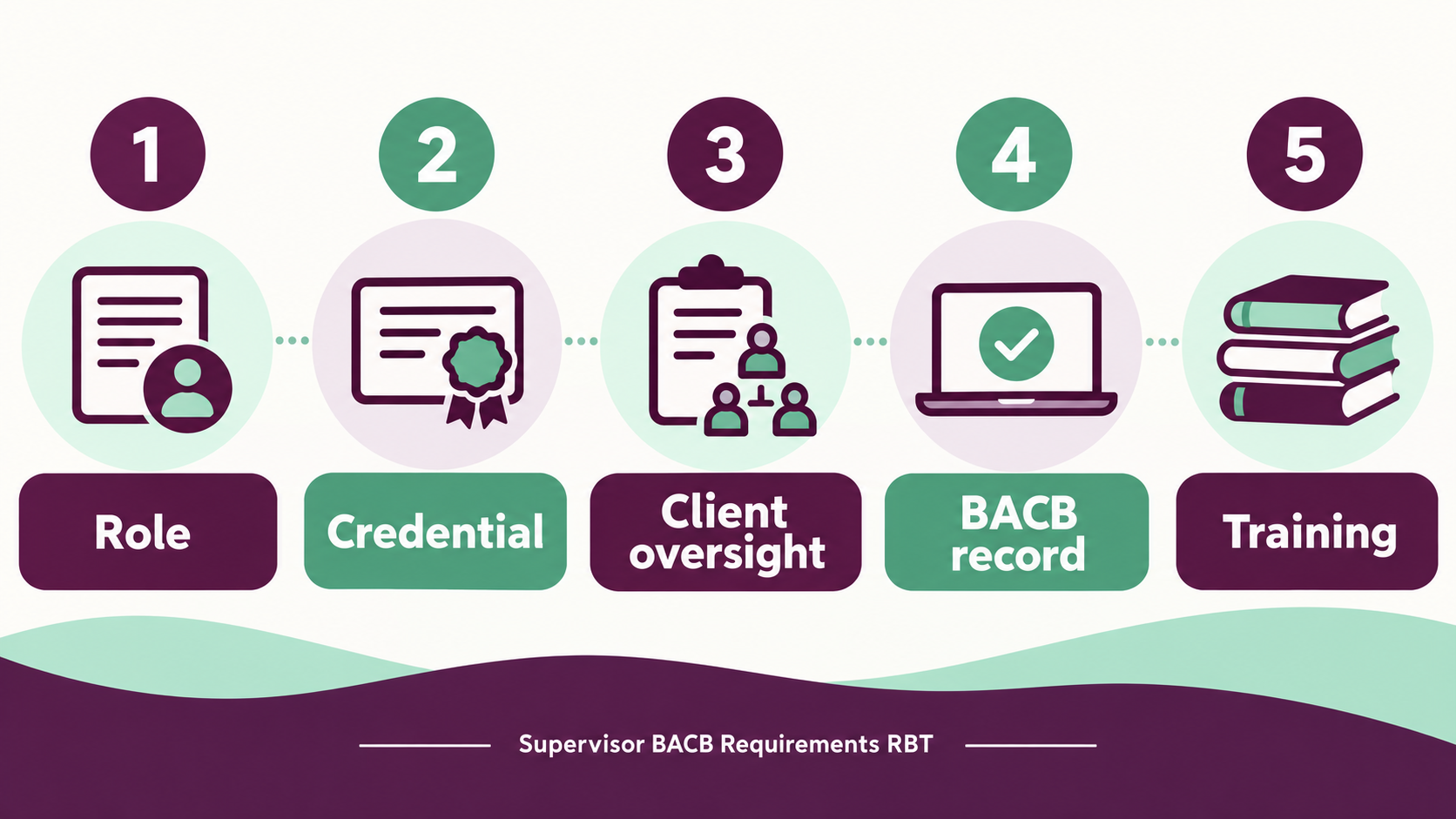
Supervisor BACB requirements RBT teams should verify include the supervisor’s role, certification or license pathway, client-specific oversight, BACB account records, and required supervision training. The exact current Handbook controls.
Table of Contents
- Supervisor BACB requirements RBT teams should check first
- The two RBT supervision structures
- Who may serve in the role
- Client-specific oversight
- BACB records and organization responsibilities
- The 8-hour supervision training question
- Questions an RBT can ask
- Frequently asked questions
- Sources and scope note
RBT SUPERVISION GUIDE · ROLE VERIFICATION
Supervisor BACB Requirements RBT Teams Need to Verify
A current-source checklist for supervisor roles, organization structures, client oversight, records, and training.
Supervisor BACB requirements RBT teams should verify include the person’s role, certification or license pathway, client-specific knowledge, applicable BACB account records, and required supervision training. The current BACB Handbook and official supervision pages control when requirements change.
People often reduce the question to “Is the supervisor a BCBA?” That may be an important part of the answer, but it is not the whole structure. The organization may use an RBT Supervisor Structure or an RBT Requirements Coordinator Structure, and the record and oversight duties can differ.
This guide helps an RBT understand what to verify and what to ask. It is not a certification decision, legal opinion, or substitute for the BACB’s current approval and handbook.
Supervisor BACB requirements RBT teams should check first
Start with five questions:
- Who is responsible for my work as the RBT Supervisor?
- Does the organization use the RBT Supervisor Structure or an RBT Requirements Coordinator Structure?
- Which credential or approved license pathway supports the person’s role?
- Does the supervisor have enough client-specific knowledge to direct the current service work?
- What records, portal entries, training, observation, and escalation routes apply to me?
These questions separate a role from a title. “Clinical director,” “lead therapist,” or “case manager” may describe a workplace position, but the BACB supervision role still needs to match the current requirements and the organization’s declared structure.
The two RBT supervision structures
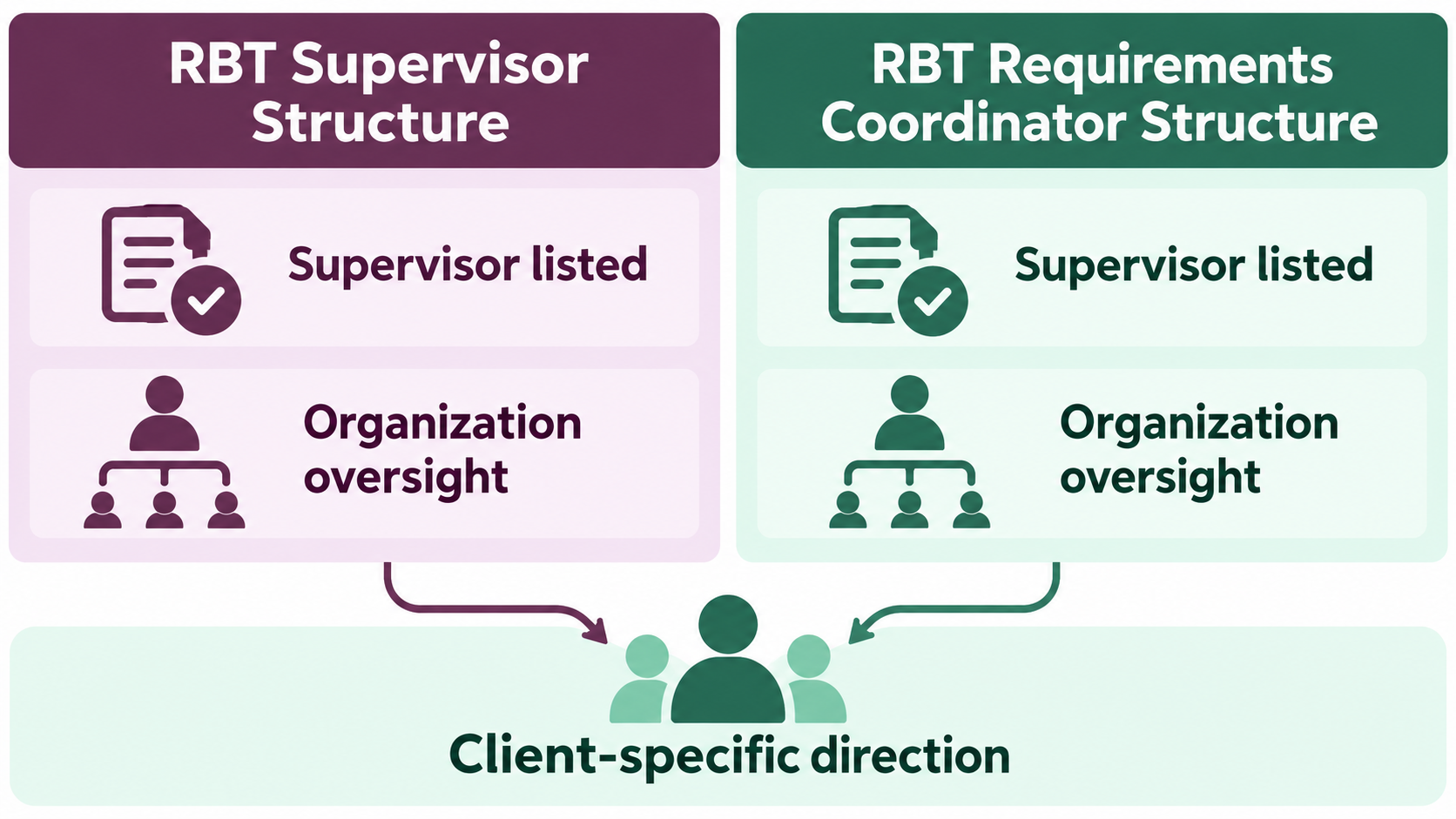
The BACB describes two ways an organization may structure RBT supervision:
- RBT Supervisor Structure: Individual RBT Supervisors identify themselves with BACB as the supervisors for the RBTs they oversee.
- RBT Requirements Coordinator Structure: An organization designates a coordinator who is responsible for ensuring that the RBTs meet supervision requirements. The coordinator may also serve as the RBT Supervisor, and the organization may have more than one coordinator, but an RBT has one coordinator per organization.
The structure affects who must appear in BACB records and who is responsible for the organization-level oversight. It does not remove the need for client-specific direction or effective, ongoing supervision.
An RBT should ask which structure is active rather than guessing from the number of supervisors. A large organization may use a coordinator model to manage records while several qualified supervisors provide direct client-facing supervision.
Who may serve in the role
The BACB’s current supervision guidance lists BCBA and BCaBA pathways for supervising RBTs, with an additional licensed-profession pathway possible when it is overseen by an RBT Requirements Coordinator and approved by BACB. The exact qualifications, restrictions, and documentation should be checked in the current Handbook.
The key point is that a license or title outside behavior analysis is not automatically enough. The pathway must fit the current BACB structure and approval rules. Likewise, a credential alone does not answer whether the person has sufficient knowledge of the client, plan, setting, and procedures to direct the RBT’s work.
Supervisors also have responsibilities beyond appearing on a roster. The person responsible for the RBT’s work needs to provide direction, maintain the appropriate supervision arrangement, and respond when the RBT reports uncertainty, an error, a safety concern, or a task beyond competence.
Client-specific oversight
Client-specific oversight is the bridge between general qualification and actual service direction. The supervisor should know enough about the current client and service context to inform the RBT’s implementation. That includes the relevant goals, procedures, data expectations, communication needs, risks, and changes that could affect performance.
An RBT should not assume that a supervisor who is qualified on paper can automatically direct every client or program without reviewing the context. Ask how the supervisor will learn the plan, observe implementation, give feedback, and handle urgent questions.
Effective oversight also protects the RBT’s boundary. The RBT implements authorized procedures; the supervisor or authorized treatment team handles decisions assigned to that role. If the instruction is unclear, the RBT should pause when appropriate and use the designated route rather than inventing a new intervention.
BACB records and organization responsibilities
The applicable structure determines which person or people must be identified in BACB records. Under the RBT Supervisor Structure, each RBT Supervisor must identify as the RBT’s supervisor in BACB records. Under the coordinator structure, the organization’s Requirements Coordinator has the relevant listing responsibility while the direct supervisor’s role is managed within that model.
The current BACB guidance also connects the 5% ongoing-supervision minimum with the applicable portal relationship. Because record rules can change, an RBT should check the current Handbook and ask the organization to explain how the assigned supervisor, coordinator, supervisee record, service hours, and supervision contacts connect.
Keep your own accurate records through the approved workplace system. Do not sign for a supervisor contact that did not occur, assume a missing portal entry is harmless, or backdate a correction. Report discrepancies promptly and document the communication.
The 8-hour supervision training question
The BACB’s current supervision page lists an 8-hour supervision training requirement for people supervising RBTs. Ask the organization how the supervisor’s training was completed, where the record is maintained, and whether any current transition or renewal rule applies.
Training is an eligibility element, not a complete measure of supervision quality. A person may complete required training and still need to establish client-specific knowledge, observe the RBT, provide feedback, and maintain accurate records. Conversely, a friendly or experienced manager is not automatically a BACB supervisor.
When the answer is unclear, use current official sources and ask the designated organization contact. The RBT does not need to investigate beyond the role’s authority, but the RBT should not ignore a supervision gap that affects service delivery or certification maintenance.
Questions an RBT can ask
A concise verification conversation can include:
- Which supervision structure does this organization use?
- Who is my RBT Supervisor, and who is the RBT Requirements Coordinator if one exists?
- Which current BACB requirement supports the supervisor’s role?
- How will client-specific knowledge and direct observation be established?
- How are the 5% monthly supervision calculation, portal records, and contact notes handled?
- Who should I contact if the supervisor is unavailable or a direction is unclear?
Write down the answer using the approved process. If you are asked to provide a service beyond certification or competence, promptly inform the supervisor or another appropriate workplace person and document the communication as required by the Ethics Code.
Frequently asked questions
Does a BCBA automatically meet every RBT supervisor requirement?
Not automatically for every organization and situation. The current structure, client-specific oversight, training, records, and applicable BACB requirements still matter.
Can a BCaBA supervise an RBT?
The BACB’s current supervision guidance lists BCaBA as a pathway for supervising RBTs. Confirm the current Handbook, training, structure, and any applicable conditions.
Can another licensed professional supervise an RBT?
A licensed-profession pathway may be possible when it is overseen by an RBT Requirements Coordinator and approved by BACB. Do not assume that any license qualifies without checking the current official requirements.
Does a supervisor’s qualification replace ongoing supervision?
No. Qualification to serve in the role does not replace client-focused observation, feedback, participation, documentation, and the ongoing supervision process.
Sources and scope note
This guide is based on the BACB Supervision, Assessment, Training, and Oversight page, the BACB Registered Behavior Technician Handbook, and the BACB guidance on establishing an RBT Requirements Coordinator structure. Requirements can change, and employer, payer, school, state, and legal rules may add obligations. Check current official sources and ask the appropriate workplace contact about your situation.
Ready to practice the RBT concepts you just reviewed?
Try an independent, original RBT practice resource with exam-style questions, scoring, and answer explanations.
References
- Behavior Analyst Certification Board. RBT Test Content Outline, 3rd edition.
- Behavior Analyst Certification Board. RBT Handbook.
- Behavior Analyst Certification Board. RBT Ethics Code.