
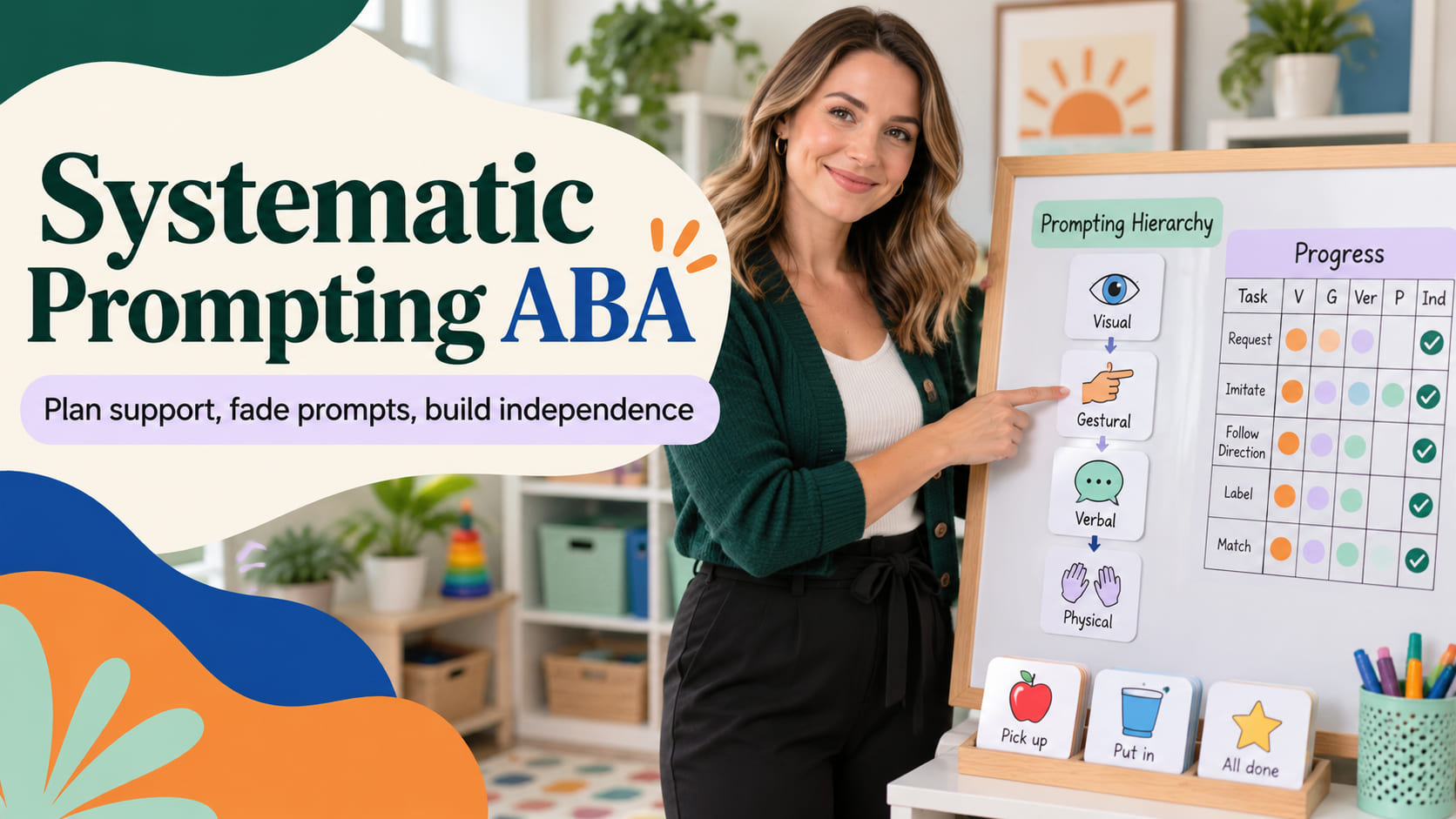
Systematic prompting ABA procedures give a learner planned support so a target response is more likely to occur, while the team measures progress and reduces help when appropriate. For an RBT, the essential habits are to follow the assigned procedure, deliver the prompt consistently, record the defined data, and ask the supervisor before changing the hierarchy or fading plan.
Table of Contents
- Systematic prompting ABA: the short answer
- What a prompt does in ABA
- How a prompting ladder works
- Why prompt fading matters
- How data supports prompting decisions
- What an RBT should implement and report
- Common prompting mistakes
- Frequently asked questions
ABA prompting, prompt fading, data collection, independence, and RBT implementation
Systematic Prompting ABA: Plan Support, Fade Prompts, Build Independence
A plain-language guide to prompt levels, consistent implementation, fading, data, and the RBT’s role under supervision.
Systematic prompting ABA procedures give a learner planned support so a target response is more likely to occur, while the team measures progress and reduces help when appropriate. For an RBT, the essential habits are to follow the assigned procedure, deliver the prompt consistently, record the defined data, and ask the supervisor before changing the hierarchy or fading plan.
Prompting is not simply “help until the learner gets it.” A well-designed procedure describes when the cue occurs, what support is added, how errors are handled, what gets recorded, and how the team will evaluate independence. The exact plan depends on the skill, learner, setting, and supervision.
Systematic prompting ABA: the short answer
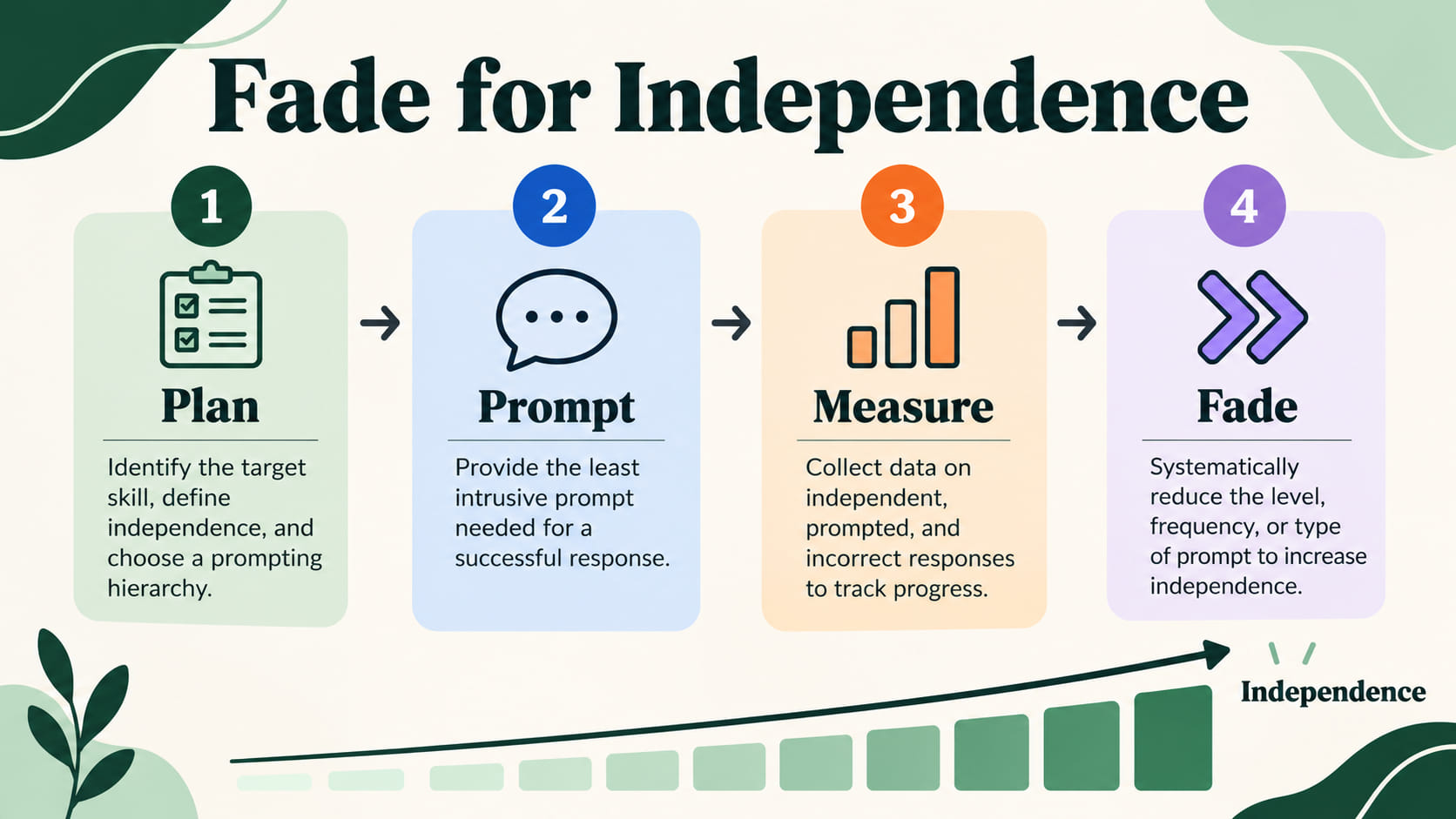
A systematic prompting routine usually includes five parts:
- Define the target response. State what the learner should do in observable terms.
- Present the cue or instruction. Use the wording, materials, and timing in the assigned procedure.
- Deliver planned support. If the learner needs help, use the specified prompt level rather than improvising.
- Reinforce and record. Follow the plan for consequences and collect the defined response or prompt-level data.
- Fade when directed. Reduce support according to the supervisor’s plan so the learner can respond more independently.
The word “systematic” is important. A different prompt on every trial makes it difficult to know whether the learner is learning the skill, responding to the prompt, or reacting to inconsistent teaching.
What a prompt does in ABA
A prompt is an additional cue or assistance intended to increase the likelihood of a correct response. It can involve a gesture, model, verbal instruction, visual support, positioning, or physical guidance when that procedure is assigned and appropriate. A prompt is not the target skill itself; it is support arranged around the target.
It helps to separate the natural cue from the prompt. Suppose the learner is expected to place a cup in the sink after a meal. The natural cue might be the routine ending or an instruction in the plan. Pointing to the sink, showing the action, or providing a specific verbal reminder could be additional prompts. The team can then measure whether the learner responds to the natural cue or still needs extra help.
The least intrusive or most effective prompt is not universal. A hierarchy that works for one skill may be inefficient or unsafe for another. The RBT should use the sequence and decision rules written by the supervising professional, especially when physical guidance, communication, feeding, mobility, or risk is involved.
How a prompting ladder works
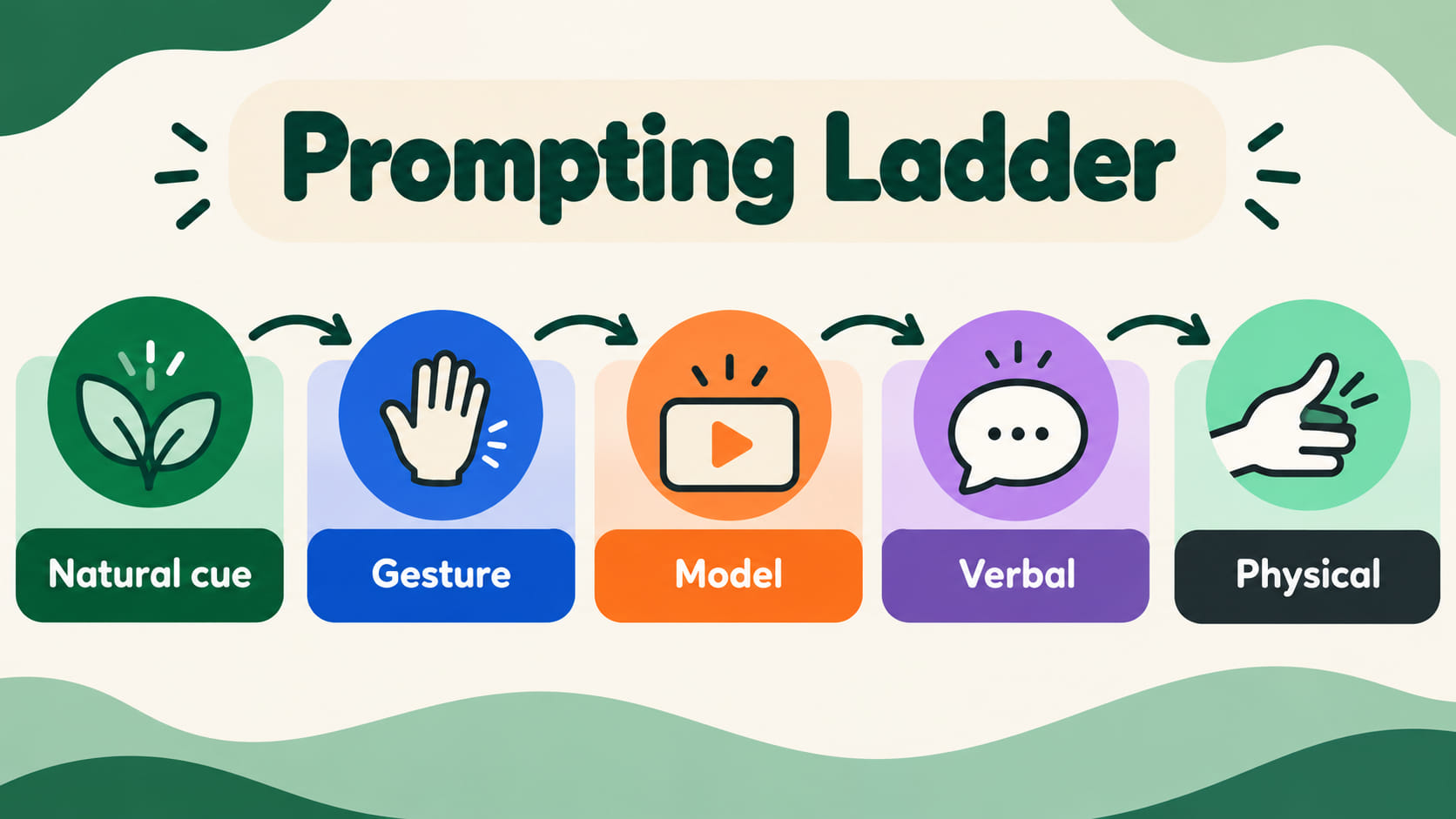
A prompt hierarchy arranges possible supports in an order. A simple teaching illustration might move from a natural cue to a gesture, then a model, verbal help, and physical assistance. Other programs use most-to-least prompting, least-to-most prompting, graduated guidance, time delay, or a different arrangement.
Least-to-most prompting may begin with the natural instruction and add more help only when the learner needs it. This can create opportunities for independent responding, but the plan must specify how long to wait and when to move up the hierarchy.
Most-to-least prompting may begin with enough support to produce a correct response and then systematically reduce it over trials or sessions. This can reduce repeated errors for some skills, but it still requires a defined fading plan and careful measurement.
Time delay changes the delay between the cue and the prompt so the learner has an opportunity to respond before support appears. The exact delay, prompt, and error procedure must come from the assigned program. These labels describe common approaches, not instructions for an RBT to select independently.
Why prompt fading matters
Prompt fading means reducing additional help when the learner can respond with less support. Without fading, a learner may wait for the RBT’s gesture, words, position, or physical guidance instead of contacting the natural cue. That pattern is often called prompt dependence, but the response should be measured rather than assumed from one difficult session.
Fading can involve reducing prompt intensity, increasing the time before help, changing the distance or position of a cue, removing visual elements, or moving toward a natural environmental cue. The right method depends on the plan and the learner’s response. Fading too quickly can produce errors or frustration; fading too slowly can maintain unnecessary support.
An RBT should not fade by personal preference just because a session looks easy. Follow the defined mastery or decision rule, record what occurred, and bring unexpected success, errors, distress, or lack of progress to the supervisor.
How data supports prompting decisions
Data should show more than whether the learner was “successful.” Depending on the program, the team may track independent responses, prompted responses, prompt level, errors, latency, opportunities, maintenance, or generalization. The data definition belongs to the plan.
Use the same operational definitions across opportunities. If one RBT calls a response independent when a verbal reminder was given and another does not, the record will not answer the clinical question. Ask the supervisor to clarify ambiguous definitions before changing the way you score.
Look for patterns across enough opportunities rather than drawing a conclusion from one trial. A learner may respond independently with one material and need a prompt with another. The supervisor can review that pattern and decide whether to adjust the teaching arrangement, prompt, reinforcement, or generalization plan.
What an RBT should implement and report
The RBT’s job is to implement the assigned procedure accurately, protect the learner’s dignity and safety, collect the required data, and communicate relevant observations. Report when a prompt is unavailable, the learner’s response does not match the definition, the procedure causes distress, a safety concern appears, or the prompt level seems to be changing without direction.
Do not independently rewrite the hierarchy, change mastery criteria, add a new physical prompt, remove a safety step, or substitute a different reinforcement arrangement. If the plan is unclear or does not fit what is happening, pause when safe and ask the supervisor for clarification.
Good implementation is not robotic. It is consistent about the programmed parts and responsive about communication, dignity, safety, and reporting. The RBT can notice that the learner is tired, the materials changed, or the setting is different without treating that observation as permission to redesign the intervention.
Common prompting mistakes
- Prompting too quickly: remove the learner’s opportunity to respond if the plan calls for a defined wait.
- Prompting too late: allow repeated errors when the assigned procedure calls for timely support.
- Changing the prompt casually: make the data difficult to interpret and the teaching inconsistent.
- Ignoring prompt level in the data: record only “correct” and lose information about independence.
- Fading without a rule: create a new procedure without supervisor approval.
- Using physical guidance automatically: ignore consent, dignity, safety, and the limits of the assigned plan.
- Confusing compliance with learning: overlook whether the learner can use the skill with the natural cue and across relevant contexts.
Frequently asked questions
What is systematic prompting in ABA?
It is a planned way to provide additional support for a target response, measure what happens, and reduce support when appropriate. The exact prompts, sequence, timing, and data rules come from the assigned program.
What is the best prompting hierarchy?
There is no single hierarchy that is best for every learner or skill. The supervising professional should select and monitor the approach based on the target, context, safety, learner needs, and data.
How does prompt fading build independence?
Fading reduces extra help so the learner has more opportunities to respond to the natural cue. It should be gradual and measured, because fading too quickly or too slowly can create problems.
Can an RBT change prompts during a session?
Follow the written procedure and supervision. If a prompt is ineffective, unavailable, unsafe, or unclear, report the facts and ask for direction instead of creating an unapproved treatment change.
Role reminder: This is educational information, not individualized clinical, credentialing, or treatment advice. RBTs should follow the assigned plan and ask a supervisor before changing prompting, fading, reinforcement, or data procedures.
Official starting points: the BACB RBT Test Content Outline, RBT Handbook, supervision and training resources, and RBT Ethics Code.
Ready to practice the RBT concepts you just reviewed?
Try an independent, original RBT practice resource with exam-style questions, scoring, and answer explanations.
References
- Behavior Analyst Certification Board. RBT Test Content Outline, 3rd edition.
- Behavior Analyst Certification Board. RBT Handbook.
- Behavior Analyst Certification Board. RBT Ethics Code.