
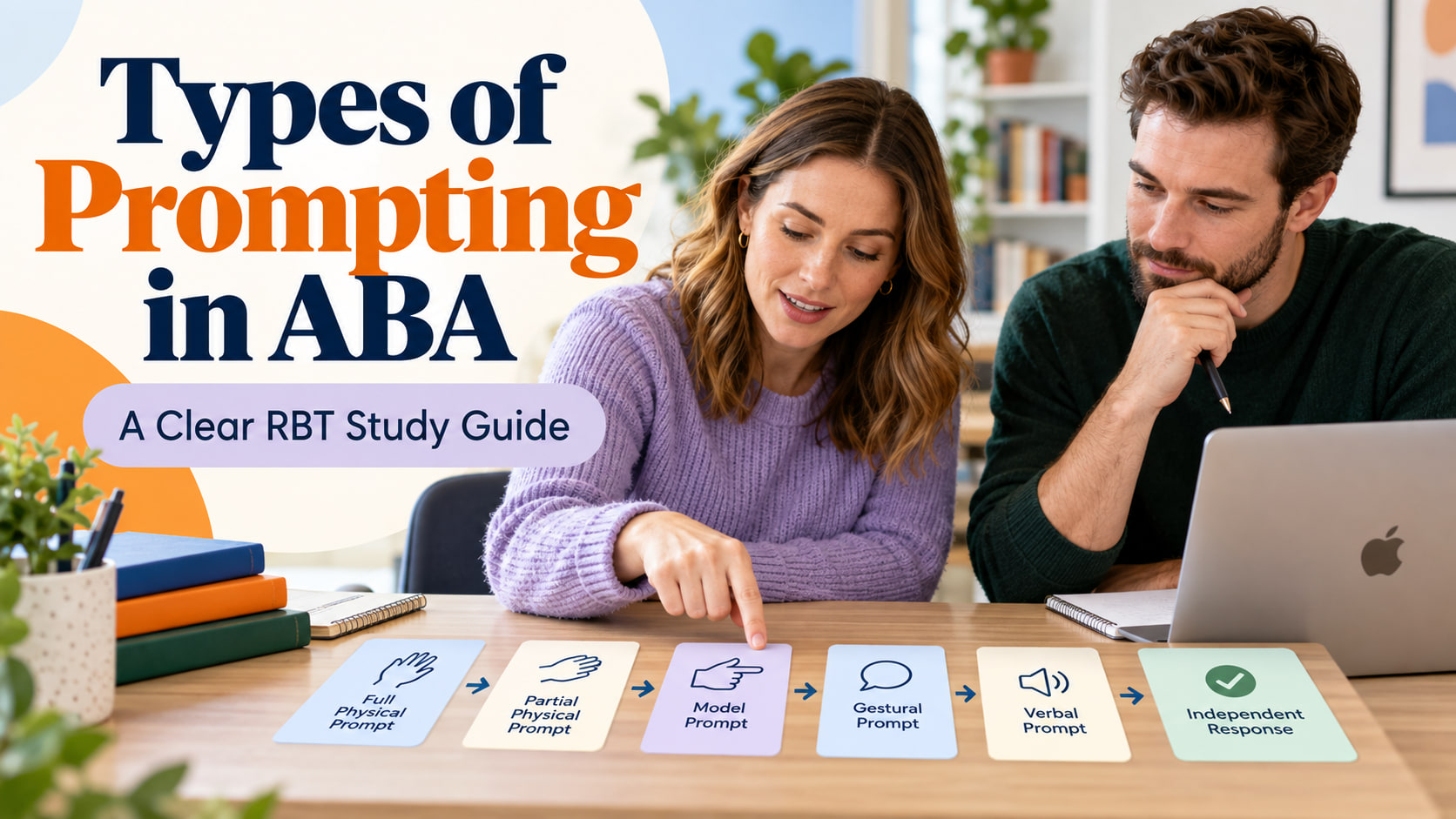
Types of prompting in ABA are forms of extra assistance arranged to increase the likelihood of a target response.
Table of Contents
- What types of prompting in ABA means
- Verbal prompts
- Gestural prompts
- Model prompts
- Physical prompts
- Timing, response, and data
- Fading and independence
- RBT role boundaries
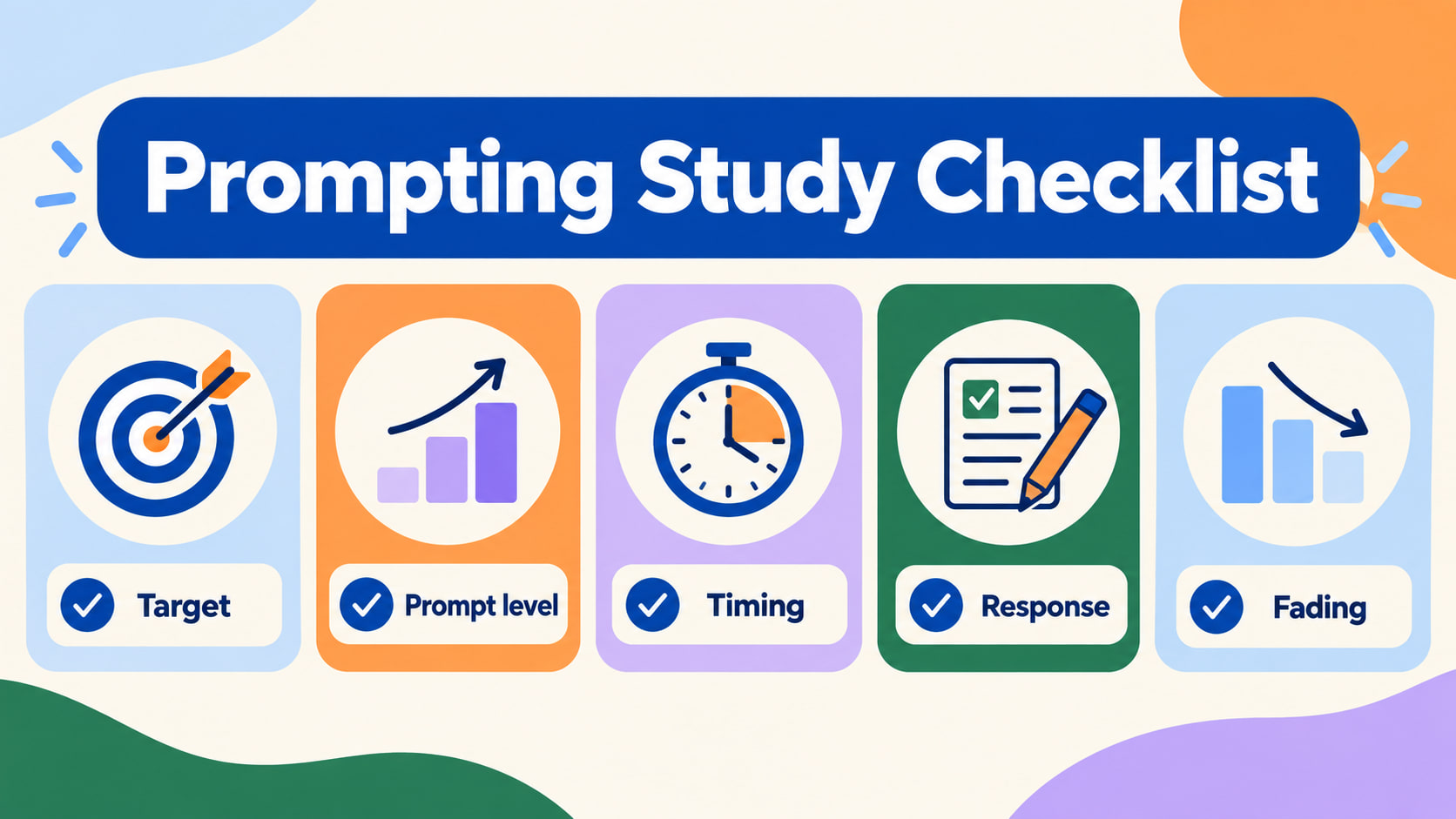
- Prompting study checklist
- Frequently asked questions
- References
ABA CONCEPTS · RBT STUDY GUIDE
Types of Prompting in ABA: A Clear RBT Study Guide
Compare verbal, gestural, model, and physical prompts while keeping timing, response, fading, and supervision clear.
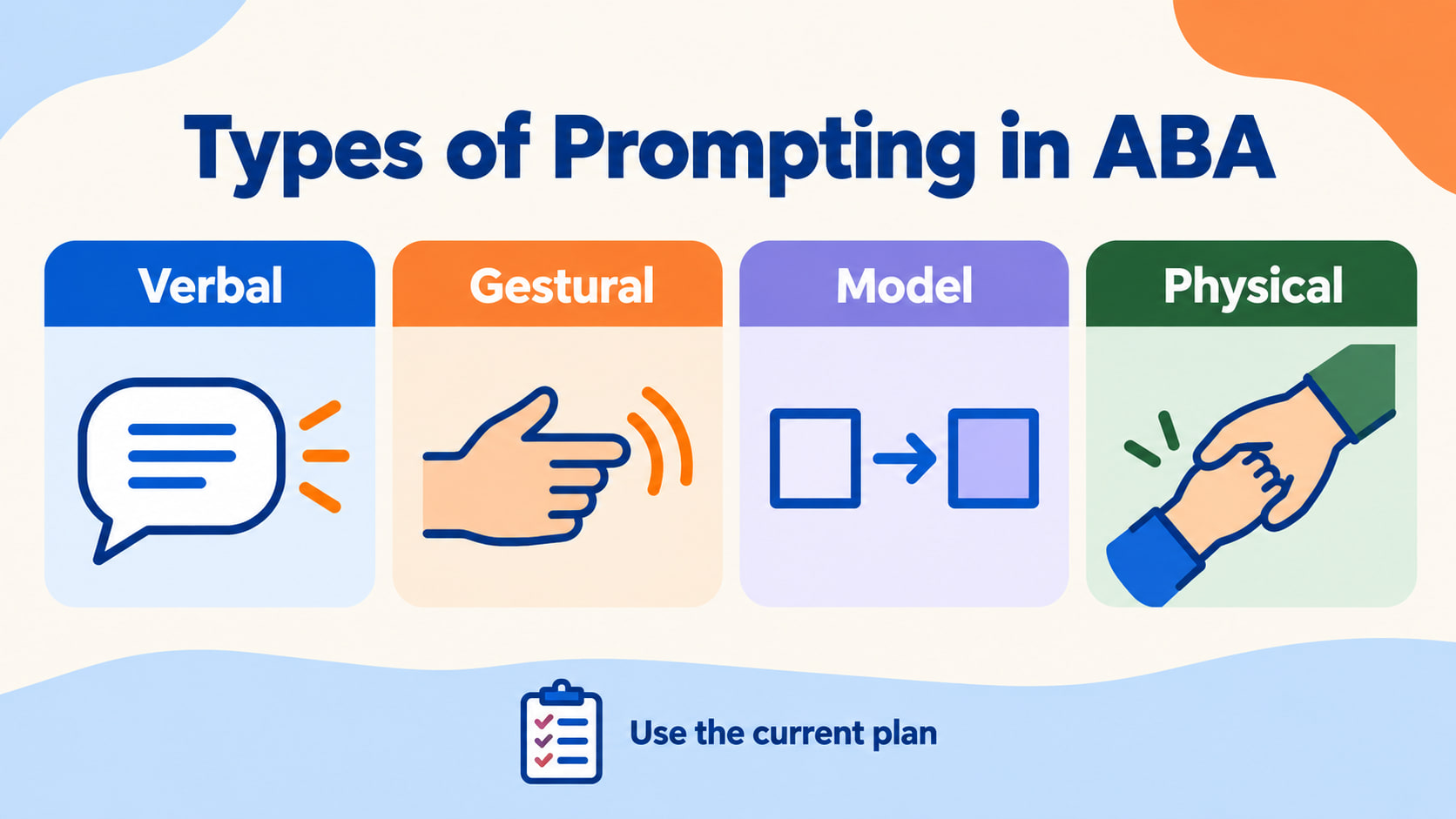
Types of prompting in ABA are forms of extra assistance arranged to increase the likelihood of a target response. Common examples include verbal, gestural, model, and physical prompts. The label alone is not enough: identify the target, the instruction, the prompt level, the timing, the learner response, and the data rule in the current program.
Prompting is not a menu an RBT can freely rearrange. The supervising professional selects the procedure, prompt hierarchy, fading plan, and decision rules. An RBT implements the trained steps, records whether the response was independent or prompted, and asks for direction when the plan is unclear or a situation is unsafe.
What types of prompting in ABA means
A prompt is an added cue that helps evoke a response. The cue may be spoken, visual, modeled, gestural, or physical, depending on the program. The natural instruction or opportunity and the extra prompt should be distinguished so the team can evaluate independence accurately.
For example, a learner may be asked to select a color. Pointing to the correct card, saying part of the word, demonstrating the selection, or guiding the movement are different kinds of assistance. The exact response, prompt level, wait interval, and consequence must come from the written program.
Verbal prompts
A verbal prompt uses spoken language to guide the target response. It may be a full verbal model, a partial word, a sound, a question, or another spoken cue defined by the program. A verbal prompt is extra assistance; it is not automatically the same as the original instruction.
Timing and wording matter. If the program says to wait before providing a partial cue, speaking immediately can change whether the response is independent. Do not repeat an instruction or invent a phrase until the learner answers simply because the session is moving slowly. Follow the trained sequence and record the prompt category required by the plan.
Gestural prompts
A gestural prompt uses a movement or visual indication to guide attention or response. Pointing, looking toward an item, or making a relevant hand movement may be a gestural prompt when the program defines it that way. The gesture should be described clearly enough that another trained person could identify it.
Do not assume every movement is a prompt. Context, timing, and the target determine its function. A natural gesture in the environment may be part of the instruction rather than extra assistance. If the distinction affects data, ask the supervisor for the operational definition.
Model prompts
A model prompt demonstrates the response for the learner to imitate. The model may involve a spoken response, motor action, communication exchange, or another behavior specified in the teaching procedure. Record a modeled response as prompted when the program defines independence as responding without the model.
Modeling should be consistent with the goal and the learner’s dignity. Do not perform an action that is unsafe, outside training, or unrelated to the written target. If the learner imitates only the model and not the natural instruction, the team may need data about fading and generalization.
Physical prompts
A physical prompt uses physical contact or guidance to support a response. The plan may distinguish partial physical assistance from more intrusive guidance, and it should specify consent, safety, timing, and fading considerations. Never improvise physical prompting based on a generic list of prompt types.
Follow training and policy precisely. If the procedure is unclear, the learner signals discomfort, or a safety condition changes, stop and use the designated supervision route. Protect privacy and dignity, explain what you are authorized to explain, and do not use physical guidance as a substitute for a missing plan.
Timing, response, and data
Prompting analysis requires more than naming the cue. Record the instruction or opportunity, planned wait interval, prompt delivered, learner response, consequence, and measurement category required by the program. Timing can determine whether a response is independent, prompted, incorrect, or absent.
Use the current operational definition and data system. The plan may track independent versus prompted responses, prompt levels, latency, percentage of opportunities, or another measure. Do not estimate a missing trial, change the category because the data look unfavorable, or copy a previous entry.
Describe objective events. “The learner touched the card after the model prompt” is more useful than “the learner needed lots of help.” If a prompt was delivered early or a response did not fit a category, record the issue according to policy and ask a specific supervision question.
Fading and independence
Prompt fading reduces extra assistance so the learner can respond to the natural instruction or context. Fading may involve reducing the amount of spoken help, moving a gesture farther away, shortening a model, increasing a wait interval, or following another programmed strategy.
The supervising professional selects the fading procedure and decision rules. An RBT should not independently remove prompts, change mastery criteria, or add a new prompt because a learner makes an error. Implement the authorized step, collect data, and report patterns or concerns.
Independence depends on the definition in the plan. A learner who answers after a prompt may be correct but prompted. A learner who answers without extra assistance may be independent only if the response, timing, and context meet the program criteria. Generalization and maintenance may require separate observations.
RBT role boundaries
An RBT may implement trained prompting procedures, collect accurate data, report observations, protect privacy, and receive feedback. An RBT should not independently select a hierarchy, diagnose the reason for an error, rewrite a target, change fading, alter a consequence, or decide that a learner has mastered a skill.
If a caregiver asks why a prompt was used, explain only what you are authorized to explain and route clinical questions to the supervisor. If a procedure is unclear or unsafe, use the escalation route. Prompting is effective professional work when it is accurate, respectful, and connected to the current plan.
Prompting study checklist
- What is the target response and natural instruction?
- What prompt type and level does the plan define?
- What is the wait interval and timing rule?
- How will an independent or prompted response be recorded?
- What fading procedure and decision rule apply?
- Which observations require supervisor direction?
Frequently asked questions
What are common types of prompting in ABA?
Common categories include verbal, gestural, model, and physical prompts, along with other visual or positional procedures. The current program defines the exact form and level.
Is a prompt the same as an instruction?
Not necessarily. An instruction may be the natural opportunity, while a prompt is extra assistance. Use the program’s definitions and sequence.
Can an RBT choose a different prompt?
No. Implement the trained procedure and ask the supervisor about ambiguity, fading, safety, or proposed changes.
Does a prompted correct response count as independent?
Usually not when independence means responding without extra assistance. Record it according to the authorized prompt and data categories.
Source note: Review the current BACB Handbook, RBT materials, learner plan, employer policy, and supervisor direction for your situation. This article is educational and does not provide individualized legal, clinical, employment, or credentialing advice.
Ready to practice the RBT concepts you just reviewed?
Try an independent, original RBT practice resource with exam-style questions, scoring, and answer explanations.
References
- Behavior Analyst Certification Board. RBT Test Content Outline, 3rd edition.
- Behavior Analyst Certification Board. RBT Handbook.
- Behavior Analyst Certification Board. RBT Ethics Code.