

Verbal prompt ABA is best understood as spoken assistance that helps evoke a target response during a teaching procedure.
Table of Contents
- What verbal prompt ABA means
- The prompt sequence
- Types of verbal prompts
- Prompt fading and independence
- Data and documentation
- Practice scenarios
- RBT role boundaries
- Study checklist
- Frequently asked questions
- References
ABA CONCEPTS · RBT STUDY GUIDE
Verbal Prompt ABA: RBT Concepts Explained
Learn what a verbal prompt is, how to separate a cue from the learner response, and how to follow the current plan.
Verbal prompt ABA is best understood as spoken assistance that helps evoke a target response during a teaching procedure. The prompt may be a word, phrase, question, or verbal model, depending on the written program. To study the concept accurately, separate the instruction, the verbal prompt, the learner’s response, the consequence, and the data rule. Do not assume that every spoken interaction is a prompt.
A verbal prompt is also not a license to improvise. An RBT implements the current authorized procedure under supervision, uses the trained wording or sequence when one is specified, and asks for direction when the prompt rule is unclear. The goal is not simply to make a learner respond in the moment; the team also considers independence, generalization, maintenance, dignity, and accurate measurement.
What verbal prompt ABA means
A prompt is an added cue that increases the likelihood of a correct response. A verbal prompt uses spoken language to guide the learner toward the target response. For example, after an instruction to identify a color, a program might specify a partial spoken cue such as “r…” or a full verbal model such as “say red.” The exact wording, timing, and level must come from the current teaching plan.
Keep the antecedent and prompt distinct. The antecedent may be the instruction or natural opportunity that should eventually evoke the response independently. The prompt is extra help arranged to increase success. If the learner responds only after the extra spoken cue, record the response according to the plan rather than calling it independent.
The prompt sequence
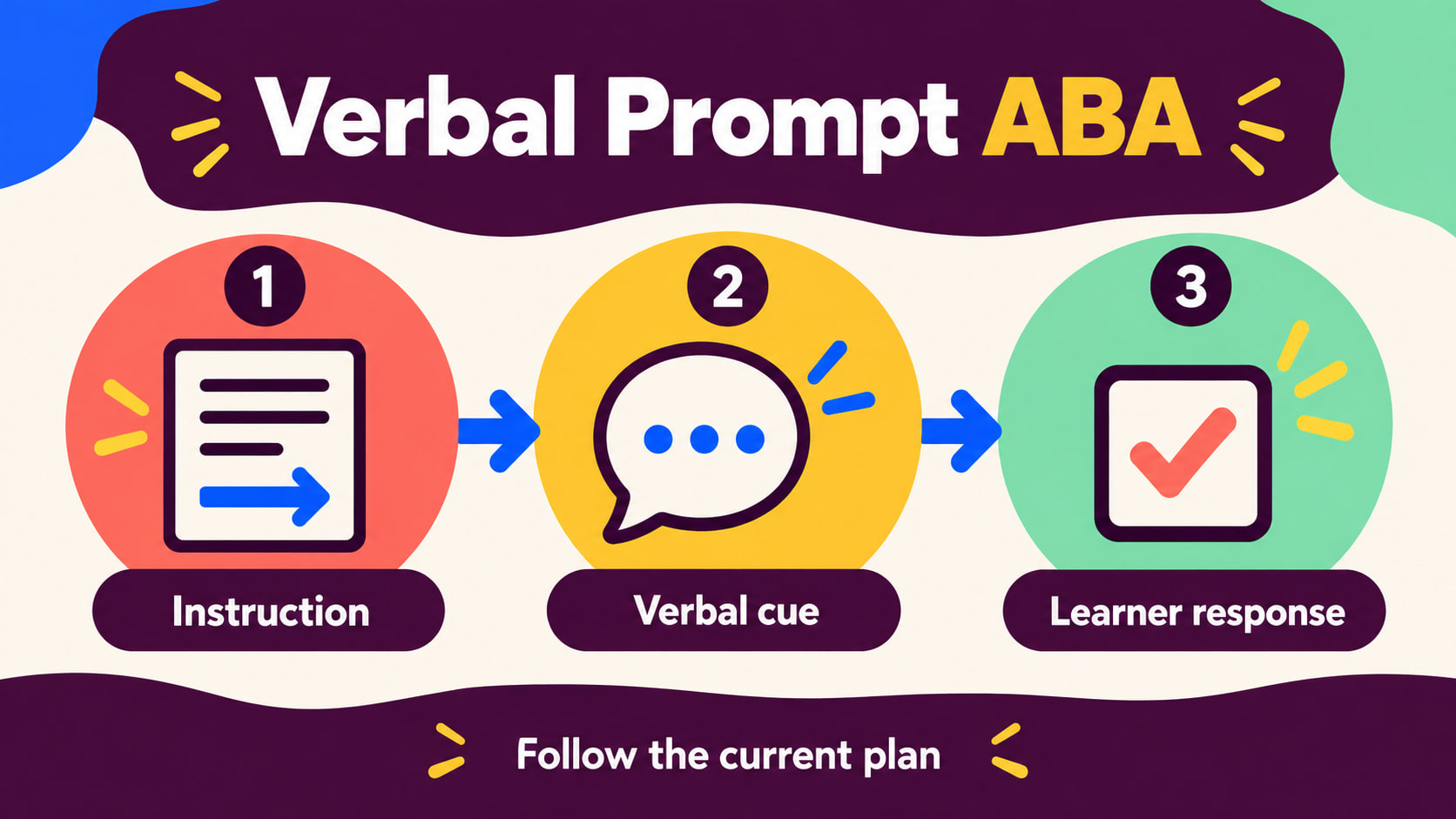
When reviewing verbal prompt ABA, write the sequence in observable order:
- Arrange the opportunity: Prepare the materials and context described in the program.
- Deliver the instruction: Present the stated cue or natural opportunity.
- Allow the planned interval: Wait for the response window specified by the program.
- Deliver the verbal prompt: Use the authorized prompt level and wording if the learner needs help.
- Observe the response: Record whether it was independent, prompted, incorrect, or absent as defined.
- Apply the consequence: Follow the programmed reinforcement, correction, or next step.
This order helps prevent a common error: speaking too quickly and then treating the prompted response as independent. It also makes it easier to identify where implementation differed from the plan. If the written procedure uses a different sequence, follow that procedure and ask the supervisor about any uncertainty.
Types of verbal prompts
Programs may use several forms of spoken assistance. A verbal model gives the response for the learner to imitate, such as saying “open” after an opportunity to request. A phonemic or partial-word prompt gives only part of the response, such as the first sound. A descriptive verbal cue may point the learner toward the relevant feature without stating the whole answer. A question or reminder may also be specified, but its function depends on the program and the learner’s response pattern.
Do not create a hierarchy from memory and apply it automatically. Some programs use a most-to-least arrangement, some use least-to-most support, and some specify a different prompting strategy. The same phrase can be an instruction in one context and a prompt in another. Identify the written definition and the consequence of each level before labeling it.
Prompt quality includes more than the words. Consider timing, volume, tone, distance, pace, and whether the spoken cue is consistent. Use respectful language and avoid repeating a direction indefinitely. Repetition can change the teaching arrangement and make it harder to determine which event occasioned the response.
Prompt fading and independence
Prompt fading reduces extra help so the learner can respond to the natural instruction or context. Fading might involve shortening a verbal model, moving from a full word to a partial cue, increasing the response interval, or following another procedure in the plan. The supervising professional selects the fading strategy and decision rules; an RBT should not change them independently.
Independence is not proven merely because the learner eventually answered. Ask what cue was present immediately before the response and whether the response met the plan’s definition of independent. If a spoken prompt was required, record the prompted level. If the learner responds independently only in one room or with one person, the team may need data about generalization and maintenance.
Fading should also be monitored for errors and frustration. If reducing a prompt produces repeated errors, a safety concern, or an unexpected change, implement the reporting and supervision process. Do not hide the result by adding an unapproved hint or changing the mastery criterion.
Data and documentation
Use the measurement system named in the program. Depending on the target, the data may distinguish independent and prompted responses, record the prompt level, measure latency, count opportunities, or track accuracy across trials. The operational definition tells you what counts as the target response and when the observation begins and ends.
Document observable events. “The learner did not respond within the stated interval; the technician delivered the programmed partial verbal cue” is more useful than “the learner was unmotivated.” If a prompt was accidentally delivered too early, record the implementation issue according to workplace policy and notify the responsible supervisor. Accurate data includes relevant errors; it is not a performance report that should be made to look perfect.
Look for patterns across sessions rather than deciding from one trial. The team may compare independent responding, prompted responding, errors, latency, and generalization. A consequence that follows a prompted response may not have the same instructional meaning as one that follows an independent response, so follow the program’s reinforcement and data rules precisely.
Practice scenarios
Scenario one: The program says to present a picture, wait five seconds, and then provide the first sound of the word if there is no response. The learner answers after the first sound. The response may be correct but prompted. Record it using the program’s prompt category, deliver the authorized consequence, and continue the procedure.
Scenario two: The learner answers after the instruction, before any extra spoken cue. Record it as independent only if the response and timing meet the program definition. Do not add a verbal prompt simply because one was used on an earlier trial.
Scenario three: The learner gives an unexpected answer and the technician is unsure whether to repeat the instruction, model the answer, or move on. The correct professional action is to follow the written error-correction procedure if one applies. If it does not address the situation, record the observable event and seek supervisor direction rather than inventing a new hierarchy.
RBT role boundaries
An RBT may implement assigned teaching procedures, present trained prompts, collect data, report observations, and receive feedback. An RBT should not independently choose a new verbal prompt, rewrite a target, change the prompt-fading rule, decide that a learner has mastered a skill, diagnose the reason for an error, or promise a caregiver a particular outcome.
When a caregiver asks why a prompt is being used, explain only what you are trained and authorized to explain, then route clinical or program-design questions to the supervisor. Protect private information, use approved documentation systems, and keep language respectful. If the procedure seems unsafe, unclear, or inconsistent with current instructions, use the designated escalation route.
Supervision is part of good implementation, not a sign that the concept was misunderstood. A supervisor may observe the sequence, model a prompt, review data, or clarify when a response is independent. Bring specific questions: what was presented, what was said, when it was said, what the learner did, and what was recorded.
Study checklist
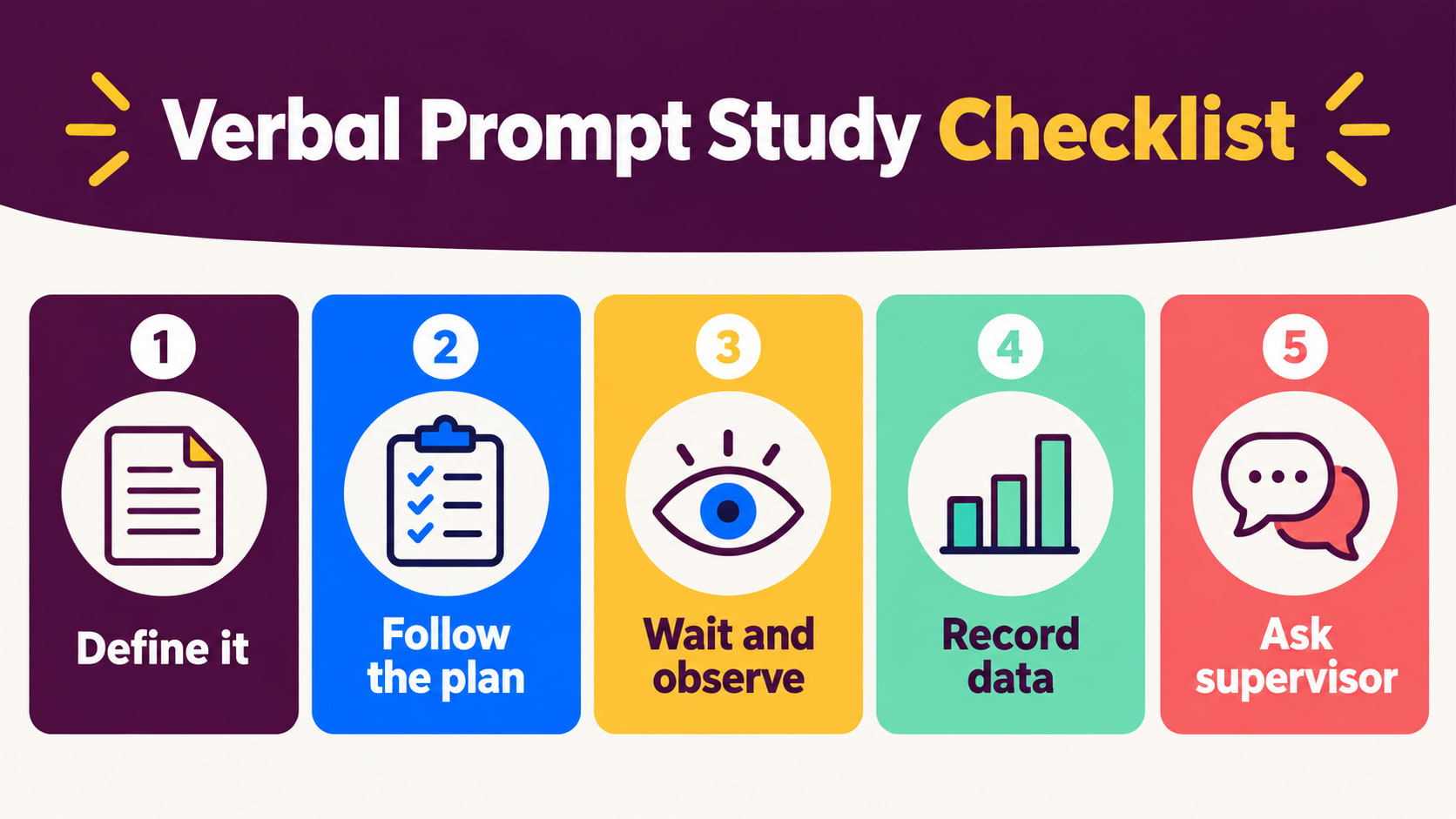
- Can I define a verbal prompt using observable language?
- Can I distinguish an instruction from an extra spoken cue?
- Can I identify the planned wait interval and prompt level?
- Can I tell whether a response was independent or prompted?
- Can I explain how prompt fading supports independence?
- Can I name the data rule and error-correction procedure?
- Can I identify which decision belongs to the supervisor?
- Can I describe the event without guessing the learner’s motivation?
Frequently asked questions
What is a verbal prompt in ABA?
It is spoken assistance arranged to increase the likelihood of a target response, such as a verbal model, partial-word cue, or other spoken cue defined by the current program.
Is a verbal prompt the same as an instruction?
Not necessarily. An instruction may be the natural or planned antecedent, while a verbal prompt is extra assistance. The program’s definitions and sequence determine the distinction.
Does a prompted response count as independent?
Usually not if the plan defines independence as responding without the extra cue. Record the response according to the authorized prompt and data categories.
Can an RBT invent a verbal prompt?
No. An RBT should implement the trained procedure and ask the supervisor when wording, timing, fading, or correction is unclear.
Source note: Review the current BACB RBT Handbook, Test Content Outline, ethics materials, learner plan, employer policy, and supervisor direction for your situation. This article is educational and does not provide individualized legal, clinical, employment, or credentialing advice.
Ready to practice the RBT concepts you just reviewed?
Try an independent, original RBT practice resource with exam-style questions, scoring, and answer explanations.
References
- Behavior Analyst Certification Board. RBT Test Content Outline, 3rd edition.
- Behavior Analyst Certification Board. RBT Handbook.
- Behavior Analyst Certification Board. RBT Ethics Code.