

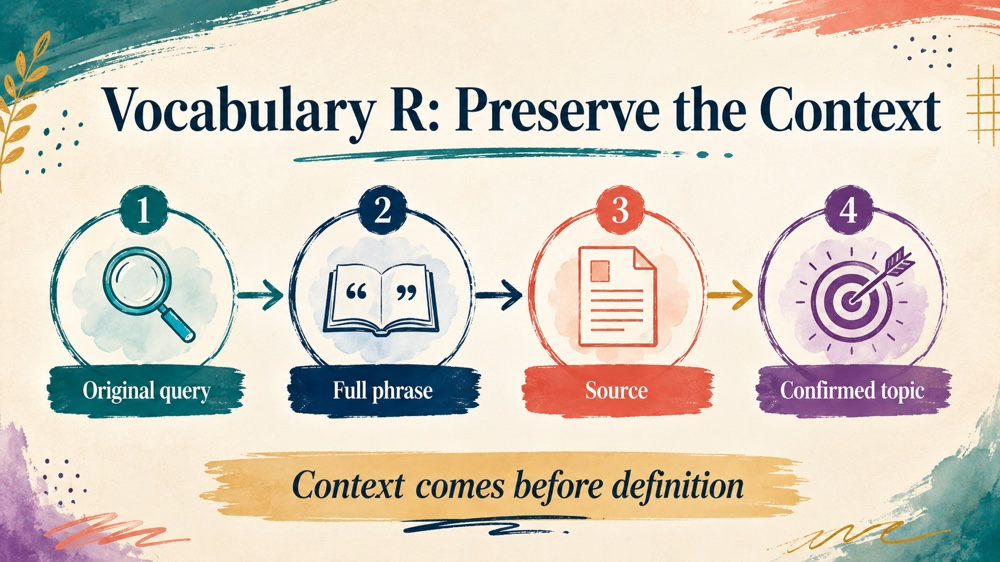
The phrase vocabulary r is incomplete without context. It may be a truncated search, a local worksheet label, or the beginning of a longer vocabulary query. This page does not invent a definition or imply that the phrase is an official BACB term. Instead, it gives a source-check workflow and a safe way to continue RBT study while the intended meaning is confirmed. Incomplete queries deserve careful handling because the missing word may change the domain, source, or intended audience. Save the original context, ask what document generated the phrase, and do not let a plausible guess become a memorized definition. While waiting for clarification, study only the RBT content that is confirmed by current sources and keep a written follow-up note. Source control is part of effective study, not a delay from it.
Table of Contents
- Clarify the vocabulary r source
- Do not guess the vocabulary r meaning
- Use current RBT domains as a safe framework
- Turn confirmed vocabulary into action
- Check measurement and teaching context
- Protect ethics and privacy
- Use vocabulary r as a source-control exercise
- Avoid incomplete-query mistakes
- vocabulary r checklist
- Frequently Asked Questions
- References
Continue your RBT study with RBT exam study materials and original practice resources.
Quick answer: Treat vocabulary r as a current-source RBT study topic. Define the concept, connect it to an observable action, use original examples, and keep the supervision boundary visible.
Study boundary: This independent guide is educational content. It is not a BACB policy, certification decision, legal opinion, answer key, or guarantee of examination success. It does not promise a passing score or certification outcome. Examples are original and are not official, recalled, leaked, or BACB-endorsed questions.
Current exam context: The current BACB RBT Test Content Outline describes 43 tasks across six domains; the examination includes 75 scored questions and 10 unscored pilot questions in a 90-minute testing period. Verify the current handbook and outline before relying on a time-sensitive detail.
Clarify the vocabulary r source
Save the original result or document context, then record the full title, issuing organization, version date, and official URL. Ask whether the phrase was truncated by a search box, copied from a local worksheet, or used as an abbreviation. Do not build a glossary from an incomplete label.
Do not guess the vocabulary r meaning
List what is known and what is missing. A plausible expansion is not evidence. Check current BACB RBT materials for official language and keep local course terminology labeled as local until the source confirms it. This protects the learner from studying a false term with confidence.
Use current RBT domains as a safe framework
While the phrase is unresolved, organize confirmed topics under Data Collection and Graphing, Behavior Assessment, Behavior Acquisition, Behavior Reduction, Documentation and Reporting, and Ethics. The current outline describes 43 tasks across these domains. Continue with source-linked topics without attaching an invented meaning to the incomplete phrase.
Turn confirmed vocabulary into action
After confirmation, define the term in plain language, write an original condition, state the observable RBT action, and identify the data or documentation implication. Add the written-program and supervision boundary. The action comes from the confirmed source, not from the phrase alone.
Check measurement and teaching context
If the completed phrase relates to frequency, rate, duration, latency, interval recording, permanent product, percentage, graphing, prompting, reinforcement, or another procedure, verify the operational definition and program details. Do not choose a measure or teaching procedure because a partial word suggests it.
Protect ethics and privacy
Use fictional examples, objective language, confidentiality, competence, supervision, and reporting routes. A missing word is a reason to ask a question, not to enter client details or change a plan. The RBT Ethics Code belongs in the source set for professional conduct.
Use vocabulary r as a source-control exercise
Record the incomplete phrase, source checked, confirmed expansion if any, unresolved alternatives, and next follow-up date. The current examination includes 75 scored questions and 10 unscored pilot questions in a 90-minute testing period; verify current BACB materials for time-sensitive context. Treat the phrase as a research note until it is confirmed.
Avoid incomplete-query mistakes
- Treating a truncated phrase as an official term.
- Choosing the first plausible expansion.
- Using a local worksheet as BACB authority.
- Leaving out source dates and URLs.
- Entering identifying details to explain the ambiguity.
- Using an incomplete label to change a plan.
- Presenting original scenarios as official or recalled questions.
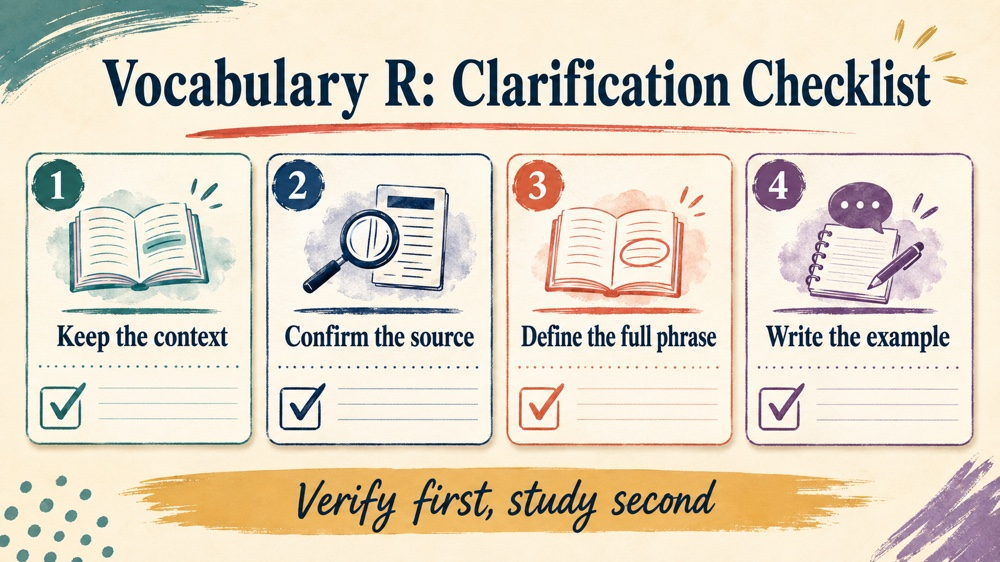
vocabulary r checklist
- Have I preserved the original context?
- Have I checked the issuing source and version date?
- Have I separated local wording from official language?
- Can I map only confirmed content to an RBT domain?
- Are examples observable, original, and privacy-safe?
- Is the role boundary explicit?
- Have I recorded the next clarification step?
Use vocabulary r as a clarification-first search topic. Preserve context, verify the intended phrase, and only then build a source-linked RBT definition and example. RBT Training is independent educational content and is not affiliated with or endorsed by BACB.
Practice the concept
Review vocabulary r with original RBT scenarios, current-source reminders, and clear role boundaries.
Review the RBT study resource →
Frequently Asked Questions
What does vocabulary r mean?
It is incomplete without context. Preserve the original source and confirm the intended phrase before defining it.
Should I choose the most likely expansion?
No. Verify the issuing source, version date, and official wording first.
Can I keep studying while it is unresolved?
Yes. Use confirmed current RBT domains and record the incomplete phrase as a source-check task.
Are the examples official questions?
No. They are original educational scenarios and are not official, recalled, leaked, or BACB-endorsed.
References
- Behavior Analyst Certification Board: Registered Behavior Technician Handbook, updated June 2026.
- Behavior Analyst Certification Board: RBT Test Content Outline (3rd ed.).
- Behavior Analyst Certification Board: RBT resources.
- Behavior Analyst Certification Board: ethics resources.
- Behavior Analyst Certification Board: RBT Ethics Code (2.0).