
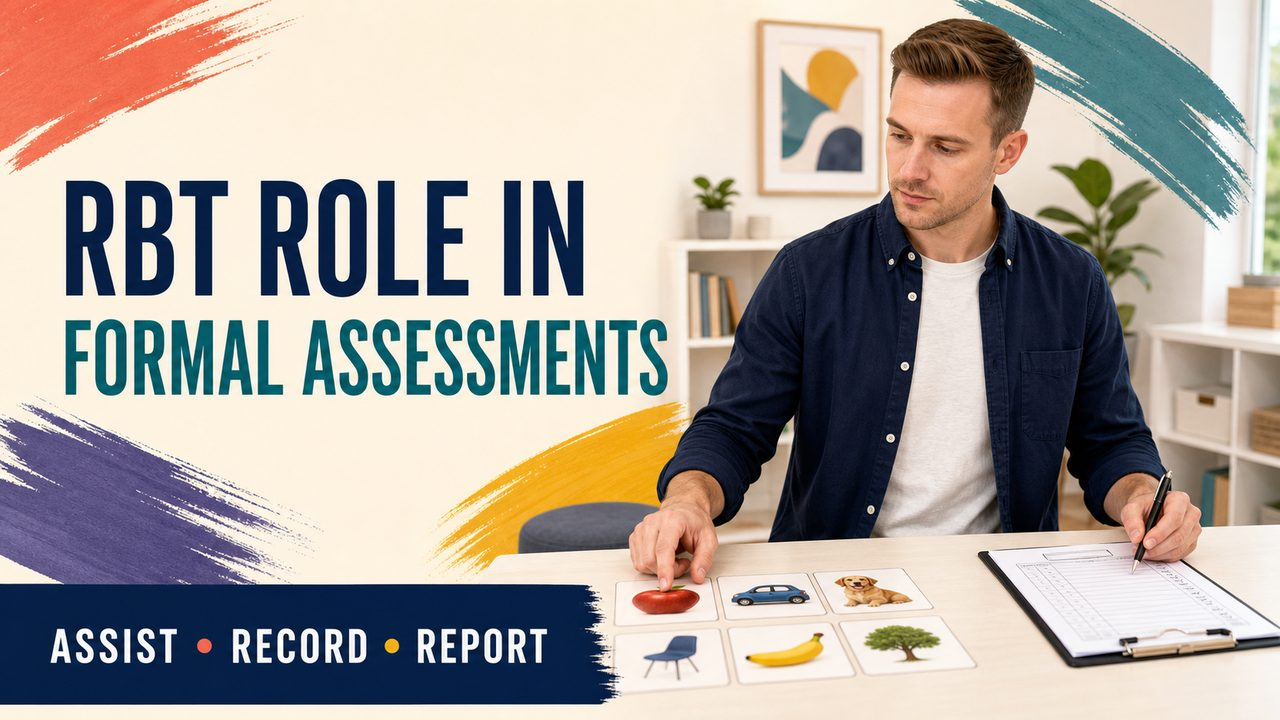
If an RBT practice question asks, what could be the RBTs role in formal assessments, the safest answer is not “do nothing” and not “administer everything independently.” An RBT may assist with or participate in assessment activities that are part of the written service plan and supervision structure. The qualified supervisor or assessor remains responsible for the assessment decisions, interpretation, and oversight that the RBT is not authorized to make alone.
Table of Contents
- What could be the RBTs role in formal assessments?
- What could be the RBTs role in formal assessments? Start by naming the assessment
- What could be the RBTs role in formal assessments? A supervised workflow
- The independent-authority boundary
- Do not confuse client assessments with the Initial Competency Assessment
- Preference assessments: participation still follows a method
- ABC data and functional-assessment components
- Standardized and formal tests require extra caution
- Original scenario practice: choose the role-safe answer
- What to report when the role is unclear
- A role-boundary study checklist
- Frequently Asked Questions
- References
That distinction matters because “formal assessment” can describe several different activities: a skill-strength or deficit assessment, a preference assessment, ABC data collection used within a functional-assessment process, a standardized instrument, or the Initial Competency Assessment used to verify an RBT applicant’s skills. These are not interchangeable.
The current RBT Test Content Outline (3rd ed.) includes 43 tasks across six domains. In Domain B, the RBT is expected to conduct preference assessments, participate in assessments of relevant skill strengths and deficits, and participate in components of functional-assessment procedures. The current exam includes 75 scored questions and 10 unscored questions. RBT Training’s examples are independent, newly written study content—not official, recalled, leaked, or BACB-endorsed questions.
This guide gives an exam-ready role boundary and original scenarios. It does not replace the current BACB Handbook, a written plan, workplace policy, legal requirements, or direction from a qualified supervisor. No practice answer can guarantee certification or a passing result.
What could be the RBTs role in formal assessments?
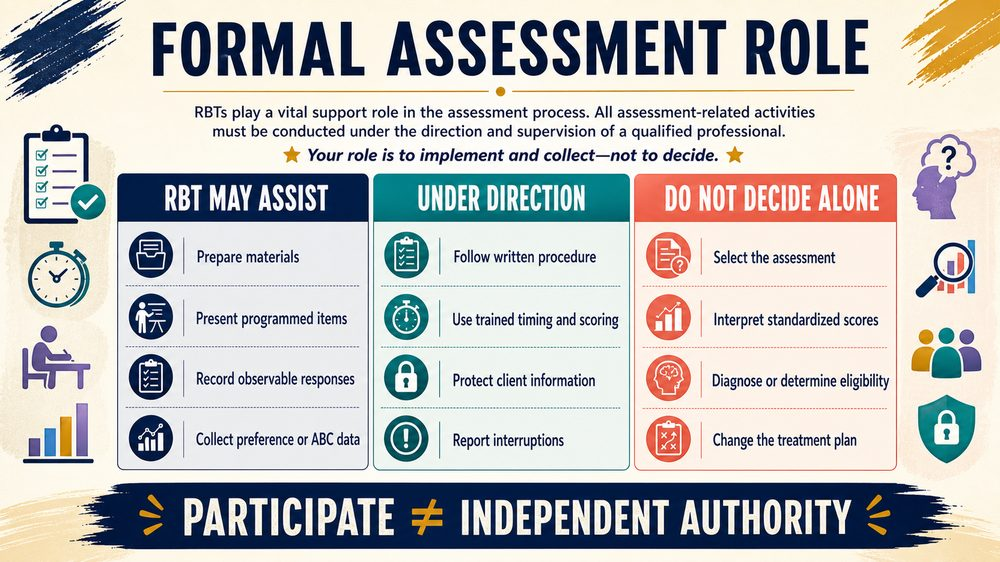
The best general answer is: assist with or participate in the administration or data-collection components of an assessment under the direction and supervision of a qualified professional, when the task is within the written plan and the RBT has demonstrated competence.
That does not mean an RBT can independently select a formal test, diagnose a condition, decide which assessment should be used, interpret standardized scores, determine eligibility, or change a treatment plan from a personal conclusion. In a multiple-choice question, look for the answer that describes supported participation rather than solo administration or a blanket prohibition on every assessment activity.
For example: an RBT may be asked to present materials in a skill assessment, record the learner’s observable responses, prepare the environment, or collect ABC data according to a supervisor’s procedure. The supervisor determines the assessment purpose, evaluates the information, and decides what it means for the program.
What could be the RBTs role in formal assessments? Start by naming the assessment
The phrase is too broad without context. Use the activity, not the label alone, to reason about the role:
| Assessment activity | Possible RBT participation | Boundary to remember |
|---|---|---|
| Skill-strength or deficit assessment | Prepare materials, present programmed items, record responses, and assist with structured procedures under direction. | Do not independently interpret scores or redesign the curriculum. |
| Preference assessment | Present stimuli, observe selections, record choices, and summarize data as written. | Follow the selected method and do not turn a preference result into an unapproved treatment decision. |
| ABC data within a functional-assessment process | Observe and record antecedent, behavior, and immediate consequence using operational definitions. | Descriptive data is not the same as independently determining behavioral function. |
| Standardized assessment | Follow only the specific support role assigned by a qualified professional and applicable policy. | Do not independently administer, score, or interpret an instrument unless the responsible professional and applicable rules authorize the exact task. |
| Initial RBT Competency Assessment | Perform assigned tasks so a qualified assessor can evaluate competence. | This evaluates the RBT applicant; it is not a client assessment and does not give independent assessment authority. |
The current TCO uses “participate” for relevant skill strengths and deficits and for components of functional assessment. That word is important: participation can include a defined task without transferring responsibility for the entire assessment.
What could be the RBTs role in formal assessments? A supervised workflow
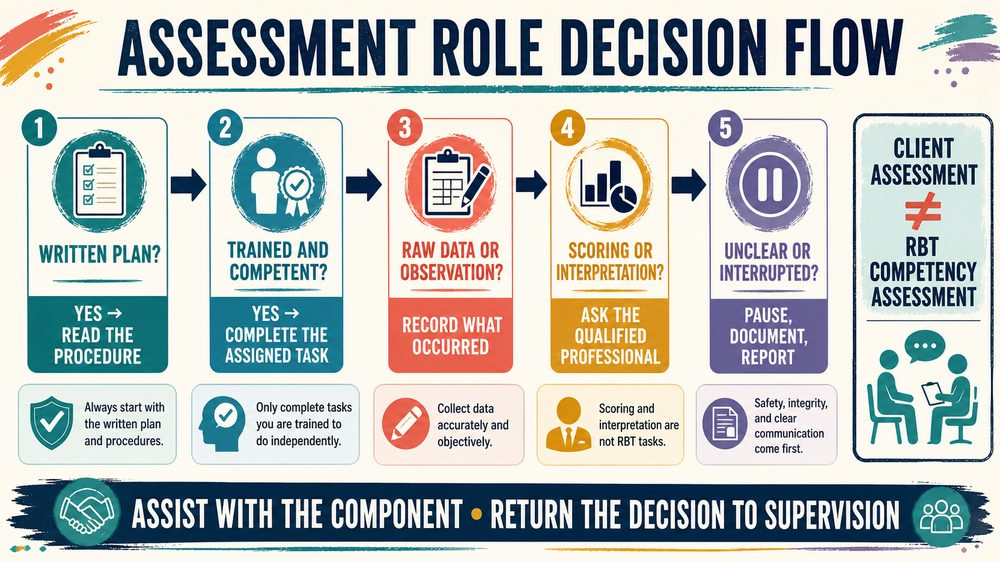
- Receive the purpose and procedure: know what is being assessed, what response counts, what materials to use, and when to ask for help.
- Prepare the environment: arrange materials, check the data sheet, and reduce avoidable distractions according to the plan.
- Implement the assigned component: present an item, run a programmed opportunity, conduct a preference procedure, or collect ABC data as trained.
- Record observable information: enter the response, prompt, selection, timing, or context exactly as the procedure states.
- Protect the record: keep client information confidential and document interruptions, missing data, or procedural deviations.
- Return the decision to the supervisor: report what occurred and ask the qualified professional to interpret, integrate, or change the assessment or program.
Original example: a supervisor asks an RBT to present five picture cards in a programmed skill assessment and record independent selections. The RBT presents the cards as trained, records each response and prompt level, and reports that a fire alarm interrupted trial four. The RBT does not announce that the learner “failed the assessment” or change the teaching target without direction.
The independent-authority boundary
The RBT role is defined by supervised implementation and accurate communication, not by independent clinical authority. A question is probably testing this boundary when the choices include “solo administration,” “interpret the results,” “diagnose,” or “change the program.” Those options usually overstate the RBT role.
| RBT may be asked to do under direction | RBT should not decide independently |
|---|---|
| Prepare materials and follow the programmed sequence. | Which formal assessment is clinically appropriate. |
| Present stimuli or instructions as trained. | Whether a score establishes a diagnosis or eligibility. |
| Collect objective response, selection, or ABC data. | What a standardized score means for treatment or placement. |
| Enter data and communicate missing or irregular observations. | Changing the measurement rule, target, or intervention based on a personal conclusion. |
| Ask questions and seek feedback when the procedure is unclear. | Representing participation as independent assessment expertise. |
This is not a statement that RBTs are passive. Accurate assessment support can require careful observation, timing, rapport, materials, data entry, and professional communication. The point is to keep task performance and assessment ownership connected to supervision and competence.
Do not confuse client assessments with the Initial Competency Assessment
The Initial Competency Assessment is a separate certification requirement for an RBT applicant. The current 2026 packet lists 19 task items and includes measurement, assessment, skill acquisition, behavior reduction, and professionalism sections. It evaluates whether the applicant can perform required RBT tasks through the assessment modes permitted by the packet.
For example, the packet includes tasks for continuous measurement, discontinuous measurement, data and graphs, preference assessments, and ABC data. Seeing the word “assessment” in that packet does not mean the applicant is being authorized to independently administer formal tests to clients. It means an appropriately qualified assessor is evaluating the applicant’s competency in specified RBT tasks.
Exam trap: if a question asks about the RBT’s role in “formal assessments,” do not automatically answer with details about the Initial Competency Assessment. First determine whether the stem is about a client’s assessment or the certification process.
Preference assessments: participation still follows a method
A preference assessment can be a clear example of supervised participation. Depending on the selected procedure, an RBT may present items, arrange choices, observe approach or selection, record the order or frequency of choices, and deliver the procedure as written. The RBT should know the rule for item placement, number of choices, repeated presentation, and data entry.
Do not improvise a preference assessment because a client reaches toward one item. A single approach may be informative in context but does not automatically establish a stable preference. Follow the method specified by the supervisor, record what occurred, and report practical concerns such as unavailable items or a change in motivation.
ABC data and functional-assessment components
ABC data can document observable events before and after a behavior. An RBT may collect that data as part of a functional-assessment process when trained and directed to do so. The RBT should record what was observed rather than writing an unverified motive or function.
| Field | Objective entry | Interpretive overreach |
|---|---|---|
| Antecedent | “Teacher presented a worksheet and said, ‘Begin.’” | “The demand made the learner want escape.” |
| Behavior | “Learner pushed the worksheet to the floor with both hands.” | “Learner was oppositional.” |
| Consequence | “Teacher removed the worksheet for 30 seconds and then represented it.” | “Removing the worksheet reinforced the behavior.” |
The supervising professional integrates ABC observations with other information and determines what assessment or intervention decisions are appropriate. An RBT should report patterns without presenting a personal interpretation as a completed functional assessment.
Standardized and formal tests require extra caution
“Formal assessment” may refer to an instrument with standardized administration, scoring, interpretation, or eligibility implications. The exact rules depend on the instrument, jurisdiction, employer, and responsible professional. An RBT should not assume that general behavior-analytic training alone authorizes independent administration or interpretation of every formal test.
If a qualified professional assigns a support task, clarify the exact role: preparing materials, supporting an approved administration, recording observable responses, or another defined activity. Ask who is responsible for scoring, interpretation, communication of results, and documentation. If the answer is unclear, stop before taking an action that could compromise the assessment.
Original scenario practice: choose the role-safe answer
| Scenario | Best RBT action | Why |
|---|---|---|
| A supervisor provides a preference-assessment sequence and data sheet. | Run the sequence as trained, record selections, and report issues. | This is participation in a defined assessment procedure. |
| A parent asks the RBT to decide which standardized test the child needs. | Explain that the qualified professional must answer and route the question appropriately. | Assessment selection is not an independent RBT decision. |
| An RBT observes a pattern in ABC data. | Describe the pattern objectively and share it with the supervisor. | Observation and communication are different from declaring function. |
| A form says “formal assessment” but gives no procedure or role. | Ask the supervisor to clarify the task, scoring, and responsibility before proceeding. | Ambiguity is a supervision issue, not an invitation to improvise. |
| An applicant performs data and graph tasks for a qualified assessor. | Complete the assigned competency task according to the current packet. | This is assessment of the applicant’s RBT competency, not independent client testing. |
What to report when the role is unclear
Use a short, objective question that identifies the uncertainty:
- “Which assessment procedure should I follow, and where is the current written version?”
- “Am I collecting raw responses only, or am I also entering a specified summary?”
- “What should I do if a trial is interrupted or a required material is unavailable?”
- “Who is responsible for scoring, interpreting, and communicating the results?”
- “Should this observation be documented as ABC data, a session note, or both?”
These questions protect the client, the RBT, and the integrity of the assessment. Document the observable issue according to workplace procedure, preserve confidentiality, and follow the chain of command.
A role-boundary study checklist
- Can you distinguish a client skill assessment from the RBT Initial Competency Assessment?
- Can you explain what “participate” means in the current TCO’s assessment tasks?
- Can you collect preference or ABC data without claiming to determine function or diagnosis?
- Can you identify which actions require a written plan, qualified supervision, or clarification?
- Can you report an observation objectively instead of converting it into a clinical conclusion?
Bottom line: what could be the RBTs role in formal assessments? An RBT may assist with defined assessment activities under the direction and supervision of a qualified professional, including collecting observations or carrying out programmed components when trained and authorized. The RBT should not independently select, administer, score, interpret, diagnose, or change a formal assessment or treatment plan outside that structure.
Practice RBT assessment role questions.
Use original scenarios to separate participation, data collection, supervision, and independent clinical authority.
Try RBT practice materials →
Frequently Asked Questions
What could be the RBTs role in formal assessments?
An RBT may assist with or participate in defined assessment activities under the direction and supervision of a qualified professional. The RBT does not independently own the assessment decision or interpretation.
Can an RBT administer a formal assessment alone?
An RBT should not assume independent authority to select, administer, score, or interpret a formal assessment. The exact support role must be assigned and authorized within the applicable professional and workplace structure.
Can an RBT collect ABC data?
Yes, an RBT may collect ABC data when trained and directed to do so. The RBT records observable events and reports them; collecting ABC data does not by itself authorize the RBT to determine behavioral function.
Is the Initial Competency Assessment a client formal assessment?
No. It is a certification-related assessment of an RBT applicant’s ability to perform specified tasks. It should not be confused with a client’s skill, preference, functional, or standardized assessment.
Can an RBT conduct a preference assessment?
The current RBT content outline includes conducting preference assessments. The RBT should use the specified method, collect the required data, and follow supervision rather than inventing a new procedure or making an unsupported clinical conclusion.
What should an RBT do when a formal-assessment role is unclear?
Pause the uncertain decision, identify the missing procedure or responsibility, and ask the supervisor or qualified professional for clarification before proceeding.
References
- Behavior Analyst Certification Board. RBT Test Content Outline (3rd ed.).
- Behavior Analyst Certification Board. Supervision, Assessment, Training, and Oversight.
- Behavior Analyst Certification Board. RBT Initial Competency Assessment Packet: Effective January 1, 2026.
- Behavior Analyst Certification Board. RBT Handbook.
- Search-result question explainer. Used to identify the query wording; official BACB sources control the article’s role explanation.
- Certified RBT behavior-assessment study guide. Reviewed for competitor research; not an official BACB source.