
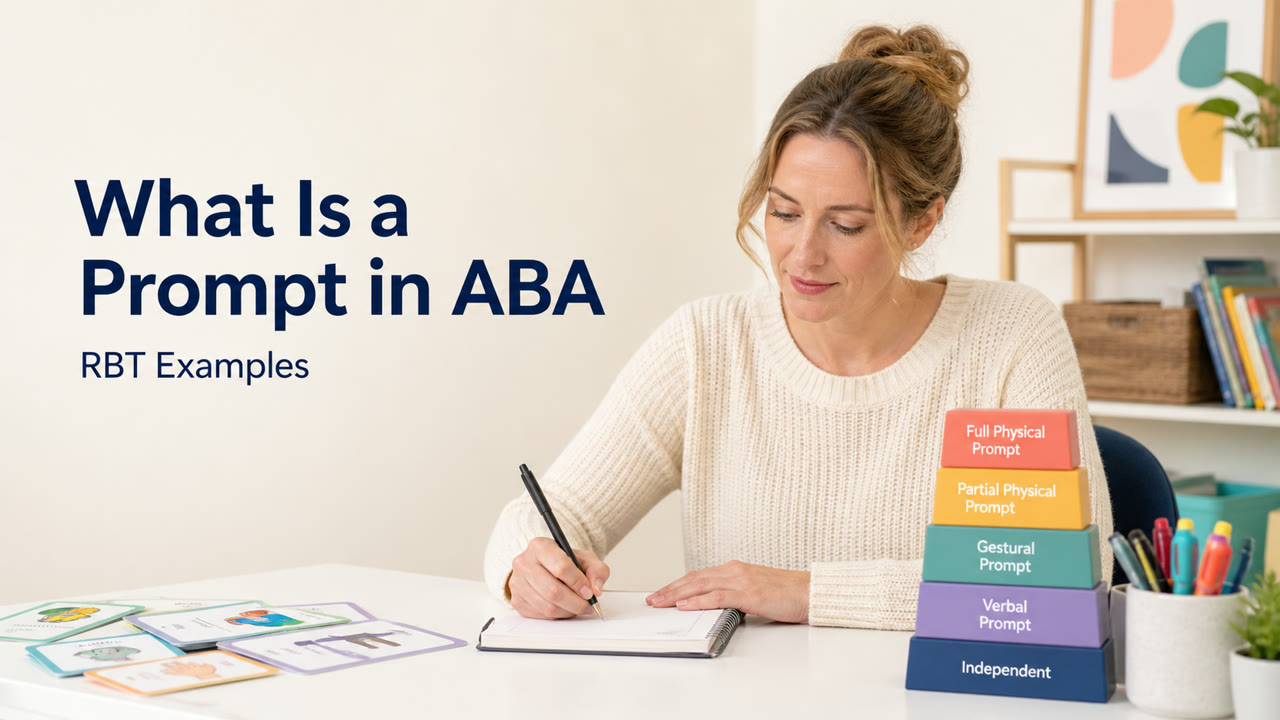
What is a prompt in ABA? A prompt is an added cue or assistance used to increase the likelihood that a learner will make a defined response. A prompt can support successful responding while a skill is being taught, but the prompt must be delivered, recorded, and faded according to the written teaching procedure.
Table of Contents
- What is a prompt in ABA? Start with the function
- The basic prompt-and-response sequence
- Common prompt types to recognize
- Original example: teaching a request
- Prompt fading and independence
- Prompts, discrimination, and generalization
- Common prompt mistakes
- Choosing and fading prompts in a real session
- Prompt study checklist
- Frequently Asked Questions
- References
Quick answer: A prompt is not simply any word, gesture, or helpful action. Its function depends on the teaching arrangement and the target response. An RBT should identify the programmed prompt, use it as trained, record the learner’s response, and seek direction before changing the procedure.
Study boundary: This is independent RBT exam-preparation content. It is not a client-specific treatment plan, official BACB guidance, or a source of secure examination material. The scenarios are original and are not official, recalled, leaked, or BACB-endorsed questions.
Continue your review with RBT practice questions that reinforce measurement, prompting, supervision, and ethics.
What is a prompt in ABA? Start with the function
When studying what is a prompt in ABA, begin with the relationship between the opportunity, the target response, and the added assistance. The learner receives an opportunity to respond. If the learner needs support, the program may specify a stimulus prompt, response prompt, verbal cue, model, gesture, positional change, or physical guidance. The prompt is intended to make the correct response more likely under the conditions described by the plan.
A prompt is different from the target response itself. If the learner is learning to point to a picture of a cup, pointing is the target response. Moving the correct picture closer, demonstrating the point, or giving a programmed spoken cue may be a prompt. The exact classification depends on the procedure and what feature of the situation is being changed.
The basic prompt-and-response sequence
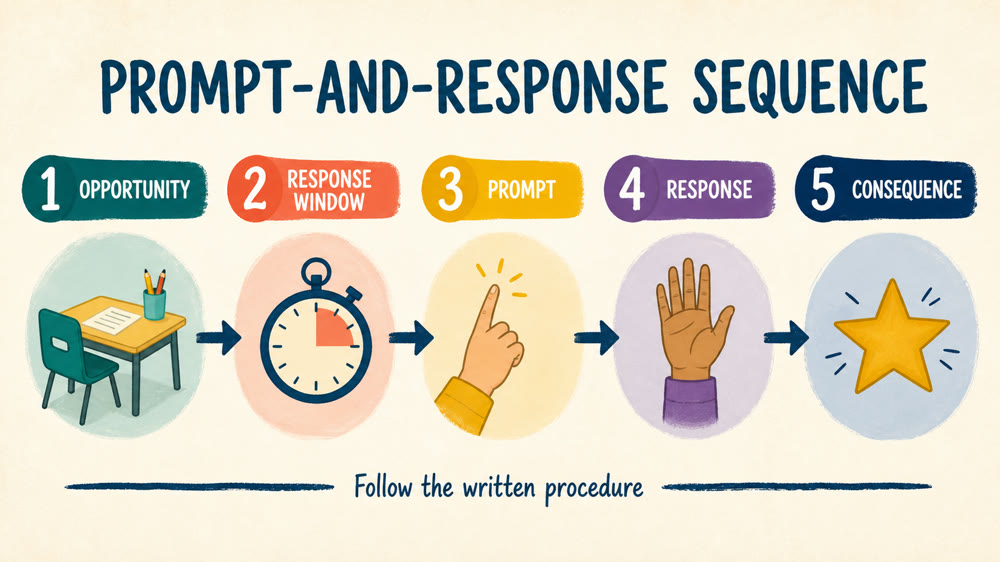
- Present the opportunity: Deliver the instruction or arrange the teaching situation as written.
- Allow the programmed response window: Do not add help early or wait longer than the procedure allows.
- Deliver the prompt: Use the specified type, level, wording, or physical assistance.
- Observe the response: Record whether the learner responded independently, with a prompt, incorrectly, or not at all.
- Provide the programmed consequence: Reinforce or correct the response as directed.
- Follow the fading plan: Reduce assistance only according to the authorized procedure.
Common prompt types to recognize
RBT learners may encounter several prompt types. A verbal prompt adds spoken information, such as part of the answer or a cue to begin. A model prompt demonstrates the target action. A gestural prompt uses a pointing movement or other gesture. A positional prompt changes the placement or arrangement of materials. A physical prompt provides contact or guidance, when that procedure is authorized and trained.
These labels are study categories, not permission to select a prompt independently. A written program may define a prompt differently, combine prompt types, or use a hierarchy with specific timing and fading rules. The RBT should use the local operational definition and ask the supervisor when the wording or level is unclear.
Original example: teaching a request
Suppose a learner is being taught to request a break by handing over a card. The opportunity occurs when a programmed activity begins. The plan says to wait for a short response window, then provide a brief verbal cue if the learner does not reach for the card. If the learner hands over the card after the cue, the technician records a prompted response and provides the programmed consequence.
The technician should not record the response as independent merely because the learner completed the final action. The technician should not replace the verbal cue with a gesture, repeat the cue several times, or remove the response window unless the written plan permits that change. This example shows why what is a prompt in ABA is inseparable from timing, scoring, and the teaching procedure.
Prompt fading and independence
Prompt fading is the planned reduction of assistance so the learner can respond under less support. A plan may use least-to-most prompting, most-to-least prompting, time delay, stimulus fading, or another arrangement. The correct method depends on the learner, the skill, and the authorized program.
Fading too quickly can produce errors and frustration. Fading too slowly can make it difficult to observe independent responding. An RBT records the programmed prompt level and follows the supervisor’s feedback. Do not treat a successful prompted response as independent unless the data definition supports that score.
Prompts, discrimination, and generalization
Prompts should not become the only cue controlling the response. Skill-acquisition programs may include discrimination training so the learner responds to the relevant instruction or stimulus rather than to an accidental prompt. Generalization procedures may help the skill transfer across people, settings, materials, or examples.
The current RBT Test Content Outline, 3rd edition, includes stimulus and response prompts with fading, discrimination training, and generalization under behavior acquisition. The outline describes 43 tasks across six domains. The current examination includes 75 scored questions and 10 unscored pilot questions. These facts provide a study frame; they do not replace the written teaching plan.
Common prompt mistakes
- Prompting before the opportunity: Early assistance may change the data and the learner’s contact with the natural cue.
- Using an unplanned hint: A “helpful” comment can function as a prompt and should be treated according to the data rule.
- Changing prompt wording: Use the trained wording unless the supervising team authorizes a change.
- Failing to record assistance: A prompted response is not automatically independent.
- Fading by intuition: Follow the programmed fading steps and communicate patterns.
- Confusing praise with a prompt: Reinforcement, feedback, and prompts may have different functions.
Choosing and fading prompts in a real session
Prompt selection should begin with the learner response you want to see, not with a favorite prompt type. If the target is handing over a requested item, first define what counts as an independent response and what delay is acceptable. Then use the least intrusive support that is likely to produce success within the teaching plan. A model, gesture, verbal cue, or visual cue may each be appropriate in different contexts, but the choice should follow the written program and supervisor direction.
Prompt fading is equally important because continued help can make a response look stronger than it is. Once the learner responds reliably, reduce the prompt in a planned way: shorten a verbal cue, move a gesture farther away, wait slightly longer, or remove one part of a visual support. Record the prompt level and the learner response rather than writing only that the trial was successful. If performance drops, pause and report the pattern to the supervisor. Do not improvise a new hierarchy or withhold reinforcement to force independence. A brief prompt review after each session can show whether support is fading, staying stable, or increasing across targets.
Prompt study checklist
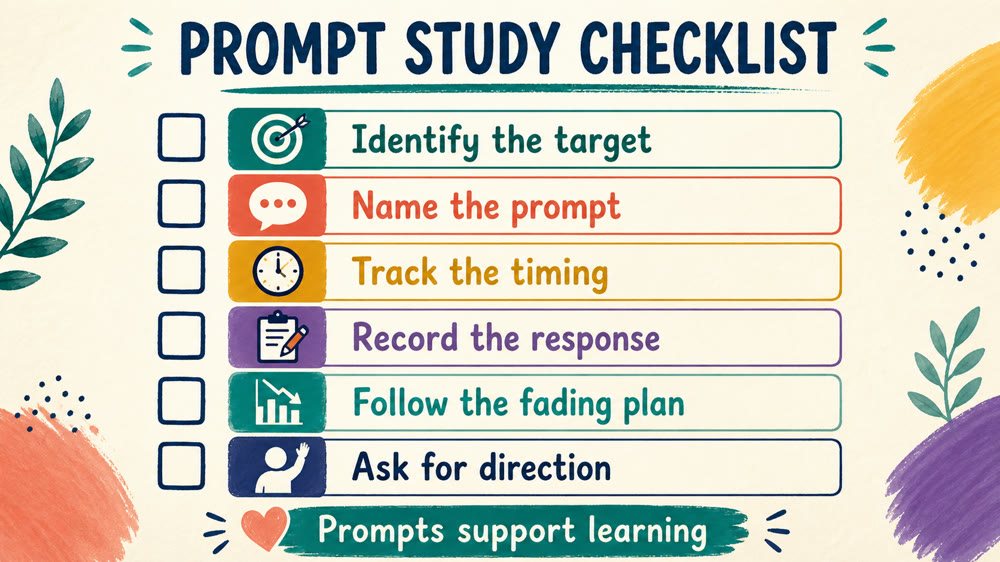
For each practice scenario, identify:
- The opportunity or instruction.
- The defined target response.
- The prompt type and level.
- The response window and timing rule.
- The programmed consequence.
- The correct data code.
- The authorized fading or correction procedure.
- The point at which supervisor direction is required.
Practice prompt decisions
Review independent scenarios about prompts, fading, discrimination training, and data recording.
Try the RBT practice resource →
Frequently Asked Questions
What is a prompt in ABA?
A prompt is added assistance arranged to increase the likelihood of a defined response during teaching. The written procedure controls its use and timing.
Is every spoken comment a verbal prompt?
No. An instruction, praise statement, feedback statement, and verbal prompt may serve different functions. Use the program’s definitions.
Can an RBT choose a new prompt hierarchy?
An RBT implements an authorized procedure and seeks supervisor direction before changing the hierarchy, timing, or data rule.
Does a prompted response count as independent?
Not automatically. Independence depends on the operational definition and the recording rule for that program.
References
- Behavior Analyst Certification Board: Registered Behavior Technician Handbook, updated June 2026.
- Behavior Analyst Certification Board: RBT Test Content Outline (3rd ed.).
- Behavior Analyst Certification Board: RBT resources.
- RBT Training: independent RBT practice questions.