
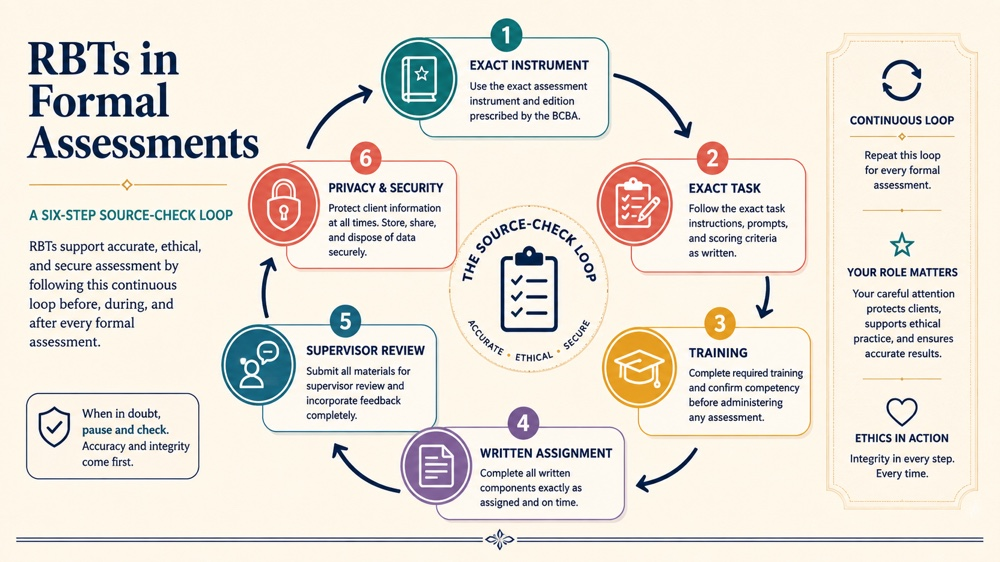
What should be the RBTs role in formal assessments? The safest answer begins by identifying the exact assessment, the assigned step, the training required, the written procedure, and the person responsible for review and interpretation. Formal assessment is not one single action. It may include observing behavior, recording responses, supporting a preference or skill assessment, entering data, following standardized directions, scoring, interpreting results, or communicating recommendations. An RBT may participate in a narrow activity under direction and supervision, but the credential does not automatically authorize independent diagnosis, interpretation, or treatment design. This independent guide explains how to study the question without turning a context-dependent boundary into an absolute slogan. Check current BACB materials, instrument instructions, local policy, and supervisor direction before acting.
Table of Contents
- What should be the RBTs role in formal assessments? Define the activity
- Start with the written assignment
- Protect standardization
- What should be the RBTs role in formal assessments? Stay within competence
- Separate observation from interpretation
- Protect privacy and assessment security
- Report useful assessment information
- Avoid formal-assessment mistakes
- What should be the RBTs role in formal assessments checklist
- Frequently Asked Questions
- References
Continue your RBT study with RBT exam study materials and original practice resources.
Quick answer: Treat what should be the rbts role in formal assessments as a current-source RBT study topic. Identify the exact action, source, data rule, and supervision boundary before deciding.
Study boundary: This independent guide is educational content. It is not a BACB policy, certification decision, legal opinion, answer key, or guarantee of examination success. Examples are original and are not official, recalled, leaked, or BACB-endorsed questions.
Current exam context: The current BACB RBT Test Content Outline describes 43 tasks across six domains; the examination includes 75 scored questions and 10 unscored pilot questions in a 90-minute testing period. Verify the current handbook and outline before relying on a time-sensitive detail.
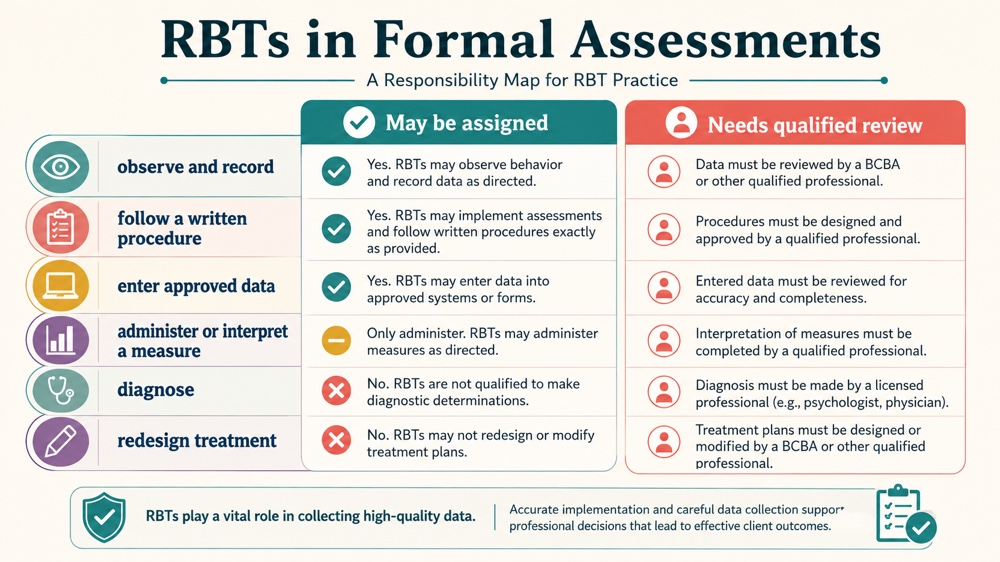
Formal assessment questions often become confusing because one word can describe several different steps. A technician may observe a response, record a score supplied by an authorized administrator, or follow a narrow written procedure while another professional retains responsibility for interpretation. That does not mean every formal assessment activity is automatically within role. Check the instrument’s own rules, required qualifications, training record, privacy controls, and review process. If a supervisor asks for a task that is not clearly assigned, state exactly what you were asked to do, what you know how to do, and what remains uncertain. A precise question protects standardization, the learner’s records, and the integrity of the team’s decision-making.
What should be the RBTs role in formal assessments? Define the activity
Write down whether the request is observation, data collection, a preference assessment, a skill probe, standardized administration, scoring, data entry, or interpretation. Different actions can have different requirements. The word assessment alone is too broad to determine the role.
Start with the written assignment
Check the program, assessment protocol, training record, and supervision plan. Identify materials, order, timing, response definitions, and who reviews the record. If the assignment does not state the boundary, ask a focused question before beginning.
Protect standardization
Follow exact wording, timing, order, materials, and scoring rules when a standardized procedure is assigned. Do not coach, paraphrase, skip, repeat, or alter items for convenience. Record a deviation rather than silently correcting it.
What should be the RBTs role in formal assessments? Stay within competence
A job title, login, or prior experience does not replace instrument-specific training and demonstrated competence. If you cannot perform the step reliably, report that limitation. The supervisor can decide whether training, observation, or reassignment is needed.
Separate observation from interpretation
Record what happened under the stated conditions, including the assigned data measure and relevant barriers. Avoid statements about diagnosis, function, prognosis, or what a score means unless the responsible professional has directed an authorized communication.
Protect privacy and assessment security
Use approved systems and minimum necessary information. Keep forms, scores, screenshots, and identifying details secure. Do not upload protected items to a personal study tool or include a learner’s identity in a public example.
Report useful assessment information
A useful report names the activity, setting, observable response, measure, deviation or barrier, and next question. This gives the supervisor enough information to review the situation without pretending that the RBT independently made a clinical decision.
Avoid formal-assessment mistakes
- Assuming an RBT credential authorizes every assessment task.
- Confusing recording or data entry with interpretation.
- Changing standardized wording or timing.
- Backfilling answers from memory.
- Sharing protected items or identifying records.
- Ignoring missing training or unclear supervision.
- Presenting original scenarios as official examination questions.
What should be the RBTs role in formal assessments checklist
- What exact instrument or assessment activity is involved?
- What exact step is assigned to the RBT?
- What training and competence evidence applies?
- Who observes, scores, reviews, or interprets?
- What privacy and security rules apply?
- How are deviations documented?
- What question should be taken to supervision?
Use what should be the RBTs role in formal assessments as a source-check and role-boundary study topic. RBT Training is independent educational content and is not affiliated with or endorsed by BACB.
Practice the concept
Review what should be the rbts role in formal assessments with original RBT scenarios, current-source reminders, and clear role boundaries.
Review the RBT study resource →
Frequently Asked Questions
What should be the RBTs role in formal assessments?
It depends on the exact activity, instrument, training, written assignment, and supervision. RBTs may participate in assigned tasks without owning independent interpretation.
Can an RBT interpret a formal assessment?
Do not assume that authority. Follow the instrument requirements and supervisor direction; interpretation may belong to another qualified professional.
What if the procedure is unclear?
Pause when appropriate, protect privacy and standardization, and ask the responsible supervisor to clarify the exact step and review process.
Are these official BACB questions?
No. They are original educational scenarios and are not official, recalled, leaked, or BACB-endorsed.
References
- Behavior Analyst Certification Board: Registered Behavior Technician Handbook, updated June 2026.
- Behavior Analyst Certification Board: RBT Test Content Outline (3rd ed.).
- Behavior Analyst Certification Board: RBT resources.
- Behavior Analyst Certification Board: ethics resources.
- Behavior Analyst Certification Board: RBT Ethics Code (2.0).