
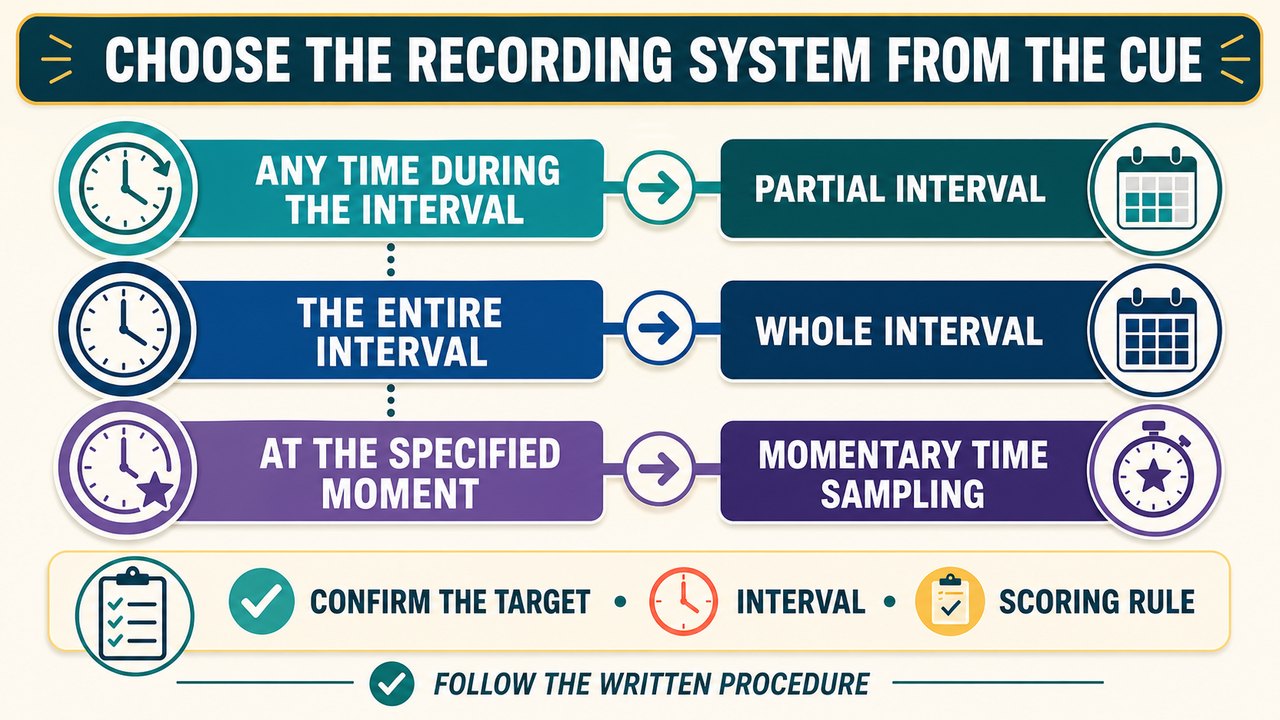
Short answer: when using discontinuous measurement, behaviors are recorded as having occurred or not occurred during defined intervals—or as occurring or not occurring at a specified sample moment. The observer does not record every instance continuously. The exact rule depends on whether the plan uses partial-interval recording, whole-interval recording, or momentary time sampling. The search phrase when using discontinuous measurement behaviors are recorded as is asking you to identify that interval-level rule.
Table of Contents
- When using discontinuous measurement behaviors are recorded as: the direct answer
- When using discontinuous measurement behaviors are recorded as partial-interval samples
- When using discontinuous measurement behaviors are recorded as whole-interval samples
- Momentary time sampling: score the specified moment
- Compare partial, whole, and momentary measurement without mixing the rules
- What discontinuous data can and cannot tell you
- RBT implementation checklist for A.2
- Original discontinuous-measurement scenarios
- Frequently Asked Questions
- References
The wording in the question matters. If the stem asks whether the behavior happened at any time in an interval, think partial interval. If it asks whether the behavior happened for the entire interval, think whole interval. If it asks whether the behavior was happening at the moment the interval ended, think momentary time sampling.
The current RBT Test Content Outline, 3rd edition, places this skill in A.2, Data Collection and Graphing. It includes 43 tasks across six domains, and the current exam frame includes 75 scored questions and 10 unscored pilot questions among 85 presented questions. This is independent study content, not an official BACB item, recalled question, leaked question, endorsed answer key, or pass guarantee.
When using discontinuous measurement behaviors are recorded as: the direct answer
Discontinuous measurement divides an observation into planned intervals or sample moments and records a rule-based yes/no, occurrence/nonoccurrence, or other defined score for each interval or moment. The system samples behavior rather than capturing every occurrence. The completed record is often summarized as the percentage of intervals scored “yes,” but the plan must specify the calculation and the target response.
| Question cue | Recorded rule | Likely procedure |
|---|---|---|
| Did it happen at any point during the interval? | Score occurrence if it happened even briefly. | Partial interval |
| Did it happen for the entire interval? | Score occurrence only when it lasted throughout. | Whole interval |
| Was it happening at the exact sample moment? | Score the behavior at the end or specified moment. | Momentary time sampling |
“Recorded as having occurred or not occurred during specific intervals” is therefore the safest general answer to the exact search question. A multiple-choice item may be testing whether you can distinguish a sampled interval score from frequency, duration, latency, or interresponse time.
When using discontinuous measurement behaviors are recorded as partial-interval samples
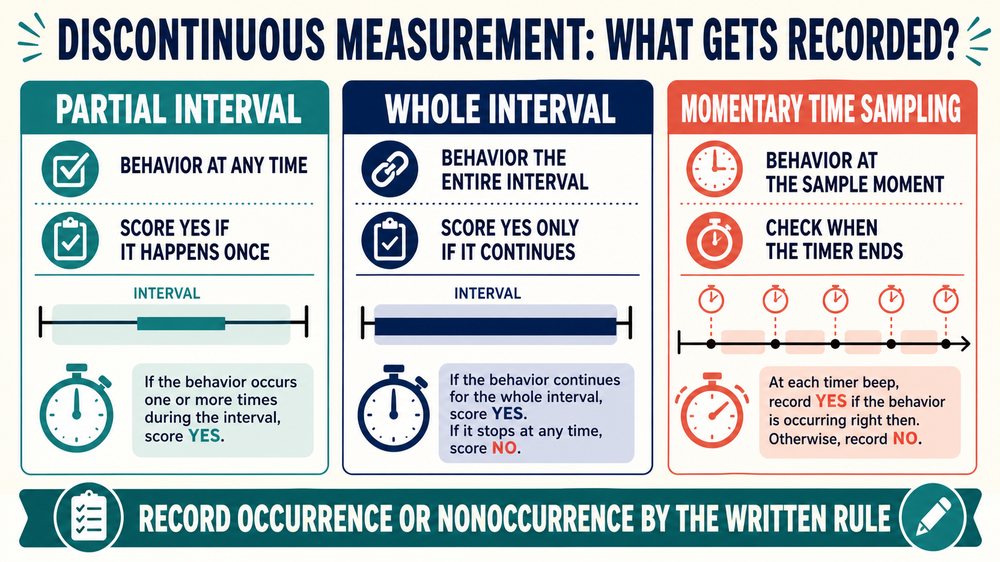
With partial-interval recording, score the interval as an occurrence if the defined behavior happens at any time during that interval. One brief response is enough for a “yes” under the written rule. The observer does not need to count how many times it happened or how long it lasted unless the plan separately asks for those measures.
For example: a 30-second interval is used to record vocal stereotypy. The behavior occurs for two seconds at second 8 and stops. Under partial-interval recording, that interval is scored as an occurrence. If the behavior never occurs, it is scored as a nonoccurrence.
Partial interval can be useful when the target is brief, frequent, or difficult to count accurately while the observer is also implementing a session. Because any occurrence makes the interval positive, the resulting percentage may be higher than a continuous measure of the actual time or number of responses. That is an interpretation issue, not a reason for the RBT to change the method.
When using discontinuous measurement behaviors are recorded as whole-interval samples
With whole-interval recording, score the interval as an occurrence only if the defined behavior continues for the entire interval. If the target stops, starts late, or is absent for part of the interval, the interval does not meet the whole-interval occurrence rule.
For example: a program measures on-task behavior in 20-second intervals. The learner looks at the assignment for the first 12 seconds, looks away for 3 seconds, and returns for the remaining 5 seconds. Under a whole-interval rule, that interval is not scored as on-task for the entire interval.
Whole interval is sensitive to sustained performance, but it can produce a lower percentage than a measure that counts any brief engagement. The target definition and the purpose of the program matter. If the goal is to increase sustained on-task behavior, the plan may intentionally use a whole-interval criterion. Follow the current plan rather than selecting a method based on which number sounds better.
Momentary time sampling: score the specified moment
Momentary time sampling records whether the behavior is occurring at a specified moment, commonly at the end of an interval. The observer may not score behavior that occurred earlier if it is not occurring at the sample moment. Conversely, the observer may score the behavior at the moment even if it began only recently.
For example: a plan uses five-minute samples for engagement. At the end of the 5-minute interval, the learner is looking at the assigned activity, so the observer scores engagement as occurring. The learner may have been off-task for much of the interval; that history is not what the MTS score captures.
MTS can reduce the burden of continuous observation, especially in busy settings, but it is an estimate. The interval length, sampling moment, target definition, and context influence what the data represent. Do not describe an MTS score as the exact number of responses or exact duration.
Compare partial, whole, and momentary measurement without mixing the rules
| Procedure | When is the interval positive? | Common interpretation caution | Exam cue |
|---|---|---|---|
| Partial interval | Behavior occurs at any point. | May overestimate occurrence or spread brief behavior across positive intervals. | “At least once,” “any time,” “during the interval.” |
| Whole interval | Behavior occurs for the entire interval. | May underestimate behavior when the target is not continuous throughout. | |
| Momentary time sampling | Behavior occurs at the specified observation moment. | May miss behavior between samples; it is a snapshot, not a full interval history. | “At the end,” “when the timer sounds,” “at the moment.” |
All three procedures require a clear interval length, a target definition, a scoring rule, and a way to summarize the results. A data sheet that says only “interval data” is incomplete for implementation. The RBT should ask for clarification before collecting data if the procedure, interval, or response definition is missing.
What discontinuous data can and cannot tell you
Discontinuous data are useful samples, but they are not automatically interchangeable with continuous measurement. Partial-interval scores may make behavior appear more prevalent because a brief response marks the whole interval positive. Whole-interval scores may make behavior appear less prevalent because the response must persist without interruption. MTS may miss events that happen between sample moments. These are general tendencies, not universal numerical corrections.
- Do not convert without a rule: a percentage of positive intervals is not automatically a frequency or duration.
- Do not infer function: an interval score describes measurement; it does not by itself explain why behavior occurred.
- Do not compare unlike systems casually: a change from partial interval to MTS can change the number even when behavior is unchanged.
- Protect fidelity: use the interval timer, target definition, and scoring convention written in the program.
- Report irregularities: document interruptions, missed intervals, unavailable materials, or uncertainty about the scoring rule.
Research on discontinuous measurement emphasizes that sampling choices affect the accuracy and interpretation of behavior estimates. For RBT exam reasoning, the important decision is to identify the scoring rule before interpreting the result.
RBT implementation checklist for A.2
- Read the operational definition of the target behavior.
- Confirm whether the plan uses partial interval, whole interval, or momentary time sampling.
- Confirm the interval duration and when the timer starts and ends.
- Know what counts as occurrence and nonoccurrence.
- Use the same scoring rule for every interval unless the supervisor changes the procedure.
- Mark interruptions or missed samples honestly.
- Ask for direction when the data sheet and written plan disagree.
- Communicate unusual data without declaring a treatment change independently.
The RBT role is implementation and accurate reporting within the supervision structure. Selecting a new measurement system, changing interval length, or deciding that a different bias is acceptable may require clinical direction. Do not “fix” a difficult data sheet by silently changing the method.
Original discontinuous-measurement scenarios
Scenario 1—any occurrence: a learner taps the desk once during a 60-second interval, and the plan says to mark the interval if tapping occurs at any time. The correct scoring logic is partial interval, not whole interval.
Scenario 2—entire interval: a learner remains seated for 30 seconds but stands for the final two seconds. If the plan requires seated behavior for the entire interval, that interval is not a whole-interval success.
Scenario 3—sample moment: a timer sounds at the end of a 2-minute interval. The learner is not engaging at that moment, although engagement occurred earlier. Under MTS, score the specified moment, not the entire history.
Scenario 4—unclear sheet: a data sheet says “interval recording” but does not say partial, whole, or momentary. Pause at the decision point and seek clarification rather than choose the method that produces the most favorable graph.
These examples are newly written independent study examples, not official, recalled, leaked, or BACB-endorsed questions.

Bottom line: when using discontinuous measurement, behaviors are recorded as occurring or not occurring within defined intervals or at defined sample moments. Match “any time” to partial interval, “entire interval” to whole interval, and “specified moment” to MTS. Then follow the written A.2 procedure and report uncertainty instead of improvising.
Practice measurement decisions.
Use original RBT scenarios to distinguish partial interval, whole interval, momentary time sampling, and continuous measures.
Try free RBT practice questions →
Frequently Asked Questions
When using discontinuous measurement behaviors are recorded as: what is the general answer?
They are recorded as occurring or not occurring during defined intervals or at a specified sample moment, rather than as every individual occurrence.
What is partial-interval recording?
Score the interval as positive if the target behavior occurs at any time during the interval.
What is whole-interval recording?
Score the interval as positive only if the target behavior occurs for the entire interval.
What is momentary time sampling?
Score whether the target behavior is occurring at the specified observation moment, commonly when the interval ends.
Are these official RBT exam questions?
No. They are newly written independent study examples and are not official, recalled, leaked, or BACB-endorsed questions.
References
- Behavior Analyst Certification Board. RBT Test Content Outline (3rd ed.).
- Fiske, K. E., & Delmolino, L. (2012). Use of Discontinuous Methods of Data Collection in Behavioral Intervention. Research article.
- Procedures and Accuracy of Discontinuous Measurement of Problem Behavior. Research article.
- RBT data collection and graphing study guide. Reviewed for competitor research; not an endorsement.
- Discontinuous measurement practice questions. Reviewed for competitor research; not an endorsement.