

If a practice item asks, which of the following is a discontinuous data recording procedure, look for the method that samples behavior rather than detecting every occurrence. The common discontinuous procedures are partial-interval recording, whole-interval recording, and momentary time sampling.
Table of Contents
- Which of the following is a discontinuous data recording procedure?
- What discontinuous measurement means
- The three discontinuous data recording procedures to recognize
- Partial-interval recording: any occurrence counts
- Whole-interval recording: the behavior must last the entire interval
- Momentary time sampling: check at the specified moment
- Which of the following is a discontinuous data recording procedure? The cue words that reveal the correct choice
- Which of the following is a discontinuous data recording procedure? Original scenario practice
- How to discuss over- and underestimation accurately
- What an RBT should do when the measurement rule is unclear
- Common mistakes on this discontinuous-measurement question
- Frequently Asked Questions
- References
Without seeing the answer choices, no one can honestly name a unique letter. If one option lists partial interval, whole interval, or momentary time sampling, that option is describing a discontinuous method. Frequency, rate, duration, latency, and interresponse time are continuous-measurement examples because they are designed to capture occurrences or dimensions directly across the observation.
The current RBT Test Content Outline (3rd ed.) places this reasoning in Data Collection and Graphing. The full outline contains 43 tasks across six domains, and the current examination presents 85 questions with 75 scored questions and 10 unscored questions. RBT Training’s practice examples are independent, not official, recalled, leaked, or BACB-endorsed questions.
This guide gives a method for solving the question and applying the distinction to original scenarios. It does not replace a written measurement plan or supervisor direction.
Which of the following is a discontinuous data recording procedure?
The correct reasoning is:
- Find an option that divides observation into intervals or checks behavior at specified moments.
- Confirm that the method does not require recording every instance or the exact total duration of the behavior.
- Identify whether the option is partial interval, whole interval, or momentary time sampling.
- Reject continuous measures such as frequency, duration, latency, and interresponse time when the question asks specifically for discontinuous recording.
For example: if the options are “frequency,” “duration,” “whole-interval recording,” and “latency,” the discontinuous procedure is whole-interval recording. If the options are “partial interval,” “whole interval,” “momentary time sampling,” and “rate,” the first three are discontinuous; a single-answer question would need another detail or a “all of the above” choice to identify one unique option.
That wording check matters. A memorized answer key can be misleading when a question is copied, paraphrased, or missing part of its original options. Learn the method cues instead of memorizing a letter.
What discontinuous measurement means
Discontinuous measurement captures a sample of behavior. The observer divides an observation into equal intervals or observes at defined moments, then records whether the behavior met that method’s rule. Some instances may occur between recorded moments or fail to meet the scoring rule, which is why the resulting percentage is an estimate of behavior under the chosen system.
| Question to ask | Discontinuous clue | Continuous contrast |
|---|---|---|
| Do I record every occurrence? | No. The method samples intervals or moments. | Frequency or rate may count occurrences across the observation. |
| Is the observation divided into intervals? | Usually yes for partial and whole interval recording. | Duration records how long behavior lasts, rather than scoring each interval as yes or no. |
| Is there a single check point? | Yes for momentary time sampling at the specified moment. | Latency measures time from an event to the start of a response. |
| What is the output? | Often the percentage of intervals scored positive. | Continuous measures may report count, rate, total duration, latency, or IRT. |
The method is not “less scientific” because it samples. It is a planned measurement choice with advantages and limitations. The RBT’s job is to follow the written definition, interval length, timing signal, and scoring rule consistently.
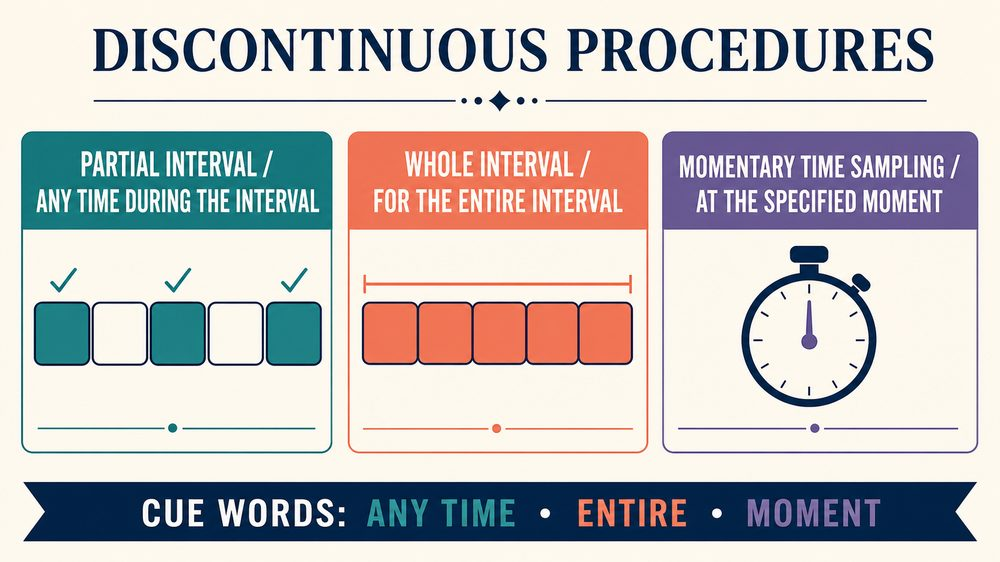
The three discontinuous data recording procedures to recognize
| Procedure | Score the interval as positive when… | Common exam cue |
|---|---|---|
| Partial-interval recording | The behavior occurs at any time during the interval, even briefly. | “At any point,” “for any duration,” or “if it happens once.” |
| Whole-interval recording | The behavior occurs for the entire interval. | |
| Momentary time sampling | The behavior is occurring at the specified observation moment, commonly the end of the interval. | “At the beep,” “when the interval ends,” or “at the momentary check.” |
All three procedures can produce a percentage of intervals. The percentage alone does not identify the procedure. The scoring rule does. Read the words that say when an interval receives a plus or yes.
Partial-interval recording: any occurrence counts
In partial-interval recording, mark the interval positive if the target behavior occurs at any point during it. You do not count how many times it occurred or how long it lasted for that interval; the rule is whether it occurred at least once.
Original example: during a 10-second interval, a learner engages in hand flapping for one second. Under partial-interval recording, score “yes.” The one-second occurrence meets the “any time during the interval” rule.
Partial-interval recording can overestimate the proportion of time a behavior was present because a brief occurrence marks the whole interval positive. “Overestimate” is a general tendency under common conditions, not a guarantee independent of interval length, behavior pattern, and the exact measurement question.
Whole-interval recording: the behavior must last the entire interval
In whole-interval recording, mark the interval positive only when the target behavior occurs for the complete interval. If the behavior stops for even part of the interval, score “no” under the stated rule.
Original example: during a 20-second interval, a learner remains engaged with the assigned task for 18 seconds and looks away for two seconds. Under whole-interval recording, the interval is not a “yes” interval because engagement did not continue for the entire 20 seconds.
Whole-interval recording can underestimate the amount of behavior that occurred because partial performance does not receive credit. This can be useful when a program defines success as sustained behavior, but the RBT should not substitute whole interval for the method written in the plan.
Momentary time sampling: check at the specified moment
In momentary time sampling, observe at a specified moment rather than throughout the full interval. Many teaching examples use the end of the interval, but the written procedure and timing signal control the exact moment.
Original example: a timer signals the end of each 30-second interval. The target behavior occurred for 20 seconds earlier but is not occurring when the signal sounds. Under a momentary end-of-interval rule, score “no.” If it is occurring exactly at the check, score “yes.”
Momentary time sampling may under- or overestimate behavior depending on the interval length, timing, and behavior pattern. Do not choose it merely because the question says “sample.” Look for the specified moment.
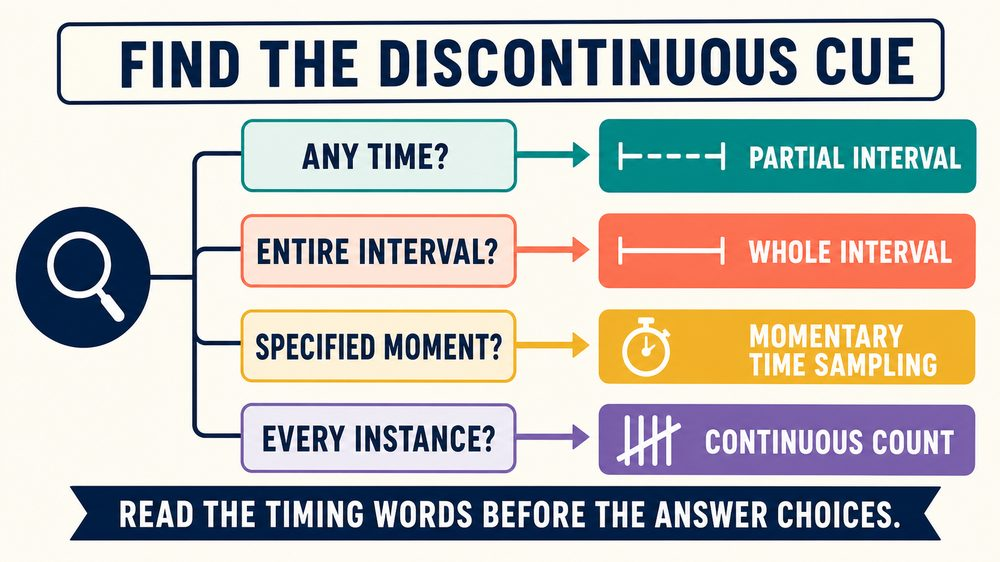
Which of the following is a discontinuous data recording procedure? The cue words that reveal the correct choice
When a multiple-choice stem is long, circle or mentally emphasize the timing phrase. The procedure name often follows directly from that phrase.
- “At any time during the interval”: partial interval.
- “For the entire interval”: whole interval.
- “At the end of each interval” or “when the signal sounds”: momentary time sampling.
- “Every instance” or “count each occurrence”: likely a continuous count or frequency measure, not interval sampling.
- “How long from start to stop”: duration, not a discontinuous interval procedure.
- “How long from instruction to response”: latency, not a discontinuous interval procedure.
Also check whether the stem asks about a data-recording procedure, a dimension of behavior, a graph, or a reason to choose a method. The word “discontinuous” answers only one layer of the question.
Which of the following is a discontinuous data recording procedure? Original scenario practice
| Scenario cue | Best method | Why |
|---|---|---|
| Mark plus if yelling occurs even once in each 15-second block. | Partial interval | Any occurrence during the interval earns a positive score. |
| Mark plus only if on-task behavior continues for all 30 seconds. | Whole interval | The behavior must persist for the full interval. |
| Look only when the timer sounds at the end of each block. | Momentary time sampling | The check occurs at a defined moment. |
| Count every instance of hitting and report occurrences per hour. | Frequency or rate | The procedure attempts to capture each occurrence, not a discontinuous interval sample. |
For interval methods, calculate the percentage exactly as the plan states. If three of six intervals are positive, the raw interval percentage is 50%. That number does not mean the behavior occurred for 50% of the time; it means 50% of the scored intervals met that method’s rule.
How to discuss over- and underestimation accurately
Exam questions often pair the method with a general measurement tendency:
- Partial interval: tends to overestimate the proportion of time behavior occurs because any brief occurrence marks the interval.
- Whole interval: tends to underestimate the proportion of time behavior occurs because the behavior must occupy the whole interval.
- Momentary time sampling: may overestimate or underestimate depending on the timing and behavior pattern.
These are measurement tendencies, not a reason to change a data system on your own. Interval length, behavior duration, response distribution, and the purpose of the measurement all affect interpretation. If data seem inconsistent with the written plan or the client’s presentation, document the concern and ask the supervisor for direction.
What an RBT should do when the measurement rule is unclear
An RBT should not invent a new scoring rule because a data sheet is confusing. Check the operational definition, read the written plan, confirm the interval length and signal, and contact the supervisor when the procedure remains unclear. Consistent measurement is more important than a confident guess.
- Locate the target behavior definition and the exact data system.
- Confirm whether the interval is partial, whole, or momentary and when the check occurs.
- Practice one or two examples with the supervisor or trainer.
- Record data as written and report uncertainty or implementation problems objectively.
Do not switch between partial interval and momentary time sampling simply because one feels easier. A method change can alter the trend and the decisions that follow.
Common mistakes on this discontinuous-measurement question
- Choosing duration because it involves time: time-based does not automatically mean discontinuous.
- Thinking “interval” tells the whole answer: partial and whole interval use different scoring rules.
- Confusing any time with the end moment: partial interval and momentary time sampling are not interchangeable.
- Calling every percentage discontinuous: a percentage can summarize many types of data.
- Using a bias rule as a universal law: interval length and response pattern matter.
- Memorizing a letter: answer choices may be reordered or paraphrased.
- Changing a client’s data system independently: follow the plan and seek clinical direction.
Bottom line: the answer to “which of the following is a discontinuous data recording procedure” is found by identifying partial-interval recording, whole-interval recording, or momentary time sampling in the choices. Use the cue words any time, entire interval, and specified moment; contrast them with continuous measures; then follow the written measurement plan and supervision structure.
Practice the distinction with new scenarios.
Use original RBT measurement questions and explanations to compare continuous and discontinuous procedures without relying on memorized answer letters.
Try the RBT practice materials →
Frequently Asked Questions
Which of the following is a discontinuous data recording procedure?
Partial-interval recording, whole-interval recording, and momentary time sampling are discontinuous procedures. The unique answer depends on the choices shown in a specific question.
What is the difference between partial and whole interval recording?
Partial interval is scored positive when the behavior occurs at any time during the interval. Whole interval is positive only when the behavior occurs for the entire interval.
Is momentary time sampling discontinuous?
Yes. Momentary time sampling checks whether the behavior is occurring at a specified moment, commonly the end of an interval, rather than recording the entire interval.
Does partial interval always overestimate behavior?
Partial interval tends to overestimate the proportion of time behavior occurs because a brief occurrence marks the interval, but the actual result depends on interval length and behavior pattern.
Is duration a discontinuous data procedure?
Duration measures how long behavior lasts and is generally treated as a continuous dimension when measured across the observation. It is not one of the three common discontinuous interval or momentary procedures.
What should an RBT do if the scoring rule is unclear?
Check the written plan and operational definition, ask the supervisor for clarification, and do not change the data system independently.
References
- Behavior Analyst Certification Board. RBT Test Content Outline (3rd ed.).
- Fiske, J. S., et al. Use of Discontinuous Methods of Data Collection in Behavioral Intervention. Behavior Analysis in Practice.
- Fisher, W. W., et al. Procedures and Accuracy of Discontinuous Measurement of Problem Behavior. Behavior Analysis in Practice.
- Learning Behavior Analysis discontinuous measurement guide. Reviewed for competitor research; not an official source.
- Passage Health discontinuous measurement guide. Reviewed for competitor research; not an official source.
- BT Exam Review discontinuous measurement guide. Reviewed for competitor research; not an official source.