
Which of the following tasks are RBTs allowed to perform? This exam-style wording tests whether you can identify an assigned entry-level service action and distinguish it from independent clinical authority. The best answer is not the task that sounds most sophisticated. It is the task that fits the written program, demonstrated competence, current training, supervision, privacy rules, and role boundary. RBTs may implement assigned procedures, collect and report objective data, prepare approved materials, support communication, and communicate observations. They should not use the credential as permission to diagnose, independently design treatment, interpret every assessment, or change criteria without direction. This independent guide provides an original decision process. Confirm current BACB materials and local supervisor instructions before applying any study rule in practice.
Table of Contents
- Which of the following tasks are RBTs allowed to perform? Find the assigned action
- Implementation is different from program design
- Data collection and objective reporting
- Which of the following tasks are RBTs allowed to perform? Check competence
- Prompting, teaching, and communication support
- Assessment-related tasks need context
- Privacy, safety, and supervision
- Avoid task-permission mistakes
- Which of the following tasks are RBTs allowed to perform? checklist
- Frequently Asked Questions
- References
Continue your RBT study with RBT exam study materials and original practice resources.
Quick answer: Treat which of the following tasks are rbts allowed to perform as a current-source RBT study topic. Identify the exact action, source, data rule, and supervision boundary before deciding.
Study boundary: This independent guide is educational content. It is not a BACB policy, certification decision, legal opinion, answer key, or guarantee of examination success. Examples are original and are not official, recalled, leaked, or BACB-endorsed questions.
Current exam context: The current BACB RBT Test Content Outline describes 43 tasks across six domains; the examination includes 75 scored questions and 10 unscored pilot questions in a 90-minute testing period. Verify the current handbook and outline before relying on a time-sensitive detail.
A useful exam strategy is to eliminate options that require an RBT to invent a program, make a diagnosis, independently interpret a standardized result, or change criteria without review. Then look for the option that describes an observable assigned action carried out with training and supervision. Even a familiar task must be checked against the current written plan and local policy. For example, collecting data on a defined response is different from deciding which response should be measured; implementing a prompt hierarchy is different from designing one; and reporting a barrier is different from declaring the cause. The context determines the boundary, so read every qualifier in the question.
Which of the following tasks are RBTs allowed to perform? Find the assigned action
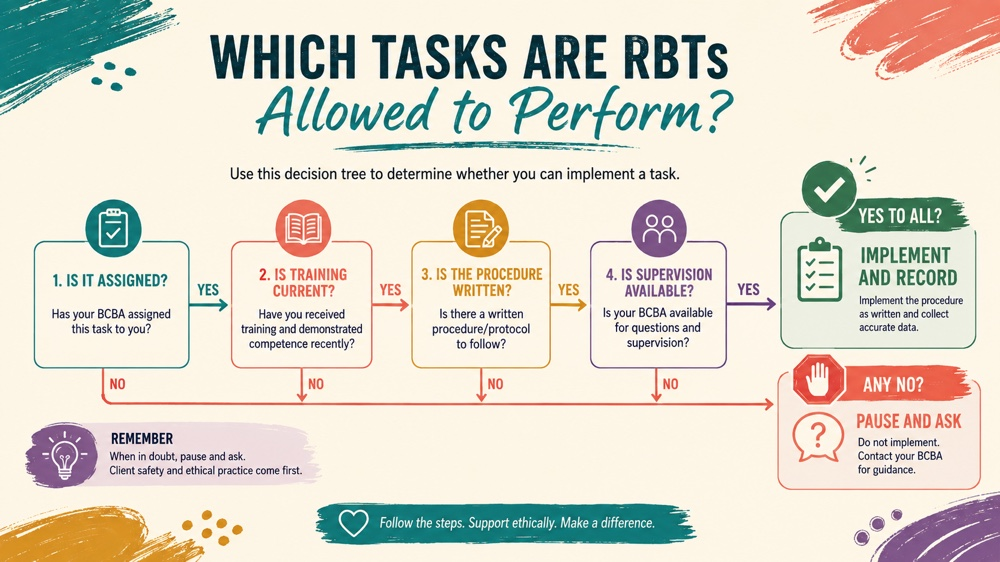
First name the verb: implement, prompt, record, prepare, observe, score, interpret, diagnose, design, or revise. Then check the written assignment and training. A task may be allowed in one narrow form and outside role in another, so the verb and context matter.
Implementation is different from program design
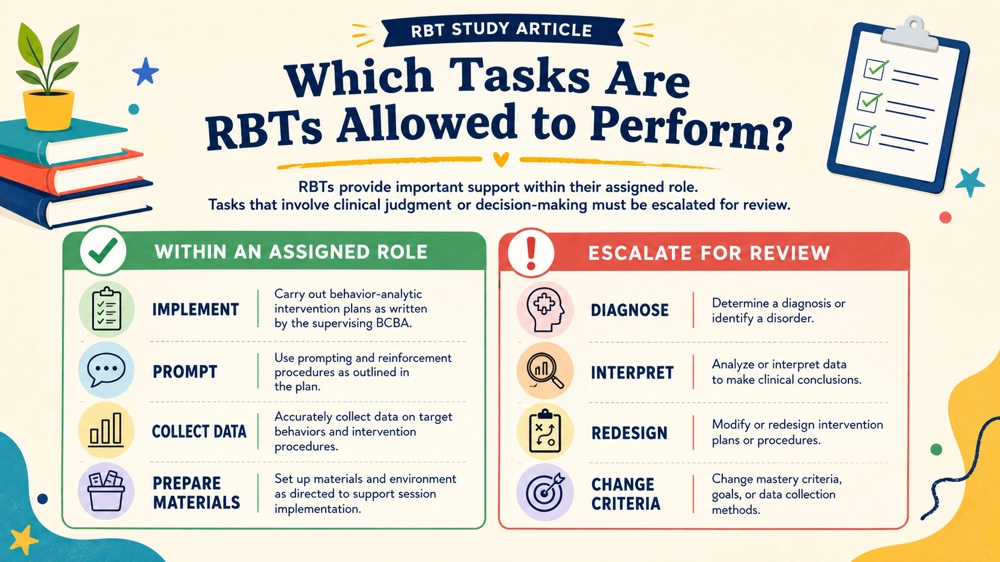
An RBT can implement an approved teaching or behavior-reduction procedure as assigned. Selecting goals, changing reinforcement criteria, designing a new intervention, or deciding that a program should end are different decisions that belong in the supervision process.
Data collection and objective reporting
Use the approved definitions, measures, timing, and recording system. Report observable events, barriers, and deviations. Do not turn a data note into an unsupported diagnosis or functional conclusion.
Which of the following tasks are RBTs allowed to perform? Check competence
A task is not automatically appropriate because it appears in a job description or because another technician performs it. Confirm training, observation, feedback, instrument instructions, and current authorization. Report when a task exceeds demonstrated competence.
Prompting, teaching, and communication support
Follow the approved prompt hierarchy, reinforcement plan, error procedure, and fading instructions. Respect a learner’s communication system and allow processing time. Do not use a prompt, reinforcer, or consequence as an improvised threat or public display.
Assessment-related tasks need context
An RBT may be assigned observation, data collection, or a specific assessment support step. Standardized administration, scoring, interpretation, and recommendations can carry different requirements. Identify the exact instrument and step before answering a broad question.
Privacy, safety, and supervision
Use approved systems, disclose only necessary information, and report safety or ethics concerns through the required route. When the task is ambiguous, a focused question is part of competent practice, not a failure to act.
Avoid task-permission mistakes
- Choosing a task because it sounds advanced.
- Treating a job title as universal authorization.
- Changing procedures without review.
- Calling interpretation data collection.
- Ignoring training or supervision requirements.
- Sharing protected records or test materials.
- Calling original scenarios official examination questions.
Which of the following tasks are RBTs allowed to perform? checklist
- What exact verb describes the task?
- Is it in the written program or assignment?
- What training and competence evidence applies?
- What data and error rules apply?
- Who supervises and reviews the work?
- What privacy, safety, and communication safeguards apply?
- Which part must be escalated before acting?
Use which of the following tasks are RBTs allowed to perform as a context-and-scope study topic. RBT Training is independent educational content and is not affiliated with or endorsed by BACB.
Practice the concept
Review which of the following tasks are rbts allowed to perform with original RBT scenarios, current-source reminders, and clear role boundaries.
Review the RBT study resource →
Frequently Asked Questions
Which tasks are RBTs generally allowed to perform?
Assigned implementation, objective data collection, approved prompting, material preparation, and communication of observations may be within role when training and supervision requirements are met.
Can an RBT choose a new intervention?
An RBT should not independently design or change an intervention. Report observations and ask the responsible professional to review the plan.
How should a task question be answered on an exam?
Identify the exact action, check whether it is assigned and observable, and reject options that require independent diagnosis, interpretation, or treatment design.
Are these official exam questions?
No. They are original educational scenarios and are not official, recalled, leaked, or BACB-endorsed.
References
- Behavior Analyst Certification Board: Registered Behavior Technician Handbook, updated June 2026.
- Behavior Analyst Certification Board: RBT Test Content Outline (3rd ed.).
- Behavior Analyst Certification Board: RBT resources.
- Behavior Analyst Certification Board: ethics resources.
- Behavior Analyst Certification Board: RBT Ethics Code (2.0).