
Why might discontinuous data collection overestimate behavior frequency? The short answer is that some discontinuous interval methods score an interval when behavior occurred at any point, so one brief event can be counted in multiple intervals even when it happened only once. The exact direction and size of bias depend on the recording method, interval length, behavior pattern, and the operational definition. This page is independent RBT study content, not a substitute for the written program or supervisor direction.
Table of Contents
- Start with the why might discontinuous data collection overestimate behavior frequency question
- Separate frequency from interval occurrence
- Compare partial-interval recording
- Compare whole-interval and momentary time sampling
- Use an original data example
- Check behavior pattern and interval size
- Use why might discontinuous data collection overestimate behavior frequency for active recall
- Avoid discontinuous-data mistakes
- Why might discontinuous data collection overestimate behavior frequency checklist
- Frequently Asked Questions
- References
Continue your RBT study with RBT exam study materials and original practice resources.
Quick answer: Treat why might discontinuous data collection overestimate behavior frequency as a current-source RBT study topic. Define the concept, connect it to an observable action, use original examples, and keep the supervision boundary visible.
Study boundary: This independent guide is educational content. It is not a BACB policy, certification decision, legal opinion, answer key, or guarantee of examination success. It does not promise a passing score or certification outcome. Examples are original and are not official, recalled, leaked, or BACB-endorsed questions.
Current exam context: The current BACB RBT Test Content Outline describes 43 tasks across six domains; the examination includes 75 scored questions and 10 unscored pilot questions in a 90-minute testing period. Verify the current handbook and outline before relying on a time-sensitive detail.
Start with the why might discontinuous data collection overestimate behavior frequency question
Begin by naming the measurement system and the behavior definition. Discontinuous recording samples behavior across intervals rather than recording every instance continuously. Before judging a graph, write the interval size, scoring rule, and whether the method is designed to capture occurrence, nonoccurrence, or a change in responding.
The current RBT sources provide the study context, but a learner’s written program controls the actual measurement procedure. A general explanation should not be used to replace an operational definition.
Separate frequency from interval occurrence
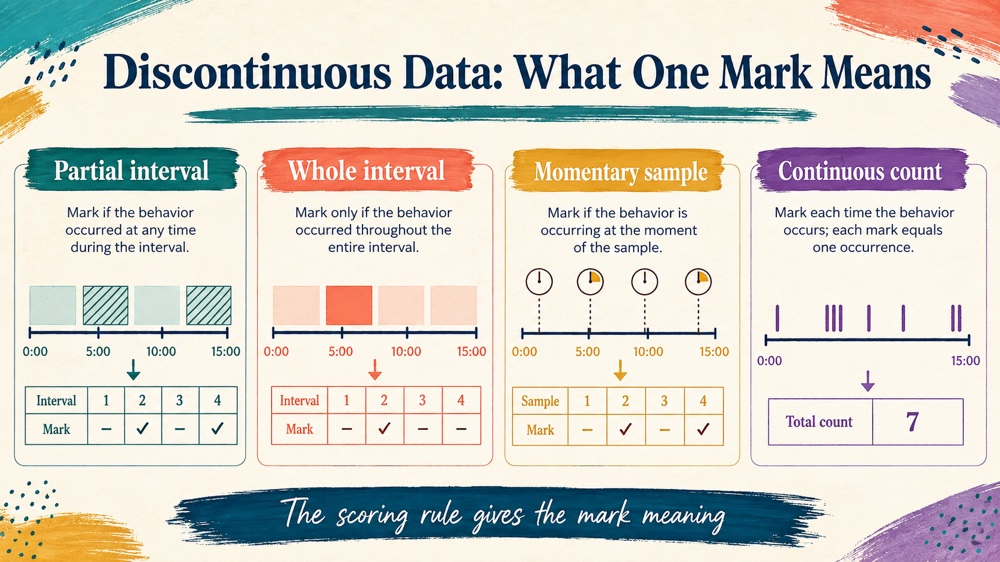
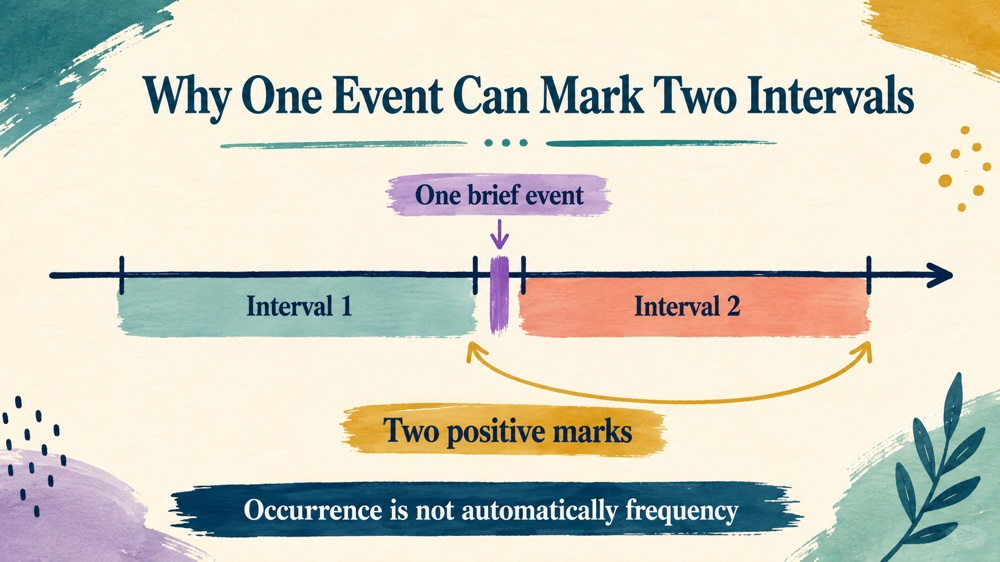
Frequency is a count of responses under a defined observation period. In discontinuous recording, the observer may mark an interval as positive if behavior occurred at least once. That positive interval is not automatically the number of responses. Treating positive intervals as exact frequency can inflate the apparent count when one event crosses or appears in several intervals.
- Read the operational definition.
- Identify the interval rule.
- Ask what one mark represents.
- Compare the mark with a true count only when the program allows it.
- Report uncertainty instead of relabeling the measure.
Compare partial-interval recording
Partial-interval recording marks an interval when the target behavior occurs at any time during it. It is sensitive to occurrence and can be useful for some questions, but it may overestimate duration and can make repeated interval marks look like a high frequency. The method does not tell the observer how many responses occurred inside each marked interval.
Use a simple timeline in study: one brief response near the end of an interval can still produce a positive mark. The correct interpretation is occurrence within sampled intervals, not an automatic response count.
Compare whole-interval and momentary time sampling
Whole-interval recording marks behavior only when it persists for the entire interval, while momentary time sampling checks behavior at a specific moment. These methods answer different questions and can underrepresent or miss brief responding. A practice explanation should compare the scoring rule, not rank one method as universally better.
When a question changes interval length or observation timing, ask how sensitivity and the meaning of a mark change. Keep the written program and supervisor direction in view.
Use an original data example
Imagine a brief response occurs once during a ten-minute observation and overlaps two partial intervals. The observer may record two positive intervals even though the direct response count is one. The example demonstrates why interval occurrence and frequency are not interchangeable; it does not provide a universal correction formula.
If the task calls for a different measure, record according to that operational definition. Do not convert a sampled measure into frequency just to make a graph easier to read.
Check behavior pattern and interval size
Bias is influenced by response duration, clustering, interval length, and when the behavior occurs. Longer intervals can hide variation inside one mark; shorter intervals can produce more opportunities for a single event to touch multiple intervals. Study the pattern and the scoring rule together.
A graph should be interpreted with the team that selected the measure. An RBT can collect and report assigned data, while changing the system requires the appropriate plan and supervision.
Use why might discontinuous data collection overestimate behavior frequency for active recall
After answering, explain what one positive interval means, draw a timeline, and contrast it with continuous frequency recording. Then write a new scenario with a different interval length. Tag a miss as vocabulary, measurement selection, scoring, calculation, or role boundary.
The current examination includes 75 scored questions and 10 unscored pilot questions in a 90-minute testing period. Verify current BACB materials for time-sensitive exam context.
Avoid discontinuous-data mistakes
- Calling positive intervals exact response frequency.
- Ignoring the operational definition or interval rule.
- Assuming every discontinuous method answers the same question.
- Changing interval length without authorization.
- Backfilling missing observations from memory.
- Interpreting a graph without the team that selected the measure.
- Presenting an original example as an official examination item.
Why might discontinuous data collection overestimate behavior frequency checklist
- Can I state what one positive interval represents?
- Can I distinguish occurrence from response count?
- Do I know the difference among partial, whole, and momentary rules?
- Is the operational definition visible?
- Can I explain how interval length changes interpretation?
- Would I report a measurement problem instead of changing the system?
- Is the example original and source-linked?
Use the phrase why might discontinuous data collection overestimate behavior frequency as a prompt to inspect the scoring rule, not to memorize a slogan. Accurate study connects the method, behavior pattern, data meaning, and role boundary. RBT Training is independent educational content and is not affiliated with or endorsed by BACB.
Practice the concept
Review why might discontinuous data collection overestimate behavior frequency with original RBT scenarios, current-source reminders, and clear role boundaries.
Review the RBT study resource →
Frequently Asked Questions
Why can partial-interval recording look like high frequency?
A single brief response can produce a positive mark in an interval, and one event may touch more than one interval. A positive interval is not automatically a response count.
Does discontinuous recording always overestimate?
No. The direction depends on the method, behavior pattern, interval length, and question being measured.
Can an RBT change the recording method?
Follow the written program and supervision. Report barriers or concerns rather than changing the measurement system independently.
Are the examples official questions?
No. They are original educational scenarios and are not official, recalled, leaked, or BACB-endorsed.
References
- Behavior Analyst Certification Board: Registered Behavior Technician Handbook, updated June 2026.
- Behavior Analyst Certification Board: RBT Test Content Outline (3rd ed.).
- Behavior Analyst Certification Board: RBT resources.
- Behavior Analyst Certification Board: ethics resources.
- Behavior Analyst Certification Board: RBT Ethics Code (2.0).