
If you search for task list BACB, you may be looking at the old RBT Task List (2nd ed.) or the current RBT Test Content Outline (3rd ed.). The naming change is important: the BACB states that the 2nd-edition Task List was used through December 31, 2025, while the 3rd-edition TCO is the framework for RBT examinations beginning January 1, 2026.
Table of Contents
- Task list BACB: which RBT framework controls now?
- Task list BACB: 2nd edition to 3rd edition domain map
- What changed from the 2nd edition to the 3rd-edition TCO?
- Current question weighting under the 3rd-edition TCO
- Can you still use 2nd-edition study materials?
- A task list BACB study-material migration audit
- Original task-list transition scenarios
- Map the migration to the six current TCO domains
- Frequently Asked Questions
- References
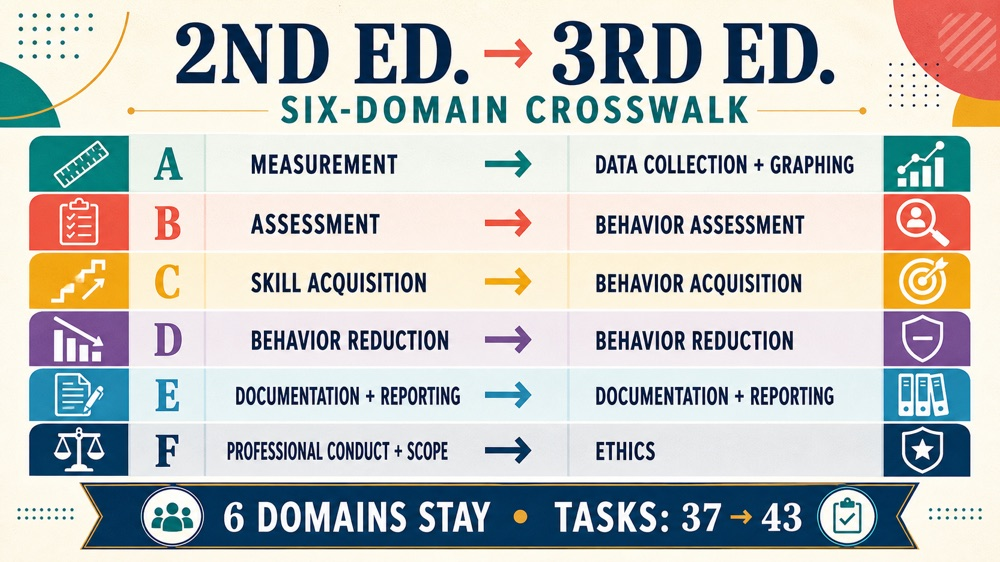
The update is evolutionary, not a reason to throw away every foundational concept. Both documents organize RBT content into six broad areas, and core concepts such as measurement, preference assessment, reinforcement, prompting, behavior reduction, documentation, and professional responsibility remain relevant. But the current TCO has 43 tasks, compared with 37 tasks in the 2nd-edition Task List, and it changes task wording, domain names, emphasis, and question weighting.
The current exam presents 85 multiple-choice questions: 75 scored questions and 10 unscored pilot questions, with four answer choices and 90 minutes. RBT Training provides independent study content, not an official BACB course or exam. It is not affiliated with or endorsed by the BACB. The comparisons and scenarios below are newly written, not official, recalled, leaked, or BACB-endorsed questions. No study guide can guarantee certification or a passing result.
Task list BACB: which RBT framework controls now?
For an RBT exam delivered beginning in 2026, use the current RBT Test Content Outline (3rd ed.) as the exam-content authority. The older RBT Task List (2nd ed.) remains useful historical and foundational material, but its labels and coverage should not be treated as a complete current exam map.
| Question | Answer |
|---|---|
| What was the old framework? | RBT Task List (2nd ed.), a 37-task framework organized into six content areas. |
| What is the current framework? | RBT Test Content Outline (3rd ed.), a 43-task framework used for examinations beginning in 2026. |
| Did the number of domains change? | No. Both frameworks use six broad domains, although names and internal task structures changed. |
| Did every ABA concept change? | No. Many foundational concepts remain, but new wording and emphasis create study gaps. |
| Should an old course be trusted without an audit? | No. Check it against the current TCO, especially data interpretation, behavior-reduction detail, and expanded ethics tasks. |
Task list BACB: 2nd edition to 3rd edition domain map
| 2nd-edition Task List | 3rd-edition TCO | What to notice |
|---|---|---|
| A. Measurement | A. Data Collection and Graphing | Data calculation, trends, and procedural-fidelity risks are explicit in the current map. |
| B. Assessment | B. Behavior Assessment | Preference, skill-strength/deficit, and functional-assessment participation are stated with more specific verbs and examples. |
| C. Skill Acquisition | C. Behavior Acquisition | Maintenance is distinguished from acquisition; prompt/fading and reinforcement wording is more explicit. |
| D. Behavior Reduction | D. Behavior Reduction | Antecedent interventions, punishment procedures, and secondary effects receive explicit task space. |
| E. Documentation and Reporting | E. Documentation and Reporting | Communication, clinical direction, variables, and objective session communication are consolidated into four current tasks. |
| F. Professional Conduct and Scope of Practice | F. Ethics | The current domain expands to 11 exam questions and 10 tasks covering core principles, supervision, privacy, public statements, relationships, gifts, and cultural humility. |
The map is a study bridge, not a claim that every old task has a one-to-one new number. Read the current TCO wording when a task name or example matters.
What changed from the 2nd edition to the 3rd-edition TCO?
Domain A: Measurement becomes Data Collection and Graphing
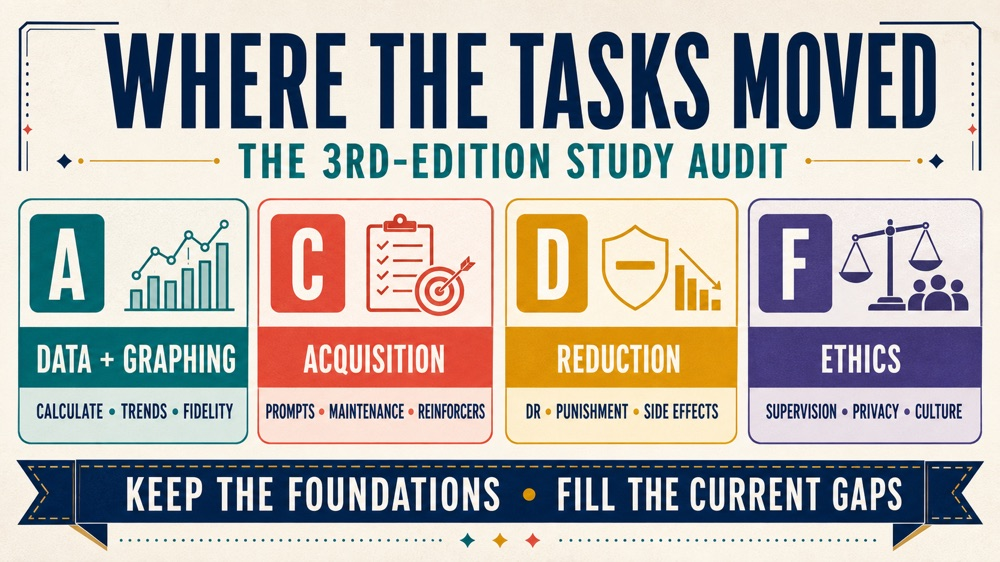
The 2nd edition included preparation for data collection, continuous and discontinuous measurement, permanent product, graph updates, and observable descriptions. The 3rd edition keeps the measurement procedures but also explicitly asks candidates to calculate and summarize data, identify trends in graphs, and describe risks linked to unreliable data and poor procedural fidelity. Continuous measurement examples also expand to include latency and interresponse time.
Study consequence: do not stop after memorizing frequency, duration, and interval recording. Practice percentage, rate, mean duration, graph trend, and what happens when an observer misses intervals or changes the procedure.
Domain B: Assessment uses more precise participation language
The 2nd edition used “assist with individualized assessment procedures” and “assist with functional assessment procedures.” The current TCO describes participating in assessments of relevant skill strengths and deficits and participating in components of functional-assessment procedures, with examples such as descriptive assessment and functional analysis. Preference assessment examples are also named more specifically.
Study consequence: learn the difference between conducting an assigned preference assessment, participating in a skill or functional-assessment component, and independently selecting or interpreting a formal assessment.
Domain C: Skill Acquisition becomes Behavior Acquisition
The 2nd edition had 12 tasks; the current TCO has 11. The current wording explicitly separates positive and negative reinforcement procedures, conditioned reinforcers, discrete-trial teaching, naturalistic teaching, chaining, discrimination training, prompts and fading, generalization, maintenance versus acquisition, shaping, and token economies.
Study consequence: old material on the core teaching procedures still helps, but update your labels and make sure you can distinguish generalization from maintenance and a prompt from prompt fading.
Domain D: Behavior Reduction adds explicit consequence and side-effect distinctions
The 2nd edition included functions, antecedent modification, differential reinforcement, extinction, and crisis/emergency procedures. The current TCO keeps those areas but explicitly includes antecedent interventions, expanded differential-reinforcement examples, positive and negative punishment procedures, and secondary effects of extinction and punishment.
Study consequence: review DRA, DRO, DRI, DRL, and FCT as written in the current plan. Also know why an extinction burst, response variation, resurgence, emotional responding, escape, and avoidance are not the same event or a license to change a plan independently.
Domain E: Documentation and Reporting is more compact but still important
The 2nd edition had five tasks, including separate compliance with data collection, storage, transportation, and documentation requirements. The current TCO has four tasks: communicate concerns and suggestions, seek and prioritize clinical direction, report variables affecting progress, and communicate objectively what occurred in accordance with applicable requirements.
Study consequence: do not read the shorter list as permission to ignore privacy, storage, or legal requirements. Those obligations continue through the Ethics Code, Handbook, employer rules, and applicable law; the TCO simply organizes the exam content differently.
Domain F: Professional Conduct and Scope becomes Ethics
This is the largest visible expansion. The 2nd edition had five professional-conduct tasks. The 3rd-edition TCO has 10 ethics tasks and explicitly covers the core principles, competence, ongoing supervision, effective supervision practices, confidential information, public statements and social media, multiple relationships, gifts, interpersonal and professional skills, and cultural humility and responsiveness.
Study consequence: an old “professional conduct” chapter may contain useful foundations but still leave current gaps. Add the RBT Ethics Code (2.0), privacy/public-statement scenarios, gifts and relationships, cultural humility, and supervision practice to your review.
Current question weighting under the 3rd-edition TCO
The current TCO distributes the 75 scored questions across six domains as follows:
| Domain | Scored questions | Percentage | Study implication |
|---|---|---|---|
| A. Data Collection and Graphing | 13 | 17% | Practice calculations, graphs, measurement, and fidelity. |
| B. Behavior Assessment | 8 | 11% | Separate preference, skill, and functional-assessment roles. |
| C. Behavior Acquisition | 19 | 25% | Expect substantial teaching, prompting, reinforcement, and generalization review. |
| D. Behavior Reduction | 14 | 19% | Review functions, antecedents, differential reinforcement, extinction, punishment, and safety. |
| E. Documentation and Reporting | 10 | 13% | Practice objective communication and timely supervisor contact. |
| F. Ethics | 11 | 15% | Study privacy, competence, supervision, public statements, relationships, gifts, and culture. |
Do not convert the percentages into a pass prediction. They are a study-allocation guide, not a guarantee about an individual exam form or result. Answer every presented question because the 10 unscored pilot questions are not identified to the candidate.
Can you still use 2nd-edition study materials?
Yes, if you use them as a foundation and run a gap audit. Old material is not automatically false because the edition changed. Definitions of reinforcement, prompting, measurement, and extinction do not become wrong solely because the framework has a new name. The risk is incomplete coverage, old labels, old emphasis, and missing tasks.
| Old material feature | Keep | Update or verify |
|---|---|---|
| Core ABA definitions | Use for concept foundations and examples. | Check that examples still match current task wording and role boundaries. |
| 2nd-edition domain headings | Use as a crosswalk while reviewing prior notes. | Relabel study folders to A–F current names. |
| Measurement drills | Keep frequency, duration, interval, and permanent-product practice. | Add latency, IRT, calculations, trends, and procedural-fidelity risks. |
| Reduction drills | Keep functions, differential reinforcement, extinction, and crisis basics. | Add punishment procedures and secondary effects from the current TCO. |
| Professional conduct chapter | Keep supervision, boundaries, dignity, and communication foundations. | Add the expanded F.1–F.10 ethics coverage and current RBT Ethics Code. |
| Practice tests | Keep original concept practice if the explanations are accurate. | Check edition, weighting, task coverage, and current exam format; reject recalled or leaked content. |
A task list BACB study-material migration audit
- Version: record whether the material cites the 2nd-edition Task List or the 3rd-edition TCO.
- Vocabulary: replace old domain labels with the current A–F names while keeping a crosswalk for recognition.
- Coverage: mark every current task, especially A.6–A.8, D.2–D.6, and F.1–F.10.
- Weight: compare practice-test section proportions with the current 13/8/19/14/10/11 scored-question distribution.
- Examples: add scenario questions that require action selection, not only term recall.
- Source: confirm requirements against current BACB pages, TCO, Handbook, and Ethics Code.
- Integrity: remove claims of official, real, recalled, leaked, or BACB-endorsed questions.
For example: a 2nd-edition workbook may have a strong chapter on DRA and extinction but no task on punishment side effects or cultural humility. Keep the valid DRA practice, add the missing current topics, and label the notes with the 3rd-edition domain and task rather than discarding the entire workbook.
Original task-list transition scenarios
Scenario 1: a candidate studies a 2nd-edition practice test and scores well, but the test has no graph trends, data-fidelity risks, gifts, or cultural-humility items. What is the problem?
Answer: the score does not establish current TCO coverage. Run a gap audit and add the current A and F emphasis before treating the result as useful diagnostic information.
Scenario 2: a flashcard says “assist with individualized assessments.” The current TCO question asks about “participate in assessments of relevant skill strengths and deficits.” How should the candidate study?
Answer: learn the current verb and its scope. The RBT participates in assigned assessment components; the candidate should not infer independent assessment selection or interpretation.
Scenario 3: a candidate sees that the current Domain C has 19 scored questions and skips Domain F because it has fewer.
Answer: use weighting to allocate time, not to eliminate a domain. Ethics still represents 11 scored questions and contains expanded current tasks.
These scenarios are newly written for study and are not official, recalled, leaked, or BACB-endorsed questions.
Map the migration to the six current TCO domains
| Domain | Migration question |
|---|---|
| A. Data Collection and Graphing | Did the material add calculations, trends, and procedural-fidelity risks? |
| B. Behavior Assessment | Does it distinguish preference, skill-strength/deficit, and functional-assessment participation? |
| C. Behavior Acquisition | Does it separate maintenance from acquisition and teach current prompt/fading wording? |
| D. Behavior Reduction | Does it cover punishment procedures and secondary effects as well as extinction and differential reinforcement? |
| E. Documentation and Reporting | Does it train objective communication, timely direction, and relevant variables? |
| F. Ethics | Does it cover the expanded 10-task ethics domain, not only old professional-boundary vocabulary? |
Bottom line: the current task list BACB search should lead you to the 3rd-edition RBT Test Content Outline for a 2026 exam. Keep accurate 2nd-edition foundations, replace old maps and weightings, fill the new or restructured tasks, and verify every high-stakes requirement with current BACB sources.
Study from the current RBT framework.
Review RBT study materials organized around the 3rd-edition TCO, six domains, original questions, and explanation-led error review.
Review the RBT study materials →
Frequently Asked Questions
What is the current BACB RBT task list?
For RBT examinations beginning in 2026, the current content framework is the RBT Test Content Outline (3rd ed.), which replaced the 2nd-edition Task List as the exam framework.
How many tasks are in the 2nd and 3rd editions?
The official 2nd-edition RBT Task List contains 37 tasks. The current 3rd-edition RBT Test Content Outline contains 43 tasks organized into six domains.
Did the number of RBT exam domains change?
No. Both frameworks use six broad domains, but domain names and task structures changed, especially the move from Professional Conduct and Scope of Practice to Ethics.
Can I use 2nd-edition RBT study materials?
Yes, as a foundation after a current-version gap audit. Add current data, reduction, documentation, and expanded ethics topics and use the 3rd-edition TCO for the study map.
What are the current RBT exam question numbers?
The current format presents 85 questions: 75 scored questions and 10 unscored pilot questions, with four answer choices and 90 minutes.
Are these task-list transition examples official?
No. They are newly written educational examples and are not official, recalled, leaked, or BACB-endorsed questions.
References
- Behavior Analyst Certification Board. Test Content Outlines for BACB Certifications.
- Behavior Analyst Certification Board. RBT Task List (2nd ed.).
- Behavior Analyst Certification Board. RBT Test Content Outline (3rd ed.).
- Behavior Analyst Certification Board. RBT Handbook.
- RBT Practice Exam 2nd versus 3rd edition guide. Reviewed for competitor research; not an official BACB source.
- ABA Resource Center transition overview. Reviewed for competitor research.
- Sidekick Learning comparison. Reviewed for competitor research.