

The initial competency assessment is the practical skills gate in the current RBT certification pathway. It is not the 40-hour training itself, not the Pearson VUE written examination, and not a generic interview with an employer. Under the current BACB packet effective January 1, 2026, an applicant must demonstrate competence on the listed task items through the permitted assessment methods and submit the completed documentation with the certification application.
Table of Contents
- What is the initial competency assessment?
- Initial competency assessment: what it is not
- Initial competency assessment: timing and delivery structure
- Who can oversee the initial competency assessment?
- The 19 initial competency assessment task items
- Tasks 1–5: measurement and assessment
- Tasks 6–14: skill acquisition and behavior reduction
- Tasks 15–19: professionalism and requirements
- With a client, role-play, and interview
- Documentation, signatures, and application checks
- A source-first preparation plan
- Frequently Asked Questions
- References
The safest way to prepare is to treat the packet as the source of truth. Confirm the version, timing, responsible assessor, assistant-assessor rules, assessment mode, task groups, signatures, and documentation requirements before practicing. A study guide can organize preparation, but it cannot replace the packet or a qualified assessor.
The current RBT Test Content Outline (3rd ed.) contains 43 tasks across six domains. The written certification exam includes 75 scored questions and 10 unscored questions, but the initial competency assessment tests practical performance rather than selected answers. RBT Training’s examples in this article are independent, newly written study content—not official, recalled, leaked, or BACB-endorsed questions.
This guide summarizes the January 2026 packet for study planning. Requirements can change, so verify the live BACB document and your application instructions before submitting anything. No course, assessor, checklist, or practice score can guarantee certification or a passing result.
What is the initial competency assessment?
The initial competency assessment is a structured evaluation in which an assessor provides opportunities for an RBT applicant to perform required tasks and evaluates whether each task is performed competently. It is part of the requirements to qualify for RBT certification.
The packet is practical and task-based. Depending on the task instructions, an applicant may demonstrate a skill with a client, in role-play, or through a live interview. The responsible assessor records the assessment type, initials completed tasks, and signs the final attestation after all required items have been demonstrated competently.
| Requirement | What it means | What it does not mean |
|---|---|---|
| 40-hour training | Training must be completed before the competency assessment under the current timing rule. | Training completion alone is not proof of practical competence. |
| Initial competency assessment | Demonstrates performance of all task items in the current packet. | It is not the multiple-choice certification examination. |
| Certification application | Submits the required documentation for BACB review. | Submitting a form does not guarantee approval. |
| Written exam | Measures selected answers through the current certification examination. | A practice test or competency assessment does not replace it. |
Original example: an applicant may know the definition of duration but still need to demonstrate that they can apply the written onset and offset rules, record the value, and communicate an interruption. The competency assessment asks whether the applicant can perform the task, not only recite a term.
Initial competency assessment: what it is not
Several similarly named activities create avoidable confusion:
- Not the 40-hour course: the course teaches required content; the packet evaluates performance after training.
- Not a mock exam: a practice quiz can rehearse concepts but cannot serve as the BACB competency form.
- Not the Pearson VUE examination: the written exam is a separate certification step with multiple-choice questions.
- Not a client treatment review: the packet evaluates the applicant’s RBT skills; it is not permission to make independent clinical decisions.
- Not a generic employer checklist: the current packet controls the required task items and documentation. Non-BACB forms are not a substitute for the required packet.
Use the exact packet title and effective date when communicating with a trainer or assessor. “I need the current packet effective January 1, 2026” is more precise than asking for an old “skills checklist.”
Initial competency assessment: timing and delivery structure
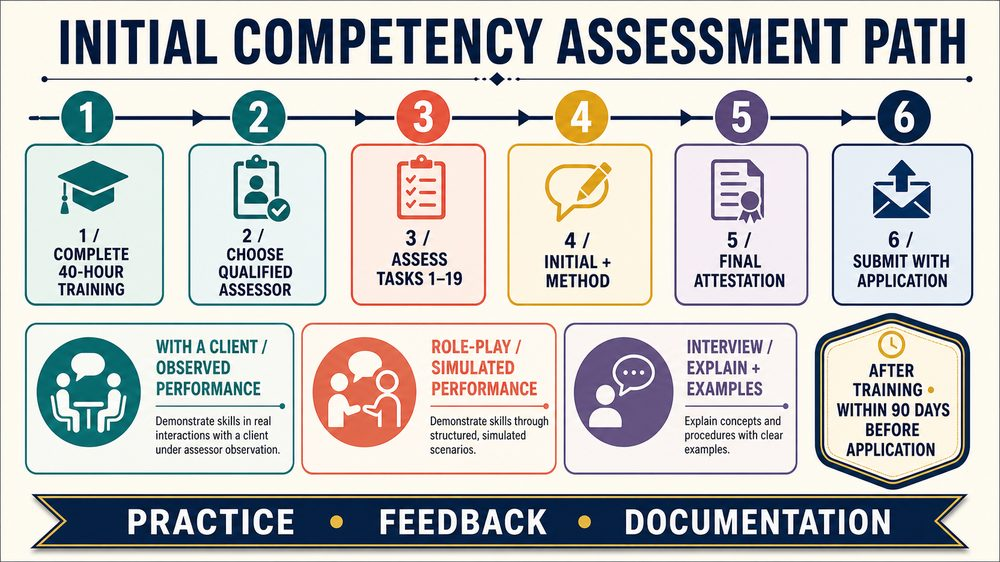
The current packet states that the assessment must be completed after the 40-hour training is complete and cannot be completed more than 90 days before submitting an RBT certification application. The “90 days” rule is a timing boundary, not a suggestion to complete the assessment whenever convenient.
The packet also allows the assessment to be conducted over one or more sessions. It may be conducted in person, live via the internet, or through observations of recorded videos created specifically for the assessment, subject to the packet’s requirements and the assessor’s process.
| Checkpoint | Candidate question |
|---|---|
| Training complete | Has the applicable 40-hour training been completed before the assessment begins? |
| Application timing | Will the completed assessment fall within the permitted 90-day window before submitting the application? |
| Delivery plan | Which tasks will be assessed with a client, in role-play, or by interview, and across how many sessions? |
| Recording and signatures | Who initials each task, who signs the final attestation, and how will the completed form be retained? |
Original scenario: an applicant completed training six months ago and wants to use a competency form completed five months ago for a new application. The applicant should not assume the old form is acceptable. Check the current packet, timing rule, application instructions, and qualified assessor before proceeding.
Who can oversee the initial competency assessment?
The current packet distinguishes a responsible assessor from assistant assessors. The responsible assessor is an active BCaBA or BCBA certificant who has completed the required 8-hour supervision training and is responsible for overseeing the assessment, ensuring it follows the requirements, signing it, maintaining records, and ensuring quality even when assistants complete portions.
A responsible assessor may delegate some or all of the assessment to an assistant assessor who has demonstrated proficiency through direct observation and holds an active RBT certification or higher. The responsible assessor may use multiple assistant assessors for one assessment, but delegation does not remove the responsible assessor’s oversight and sign-off responsibility.
| Role | Core responsibility in the packet | Candidate check |
|---|---|---|
| Responsible assessor | Oversees requirements, quality, records, task completion, and final attestation. | Confirm active certification, supervision training, relationship requirements, and sign-off process. |
| Assistant assessor | May conduct delegated portions after demonstrating proficiency and meeting certification requirements. | Confirm who will assess each task and how the responsible assessor reviews the portion. |
| RBT applicant | Performs all task items competently and provides the required information. | Practice the procedure and ask what to do when a task or mode is unclear. |
The packet also includes relationship expectations. The responsible assessor, assistant assessor(s), and applicant must meet the stated employment or contractual relationship conditions with the organization providing services to the involved client(s). Assessors may not be related to, subordinate to, or employed by the applicant during the assessment. Read the current packet for the complete wording rather than relying on a forum summary.
The 19 initial competency assessment task items
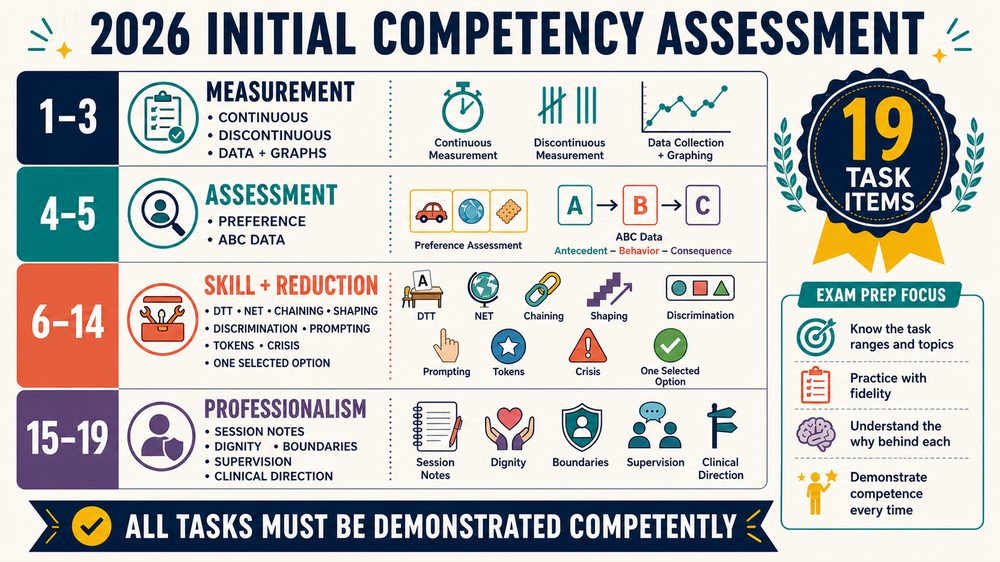
All task items 1–19 must be completed. The task groups in the current form are:
| Section | Tasks | What to prepare |
|---|---|---|
| Measurement | 1. Continuous measurement; 2. Discontinuous measurement; 3. Data and graphs. | Frequency, duration, latency, IRT, interval rules, data entry, and graph updates as written. |
| Assessment | 4. Preference assessments; 5. ABC data. | Present the procedure, record choices or ABC events, and describe observations objectively. |
| Skill acquisition and behavior reduction | 6. DTT; 7. naturalistic teaching; 8. chaining; 9. shaping; 10. discrimination training; 11. prompting; 12. token systems; 13. crisis/emergency procedures; 14. one of antecedent interventions, differential reinforcement, or extinction. | Rehearse the written sequence, prompting/fading, reinforcement, safety protocol, and the selected task-14 option. |
| Professionalism and requirements | 15. Session notes; 16. client dignity; 17. professional boundaries; 18. supervision requirements; 19. clinical direction. | Use objective language, protect dignity, identify boundaries, describe supervision standards, and give a situation requiring supervisor direction. |
Three of tasks 6–14 must be demonstrated with a client. Other task-specific instructions determine whether the available modes are with a client, role-play, or interview. Do not assume that one role-play session satisfies every task; the assessor marks the method used for each item.
Tasks 1–5: measurement and assessment
The first five tasks connect to everyday RBT data and assessment work:
- Continuous measurement: implement a procedure such as frequency, duration, latency, or interresponse time according to the operational definition.
- Discontinuous measurement: apply partial interval, whole interval, or momentary time sampling using the stated timing and scoring rule.
- Data and graphs: enter data and update graphs without changing the raw value or placing it in the wrong target or phase.
- Preference assessments: conduct the selected preference procedure and record the results.
- ABC data: collect objective antecedent, behavior, and consequence information.
Original practice cue: if the timer fails halfway through an interval assessment, do not invent scores from memory. Preserve the information available, report the interruption, and ask how the assessor wants the event handled under the written procedure.
Tasks 6–14: skill acquisition and behavior reduction
The middle group tests implementation, not independent treatment design. Prepare by reading the procedure, identifying the response and consequence rules, practicing with feedback, and knowing when to seek clarification.
- Teaching procedures: DTT, naturalistic teaching, chaining, shaping, and discrimination training.
- Prompting: use the stated prompt and fading procedure rather than adding help whenever a response is slow.
- Token systems: deliver tokens and exchange steps according to the written contingency.
- Crisis/emergency: implement the current protocol, prioritize safety, and do not improvise a restrictive response.
- One selected task: demonstrate the option assigned or selected from antecedent interventions, differential reinforcement, or extinction according to the packet and written procedures.
A candidate may understand the definition of extinction but still need to demonstrate correct implementation in the assigned scenario. Ask the trainer or assessor which option is being evaluated and what materials, role-play conditions, or client demonstration are required.
Tasks 15–19: professionalism and requirements
The final group prevents a common study mistake: treating hands-on behavior procedures as the whole job. The packet also checks documentation, dignity, boundaries, supervision, and clinical direction.
| Task | Preparation focus |
|---|---|
| 15. Session notes | Describe what occurred objectively, including relevant data and events, without unsupported labels or conclusions. |
| 16. Client dignity | Give examples of protecting privacy, choice, respectful communication, and humane treatment. |
| 17. Professional boundaries | Recognize conflicts, multiple relationships, gifts, social-media issues, and communication limits. |
| 18. Supervision requirements | Describe the applicable BACB supervision standards for RBTs using current sources. |
| 19. Clinical direction | Give a situation in which an RBT should seek supervisor direction, such as an unclear plan, safety concern, data irregularity, or procedure outside competence. |
Original example: a candidate notices that a session-note template says “client was manipulative.” A stronger response is to replace the label with observable events and ask the supervisor which objective documentation format is required. Professional competence includes knowing when a wording or clinical decision needs direction.
With a client, role-play, and interview
The packet describes three assessment types. “With a client” means the assessor observes the applicant performing the task with a client receiving behavior-analytic services. “Role-play” means the applicant performs in a situation similar to a client interaction, with another person acting in that role. “Interview” is a live conversation in which the applicant accurately describes or discusses the concept and gives examples and nonexamples when applicable.
The available method depends on the task instructions. For example, a crisis/emergency task may include an interview option, while some implementation tasks may be performed with a client or in role-play. A candidate should ask the assessor which method will be used for each item, what the evaluation criteria are, and what corrective feedback means for a later attempt.
If competence is not demonstrated on a task, the assessor may provide corrective feedback and assess it again on another day. The process continues until competence is demonstrated. Corrective feedback may not be delivered on the final assessment of a task. That makes practice and feedback part of the pathway, not evidence that the candidate is permanently disqualified after one weak attempt.
Documentation, signatures, and application checks
After an assessor observes a task performed competently, the assessor initials the task and marks the assessment type used. Once all tasks are complete, the responsible assessor signs and dates the final attestation. The applicant submits the completed Initial Competency Assessment with the certification application, and the current packet states that non-BACB forms will not be accepted as substitutes.
- Use the current packet effective January 1, 2026.
- Confirm applicant and organization fields are complete.
- Confirm each task 1–19 is initialed and the applicable assessment type is marked.
- Confirm responsible-assessor and assistant-assessor information is complete when applicable.
- Confirm the final attestation is signed and dated under the Acceptable Signatures Policy.
- Keep copies and submit documents through the current BACB application route.
The responsible assessor must maintain documentation of each assessment, including completed forms and assessors who conducted portions, for a minimum of seven years. Candidates should ask how their organization will retain and provide the required record.
A source-first preparation plan
- Download the current packet: highlight the effective date, timing, modes, task groups, and signature rules.
- Map the 19 tasks: mark which tasks require client demonstration, role-play, or interview options.
- Practice the written procedures: rehearse measurement, teaching, reduction, documentation, and escalation steps.
- Use feedback: ask the trainer or assessor to identify the exact behavior or decision that needs correction.
- Run a document audit: check dates, initials, assessment types, names, signatures, and timing before application.
- Keep the written exam separate: use the TCO and Handbook for exam preparation, and do not count a mock score as competency evidence.
Bottom line: the initial competency assessment is a current, structured demonstration of all 19 task items after the applicable training and within the packet’s timing window. Prepare from the official 2026 packet, use a qualified responsible assessor, understand the permitted assessment modes, practice with feedback, and audit the final form before submitting it.
Prepare the competency skills and the written exam separately.
Use original RBT scenarios to review measurement, assessment, teaching, behavior reduction, documentation, and supervision decisions.
Review RBT study materials →
Frequently Asked Questions
What is the initial competency assessment?
It is a structured evaluation of an RBT applicant’s performance on the task items in the current BACB packet. It is separate from the 40-hour training and the written certification examination.
How many tasks are on the 2026 initial competency assessment?
The current packet effective January 1, 2026 requires all 19 task items to be completed.
When should the initial competency assessment be completed?
It must be completed after the 40-hour training is complete and cannot be completed more than 90 days before submitting an RBT certification application, according to the current packet.
What assessment modes are allowed?
Depending on the task, the packet allows assessment with a client, role-play, or interview. The task-specific instructions determine which modes can be used.
Who is the responsible assessor?
The current packet identifies a responsible assessor as an active BCaBA or BCBA certificant who has completed the 8-hour supervision training and accepts responsibility for oversight, quality, records, and final sign-off.
What if I do not demonstrate a task competently?
The assessor may provide corrective feedback and assess the task again on another day. The process is repeated until competence is demonstrated, and corrective feedback cannot be delivered on the final assessment of a task.
References
- Behavior Analyst Certification Board. RBT Initial Competency Assessment Packet: Effective January 1, 2026.
- Behavior Analyst Certification Board. RBT Handbook.
- Behavior Analyst Certification Board. Supervision, Assessment, Training, and Oversight.
- Behavior Analyst Certification Board. Guidance for Meeting RBT Requirements During the 2026 Transition.
- Behavior Analyst Certification Board. RBT Test Content Outline (3rd ed.).
- RBT Hub competency-assessment overview. Reviewed for competitor research; not an official BACB source.