
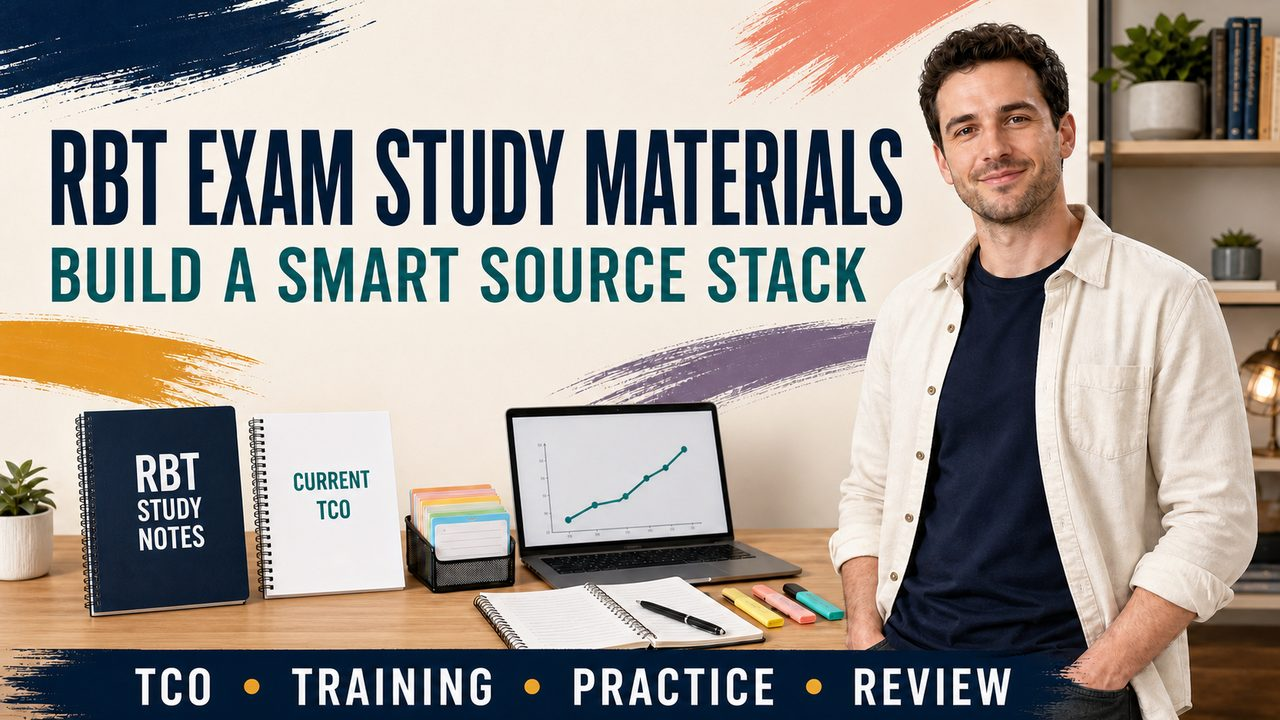
RBT exam study materials should do more than collect definitions. The best stack helps you read the current requirements, locate every task in the 3rd-edition Test Content Outline, practice applied decisions, review mistakes, and verify that a correct answer transfers to a new scenario.
Table of Contents
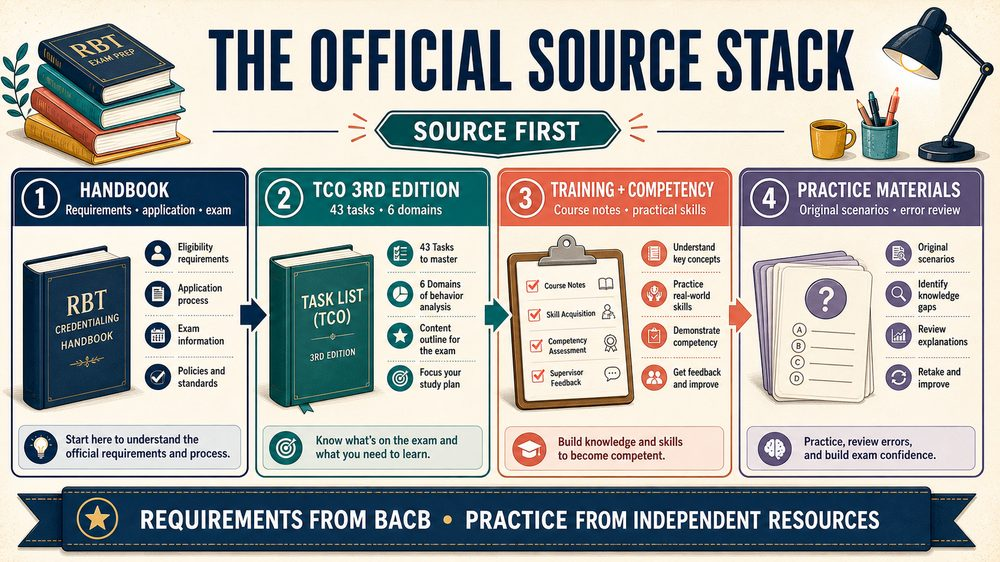
- The official source stack for RBT exam study materials
- How to choose independent RBT exam study materials
- Use a readiness matrix instead of one headline score
- Map RBT exam study materials to six domains
- Use practice materials for transfer and explanation
- Audit an RBT study guide before trusting it
- A practical workflow for using RBT exam study materials
- Frequently Asked Questions
- References
Start with the official source layer: the current RBT Handbook, the RBT Test Content Outline (3rd ed.), the current examination information, and the materials from the applicable 40-hour training and competency assessment. Then add independent study guides, original practice questions, visual notes, or mock exams that make the source layer easier to use. An independent guide can organize learning; it cannot replace BACB requirements or endorse a certification result.
The current TCO describes 43 tasks across six domains. The current exam frame includes 75 scored questions and 10 unscored pilot questions in 85 presented questions, with four choices and 90 minutes. RBT Training’s examples are newly written, independent, and not official, recalled, leaked, or BACB-endorsed questions. No material, course, or practice score can guarantee certification or a passing result.
The official source stack for RBT exam study materials
| Source | Use it for | Do not use it for |
|---|---|---|
| RBT Handbook | Eligibility, application, examination, ongoing requirements, and preparation guidance. | Replacing the live BACB page when a rule or processing update changes. |
| RBT TCO, 3rd edition | Task names, six domains, and the blueprint for coverage. | Assuming a third-party question is an official item. |
| 40-hour training materials | Definitions, demonstrations, activities, and procedures you were taught. | Assuming course completion alone proves exam or practical mastery. |
| Competency-assessment materials | Technician performance expectations and task modes. | Confusing practical competency with a written mock score. |
| Examination Information | Current delivery, timing, question count, and scheduling details. | Using an old study guide’s format as the current rule. |
When a paid or free guide conflicts with an official source, the official source wins. Save the document date or version in your notes. This simple habit prevents an older task list, question count, or application rule from silently becoming your study foundation.
How to choose independent RBT exam study materials
| Check | Strong signal | Red flag |
|---|---|---|
| Currency | Names the 3rd-edition TCO and links current BACB sources. | Uses only “old task list,” unexplained weights, or obsolete exam numbers. |
| Coverage | Shows all six domains and maps concepts to tasks or decisions. | Spends most pages on a few popular definitions. |
| Explanations | Explains why the best answer fits and why the nearest distractor fails. | Provides answer letters without reasoning. |
| Originality | Clearly labels examples as newly written and independent. | Claims “real,” “leaked,” “recalled,” or guaranteed questions. |
| Usefulness | Includes error review, transfer examples, and accessible formats. | Rewards repeated memorization of one identical quiz. |
The BACB does not need to endorse an independent guide for that guide to be useful, but the guide should be transparent about its status. Use official sources for requirements and independent materials for explanation, practice, and organization.
Use a readiness matrix instead of one headline score
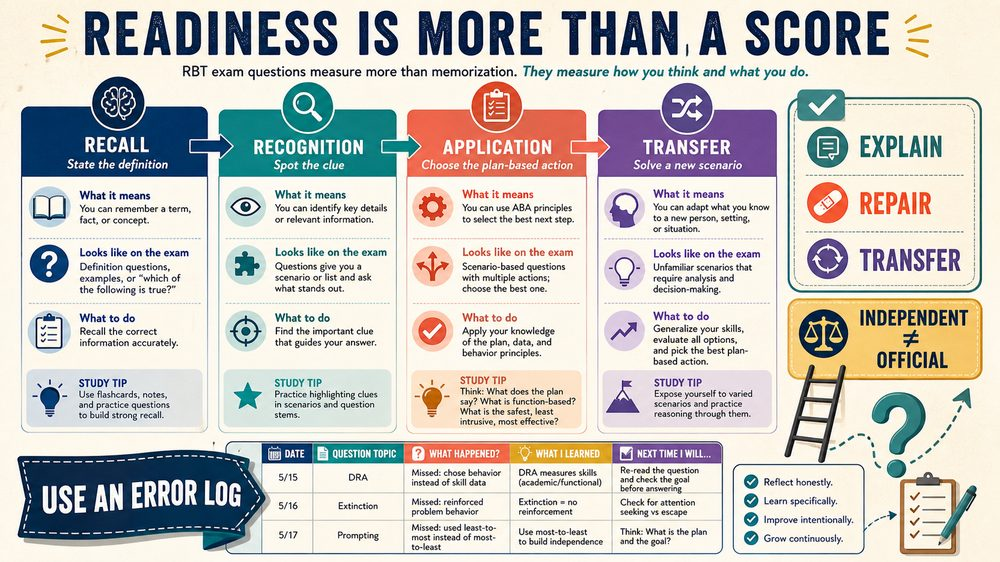
For each domain, record four things: can you define the concept, recognize it in a scenario, perform or describe the plan-based action, and explain the nearest distractor? A material set is doing its job when it helps you move from one column to the next.
| Level | Evidence | Next action |
|---|---|---|
| Recall | You can state a definition or task name. | Write a short scenario with a different surface detail. |
| Recognition | You can identify the concept in a familiar question. | Explain the clue without looking at the answer. |
| Application | You choose a plan-based action in a new scenario. | Check data, supervision, documentation, and ethics boundaries. |
| Transfer | You can solve the same concept with a new person, setting, or measurement. | Keep it in spaced review and test a nearest distractor. |
For example: recognizing that a two-item choice is paired-stimulus preference assessment is recall-plus-recognition. If a new scenario changes the items, adds a prompt, or asks what data to record, you need application and transfer—not simply another copy of the same question.
Map RBT exam study materials to six domains
| Domain | Material should help you practice | Review prompt |
|---|---|---|
| A. Data Collection and Graphing | Observable definitions, measurement units, data displays, and accuracy checks. | What is the unit and what is directly observed? |
| B. Behavior Assessment | Preference, skill, and functional-assessment participation with scope boundaries. | What is being assessed and what requires supervision? |
| C. Behavior Acquisition | Prompting, fading, shaping, chaining, reinforcement, maintenance, and generalization. | Which teaching step matches the current plan? |
| D. Behavior Reduction | Antecedent strategies, replacement skills, safety, and plan fidelity. | What happens after the target behavior and what must be reported? |
| E. Documentation and Reporting | Objective notes, communication, privacy, and record accuracy. | Can another professional verify the statement? |
| F. Ethics | Dignity, assent, competence, boundaries, confidentiality, and supervision. | Is the choice authorized, respectful, and role-safe? |
Domain counts can guide coverage, but do not convert them into a separate domain passing formula. The current Handbook states that examination questions are equally weighted and overall performance determines the result. Study the high-frequency concepts while still covering every domain.
Use practice materials for transfer and explanation
- Preview: read the task and write what you expect to see.
- Answer: choose before checking the explanation.
- Explain: name the controlling clue and role boundary.
- Repair: write why the nearest distractor is wrong.
- Transfer: change the setting, person, material, or measurement.
- Space: revisit the error after a delay rather than repeating it immediately.
A practice bank should create decisions, not just vocabulary exposure. For a data question, say the unit aloud. For a teaching question, identify the prompt and consequence. For an ethics question, identify privacy, assent, competence, or supervision. For an assessment question, identify whether the target is preference, skill, function, or technician competency.
Keep an error log with the article or set, TCO domain, missed clue, wrong assumption, nearest distractor, and repair date. If you repeatedly miss “independent versus prompted,” more questions about unrelated definitions will not solve the gap; you need a targeted data-and-prompt review.
Audit an RBT study guide before trusting it
- Does it identify the current 3rd-edition TCO?
- Does it cover all six domains and name the 43 tasks or link to the official outline?
- Does it distinguish the written exam from the Initial Competency Assessment?
- Does it explain current exam logistics without claiming old question counts?
- Does it link or point readers to the current Handbook and examination information?
- Does it label practice questions as original and independent?
- Does it avoid passing, certification, score, or employment guarantees?
- Can you see a clear explanation-and-repair workflow?
Do not confuse visual polish with academic currency. A colorful PDF can still carry a 2nd-edition task list, and a plain official document can contain the rule that controls the entire pathway. Use design to support learning after source control is complete.
A practical workflow for using RBT exam study materials
| Stage | Primary material | Output |
|---|---|---|
| Orient | Handbook, TCO, examination information. | Current source sheet and six-domain checklist. |
| Learn | Training notes, official task descriptions, one independent explainer. | Definition plus a plain-language example. |
| Practice | Original questions, scenario cards, or targeted quizzes. | Answer, rationale, nearest distractor. |
| Repair | Error log and supervisor or course feedback. | One corrected rule and one transfer scenario. |
| Simulate | Mixed practice set under a timed condition. | Domain-by-domain review plan, not a guarantee. |
| Refresh | Live BACB pages and current documents. | Remove stale notes before exam day. |
This workflow keeps materials in their proper roles. The official documents answer “what is current?” Training and independent resources answer “how can I understand and practice it?” Your error log answers “what do I still need to repair?”
Bottom line: choose RBT exam study materials by source control, six-domain coverage, explanation quality, originality, and transfer value. Build around the current Handbook and TCO, use training and competency materials, practice original scenarios, and measure readiness by what you can explain and apply—not by a single repeated score.
Choose materials that create real decisions.
Use current RBT study materials and original practice questions to build an error log and review path.
Review RBT study materials →
Frequently Asked Questions
What should RBT exam study materials include?
They should connect the current Handbook and 3rd-edition TCO to all six domains, original scenarios, explanations, error review, and the distinction between written exam preparation and practical competency.
Does the BACB endorse a specific study guide?
Use official BACB documents for requirements and evaluate independent guides for currency and usefulness. Do not treat a commercial guide as BACB-endorsed unless an official BACB source explicitly says so.
How many tasks are in the current RBT TCO?
The current RBT Test Content Outline, 3rd edition, describes 43 tasks across six domains. Verify the official document when a third-party guide uses different counts or names.
Are all RBT exam questions equally weighted?
The current Handbook states that questions are equally weighted and overall performance determines the result. Domain coverage should guide study, not create a separate passing threshold.
Should I review my 40-hour training materials?
Yes. Combine the current official sources with the materials from your applicable training and competency assessment, then use independent practice for explanation and transfer.
Can study materials guarantee certification?
No. No guide, course, mock score, or practice resource can guarantee certification or a passing result.
References
- Behavior Analyst Certification Board. RBT Handbook.
- Behavior Analyst Certification Board. RBT Test Content Outline (3rd ed.).
- Behavior Analyst Certification Board. Examination Information.
- Behavior Analyst Certification Board. RBT resources.
- RBT Practice Exam study guide. Reviewed for competitor research; not an endorsement.
- RBT Mock Exam study guide. Reviewed for competitor research; not an endorsement.
- RBT Study Guide 3rd Edition. Reviewed for competitor research; not an endorsement.
- My RBT Prep. Reviewed for competitor research; not an endorsement.